

A sales funnel can replace a website for a service business when you sell a clearly defined service to a specific audience and need a focused enquiry or booking path. It does not automatically replace the broader service information, business credentials and search content that customers use to choose a provider—and it will not fix a team that relies on you to handle every enquiry.
TL;DR
- Can a sales funnel replace a website? Yes, for a focused service offer—not every customer journey.
- Keep your website when customers need to compare services, check credentials or research their problem.
- Match lead generation to team capacity before sending more enquiries into the business.
- Elevatory business coaching suits established Australian service owners seeking coaching with done-with-you marketing implementation.
Why this matters
Your first decision is not which pages to build. It is who will qualify enquiries, prepare quotes and manage delivery without sending every decision back to you.
For your 2026 marketing plan, start with that handover. A focused funnel gives customers a clear next step, but someone still needs to own what happens afterwards. Use this guide to service-business lead handover if enquiries currently land with the owner by default.
Choose the customer journey your team can deliver, not just the page your advertising can send people to. A new landing page is not a substitute for clear responsibilities.
Can a sales funnel replace a website for a service business?
Yes, when the funnel contains the information a customer needs to take the next appropriate step. That includes who the service suits, what it covers, evidence supporting your claims and what happens after an enquiry.
A funnel and a website are not opposing technologies. A funnel is a guided path towards an action; a website can contain that path alongside broader information. You can build a campaign landing page within an existing website without replacing the website itself.
| Approach | Best for | Main advantage | Main limitation |
|---|---|---|---|
| Standalone funnel | A defined service with a focused campaign | Keeps the message and next action specific | Needs additional content when customers have broader questions |
| Broader website | A business with several services or research-heavy buying decisions | Gives customers room to explore services and credentials | Requires clear navigation and enquiry paths to avoid dead ends |
| Website plus funnel | A business needing both research content and campaign-specific enquiries | Separates broad research from a focused booking journey | Adds pages and handovers that someone must maintain |
Do not remove useful pages simply because a funnel builder can publish replacements. First identify which customer questions those pages answer and where those answers will live afterwards.
The practical test is straightforward: can a suitable customer understand the service, establish trust and take the right next step without contacting you for basic clarification? If not, the replacement is incomplete.
When a standalone funnel is enough
Best for: a specific service with a clear qualification and enquiry process. Choose a standalone funnel when the campaign has a narrow purpose and the page can answer the relevant buying questions.
For example, a hypothetical plumbing business could promote a defined maintenance service rather than every plumbing job it accepts. The page would explain the service scope, suitable properties, service area and enquiry process. Its job is to attract relevant requests, not promise an instant booking the team cannot honour.
Before building, write down these recommended boundaries:
- 1 offer: the service this page promotes.
- 1 audience: the customer and situation it serves.
- 1 primary action: the next step you want that customer to take.
These are planning constraints, not conversion benchmarks. They prevent a campaign page from becoming an unfocused catalogue.
The trade-off is depth. A short funnel can become inadequate when buyers need detailed explanations, several service choices or substantial reassurance. Add the necessary information rather than keeping the page short for its own sake.
When your website should stay
Best for: customers who need to research before they enquire. Keep a broader website when buyers need to understand different services, assess your expertise or work out which problem needs attention.
Consider a hypothetical accounting practice offering several types of advice. A visitor researching ongoing support has different questions from someone seeking help with a particular business decision. Forcing both into the same short booking pitch leaves useful questions unanswered.
Keep useful website content when it performs a clear job:
- Service pages explain different scopes and customer needs.
- Team information helps buyers understand who will do the work.
- Verified case studies show relevant experience without promising the same result.
- Educational pages answer questions before a sales conversation.
- Contact information explains how to reach the business.
The limitation is upkeep. Outdated service descriptions and unclear enquiry routes undermine the usefulness of a larger site. Retain pages because they help customers, not because they have always existed.
Before any 2026 rebuild, review which existing pages receive relevant visits and enquiries. Preserve useful information and plan redirects for changed addresses rather than deleting everything at launch.
When a website plus funnel is the better fit
Best for: an established service business with broad research needs and a focused campaign. Keep the website as the information base and use a dedicated landing page for a particular offer or audience.
A hypothetical electrical business could retain its service information while running a campaign for a defined installation service. The campaign page would explain that job, ask relevant qualification questions and send the enquiry to the responsible team member.
This arrangement gives each page a purpose. The website supports exploration; the funnel guides a specific decision.
The downside is coordination. If the landing page describes a service differently from the main website, your team inherits the confusion. Assign responsibility for keeping the scope, qualification questions and follow-up instructions consistent.
Do not add a funnel unless you can explain what it does better than the existing enquiry path. A duplicate page with different wording is not a strategy.
Why the right setup varies
Your page structure should follow the buying decision and your delivery process. These factors determine how much information and qualification the journey needs:
- Service scope: a defined job supports a focused page; varied requirements need clearer routes to relevant information.
- Buyer questions: customers who need detailed explanations require more than a booking button.
- Traffic intent: a campaign for a named service needs a matching page, not an unrelated general pitch.
- Qualification needs: service area, job type and scope affect whether an enquiry belongs with your team.
- Team capacity: available delivery capacity determines which enquiries you should actively seek.
- Owner dependence: a funnel needs a handover process if the owner currently qualifies and progresses every lead.
For a 2026 decision, assess these factors before choosing a platform. Software features do not decide whether your offer is clear or your team has authority to act.
How do you build a funnel that does not depend on the owner?
Start with the work after the form submission. Then build the page around the information your team needs to progress a suitable enquiry.
1. Define scope
Write down the service, intended customer, inclusions and exclusions. Explain what requires assessment before you can confirm suitability.
For trades and home services, ask about the job and location. For professional services, ask about the business problem and the support required. Keep questions relevant to an actual decision; do not collect detail nobody uses.
2. Check capacity
Confirm who can deliver the work and what commitments already exist. Do not treat an open calendar slot as proof that every requested job fits.
Agree which work the business wants more of, based on delivery requirements and margin. If the team is stretched, address scheduling, scope or responsibilities before increasing campaign activity.
3. Assign ownership
Name the role responsible for reviewing new enquiries, responding and progressing the next step. Give that role clear authority and an escalation rule.
A staff member cannot own the process if every quote or customer question still requires your permission. Define which decisions the team can make and which genuinely need an owner review.
4. Qualify enquiries
Make the form reflect your service boundaries. Ask enough to identify fit without asking the customer to complete a full consultation before speaking to anyone.
Tell customers what submission means. A request for assessment is not a confirmed appointment; your page and confirmation message should make that distinction clear.
5. Review outcomes
Connect the original enquiry to its outcome: suitable request, quote, accepted work and completed delivery. Record why unsuitable enquiries or lost quotes did not progress.
Review the process with the person responsible for it. If enquiries repeatedly stall at the same handover, fix that responsibility before rewriting the headline.
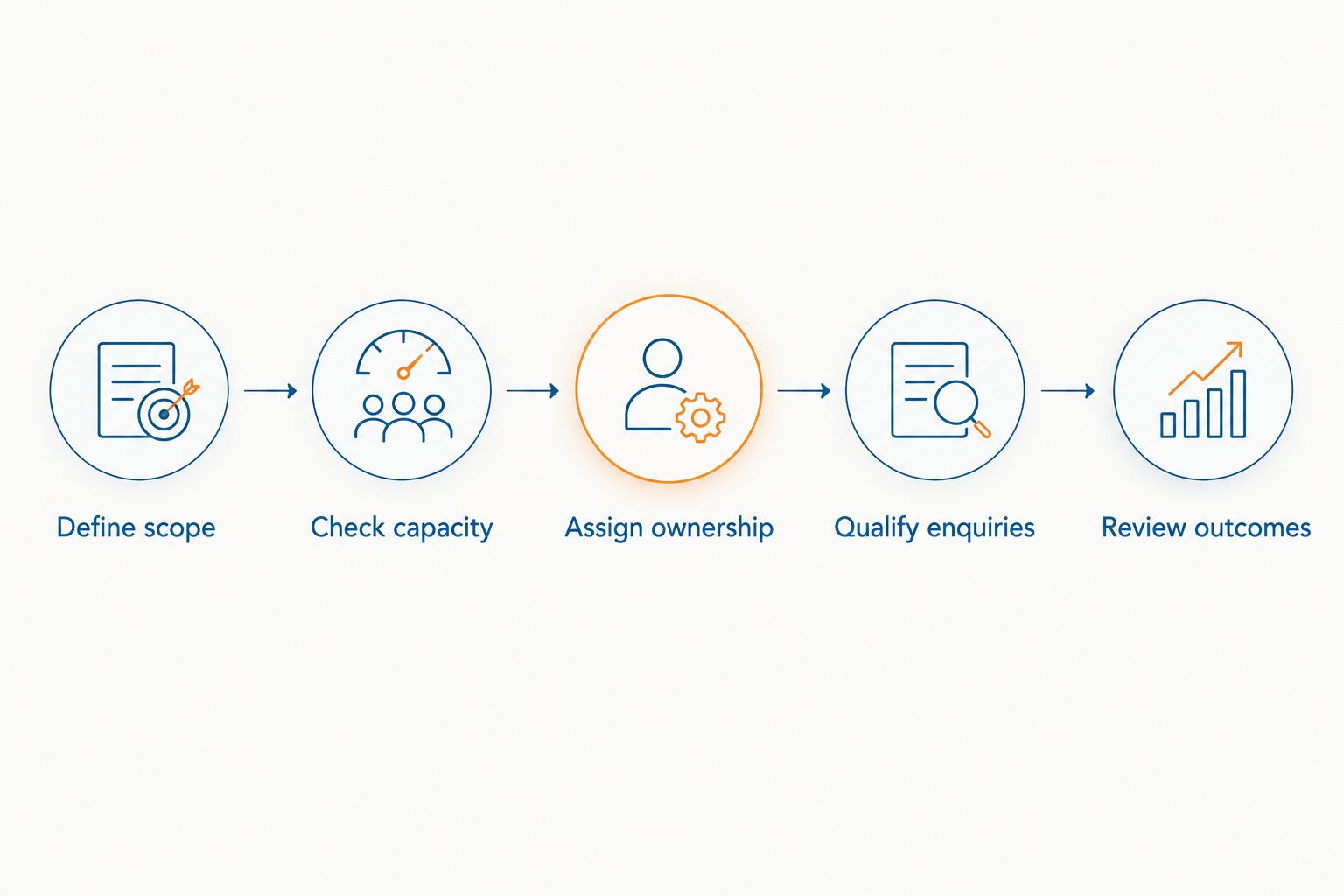
Build the handover before increasing the flow of enquiries.
What should you measure before replacing the website?
For your 2026 review, compare the current customer journey with the proposed replacement. Keep the service and enquiry definitions consistent so you are comparing the same work.
Track relevant enquiries, accepted jobs, delivery requirements and the owner's involvement. Form submissions alone do not tell you whether the campaign is bringing suitable work into the business.
Include margin in the review. A booking that requires repeated quoting, extra travel or an unsuitable delivery commitment needs a different assessment from work your team can deliver within the agreed scope.
Also record the questions customers keep asking. Repeated requests for basic service information suggest the page needs clearer explanations. Repeated requests for owner approval suggest the operating process needs attention.
Judge the replacement by suitable work and manageable delivery, not by how quickly you can publish it. Keep records consistent before drawing conclusions about which approach works better.
Do you need a website before running paid ads?
You need a suitable destination and a working follow-up process, not necessarily a broad website. A focused landing page can support a specific campaign when it explains the service accurately and gives customers a clear next step.
Before launching, test the form, notification, assignment and response process yourself. Confirm that someone other than the owner can progress the enquiry within their authority.
Can a funnel replace your website's search visibility?
A funnel does not automatically replace the search visibility of existing website pages. A narrowly focused landing page also does not answer every question covered by a broader service site.
If organic search already sends relevant enquiries, review that contribution before removing pages. Keep useful content accessible and include address changes in the migration plan.
Should you get coaching before building the funnel?
Get business or marketing coaching when the unresolved problem is offer scope, team capacity, decision authority or follow-up ownership. If those decisions are already clear, your next need is implementation rather than another strategy discussion.
Elevatory is best for established Australian service owners seeking business coaching with done-with-you marketing implementation. Its stated focus includes offers, funnels, paid advertising and systems; it is not positioned as a funnel software vendor or a done-for-you replacement for your team.
For your 2026 brief, separate the advice you need from the work your business must own. Done-with-you support still requires participation, decisions and implementation responsibility inside your business.
FAQ
Can a sales funnel replace a website for my service business?
Yes, a sales funnel can replace a website when a focused page answers the relevant buying questions and supports a clear enquiry process. Keep broader website content when customers need to research services, credentials or different problems.
Is a sales funnel better than a website for generating leads?
Neither is automatically better for generating suitable leads. Match the page to the customer's intent, explain the service clearly and give your team the information needed to qualify the enquiry.
Can I put a sales funnel on my existing website?
Yes, a sales funnel can sit within your existing website as a dedicated landing page and follow-up journey. You do not need to replace useful website content to create a focused campaign path.
Should I delete my old website when my funnel goes live?
Do not delete useful website pages simply because your funnel is live. Review their customer and search value, preserve necessary information and plan redirects for any changed addresses.
What should happen after someone completes my funnel form?
The enquiry should reach a named person with responsibility for checking suitability and progressing the next step. Give that person clear decision authority and explain to customers whether they have requested an assessment or confirmed a booking.
What if my team is already fully committed?
Resolve delivery capacity before increasing demand for work your team cannot accept. Review scheduling, scope and responsibilities, then align campaign activity with the work the business can deliver.
Does Elevatory build funnels without involving the business owner?
Elevatory positions its support as business coaching with done-with-you marketing implementation, not a done-for-you service. Your business needs to participate in decisions about offers, responsibilities, follow-up and delivery.
One last thing
Before approving a replacement website or funnel, give a team member a hypothetical enquiry and ask them to progress it without you. Watch where they stop.
If the blocker is missing service information, improve the page. If it is missing authority, fix the role. Do not rebuild your website to solve a delegation problem.
Related guides
Book a free growth strategy call
Forty-five minutes with a strategist to pressure-test where your business is stuck and what to prioritise next.
Prefer to talk first? Call 1300 634 230 or email chris@elevatory.com.au