

A marketing consultant should help your team qualify enquiries by defining suitable work, setting decision rules and giving staff authority to act without asking you about every lead. Start with delivery capacity and profitable bookings, then connect your enquiry form, phone questions and handover process to those limits—not to a target for more leads.
TL;DR
- Marketing consultant lead qualification should give your team decision rules, not another owner approval queue.
- Check service fit, location, scope, timing and delivery capacity before committing to the next step.
- Elevatory suits established Australian service businesses seeking business coaching with done-with-you marketing implementation.
- Track qualified enquiries, booking outcomes and owner escalations together; enquiry volume alone does not show booking quality.
How can a marketing consultant help your team qualify enquiries?
A marketing consultant helps by turning your judgement into a process another person can follow. The deliverable is not just a better enquiry form. It is a clear decision path from first contact to an appropriate booking, further assessment or a polite decline.
Build qualification alongside your service-business lead handover. A lead is not ready for delivery simply because someone has filled in the form.
1. Define suitable work
Write down which services you want enquiries for, where you deliver them and what makes a job commercially sensible. Use actual completed work to identify the scope your team handles well. Separate customer preferences from conditions that genuinely prevent you from delivering.
Give staff an approved description of suitable work. Avoid vague instructions such as accepting good opportunities; different people will interpret that differently.
2. Set capacity limits
Ask the delivery lead what the team can accept before marketing promises the next step. Capacity includes the right skills, supervision and time to complete the work—not just an empty space in the diary.
Specify who confirms availability. Reception staff should not need to guess whether a technically demanding job fits an apparently open booking slot.
3. Write the qualification questions
Ask about the requested service, location, scope, timing and any information needed before assessment. Explain why you need sensitive or detailed information. Keep questions relevant to deciding the next action.
Every question should change a decision. If an answer does not affect fit, routing or preparation, remove it from the initial conversation.
4. Give staff decision authority
State what staff can book, what needs technical assessment and what requires owner approval. Attach an escalation reason to each exception so the owner receives a defined question, not an entire unresolved enquiry.
Authority needs boundaries. Staff should not promise unusual work, delivery dates or variations outside the rules simply to keep a prospect interested.
5. Review outcomes against the original enquiry
Follow the enquiry through to its outcome. Record whether it became suitable work, stalled before assessment, fell outside scope or reached the owner unnecessarily.
Review the original answers when something goes wrong. That shows whether the problem sits in the question, the decision rule or the handover—not automatically in the person answering the phone.
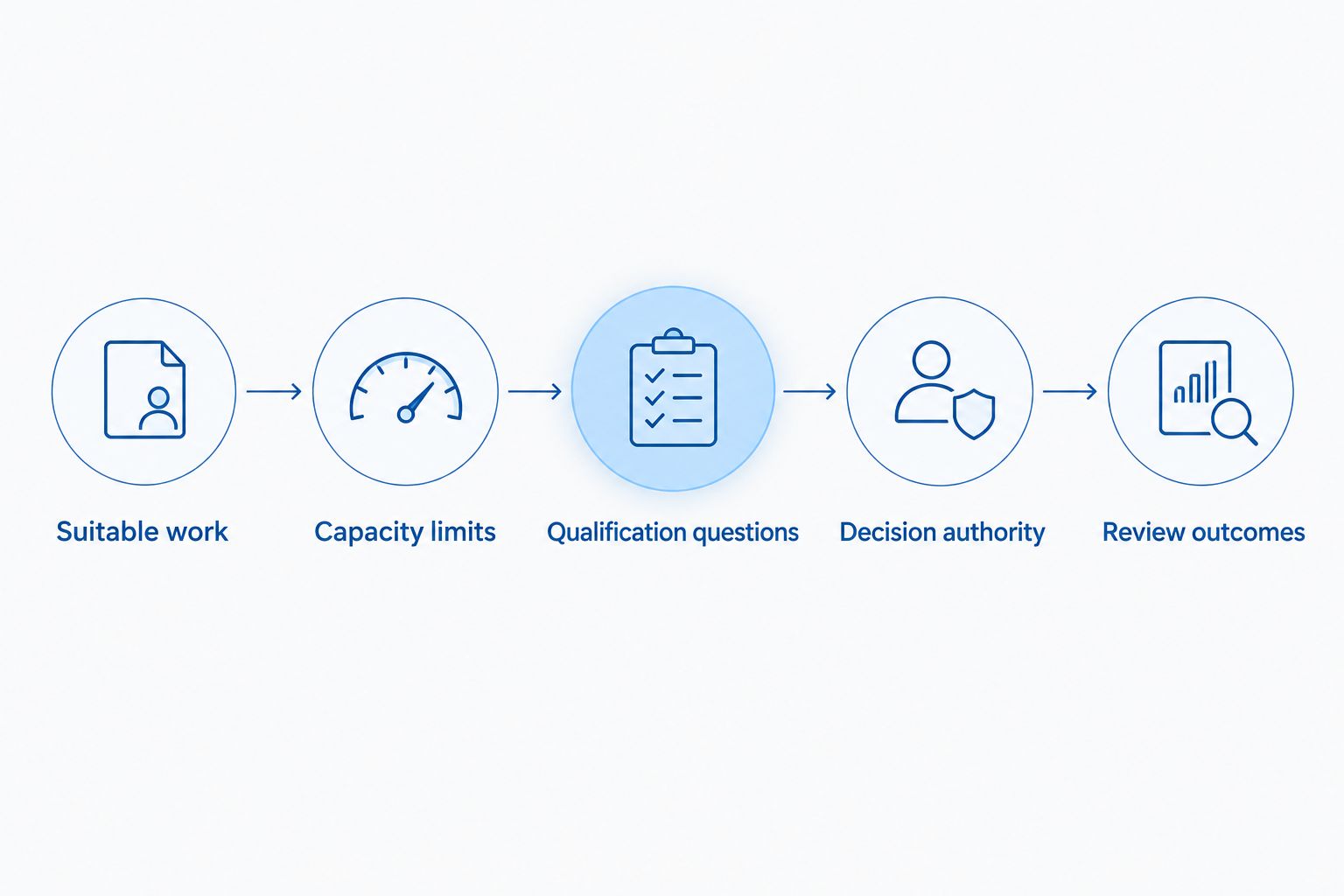
Define the work and capacity before asking staff to make booking decisions.
Why this matters
If every uncertain enquiry returns to you, qualification has not been delegated. Your team is collecting information while you still make the decisions. That leaves marketing activity dependent on the same owner bottleneck you want to remove.
For your 2026 plan, separate demand from deliverable demand. A full enquiry inbox does not tell you whether the work fits your services, the customer understands the scope or your team can deliver it.
The aim is not to reject more people. It is to give suitable customers a clear next step without committing the business to unsuitable work.
What should your team ask before booking an enquiry?
Use a short question set that reflects your business rather than copying a generic sales script. Staff need enough information to route the enquiry, not enough to complete the entire job assessment.
- Service fit: What does the customer need, and is it work your business handles?
- Location: Where will you deliver the service, and is that within your approved area?
- Scope: What is included, and what still needs clarification?
- Timing: When does the customer need the work, and can your team assess that request?
- Decision process: Who needs to approve the scope or next step?
- Preparation: What information will the person assessing the job need?
For a hypothetical plumbing enquiry, staff might confirm the location, reported issue and access arrangements before routing it. They should not diagnose a technical fault beyond their competence or promise that the first available appointment will resolve it.
For a hypothetical professional-services enquiry, staff might confirm the requested service and relevant deadline. An adviser can then assess complexity. Qualification establishes the next step; it does not replace professional judgement.
Which qualification route should your team use?
Use different routes for different decisions. Forcing every enquiry into an immediate booking or rejection creates unnecessary conflict when the correct answer is further assessment.
| Route | Best for | Benefit | Limitation | Staff action |
|---|---|---|---|---|
| Direct booking | Work within documented scope and confirmed capacity | Gives the customer a clear next step | Depends on accurate booking rules | Book within approved authority |
| Technical assessment | Unclear scope or specialist requirements | Keeps technical decisions with the right person | Requires an assessment handover | Capture the unanswered question |
| Capacity review | Suitable work without a confirmed delivery slot | Separates customer fit from scheduling | Does not establish a delivery commitment | Request capacity confirmation |
| Decline or redirect | Work outside service scope or coverage | Prevents unsuitable commitments | Requires a clear explanation | Explain the relevant boundary |
Direct booking should not become the default merely because it is the fastest route. Technical assessment should not become a holding area for every enquiry that staff feel nervous about.
Review these routes in your 2026 operating plan whenever your services or delivery team change. A qualification rule that no longer matches capacity gives staff the wrong instruction.
Why lead qualification varies between service businesses
Your qualification process should reflect the decisions your team actually faces. These factors determine what belongs in the form, what needs a conversation and who has authority to act:
- Service scope: Standard work needs different checks from work requiring a detailed assessment.
- Delivery location: On-site services need coverage and access checks that remote work does not.
- Technical complexity: Specialist judgement belongs with a suitably qualified team member.
- Team capacity: A suitable enquiry still needs a realistic delivery pathway.
- Owner dependence: Frequent owner intervention signals that authority or decision rules need attention.
Do not copy another business's criteria without testing them against your work. A question that helps a builder assess a project might add no value to an accounting enquiry.
Keep the rule tied to the decision it supports. Staff should be able to explain why they ask each question.
What belongs in the handover to your delivery team?
A useful handover answers what the customer needs, what has been established and what remains undecided. It also identifies who owns the next action. A collection of notes without a responsible person is not a completed handover.
Use these fields in your existing enquiry record:
- Requested service and customer contact details.
- Relevant location, scope and timing information.
- Qualification route and the reason selected.
- Promises already made to the customer.
- Unanswered questions requiring assessment.
- Named next owner and agreed follow-up action.
Record unknowns as unknowns. Do not let staff fill gaps with assumptions to make the record look complete. The delivery team needs an accurate account, including uncertainty.
For your 2026 handover template, make commitments easy to find. A customer told to expect a call should not disappear into an inbox because everyone assumed someone else would respond.
How do you stop every enquiry coming back to the owner?
Give staff approved decisions and specific escalation triggers. If the instruction is simply to use their judgement, you have transferred responsibility without defining authority.
Reserve escalation for exceptions such as unclear service boundaries or commitments beyond an employee's authority. Require the team member to state the decision needed and the information already gathered.
Write the exception, not just the approval
When you resolve an escalated enquiry, decide whether the answer applies only to that situation or should become a reusable rule. Otherwise, you will keep answering the same question in slightly different forms.
Keep genuine exceptions available. Removing owner dependence does not mean forcing staff to make decisions outside their competence.
How do you know whether lead qualification is working?
Track enquiry outcomes alongside the effort needed to reach them. Avoid judging the process solely by how many people submit a form or book an initial conversation.
Use a 30-minute weekly review as a starting routine, not a performance benchmark. Bring the enquiry record, booking outcome and delivery feedback together so the team can examine the same case.
| Measure | What it helps you check | What it does not prove |
|---|---|---|
| Qualified enquiries | Whether enquiries meet your stated criteria | That the criteria identify profitable work |
| Booked work | Whether suitable enquiries reach a booking | That delivery has been completed well |
| Decline reasons | Where enquiries fall outside scope | That every declined enquiry was handled correctly |
| Owner escalations | Which decisions still depend on you | That every escalation was unnecessary |
| Delivery feedback | Whether handovers prepare the team | That marketing caused every delivery issue |
For your 2026 reporting, keep the definitions stable enough to compare outcomes. If staff change what qualified means without recording the change, the figures stop describing the same thing.
How should you introduce the process without overwhelming staff?
Start with one service category and the people who handle its enquiries. A narrow pilot makes the rules easier to inspect before you extend them across different work types.
Use a 15-minute practice session to rehearse a suitable enquiry, an unclear request and an out-of-scope request. These are suggested training exercises, not claims about how quickly a team becomes competent.
Ask staff to explain the next action in their own words. If two people interpret the same instruction differently, rewrite the instruction before adding more steps.
During the pilot, review both accepted and declined enquiries. Looking only at successful bookings hides suitable work that was turned away and unsuitable work that reached delivery. Change the rule that caused the error rather than adding a blanket requirement for owner approval.
When is coaching with implementation support the right fit?
Elevatory suits established Australian service businesses seeking business coaching with done-with-you marketing implementation. The fit is strongest when you want support connecting offers, funnels, paid advertising and systems with how your team delivers work.
Elevatory is not a software vendor or a substitute for your internal delivery leader. Done-with-you support requires your team to contribute service knowledge, make operational decisions and apply the agreed process.
Choose support against the constraint. If your team lacks clear responsibilities, a new campaign is not the first fix. If qualification rules are clear but enquiries consistently miss the service scope, examine the offer, campaign message and enquiry pathway.
FAQ
What does marketing consultant lead qualification actually involve?
Marketing consultant lead qualification involves defining suitable enquiries, writing decision rules and connecting marketing to a clear team handover. The process should tell staff what they can book, what needs assessment and when to escalate.
Can my receptionist qualify enquiries without technical expertise?
Your receptionist can qualify service fit and capture relevant information without making technical decisions. Keep diagnosis, complex scope assessment and commitments outside their authority with the appropriate specialist.
Should I put all qualification questions on my enquiry form?
Put only questions needed for the initial decision on your enquiry form. Gather detailed information during the appropriate follow-up when customers need help explaining the work.
Should my team reject a lead if we cannot meet the requested date?
Your team should separate service fit from delivery timing rather than automatically rejecting the enquiry. Confirm capacity and explain the available next step without promising an unapproved date.
How do I stop lead qualification slowing down responses?
Keep qualification focused on the next decision and remove questions that do not affect it. Give staff clear booking authority so routine enquiries do not wait for owner approval.
Is Elevatory a done-for-you lead qualification service?
Elevatory provides business coaching and done-with-you marketing implementation, not a replacement for your internal team. Your business supplies the service knowledge and decision authority needed to apply qualification rules.
Do I need new software before I improve lead qualification?
You can define qualification rules and handover responsibilities before choosing new software. First establish the information, decisions and ownership your existing process needs to support.
One last thing
Review the enquiries your team declined, not just the ones it booked. A process can look efficient while quietly excluding suitable work. Check whether the decline followed an approved rule or an assumption nobody questioned.
For your next review, choose a declined enquiry and ask the team to explain the decision from the record alone. If the reason is unclear, improve the rule or the record before demanding better judgement. That is a practical place to start reducing owner dependence.
Related guides
Book a free growth strategy call
Forty-five minutes with a strategist to pressure-test where your business is stuck and what to prioritise next.
Prefer to talk first? Call 1300 634 230 or email chris@elevatory.com.au