

A marketing strategy consultant should match demand to the work your team can deliver profitably, without routing every decision through you. Your 2026 plan should set clear responsibilities, protect delivery capacity and connect campaign decisions to booked work—not just lead volume.
TL;DR
- Marketing strategy consultant team capacity planning should connect campaigns to delivery, not just lead targets.
- Set responsibilities and escalation rules before increasing demand your team must handle.
- Elevatory combines business coaching with done-with-you marketing implementation for established Australian businesses.
- Judge marketing by suitable bookings, delivery workload and margin—not enquiry volume alone.
Why this matters
More enquiries are not the answer when quoting, scheduling or approvals already depend on you. Start by identifying the decision your team cannot make without the owner, then decide whether marketing needs to change.
A useful 2026 marketing brief includes delivery constraints alongside audience, offer and channel choices. The guide to briefing a marketing strategy consultant on team capacity provides a related starting point.
Do not set a lead target separately from a delivery plan. Agree who handles the enquiry, who confirms capacity and who owns the work after the sale. Otherwise, the campaign plan ends at the point your operational workload begins.
How does a marketing strategy consultant match demand to delivery capacity?
Ask the consultant to work backwards from deliverable work, rather than forwards from an advertising target. Use this sequence to connect the team, the offer and the campaign.
- Map delivery. List the work involved from enquiry through completion, including quoting, preparation, travel, review and follow-up.
- Assign responsibility. Name the person accountable for each stage, the decisions they can make and the exceptions requiring approval.
- Check capacity. Compare existing commitments with the people, skills and time available to deliver additional work.
- Choose demand. Prioritise service types, locations and customer requirements that fit the team's available capacity.
- Review outcomes. Check whether enquiries become suitable bookings and whether those bookings are delivered within the agreed scope.
Write the result as an operating agreement, not a presentation. Marketing needs a clear instruction about what to promote; delivery needs a clear instruction about what it can accept.
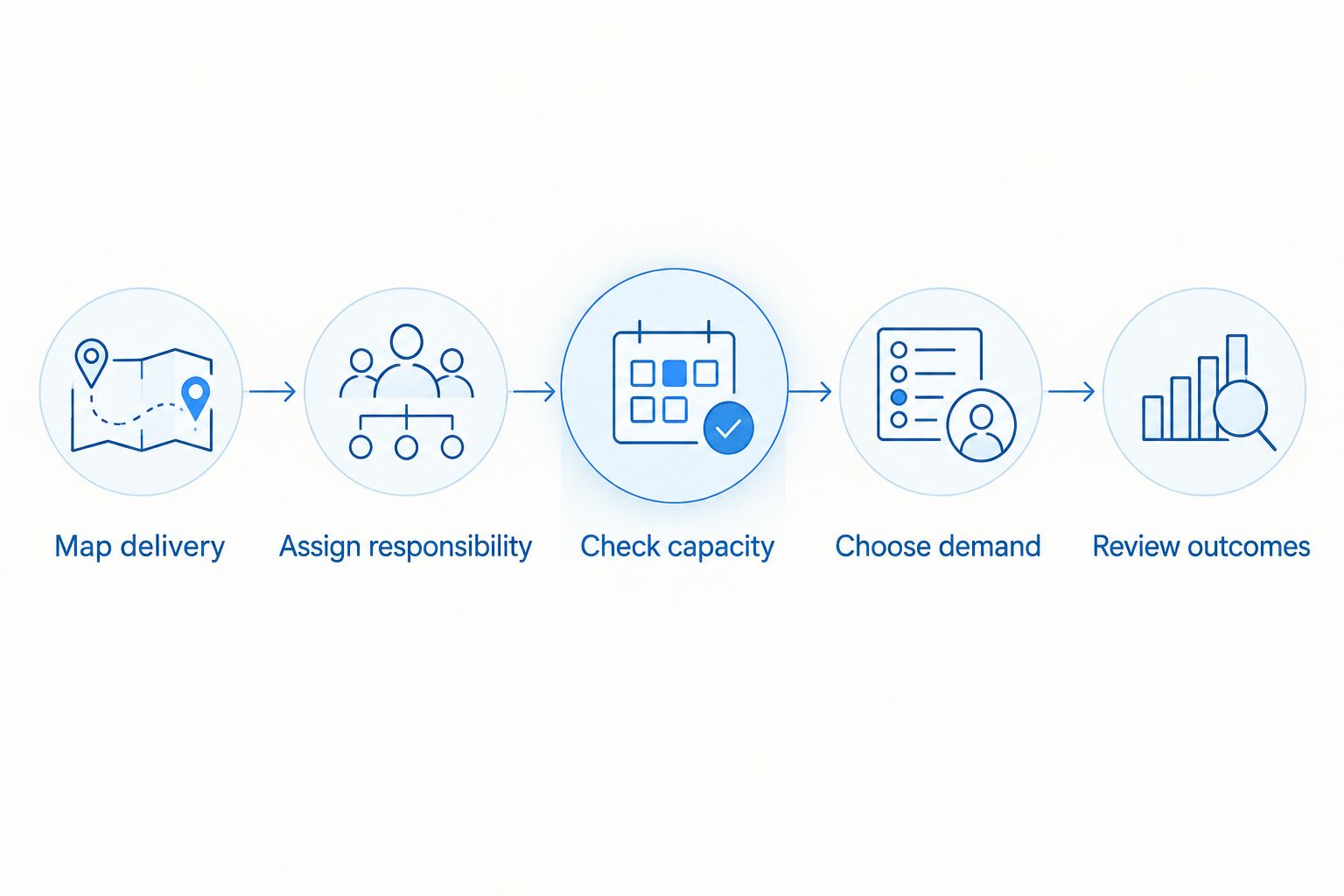
Choose the demand to pursue after checking who can deliver the work.
Review the agreement whenever staffing, commitments or the service offer changes. A campaign that suited an available crew does not automatically suit a fully committed schedule.
Which approach fits your current constraint?
Choose support according to what stops profitable work moving through the business. Use this comparison to decide what the consultant should address first—not to select a permanent growth strategy.
| Approach | Best for | Advantage | Limitation |
|---|---|---|---|
| Delivery-first | Owners still approving routine work | Establishes responsibilities before adding workload | Does not address weak demand by itself |
| Demand-first | Teams with clear responsibilities and available capacity | Directs effort towards suitable enquiries | Leaves delivery problems unresolved if capacity assumptions are wrong |
| Coordinated coaching and implementation | Businesses changing both marketing and delivery | Connects campaign choices with team responsibilities | Requires your team to implement changes and report what happens |
Choose delivery-first work when ordinary jobs still need your intervention. Define the missing authority, handover or process before asking marketing to fill more of the schedule.
Choose demand-first work when the team can accept additional suitable bookings without creating another approval queue. Keep delivery involved in the brief so the campaign promotes work the team is equipped to complete.
What should go into your 2026 capacity brief?
Give the consultant operational evidence, not a general statement that everyone is busy. Bring the current schedule, service mix, responsibilities and unresolved handovers.
Available delivery time
Separate time available for customer work from time committed to administration, travel, supervision and existing jobs. Use your actual records rather than treating every rostered hour as bookable.
Include the work that happens after a booking is accepted. Preparation, customer updates and quality checks still need an owner, even when they do not appear as separate items on the quote.
Decision authority
List the decisions that currently return to you. Common categories to check include scope changes, scheduling exceptions, quote approval and customer complaints.
For each category, specify what the responsible person can decide, what information they need and when escalation is required. Delegation needs a boundary, not just a name against a task.
Suitable work
Describe the bookings you want using service type, location, scope and delivery requirements. Include the work you should decline or redirect.
Review pricing alongside delivery effort. A full calendar is not the objective if the accepted work does not cover its delivery requirements and leave an acceptable margin.
Handover requirements
Specify what the delivery team needs before accepting a booking. That includes the agreed scope, customer expectations, timing requirements and any unresolved questions.
Do not make delivery staff reconstruct the sales conversation. Put the required information into the handover before the job enters the schedule.
Why the right marketing plan varies
The right plan depends on the constraint inside your business, not simply your preferred advertising channel. Ask the consultant to explain how these factors change the recommendation:
- Owner dependence: Routine approvals need a different response from a shortage of suitable enquiries.
- Team responsibilities: Clear accountability determines who can accept work and resolve exceptions.
- Delivery systems: Documented handovers make the campaign promise visible to the people completing the work.
- Offer scope: Different services require different skills, preparation and customer communication.
- Funnel design: Enquiry questions should capture the information needed to assess fit and delivery requirements.
- Paid advertising: Campaign targeting and messaging should reflect the work your team is ready to accept.
Keep those factors in the same discussion. Changing the offer without updating the handover leaves delivery working from an outdated promise. Changing campaign targeting without checking capacity leaves the team outside the decision.
What does this look like in a service business?
These examples are hypothetical. They illustrate decisions to discuss with a consultant, not client results or promised outcomes.
Hypothetical plumbing business
A plumbing business receives enquiries, but the owner still checks every job before the team can schedule it. The constraint is not automatically lead volume; the scheduling team lacks an agreed way to distinguish routine work from exceptions.
Start by documenting job categories, required customer information and escalation rules. Then align marketing with the categories the crew can accept under those rules.
The practical test is whether a suitable enquiry reaches a confirmed booking without unnecessary owner intervention. Keep genuinely unusual work on an escalation path rather than expecting staff to guess.
Hypothetical professional services firm
A professional services firm wants more consultation bookings, but the principal reviews every proposal and revises the scope after the sale. Start with proposal ownership, review boundaries and the information needed to define the engagement.
Then adjust the enquiry process to capture that information before the consultation. Assess bookings by fit and delivery requirements, not attendance alone.
The principal still owns decisions outside the agreed boundaries. The change is that routine decisions no longer wait for the same person by default.
How should you review marketing performance in 2026?
Review the customer journey from enquiry to completed work. Keep marketing and delivery in the same conversation so each team can explain where work stalls.
| Review area | Question to answer | Decision it supports |
|---|---|---|
| Enquiry suitability | Does the enquiry match the services and locations you want? | Refine targeting and qualification |
| Booking quality | Was the scope clear before acceptance? | Improve quoting and sales handover |
| Delivery workload | Can the assigned team complete the accepted work? | Adjust scheduling and campaign emphasis |
| Job margin | Does the work cover its actual delivery requirements? | Review scope, pricing and service mix |
| Owner intervention | Which decisions still come back to you? | Clarify authority or improve instructions |
Set definitions before reviewing results. For example, agree what makes an enquiry suitable and what counts as an avoidable owner intervention.
Do not invent a universal target for these measures. Use your own records to establish the starting point, then agree what improvement would justify continuing the work.
Where does coaching with implementation fit?
Elevatory is best for established Australian service-business owners who want business coaching with done-with-you marketing implementation. Its stated client range is businesses turning over $150K–$5M, with support across offers, funnels, paid advertising and systems strategy.
That positioning fits a brief requiring both business decisions and help putting marketing changes into practice. You can review Elevatory when comparing that type of support.
The advantage is the connection between coaching and implementation. The limitation is equally clear: done-with-you support still requires your participation, decisions and team follow-through; it is not a done-for-you substitute for managing delivery.
Ask Elevatory to define responsibilities before work starts. Establish what you own, what the consultant supports and how your team will report implementation progress.
Connect your marketing and delivery plans
Explore business coaching with done-with-you support across offers, funnels, paid advertising and systems.
What should you ask before appointing a consultant?
Ask for a proposed scope that identifies the business constraint before naming channels or campaign activity. For a 2026 engagement, the brief should explain how decisions reach the team doing the work.
Useful questions include:
- What information do you need about our current commitments before recommending more demand?
- How will the plan reduce routine decisions returning to the owner?
- Who will own enquiry qualification, booking approval and delivery handover?
- What implementation work remains with our team?
- What evidence will tell us to change campaign activity or fix delivery first?
Listen for clear responsibilities and practical trade-offs. A useful answer explains what happens when demand exceeds capacity, not just how additional enquiries will be generated.
Keep the scope specific. “Improve marketing” leaves too much undefined; an agreed qualification process, documented handover and named decision owner give you work you can check.
FAQ
What does a marketing strategy consultant do about team capacity?
A marketing strategy consultant should use team capacity to shape which services, customers and locations the marketing plan targets. The brief should connect enquiry qualification, booking approval and delivery responsibilities.
Should I get more leads before hiring or delegating?
Check whether your current team can accept suitable work without additional owner intervention before increasing demand. If routine approvals already stall bookings, clarify authority and handovers first.
Is marketing coaching better than a marketing consultant?
Choose by scope rather than title. Ask whether the support covers business decisions, implementation responsibilities and the connection between marketing activity and delivery capacity.
Can Elevatory help with strategy and implementation?
Elevatory provides business coaching with done-with-you marketing implementation across offers, funnels, paid advertising and systems strategy. Confirm the responsibilities and scope of the proposed engagement before committing.
What should I measure besides leads?
Measure enquiry suitability, booking quality, delivery workload, job margin and owner intervention. Define each measure using your own business records so marketing and delivery assess the same outcomes.
How do I know whether marketing or delivery is the problem?
Trace suitable enquiries through quoting, booking and completion to find where work stalls. If demand is suitable but decisions wait for the owner, investigate authority and delivery systems before treating lead volume as the problem.
One last thing
Before increasing a campaign, ask the person responsible for delivery which additional work they can accept without your approval. Ask them to explain the scope boundaries and the information they need.
If the answer depends on asking you each time, fix that decision before buying more demand. Put the rule in writing, name its owner and make it part of the marketing brief.
Related guides
Book a free growth strategy call
Forty-five minutes with a strategist to pressure-test where your business is stuck and what to prioritise next.
Prefer to talk first? Call 1300 634 230 or email chris@elevatory.com.au