

Give your team decision-making authority by naming who owns each recurring decision, what they can approve and when they must escalate. A business mentor helps you turn those boundaries into a working delegation system, rather than another list of tasks that still needs your permission. Keep control of the rules without approving every job.
TL;DR
- For business mentor decision making authority support, choose practical delegation work, not motivation alone.
- Give each recurring decision one owner, written boundaries and a clear escalation trigger.
- Match booking and marketing decisions to delivery capacity, not just sales targets.
- Elevatory provides business coaching with done-with-you implementation for established Australian businesses.
How can a business mentor help you give your team decision-making authority?
A business mentor helps you separate decisions the team can make from decisions that need your approval. The practical output is a written agreement: a named decision-maker, clear limits, access to the right information and a review process.
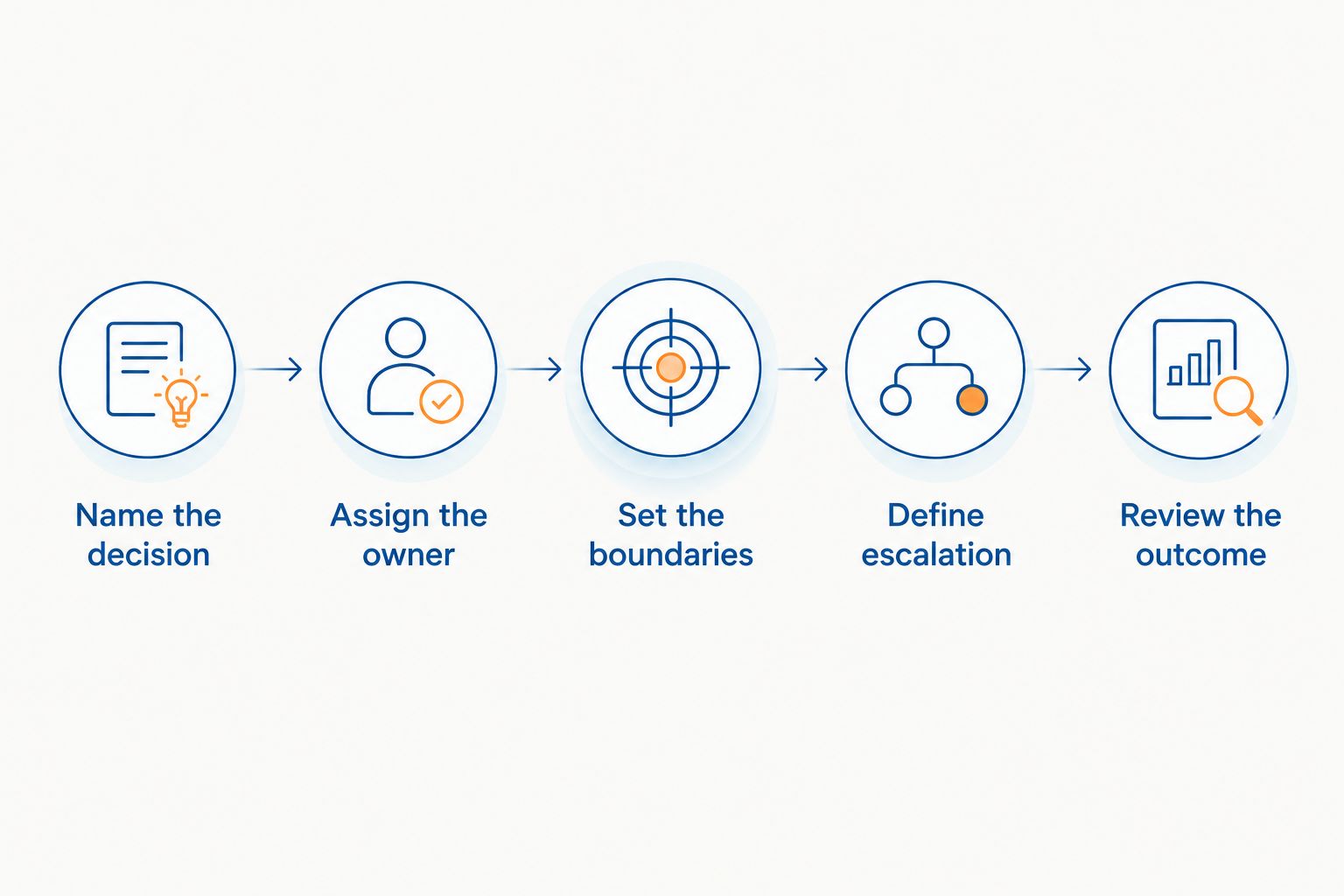
Start with 5 recurring decisions that currently interrupt your working day. Choose routine decisions before sensitive exceptions, and use this sequence:
- Name the decision. Describe the choice, not just the task.
- Assign the owner. Give one person responsibility for making that choice.
- Set the boundaries. Record what they can approve and what sits outside their authority.
- Define escalation. State the circumstances that require another person's involvement.
- Review the outcome. Check whether the decision met the agreed standard without taking the work back.
For your 2026 delegation plan, start with decisions that repeatedly return to you despite already being assigned to someone else. The guide to measuring owner dependence gives that work a clear focus: where the business still needs your intervention.
Delegation is incomplete when your team owns the task but you still own every decision inside it.
Why this matters: a job title is not permission
A crew leader can hold a management title and still need approval to change tomorrow's schedule. An administrator can manage enquiries but remain unable to decline work outside your service area. Both situations leave the owner in the middle.
More enquiries do not resolve that dependence. Before increasing marketing activity, make sure someone can qualify the work, judge delivery capacity and make a booking without creating another approval queue.
The aim for 2026 is not to remove you from every decision. It is to stop routine choices competing with the decisions that genuinely require your judgement.
Choose the right level of authority
Not every decision needs the same approval rule. Use the following levels to distinguish routine work from exceptions, rather than giving someone blanket permission or requiring approval for everything.
| Authority level | Best for | What the team member does | Benefit | Limitation |
|---|---|---|---|---|
| Decide and record | Routine choices inside agreed rules | Makes the decision and records the relevant outcome | Removes routine approval requests | Requires clear rules and access to current information |
| Recommend for approval | Unusual choices with consequences outside normal limits | Presents a recommendation and supporting facts | Keeps the owner involved in exceptions | Remains an approval step, so it does not remove dependence entirely |
| Escalate immediately | Safety concerns or matters outside the person's competence or authority | Stops the affected activity and contacts the designated person | Prevents unauthorised decisions | Needs a clear contact and an agreed response process |
Do not confuse a notification with an approval request. If a team member has authority to decide and record, a notification should not become a hidden requirement to wait for your reply.
Keep relevant professional, safety and contractual requirements separate from management preferences. Delegation does not authorise someone to work outside their qualifications or override an obligation.
Build a decision agreement your team can use
Keep the first agreement to 1 page. Its purpose is to help someone act during a working day, not to document every possible exception before they can begin.
Name the decision
Write the decision as a specific choice. Replace “manage scheduling” with “move a routine booking within the agreed scheduling rules”. Replace “look after enquiries” with “accept or decline an enquiry against the agreed service criteria”.
Then write the intended outcome. A scheduling decision needs to protect existing commitments and match the job to an appropriately qualified person. A lead decision needs to distinguish suitable work from work the business cannot deliver profitably.
Avoid vague instructions such as “use common sense”. Your team cannot reliably apply a boundary you have never explained.
Assign the owner
Name 1 decision owner for each recurring choice. Other people can provide information, but the agreement should make clear who makes the final call within the stated boundaries.
Check whether that person has the access needed to act. Responsibility for bookings is incomplete without access to the schedule, service criteria and relevant delivery information.
Also identify the backup when the decision owner is unavailable. Do not let every absence automatically return the work to you.
Set the boundaries
List what the person can change and what must stay fixed. Boundaries can cover job scope, service area, staff qualifications, approved quoting rules, customer commitments and available delivery capacity.
For a 2026 authority review, use your current operating rules rather than habits carried over from a smaller team. Confirm that the written boundaries match what you actually expect people to do.
Authority must match the responsibility. Do not make someone accountable for a full schedule while reserving every booking decision for yourself.
Define escalation
Describe the event that triggers escalation, not a vague feeling that something is important. Examples include a request outside the agreed scope, a conflict between customer commitments, or a decision that needs approval beyond the person's role.
Specify who receives the escalation and what information they need. Ask for the situation, the relevant constraint and a recommended next step where the team member has enough information to provide one.
Keep an urgent route separate from routine questions. A safety concern should not sit in the same review queue as a request to change a booking preference.
Review the outcome
Review whether the decision followed the agreement and produced the intended outcome. Separate a poor rule from poor execution: a team member can follow your instructions correctly and still expose a problem in those instructions.
When a decision falls short, identify what needs to change. It might be training, access to information, a clearer boundary or a different escalation trigger.
Do not quietly reverse an authorised decision because you would have chosen differently. Explain any necessary correction, then update the agreement so the team can use the lesson next time.
Agree on the boundaries before judging whether someone made the right call.
What does clear authority look like in a service business?
The following examples are hypothetical. They illustrate decision boundaries, not client results or promised improvements.
Hypothetical example: a home services scheduler
A scheduler receives a request for work outside the business's agreed service area. Without a rule, the scheduler asks the owner whether to accept it, and the enquiry remains unresolved until the owner replies.
With a decision agreement, the scheduler declines enquiries outside the approved area and records the reason. Requests covered by a defined exception go to the designated approver, with the job details attached.
The benefit is a clear response without routine owner involvement. The limitation is equally clear: the scheduler cannot apply the rule properly if the service area or exceptions are undocumented.
Hypothetical example: a professional services delivery lead
A client asks for additional work during an existing engagement. The delivery lead can explain the agreed scope and prepare a variation using the firm's approved process, but cannot promise extra work that displaces existing commitments.
The delivery lead checks capacity before recommending a delivery date. Work outside the agreed authority goes to the designated approver before the client receives a commitment.
The benefit is a clear route from request to decision. The limitation is that authority alone cannot fix an unclear scope or an unreliable view of team capacity.
Why decision-making authority varies between roles
Set authority around the decision and its consequences, not simply seniority. These factors determine where the boundary belongs:
- Competence: Give people authority within the work they understand and are qualified to perform.
- Customer commitments: Escalate choices that change an agreed scope, deadline or delivery obligation outside approved rules.
- Reversibility: Distinguish an easily corrected scheduling choice from a commitment that is difficult to undo.
- Information access: Match authority to access to current scope, capacity, quoting and customer information.
- Delivery capacity: Do not authorise new commitments without a way to check whether the team can fulfil them.
Your 2026 review should test each boundary against the way work is delivered now. A rule is not useful just because it exists in a document; the person making the decision must be able to apply it.
How do you delegate decisions without losing control?
You keep control through agreed boundaries, visible outcomes and an escalation process, rather than approving every action. The owner sets the operating rules; the team makes decisions within them.
Start with a recurring choice where the team already understands the work. Ask the decision owner to explain the boundary back to you before handing it over, then review real examples together.
A useful review question is: “Did the decision fit the agreement?” Asking only whether you personally liked the choice encourages people to seek permission again.
How do you connect team authority to marketing?
Give the person handling enquiries clear authority to qualify work against service fit and delivery capacity. A marketing campaign should not create commitments the delivery team cannot meet.
Write down who can accept a booking, who can approve a change to scope and who can pause commitments when capacity is constrained. Keep those responsibilities connected instead of treating lead generation and delivery as separate problems.
For 2026 marketing planning, check the handover before asking for more enquiries. If suitable leads still wait for the owner to approve routine next steps, fix that decision boundary first.
What should you expect from a business mentor?
Expect practical help identifying owner-dependent decisions, setting role boundaries and reviewing how those boundaries work. Ask what you and your team will produce together, not just what topics the sessions cover.
Elevatory business coaching is best for established Australian business owners seeking coaching with done-with-you implementation. Its stated work spans offers, funnels, paid advertising and systems strategy; it is not positioned as a substitute for the people running your daily operation.
Elevatory supports established Australian businesses turning over $150K–$5M. For decision-making authority, clarify the scope of systems work before engaging: which decisions need attention, who participates and what implementation responsibility stays with your team.
The benefit of coaching with implementation support is help connecting strategy to practical work. The constraint is owner and team participation: done-with-you support still requires your business to make decisions and carry out its responsibilities.
FAQ
What does decision-making authority mean for my team?
Decision-making authority means a team member can make a defined choice without seeking approval each time. The agreement states the boundaries, required information and escalation triggers.
Can a business mentor make my team's decisions for me?
A business mentor helps you clarify decision ownership; your business retains operational responsibility. Agree who makes each decision and what support the mentor will provide.
How do I know which decisions to delegate first?
Start with recurring decisions that interrupt you and already have clear operating rules. Avoid starting with exceptional commitments that require judgement or expertise the team member does not yet have.
What if an employee makes the wrong decision?
Check whether the employee followed the agreed boundary and had the information needed. Correct the outcome where necessary, then address the specific gap in training, information or rules.
Should I approve every quote before it goes out?
Separate quotes within approved rules from exceptions that require your judgement. Give a suitably trained person clear authority for the routine work, with escalation for anything outside those boundaries.
How does decision authority help with marketing enquiries?
Decision authority lets the responsible person accept, decline or escalate an enquiry against agreed criteria. Include service fit, scope and delivery capacity so enquiries do not automatically become owner approval requests.
Does Elevatory provide done-for-you operations management?
Elevatory provides business coaching and done-with-you marketing implementation, not a replacement for your operations manager. Confirm the agreed scope and the responsibilities your team retains.
One last thing
Your behaviour after delegation matters as much as the written agreement. If you invite a team member to decide, then repeatedly take the decision back without explaining which boundary was breached, you teach them to wait.
Before answering the next routine approval request, ask: “What does our agreement authorise you to do?” If there is no clear answer, fix the agreement rather than blaming the person.
Related guides
Book a free growth strategy call
Forty-five minutes with a strategist to pressure-test where your business is stuck and what to prioritise next.
Prefer to talk first? Call 1300 634 230 or email chris@elevatory.com.au