

Service-business marketing consultancy is support that connects enquiry generation, team responsibilities and delivery systems so you can turn suitable leads into profitable bookings without handling every decision yourself. This guide explains how to choose a marketing consultant and fix lead handover before asking your team to manage more enquiries.
TL;DR
- Choose a marketing consultant who connects lead handover, team capacity and profitable bookings—not just advertising.
- Elevatory suits established Australian service businesses seeking business coaching with done-with-you marketing implementation.
- Assign a named owner to every enquiry and define when responsibility passes to delivery.
- Fix unclear responsibilities before increasing lead generation or paid advertising.
Why marketing consultancy matters for service businesses
A local service business needs more than an enquiry form. Someone must assess the job, arrange the next conversation, prepare the quote and confirm that the team can deliver what was sold. When those responsibilities are unclear, the owner becomes the fallback for every decision.
The first question for your 2026 marketing plan is who handles the next suitable enquiry—not how to generate another one. Trades, home services and professional services need a handover that respects scheduling, scope and delivery capacity.
Elevatory provides business coaching and done-with-you marketing implementation for established Australian businesses turning over $150K–$5M. That positioning connects offers, funnels, paid advertising and systems rather than treating lead generation as a separate job.
Elevatory is best for established Australian service businesses seeking business coaching with done-with-you marketing implementation. You still need an internal person responsible for decisions and follow-through. Done-with-you support is not a replacement for managing your team.
Fix lead handover before expanding your marketing
Start with the work already moving through your business. A shared document, existing inbox and booking calendar are enough to map responsibilities; buying another system does not resolve an unclear decision.
Use these six steps to identify where the owner gets pulled back in, set practical rules and measure whether suitable enquiries become work your team can deliver.
1. Map the handover
Write down what happens between the first enquiry and the completed job. Include phone calls, website forms, referrals and messages—not just leads from paid advertising. Record who receives each enquiry, who makes the next decision and where the details go.
Separate the intended process from the actual process. If an administrator receives the form but the owner decides whether every job is suitable, the owner still controls qualification. Naming an administrator does not remove that dependency.
Use 3 stages as a starting structure: enquiry, booking and delivery. Add detail where responsibility changes, not a separate stage for every email. Your map should expose decisions, not become a wall of boxes nobody uses.
Ask the people doing the work to check the map. A documented process that ignores how enquiries actually arrive will leave gaps.
- List every active enquiry channel.
- Name the person receiving enquiries from each channel.
- Record where enquiry details are stored.
- Mark every point requiring owner approval.
- Identify the information delivery needs before accepting work.
2. Assign responsibility
Give each live enquiry 1 named owner. Other people can contribute, but one person remains responsible for the next action until someone else explicitly accepts the handover. A shared inbox is a location, not an accountable person.
Define what the team can decide without you. That includes whether a job fits your service area, whether the requested work matches your offer and which enquiries need technical assessment. Separate routine decisions from exceptions that genuinely require your judgement.
For your 2026 operating plan, write responsibilities against roles rather than relying on whoever happens to notice a message. Include a backup for absence and a clear escalation route when the usual person cannot proceed.
A marketing consultant should help connect campaign promises to these responsibilities. If support stops at generating the lead, you still need someone to design the handover.
- Name the enquiry owner and backup role.
- Define routine decisions the role can make.
- List exceptions requiring owner approval.
- Require explicit acceptance when responsibility changes.
- Keep the next action visible to everyone involved.
3. Qualify each enquiry
Qualification means checking whether the requested work fits your business before spending time preparing a detailed quote. Ask questions that change the next decision. Do not collect information simply because a form has room for it.
For trades and home services, useful questions include location, job scope, access requirements and the requested timing. For professional services, focus on the required outcome, decision-maker, scope and dependencies. The questions differ, but the purpose stays the same: make the next step clear.
Hypothetical example: a plumbing business receives an enquiry outside its service area. An administrator applies the agreed location rule and closes the enquiry without asking the owner to review it. This is an illustrative process, not a client result.
Elevatory's marketing consultant and coaching support is a fit when you want help connecting offer, funnel and systems decisions. The faster path is shared implementation work; your team still supplies the service knowledge needed to set useful qualification rules.
- Ask where the work needs to happen.
- Capture the customer's requested outcome.
- Confirm whether the scope matches your offer.
- Identify the person authorised to approve the work.
- Record the agreed next step before handing over.
4. Connect delivery capacity
Before increasing advertising, ask delivery what work it can accept. Available appointments alone do not answer the question. Check the skills required, job duration, materials or preparation, and the work already committed.
Your 2026 campaign brief should state the work you want, the work you cannot currently accept and who approves exceptions. This gives the marketing consultant a practical boundary. It also gives the enquiry team a rule they can apply without interrupting you.
Hypothetical example: an electrical business has room for maintenance work but cannot accept another large installation. Its marketing brief prioritises maintenance enquiries, and its intake process separates installation requests for review. This illustrates capacity-led marketing; it is not a reported outcome.
Keep responsibility for technical and scheduling decisions with the people authorised to make them. Marketing support does not replace operational judgement.
- List the service types your team can currently deliver.
- Check capacity with the delivery lead.
- Identify work requiring specialist approval.
- Match campaign scope to deliverable services.
- Agree when capacity changes trigger a campaign review.
5. Measure profitable bookings
Start with a shared record of enquiries, decisions and booked work. You need to distinguish an unsuitable enquiry from a suitable enquiry that stalled during follow-up. Combining them hides whether the problem sits in targeting or handover.
Record the lead source, qualification outcome, next action, booking outcome and reason for loss. Compare those records with the delivered job and its costs where your financial records allow it. Revenue alone does not tell you whether the work was worth accepting.
Use the same definition of a qualified enquiry across your marketing and intake team. Otherwise, a campaign report and an administrator's assessment can describe different things while using the same label.
Your 2026 reporting should answer a practical question: which sources bring suitable work that the team can book and deliver? Ask your marketing consultant to explain the connection between campaign activity and those business outcomes.
- Record the source of each enquiry.
- Use agreed qualification categories.
- Track bookings separately from quotes sent.
- Capture the reason suitable enquiries did not proceed.
- Review delivered work against its recorded costs.
6. Review the constraint
Review a selection of actual enquiries with the people handling intake and delivery. Follow each one through the process. Ask where it stopped, which information was missing and whether someone had the authority to move it forward.
Choose the next change from that evidence. If suitable enquiries sit without follow-up, fix ownership. If quotes need repeated clarification, fix scope capture. If booked work overwhelms delivery, review capacity and campaign priorities before adding demand.
A business growth consultant or marketing strategy consultant should make the proposed change specific: the decision, responsible role and evidence that will show whether the change helped. More meetings without a changed responsibility leave the same problem in place.
Keep owner involvement focused on exceptions, not routine approvals. The objective is a team that can apply agreed rules—not a team that waits for your permission at every stage.
- Review real enquiry records, not recollections alone.
- Identify the point where progress stopped.
- Separate targeting problems from handover problems.
- Assign responsibility for the next process change.
- Check whether routine owner approvals have reduced.
The sequence is deliberate: map the handover, assign responsibility, qualify each enquiry, connect delivery capacity, measure profitable bookings and review the constraint. Advertising changes should follow the operational decision they support.
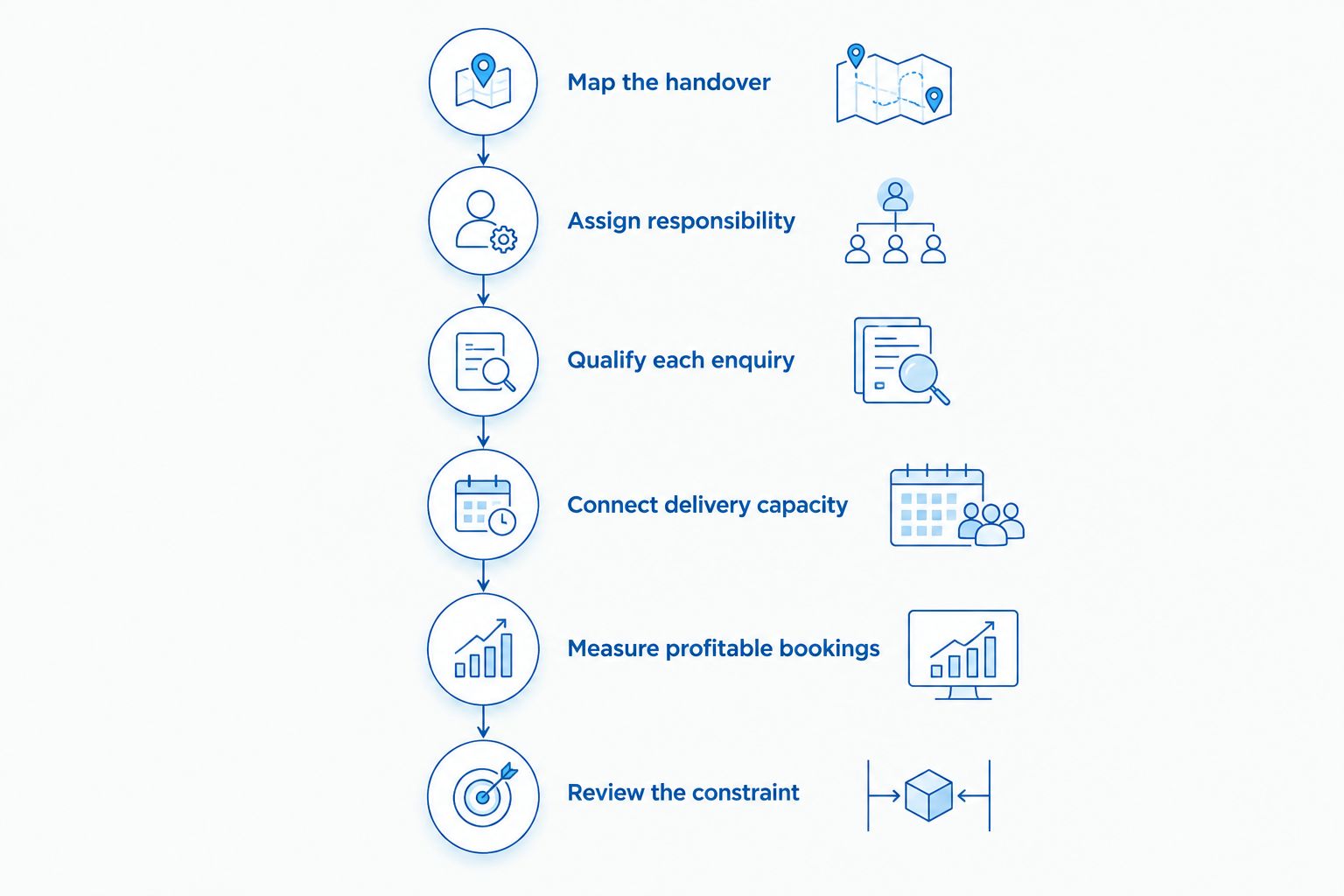
Set ownership and delivery boundaries before asking marketing to generate more work.
Compare support options for your service business
Choose support around the work you need help completing. Advice, implementation and ongoing management are different responsibilities. Confirm which ones sit with the provider and which remain with your team.
| Option | Best for | Main advantage | Key limitation |
|---|---|---|---|
| Owner-led process review | A defined handover problem you can address internally | Direct access to your team's working knowledge | The owner must organise the review and follow-through |
| Advisory marketing consultant | A team that can implement but needs outside direction | A focused brief for strategy and process decisions | Advice still needs an internal implementation owner |
| Elevatory business coaching with done-with-you marketing implementation | Established Australian service businesses needing strategy and shared implementation | Connects offers, funnels, paid advertising and systems | Your team must participate and retain operational responsibility |
| Done-for-you campaign management | A business with a working intake and delivery process that wants campaign execution delegated | External responsibility for the agreed campaign work | Campaign management alone does not assign your internal handover roles |
Choose shared implementation when the gap is getting decisions into practice. Choose campaign management when the internal process already works and campaign execution is the task you want delegated. Check the actual scope rather than assuming the service label includes both.
Connect your marketing and delivery
Explore business coaching and done-with-you support for offers, funnels, paid advertising and systems.
Common mistakes service business owners make
Delegating the inbox but keeping every decision
An administrator cannot own intake if every scope question returns to you. Write the rules for suitable work and escalation, then give the role authority to apply them. Review exceptions rather than approving every routine enquiry.
Increasing enquiries without checking capacity
An advertising brief that ignores the delivery schedule leaves intake to reconcile promises with available resources. For 2026, include acceptable service types and capacity boundaries in the brief—not just an enquiry target.
Calling every enquiry a qualified lead
A form submission does not establish service fit, location or scope. Agree the qualification criteria before assessing campaign quality. Keep unsuitable enquiries separate from suitable enquiries lost through unclear follow-up.
Handing over contact details without the job context
A name and phone number do not tell delivery what was discussed or promised. Pass on the scope, constraints, agreed next step and unresolved questions. Require the receiving person to accept responsibility explicitly.
FAQ
What's the best marketing consultant for a local service business?
The best fit is a marketing consultant whose scope connects lead generation with qualification, team responsibilities and delivery capacity. Elevatory suits established Australian businesses seeking business coaching with done-with-you marketing implementation, rather than fully outsourced execution.
Should I fix lead handover before running more ads?
Fix unclear ownership and capacity rules before increasing paid advertising. Your team needs a defined way to assess, follow up and accept suitable enquiries without sending every routine decision back to you.
Can a marketing consultant help me reduce owner dependence?
A marketing consultant can help when the agreed scope includes intake responsibilities, qualification rules and the connection to delivery. Your team still needs authority to apply those rules and an internal person responsible for implementation.
What's the difference between business coaching and campaign management?
Business coaching addresses business decisions and accountability, while campaign management handles the agreed advertising work. Check whether either engagement includes implementation and lead handover; the label alone does not define the scope.
Do I need new software to fix lead handover?
Start by fixing responsibilities and decision rules, not by buying software. A shared record can make ownership, qualification and the next action visible while you establish the process.
How do I measure whether marketing brings useful enquiries?
Track source, qualification, booking outcome and the reason enquiries do not proceed. Connect booked work to delivery and cost records so your assessment goes beyond enquiry volume.
Is done-with-you marketing the same as done-for-you marketing?
No: done-with-you marketing requires your participation in decisions and implementation. Done-for-you work delegates the agreed execution, but your business still retains responsibility for its internal intake and delivery operations.
One last thing
Make the handover receiver part of the process design. Ask the person quoting, scheduling or delivering the work what information they need to accept responsibility without calling you. Put those requirements into the intake record.
Do not ask marketing to solve a decision your team has not been authorised to make. Give the team clear boundaries, then use marketing to bring work that fits them.
Individual client results. Results vary and are not guaranteed.
Related guides
Book a free growth strategy call
Forty-five minutes with a strategist to pressure-test where your business is stuck and what to prioritise next.
Prefer to talk first? Call 1300 634 230 or email chris@elevatory.com.au