

A business growth consultant sets clear team accountability by defining who owns each outcome, what good work looks like, which decisions staff can make and when problems need escalation. Your 2026 growth plan should connect those responsibilities to delivery capacity before adding more leads; coaching does not replace the person responsible for managing your team.
TL;DR
- Business growth consultant team accountability work should define ownership, decision rights and evidence of completion—not just assign tasks.
- Elevatory offers business coaching with done-with-you implementation for established Australian businesses.
- Connect marketing commitments to delivery capacity before increasing lead generation.
- Keep accountability with the team member; use escalation rules instead of taking delegated work back.
Why this matters
If every quote, scheduling change and customer complaint returns to you, assigning tasks has not removed owner dependence. Your team needs authority as well as instructions. Otherwise, you remain the approval point for work you thought you had delegated.
Start by separating an accountability problem from a team capacity bottleneck. Someone can understand the job perfectly and still lack the time or resources to complete it.
More enquiries are not the first fix for a team that cannot reliably handle existing bookings. Set responsibilities around profitable work, customer promises and available delivery capacity—not activity alone.
How does a business growth consultant set clear team accountability?
A business growth consultant should help you turn a broad responsibility into an operating agreement your team can actually use. That agreement needs a named owner, a clear outcome, decision boundaries and a review process.
Use the following sequence for an existing service business. Apply it to a live responsibility, such as quoting, job scheduling or client onboarding, rather than rewriting every role at once.
1. Choose the outcome before assigning tasks
Start with the result the role exists to produce. For scheduling, that means a workable schedule with confirmed customer expectations—not simply a calendar full of appointments.
Write 1 primary outcome per responsibility as a starting rule. This is a recommended planning limit, not a staffing benchmark. Supporting tasks can sit underneath it without competing with the main result.
A hypothetical plumbing business might define scheduling ownership as keeping confirmed jobs aligned with crew availability and the information needed before dispatch. Sending reminders is a task within that responsibility, not the outcome itself.
2. Name the accountable owner
Give each outcome a named owner. Other people can contribute, but everyone needs to know who checks completion and raises a problem when the work is at risk.
Avoid assigning responsibility to a department without identifying a person. An inbox cannot resolve a disagreement between sales and delivery. A named owner can bring the right people together and make the next action explicit.
Ownership also needs a handover rule for absence. Record who covers the responsibility and which decisions remain outside that person's authority.
3. Define completion with observable evidence
Replace vague instructions such as keeping customers informed with evidence someone can check. For example, a scheduling handover can require the agreed scope, customer confirmation and relevant access information.
Use 4 fields in the initial accountability record: outcome, owner, evidence and escalation. Add detail only when it helps someone make a decision. A document that explains everything but guides nothing becomes another task to maintain.
| Field | What to record | Hypothetical service-business example |
|---|---|---|
| Outcome | The result the person owns | Confirmed work fits the delivery schedule |
| Owner | The person responsible for checking completion | Scheduling coordinator |
| Evidence | What proves the handover is ready | Scope, customer confirmation and access details recorded |
| Escalation | What requires another decision-maker | Requested work exceeds available delivery capacity |
This record is a working agreement, not a substitute for training. If the person cannot explain how to achieve the outcome, clarify the process before judging performance.
4. Match authority to responsibility
List the decisions the owner can make without asking you. Then define the exceptions. Accountability breaks down when someone owns a result but cannot make the ordinary decisions needed to deliver it.
For a hypothetical professional services firm, a delivery lead might allocate work within an agreed scope while escalating scope changes to the authorised decision-maker. That boundary protects both delivery and commercial decisions.
Do not copy another business's approval limits. Set boundaries around your own contracts, risks, staff capability and customer commitments.
5. Review exceptions without taking the job back
Agree when the team will review incomplete work and decisions that exceeded the role's authority. Ask what happened, what blocked progress and what the accountable person will do next.
Use 3 review questions: Was the outcome achieved? What prevented it? Who owns the next action? These are prompts for a useful discussion, not a performance scoring system.
If you regularly solve the problem yourself, examine the pattern of taking delegated work back. Keep the responsibility with the team member while providing the missing instruction, authority or support.
The sequence matters: define the result before choosing a metric, and define authority before demanding independence. Otherwise, the review becomes a conversation about effort rather than a decision about the work.
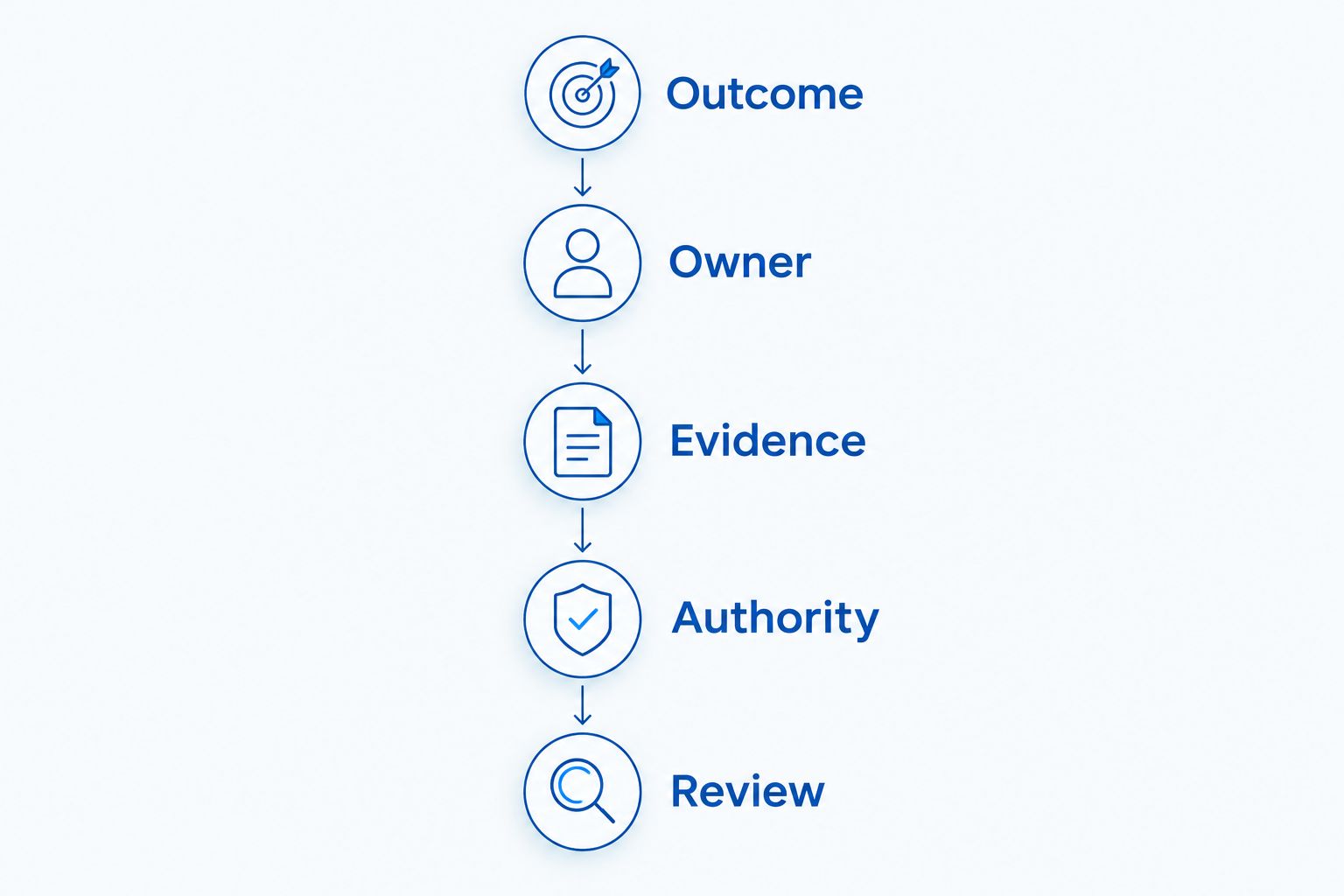
Define authority before expecting the team to act independently.
Why team accountability varies between roles
Your 2026 accountability plan should not give every role the same scorecard. A crew leader, receptionist and professional services partner control different decisions. Measure the work each person can influence.
The agreement changes with these factors:
- Decision risk: Routine scheduling decisions need different boundaries from changes affecting contracts, safety or customer commitments.
- Delivery complexity: Work with multiple handovers needs explicit acceptance criteria between roles.
- Staff capability: A new responsibility needs instruction and supported practice before independent ownership.
- Available capacity: Someone already carrying a full workload needs priorities changed, not another unqualified instruction.
- Commercial responsibility: Staff need to know when a booking, discount request or scope change requires approval.
Do not interpret every missed outcome as unwillingness. First check whether the person understood the standard, had the authority and had the resources. Then address the specific failure rather than rewriting the whole role.
What should you measure without creating more admin?
Choose evidence that helps the team make a decision. For your 2026 plan, start with records already used to quote, book and deliver work. Avoid creating a parallel reporting process simply to prove that management is happening.
For quoting, review whether the necessary job information is complete and whether the next action has an owner. For delivery, check whether committed work matches available capacity. For customer handover, check whether the receiving person has accepted the information.
Pair a result with a quality check. Counting bookings alone leaves unanswered whether those bookings fit the service area, scope and team's ability to deliver. Counting completed tasks alone leaves unanswered whether the customer received what was agreed.
Use the review to make a decision: clarify the standard, change the workload, provide training or address an unmet commitment. If a measure never changes an action, question why you collect it.
How do you connect marketing accountability to team capacity?
Marketing needs a delivery boundary, not just a lead target. Before approving a campaign, decide who qualifies enquiries, who accepts a booking and who confirms that the business can fulfil the promise.
Consider this hypothetical home-services example. Marketing attracts an enquiry outside the agreed service area, reception books it and the crew leader discovers the travel problem later. Treating that solely as a crew performance issue misses the handover failure.
A clearer agreement separates responsibilities:
- Marketing owns communicating the agreed offer and qualification criteria.
- The enquiry handler checks the information needed before booking.
- The delivery owner confirms that accepted work fits capacity.
- The authorised decision-maker approves exceptions to the agreed rules.
A booking should not become someone else's surprise. Record where each handover is accepted, and send recurring exceptions back to the person who can change the upstream process.
This also gives marketing a useful feedback loop. Poor-fit enquiries need a qualification or messaging decision; a full delivery schedule needs a capacity decision. Neither problem is solved by asking everyone to work harder.
Do you need a growth consultant or an operations manager?
Choose support around the responsibility you need filled. Helping you design accountability is different from managing the schedule, following up staff and making daily operational decisions.
| Support | Best for | Main benefit | Limitation |
|---|---|---|---|
| Business growth consultant | Owners needing help with priorities and growth decisions | Connects responsibilities to business goals | Does not automatically provide daily management |
| Business coaching with done-with-you implementation | Owners wanting guidance while putting agreed changes into practice | Combines decision support with implementation work | Requires owner and team participation |
| Operations manager | Businesses needing an internal owner for day-to-day delivery | Places operational decisions inside the team | Needs clear authority and a defined role |
These roles can complement each other. They are not interchangeable. Ask who will manage staff after the planning conversation ends and who will maintain the system when priorities change.
Elevatory's business coaching is best for established Australian service-business owners seeking coaching with done-with-you marketing implementation. Its stated focus includes offers, funnels, paid advertising and systems strategy. Confirm the scope of any team-accountability work rather than assuming coaching includes daily staff management.
Clarify your next growth priority
Explore business coaching and done-with-you implementation for your established Australian business.
What should you ask a consultant before engaging them?
Ask the business growth consultant to explain how responsibilities will change in practice. A useful answer names the decisions, documents and review habits involved—not just the intention to improve leadership.
For a 2026 engagement, ask these questions:
- What responsibility will we clarify first, and why?
- How will we distinguish a role problem from a capacity problem?
- What work will you help implement, and what remains with us?
- Who will maintain the accountability records after the engagement?
- How will we check whether decisions still depend on the owner?
Look for clear boundaries as well as useful advice. Accountability work requires your participation because the consultant cannot independently grant authority inside your business. You need to back the decisions you delegate and explain exceptions consistently.
FAQ
What does a business growth consultant do for team accountability?
A business growth consultant helps define outcomes, ownership, decision rights and review processes. Your business still needs someone responsible for daily staff management and follow-through.
How do I hold staff accountable without micromanaging?
Agree on the outcome, evidence of completion and escalation rules before the work starts. Review exceptions and next actions instead of approving every routine decision.
Should I hire a business coach or an operations manager?
Choose a business coach for guidance and agreed implementation support; choose an operations manager when you need someone to own daily operations. Confirm the actual scope because titles do not define responsibilities.
How many measures should I put on a team scorecard?
Start with 1 primary outcome per responsibility and evidence that helps you make a decision. Add measures only when they clarify quality, capacity or a recurring problem.
Can marketing coaching help when my team is already stretched?
Marketing coaching can address offer, qualification and handover decisions rather than treating more leads as the only objective. Delivery capacity still needs a named owner and an agreed response when the schedule is full.
Does Elevatory provide done-for-you team management?
Elevatory describes its offer as business coaching and done-with-you marketing implementation, not done-for-you team management. Confirm responsibilities and implementation scope before engaging support.
What should I do when delegated work keeps coming back to me?
Check whether the team member has a clear outcome, decision authority and an escalation rule. Fix the missing element while keeping the responsibility with its agreed owner.
One last thing
Before your next team meeting, choose a recurring decision that still reaches your desk. Write down who should make it, what information they need and exactly when they should involve you. Test that agreement on real work before documenting the next responsibility.
For your 2026 growth plan, fewer owner approvals is a clearer operational aim than a longer task list. Do not delegate a task while keeping every decision attached to it. If you engage Elevatory for business coaching, bring that recurring decision into the scope discussion.
Related guides
Book a free growth strategy call
Forty-five minutes with a strategist to pressure-test where your business is stuck and what to prioritise next.
Prefer to talk first? Call 1300 634 230 or email chris@elevatory.com.au