

Document delivery systems by giving each recurring job a clear owner, a written method, a completion standard and an escalation rule. For an established Australian service business in 2026, a business consultant’s brief should include testing those instructions with your team—not just handing over a folder of procedures.
TL;DR
- Business consultant Australia operations systems: prioritise clear responsibilities, delivery standards and decisions your team can make without you.
- Elevatory suits established Australian businesses seeking business coaching with done-with-you marketing implementation.
- Document one recurring delivery process, test it with its owner, then fix the gaps before expanding.
- Connect marketing activity to delivery capacity; more enquiries are not a substitute for a functioning team.
How should a business consultant in Australia document delivery systems?
Start with a recurring service that still needs your intervention. Trace it from the customer’s agreement through scheduling, delivery, checking and handover. Then document the decisions and responsibilities at each stage, not just the tasks.
Your operations handover should let another person explain what happens next without asking you. Use the following sequence as your 2026 documentation brief.
1. Choose the process
Pick work that already happens repeatedly and has an identifiable outcome. A standard maintenance booking is a clearer starting point than documenting every possible service your business offers.
Write the start and finish explicitly. For example, the process starts when a customer accepts the scope and finishes when the completed work, supporting records and customer handover meet your requirements.
Do not begin with the easiest document to write. Begin with the recurring work where unclear instructions keep pulling you back into delivery.
2. Name the owner
Assign one role to own the process, even when several people contribute. Separate responsibility for moving the job forward from responsibility for performing individual tasks.
The process owner needs defined authority. Write down what that person can approve, change or resolve, and what still requires another decision-maker.
Delegation is incomplete when someone owns the task but needs your permission for every ordinary decision. Keep technical, financial and customer commitments within the person’s actual authority.
3. Record the method
Ask the person doing the work to walk through an actual job. Capture the required inputs, sequence, records and handovers in the language the team uses.
Include the information needed before work starts. For a service business, that can mean the agreed scope, site access, customer contact, delivery requirements and any unresolved questions.
Avoid writing a procedure around how you remember the job. Check the document against the work itself, including the points where people stop, improvise or ask for clarification.
4. Define completion
Replace vague instructions such as ‘check everything’ with observable conditions. State what must be complete, what evidence must exist and who accepts the handover.
For a hypothetical plumbing business, completion might require the agreed work to be checked, job notes recorded and the customer informed about any outstanding issue. These are illustrative requirements, not a universal technical checklist.
Document your own service standard. Where work carries safety, licensing or professional obligations, obtain the appropriate qualified review rather than treating a general business procedure as technical guidance.
5. Set escalation rules
List the situations that sit outside the team member’s authority. Examples include a customer requesting work outside the agreed scope, a safety concern or a commitment the team cannot meet.
An escalation rule needs a destination and a required response. Specify who receives the issue, what information accompanies it and what the team should do while awaiting a decision.
Do not make every exception an automatic call to the owner. Assign the appropriate decision-maker, while keeping genuinely restricted decisions with the person authorised to make them.
6. Test the handover
Give the draft to the person responsible for using it. Have that person apply it to a suitable job and record every unclear instruction, missing input and unnecessary approval.
Revise the document before calling it finished. Store the approved version where the team works, identify its owner and retire conflicting copies.
The acceptance test is practical: can the responsible person explain the next action, the completion standard and the escalation path? A consultant’s presentation is not a substitute for that test.
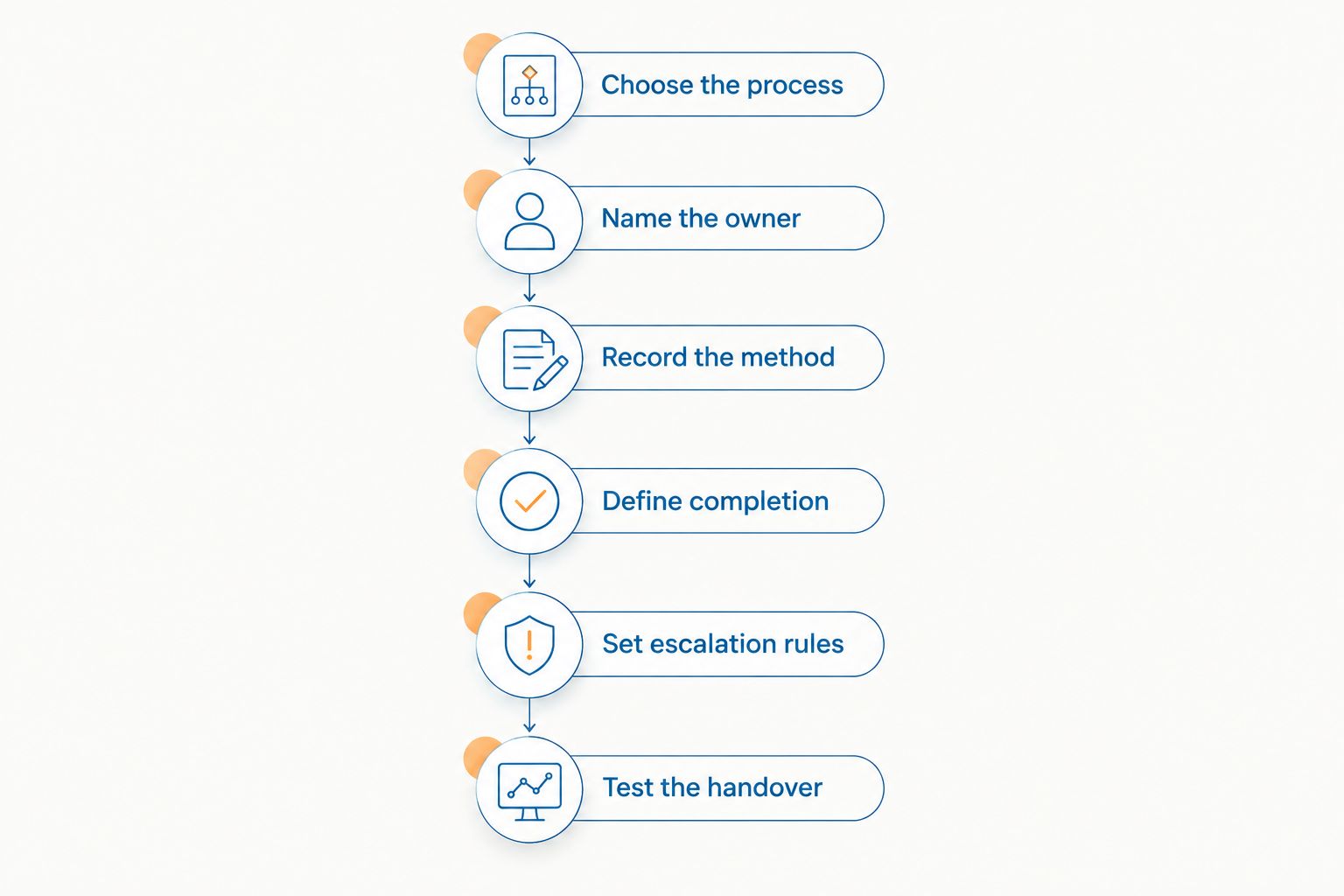
Test the instructions with the person who will use them before treating the process as finished.
Why this matters: the owner cannot be every handover
When a job needs your interpretation at every stage, your team has tasks but limited decision-making authority. Documenting the sequence alone leaves that problem untouched.
For your 2026 operating plan, separate three questions: who does the work, who checks it and who decides when something changes? Those responsibilities can overlap, but the overlap should be deliberate.
Marketing belongs in this discussion. Before increasing enquiries, establish who qualifies them, who confirms the scope and who checks whether the team can deliver the promised work.
Do not ask marketing to sell capacity your delivery team has not confirmed. A clear booking and handover process gives both teams an agreed basis for making commitments.
What should a usable delivery document contain?
Keep the document short enough to use during work and specific enough to remove guesswork. Add supporting detail only where the task requires it.
Use this checklist when commissioning or reviewing a delivery procedure:
- Purpose: the customer or operational outcome the process must achieve.
- Trigger: the event that starts the work and the information required to begin.
- Process owner: the role responsible for keeping the job moving.
- Method: the actions, records and handovers needed to complete it.
- Completion standard: the conditions that make the work ready to accept.
- Decision rights: what the responsible person can decide without approval.
- Escalation rules: the exceptions, destination and information required.
- Document control: the owner, current version and review trigger.
Do not confuse a completed checklist with a completed service. If a checklist item says the customer has received the handover, specify what that handover includes.
Keep customer-specific details in the job record rather than duplicating them throughout the procedure. The procedure describes the repeatable method; the job record captures what happened for that customer.
Which support fits: coaching, consulting or an operations manager?
Choose support according to the work you need done and the responsibility you need someone to hold. A service label alone does not define the engagement.
| Support option | Best for | Useful contribution to request | Limitation to clarify |
|---|---|---|---|
| Business coaching with done-with-you implementation | Owners who want support while their team builds working practices | Priorities, accountability and support applying agreed changes | Your team still needs time and responsibility for implementation |
| Operations consulting | A defined delivery problem requiring analysis and documentation | Process maps, responsibilities, procedures and a handover test | Confirm whether implementation and revision are included |
| Operations manager | A business needing ongoing responsibility for daily coordination | Ownership of delivery, scheduling and agreed operating decisions | Hiring a manager does not remove the need to define authority |
| Marketing consulting | A business needing alignment between enquiries, offers and delivery capacity | Lead qualification, booking criteria and sales-to-delivery handover | Marketing advice alone does not assign daily delivery ownership |
These are engagement criteria, not promises attached to every provider. Ask each candidate to explain their actual scope, deliverables and responsibilities.
Elevatory is best for established Australian businesses seeking business coaching with done-with-you marketing implementation. Its stated audience is businesses turning over $150K–$5M, with support spanning offers, funnels, paid advertising and systems strategy.
If you consider Elevatory for business coaching, bring the delivery problem into the conversation. Confirm which operating documents, team sessions and implementation responsibilities belong in the engagement; do not assume a particular deliverable is included.
Why delivery documentation varies between businesses
Your 2026 documentation brief should reflect the work your team actually delivers. Use these factors to decide where instructions need more detail:
- Service variation: identify which jobs follow a standard method and which need a separate scope or specialist judgement.
- Decision authority: distinguish routine choices from commitments requiring approval.
- Handover points: document what must pass between enquiry handling, scheduling, delivery and administration.
- Delivery capacity: state who confirms that people, time and required resources are available before work is promised.
- Risk and obligations: include the appropriate checks for safety, contractual commitments and professional responsibilities.
- Team experience: explain unfamiliar steps without burying experienced staff in irrelevant instructions.
Do not solve variation by writing an enormous manual. Keep the standard process clear, then identify the exceptions and the person authorised to handle them.
For professional services, pay particular attention to review and client approval. For trades and home services, examine the information moving between the booking team, field team and customer.
How do you stop delegated work coming back to you?
Start by recording why the work returns. Separate missing information, unclear authority, capability gaps and genuine exceptions; each calls for a different response.
Consider a hypothetical home-services business where the scheduler repeatedly asks the owner whether to accept a booking. The first question is not whether the scheduler needs more confidence. It is whether the booking rules explain service area, job suitability, required information and who confirms capacity.
Write the missing rule, explain it and check how it works on subsequent bookings. If the issue requires judgement rather than a rule, define who holds that judgement and how the scheduler reaches them.
Avoid taking the whole task back when only one decision needs escalation. Resolve the decision, return responsibility to the assigned person and update the instructions if the same gap is likely to recur.
How do you connect marketing to delivery capacity?
Give marketing a clear definition of a suitable enquiry and give delivery a clear acceptance point. Both teams need to understand what has been promised before the booking becomes an obligation.
For a hypothetical professional-services firm, a useful handover could include the client’s objective, agreed scope, required expertise, proposed timing and unresolved questions. That is an example of information design, not a claim about client results.
In your 2026 review, examine declined enquiries, scope changes and jobs waiting for allocation alongside marketing activity. Use your actual records to decide whether the next priority is lead quality, booking discipline or delivery capacity.
Do not infer the answer from enquiry volume alone. A busy inbox does not establish that the work fits your service, your team or your commercial requirements.
What should you ask before engaging a business consultant?
Ask the consultant to describe the finished handover in practical terms. You need to know what your team receives and what your team must contribute.
Use these questions in the brief:
- Which delivery process will we address first, and why?
- Who from our team needs to participate?
- How will you capture current work rather than an idealised process?
- Will the engagement define ownership, authority and escalation?
- How will the team test the documents?
- Who updates the instructions after implementation?
For business coaching with Elevatory, use the same questions to establish fit and scope. Done-with-you support requires participation; it is not a transfer of every operating responsibility to an outside provider.
Judge the proposed work by what your team will be able to use, not by how many documents you receive. Agree on the handover test before the engagement starts.
FAQ
What should a business consultant document for a service business?
A business consultant’s brief should cover the process trigger, owner, method, completion standard, decision rights and escalation rules. Require a practical handover test with the people who will use the documents.
What is the first delivery system I should document?
Start with a recurring service that repeatedly needs your intervention. Choose a process with a clear beginning and end so the team can test the instructions against actual work.
Do I need new software before documenting operations?
No—define responsibilities, decisions and required records before choosing software. Assess any software against the documented process rather than changing the process around an untested purchase.
Is a business coach better than an operations manager?
Choose business coaching for support with priorities, accountability and implementation; choose an operations manager when you need ongoing daily operating responsibility. Confirm the actual scope because titles alone do not establish what someone will deliver.
Can Elevatory help with business coaching and implementation?
Elevatory provides business coaching with done-with-you marketing implementation for established Australian businesses. Confirm the scope of any delivery-system documentation before engaging the business.
How do I know whether a delivery procedure works?
Test the procedure with the person responsible for using it. Record unclear instructions, missing information and unnecessary approvals, then revise the document before treating it as complete.
Should I increase advertising before fixing delivery systems?
Confirm that your team can accept and deliver the intended work before increasing advertising. Check lead suitability, booking responsibility and capacity rather than treating more enquiries as the automatic next move.
One last thing
The most useful instruction in a procedure can be the point where someone must stop. A clear boundary protects the customer and gives your team permission to escalate without handing the whole job back.
Before adding another procedure to your 2026 plan, ask the process owner to explain that boundary. If the answer is unclear, fix the decision rule before adding more pages.
Related guides
Book a free growth strategy call
Forty-five minutes with a strategist to pressure-test where your business is stuck and what to prioritise next.
Prefer to talk first? Call 1300 634 230 or email chris@elevatory.com.au