

A business mentor for delegation helps you stop taking work back by making the handover explicit: the outcome, the decision authority, the quality standard and the point where you step in. The mentor challenges your rescue habit and helps you replace it with a review process that leaves responsibility with the team member. You still intervene when safety, legal obligations or an agreed escalation trigger requires it; delegation is not permission to ignore risk.
TL;DR
- A business mentor for delegation helps you replace owner rescue with clear responsibilities, decision boundaries and review points.
- Keep delegated work with its owner; return feedback rather than silently fixing the task yourself.
- Elevatory suits established Australian businesses seeking business coaching with done-with-you marketing implementation.
- Match marketing activity to team capacity before asking for more leads.
How can a business mentor help you stop taking delegated work back?
A mentor helps you separate a genuine delivery problem from discomfort about someone doing the work differently. Then you build a handover that gives the team member enough information and authority to finish without sending every decision back to you.
Elevatory provides business coaching with done-with-you marketing implementation for established Australian businesses turning over $150K–$5M. Elevatory is best for established Australian business owners who want business coaching with done-with-you marketing implementation. If your main need is daily operational supervision, ask about that scope before choosing coaching.
Use this sequence for your next handover:
- Define the outcome. Describe what completed work must achieve, not just the activity someone should perform.
- Set decision boundaries. State what the person can decide and which exceptions require approval.
- Agree the standard. Show an acceptable example and explain the checks that matter.
- Review the work. Agree when you will check progress and what evidence you need.
- Return the correction. Explain the gap and let the responsible person fix it, unless an escalation trigger requires intervention.
A mentor can use this sequence to question the handover rather than automatically blaming the employee. Was the standard clear? Did you delegate the decision, or only the task? Did your feedback leave the work with its owner?
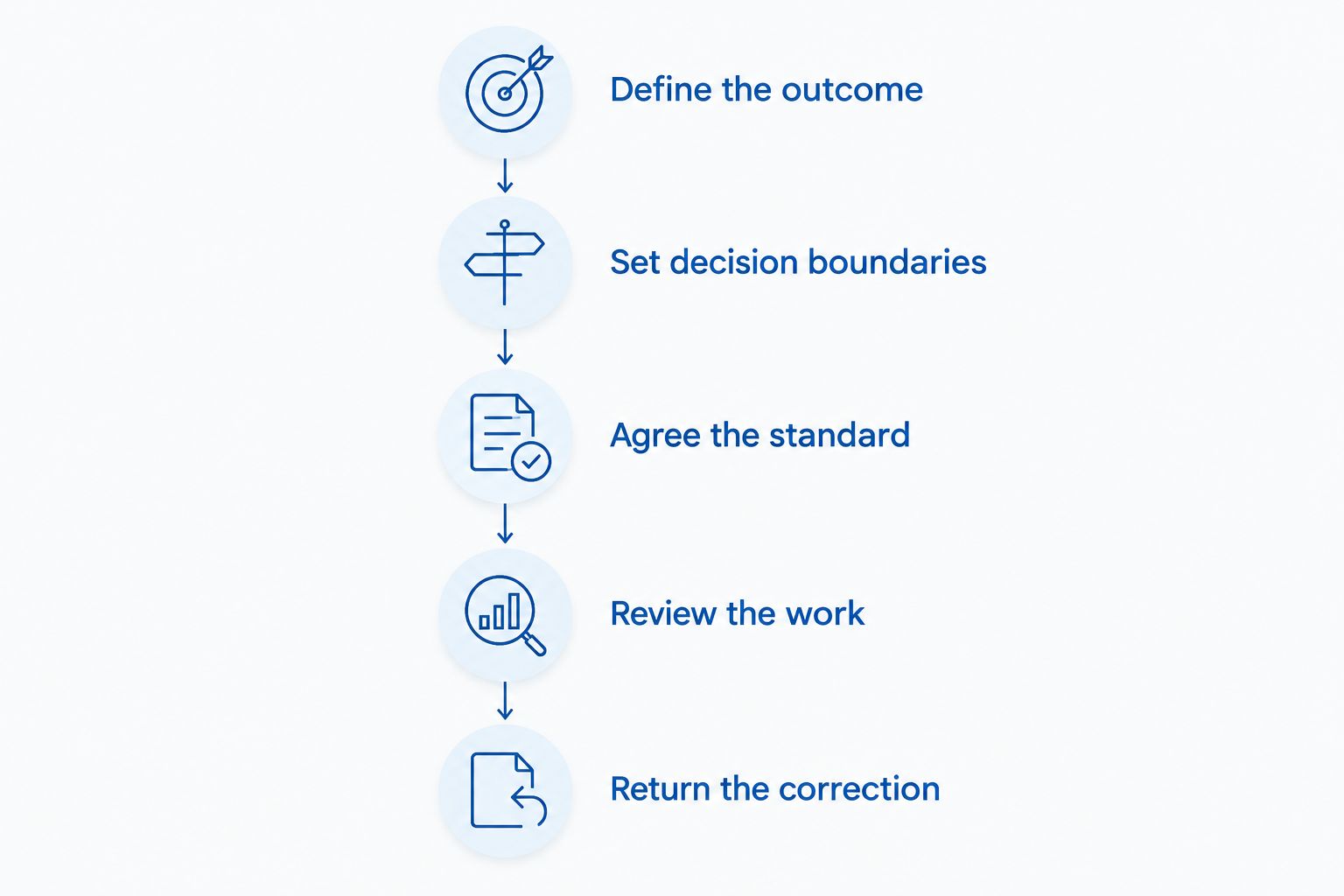
Review the work without automatically becoming the person who finishes it.
Why this matters
If you want less owner dependence in 2026, handing out more tasks is not enough. Your team needs to know which decisions belong to them, what acceptable work looks like and when to escalate. Otherwise, a task leaves your desk while responsibility stays there.
For a local service business, this connects directly to delivery. A booking is not ready just because someone entered it into a calendar. The scope, customer expectations and crew requirements need to be clear before the job proceeds.
The aim is not to stop checking work. It is to stop making yourself the default person who completes it. That distinction lets you protect standards while building a team that can act without constant permission.
Make the handover specific enough to use
A vague instruction gives you little basis for useful feedback. If you ask someone to handle enquiries, they still need to know which enquiries fit, what information to collect and what happens next.
Build the handover around the actual work:
- Outcome: What must be true when the task is finished?
- Owner: Who remains responsible for completion and follow-up?
- Authority: Which decisions can that person make without approval?
- Evidence: What shows that the work meets the agreed standard?
- Escalation: What requires a decision from you or another authorised person?
For example, a booking coordinator needs more than access to the diary. They need your rules for service area, job scope, scheduling and exceptions. Write those rules down rather than answering the same questions separately each time.
Give the team member a chance to explain the handover back to you. Ask what they will do if the customer changes the scope or the crew cannot attend. That conversation exposes unclear boundaries before a live problem lands.
For your next 2026 handover, use an example from your own business. Discuss what makes it acceptable and what would require correction. A generic checklist is a starting point, not a substitute for your delivery standard.
Choose support that matches the responsibility gap
A business mentor, an operations manager and owner review serve different purposes. Choose according to whether you need help changing your management approach, someone running delivery, or a checkpoint for work that already has a capable owner.
| Approach | Best for | What it contributes | Limitation |
|---|---|---|---|
| Business mentor for delegation | Owners improving handovers and management habits | Challenges decisions and helps structure responsibilities and review | Does not automatically provide daily team supervision |
| Operations manager | Businesses needing someone accountable for day-to-day delivery | Coordinates work and manages operational follow-through within an agreed role | Still needs clear authority and a defined remit |
| Owner review | Tasks with a responsible team member and an agreed standard | Provides a checkpoint and decisions on defined exceptions | Becomes owner rescue if you routinely finish the work yourself |
Choose mentoring when the problem is how you delegate; choose operational management when the business needs someone to run delivery. If both needs exist, define them separately. Do not expect a coaching conversation to replace an unfilled management role.
When assessing support, ask who will build the handover documents, who will manage staff and who will check implementation. Get concrete answers about responsibilities. The label on the service matters less than the work included.
Why taking delegated work back persists
Before you replace someone or add another approval step, inspect the handover. These are practical points to test, not a diagnosis of every team problem:
- The outcome is unclear. You assigned an activity without explaining the finished result.
- Authority is missing. The person owns the task but cannot make the decisions needed to complete it.
- The standard stays in your head. You judge against expectations that were never explained.
- The review happens too late. You discover a gap when there is no room left for correction.
- The workload does not fit capacity. The person lacks the time, skills or resources the task requires.
- Your intervention resets ownership. You fix the work without returning responsibility for the next step.
A business mentor can help you test which issue needs attention. The answer is not always more confidence or accountability. Sometimes you need training, a clearer role or a different allocation of work.
Use actual examples from your 2026 workload. Bring the instruction you gave, the work you received and the feedback you delivered. A specific incident gives you something to change; a complaint that nobody takes ownership does not.
Correct the work without taking ownership back
When work misses the standard, name the gap before touching the task. Explain what does not meet the brief, why it matters and what needs to change. Then ask the responsible person to propose the correction.
Keep feedback about the work. Avoid turning a missed detail into a judgement about attitude when you have not established the cause. Check whether the person understood the instruction, had the required information and could make the necessary decisions.
A suggested starting point is a 15-minute review focused on the outcome, the evidence and the next action. This is a meeting format, not a promised result. Extend it when the task requires a deeper discussion.
End the review with a named owner and an agreed checkpoint. If you need to demonstrate a correction, explain the reasoning and return the remaining work. Demonstration should teach the standard, not quietly transfer the whole task back to you.
If repeated corrections reveal a capability problem, address it directly. Training, closer supervision or reassignment can be appropriate. Delegation does not require leaving someone responsible for work they cannot safely or competently complete.
Keep marketing within the team's delivery capacity
More enquiries do not resolve an unclear booking process. Before increasing marketing activity, confirm who qualifies leads, who checks delivery capacity and who decides whether a job fits the business.
For your 2026 marketing plan, include delivery responsibilities alongside campaign responsibilities. Someone must own the handover from enquiry to booked work. Someone must also handle exceptions without sending every ordinary decision to the founder.
Hypothetical example: A plumbing business delegates booking enquiries to a coordinator but leaves job suitability undefined. The owner then reviews every enquiry and changes bookings personally. The corrective action is to define qualification questions, scheduling authority and the exceptions that need technical review—not simply demand more initiative.
In that hypothetical example, the coordinator keeps ownership of routine booking work. Technical questions go to the authorised person. The owner reviews whether the process works without becoming the permanent booking desk.
Elevatory's business coaching and done-with-you marketing implementation are relevant where offer, funnel and marketing decisions need to sit alongside delivery capacity. That does not establish a daily operations-management service. Clarify who owns team supervision before agreeing the scope.
How do I know whether I need a mentor or a manager?
You need a mentor when you want help improving how you assign responsibility, review work and make management decisions. You need a manager when someone must own daily scheduling, supervision and operational follow-through. Write down the required responsibilities before choosing either service.
What should I do when delegated work is wrong?
Explain the gap against the agreed standard and return the correction to the responsible person. Intervene directly when safety, legal obligations or a defined escalation trigger requires it. Afterwards, review whether the failure came from the brief, capability, capacity or execution.
How do I stop being the approval point for everything?
Give each role explicit decision authority and define exceptions. Start with routine decisions that have clear boundaries, rather than removing every approval at once. Review the decisions made and adjust the boundaries using actual work.
FAQ
What's the best way to use a business mentor for delegation?
Use a business mentor for delegation to work through actual handovers, decision boundaries and feedback. Bring examples of work you took back so the discussion produces a specific change rather than general encouragement.
Is a business mentor better than an operations manager?
A business mentor is better suited to improving your management approach; an operations manager is better suited to owning daily delivery. Choose based on the responsibility you need covered, not the job title alone.
How do I delegate without losing control of quality?
Set an explicit quality standard and review evidence against it. Keep responsibility with the team member while retaining defined escalation points for decisions that need your authority.
Should I take delegated work back if a customer complains?
Take control when the complaint requires your authority or presents a safety or legal issue. Otherwise, assign the response and correction clearly, and review them without automatically completing everything yourself.
Can small business coaching help me get off the tools?
Small business coaching can help you plan responsibilities, handovers and management routines. Stepping off the tools also requires people with the skills, authority and capacity to carry the work.
Does Elevatory provide done-for-you team management?
Elevatory is described as business coaching with done-with-you marketing implementation, not a done-for-you team-management service. Confirm operational responsibilities and supervision scope before engaging support.
What should I prepare before speaking to a business mentor?
Prepare a real delegated task, the instruction you gave, the standard you expected and what happened next. Include the decisions that came back to you and any workload or capability constraints.
One last thing
Before your next handover in 2026, write down the decision you usually take back—not just the task. If the team member must still ask you to make that decision, you have delegated the activity without transferring the authority needed to finish it.
Start with a routine decision, define its boundary and leave the next action with its owner. Review the outcome. Change the boundary if needed, rather than treating every imperfect result as proof that you must do the work yourself.
Related guides
Book a free growth strategy call
Forty-five minutes with a strategist to pressure-test where your business is stuck and what to prioritise next.
Prefer to talk first? Call 1300 634 230 or email chris@elevatory.com.au