

Choose a business mentor first when you need to decide what to fix, delegate or stop; choose an operations manager first when those decisions are clear but daily delivery still depends on you. The distinction is direction versus ownership: a mentor helps you make better decisions, while an operations manager takes responsibility for running an agreed part of the business. Neither role removes owner dependence without clear responsibilities and authority.
TL;DR
- Choose a business mentor when unclear priorities keep you involved in every decision.
- Choose an operations manager when your team needs daily delivery ownership, not another strategy discussion.
- Business coaching should connect marketing decisions to profitable bookings and team capacity.
- Elevatory provides business coaching with done-with-you implementation for established Australian businesses.
Why this matters
Hiring support without defining the problem creates another person who needs your attention. You can end up briefing a manager who cannot make decisions, or discussing delegation with a mentor while every booking still comes back to you.
For established Australian service businesses, the useful question in 2026 is not who has the more impressive title. It is which decisions need improving, and which responsibilities need a new owner. More enquiries do not solve a delivery system that already depends on the founder.
Elevatory provides business coaching with done-with-you marketing implementation for established Australian businesses turning over $150K–$5M. That is a different kind of support from employing someone to manage your team's daily work.
Business mentor or operations manager: who do you need first?
Use the distinction below to match the role to the work. These are role-selection criteria, not promises about what every mentor or manager includes; check the actual scope before you commit.
| Support | Best for | Responsibility to agree | Useful contribution | Limitation |
|---|---|---|---|---|
| Business mentor | Owners with unclear priorities or delegation boundaries | Challenge decisions, define priorities and review progress | Helps you decide what deserves attention | Advice does not transfer daily delivery responsibility |
| Operations manager | Owners with a clear service model but owner-dependent delivery | Own scheduling, team coordination and agreed operational decisions | Gives daily work an accountable owner | An unclear role sends decisions back to you |
| Both, with separate scopes | Owners who need strategic challenge and operational ownership | Keep advisory work separate from management authority | Connects business decisions with delivery | Overlapping responsibilities create conflicting instructions |
Start with a decision audit rather than a job title. Look at the interruptions that reach you: are people asking what the business should do, or asking for permission to carry out work that should already be defined?
The first problem calls for clearer direction. The second calls for clearer authority, stronger processes or an operational owner. Hiring alone does not answer either question.
Business mentor first: when the priorities are unclear
A business mentor is the better first choice when you cannot yet write a useful operations manager brief. You need to settle the priorities before asking someone else to execute them.
Look for unresolved decisions such as:
- Which services should receive the team's attention?
- Which bookings fit your delivery capacity and margin requirements?
- What can staff decide without asking you?
- Which owner responsibilities should move first?
- What should marketing attract, and what should it filter out?
A mentor's contribution should become visible in those decisions. Ask for a clear description of how discussions become priorities, responsibilities and follow-through. Encouragement is not a substitute for an agreed action.
The limitation is equally clear: a mentoring conversation does not run tomorrow's schedule. If you need someone to coordinate staff, handle delivery exceptions and maintain operating routines, agree that responsibility separately.
Best for: owners who need help choosing the next constraint to address. Skip an advice-only arrangement if your immediate need is hands-on daily management.
Operations manager first: when execution needs an owner
An operations manager is the better first choice when the direction is settled but delivery still relies on your constant involvement. The role needs responsibility for outcomes, not just a list of tasks.
For a trade or home-service business, that scope might include job scheduling, team coordination, handovers and escalation. For a professional-services business, it might include assigning work, checking progress and maintaining client-delivery routines. These are possible responsibilities to define, not a universal job description.
Before hiring, write down what the manager can decide without you. Separate routine decisions from exceptions involving safety, contractual obligations, pricing or other matters that require owner approval.
Then name the outcomes the role owns. Completing a schedule is an activity; maintaining a workable schedule with clear handovers is a responsibility. Your brief needs both the work and the decision boundaries.
Best for: owners with a defined service model and a team that needs daily coordination. Hold the hire if you still expect to approve every routine decision.
Both roles: when advice and delivery are separate needs
A mentor and an operations manager can address different problems at the same time. The useful combination is strategic challenge for the owner and operational accountability for the team.
Keep the reporting lines explicit. A mentor can help you assess priorities, but the operations manager needs an agreed route for receiving decisions and raising problems. Staff should not have to choose between competing instructions.
For a 2026 hiring or coaching brief, specify who recommends, who decides and who implements. That distinction matters more than whether a provider uses the word mentor, coach or consultant.
Best for: owners who can name both an advisory need and an operational need. The drawback is coordination: you must keep the scopes separate and resolve disagreements rather than letting them reach the team.
Why the right first hire varies
The right sequence depends on the work that currently lands on your desk. Use these factors to assess the choice:
- Decision clarity: If priorities change whenever a new problem appears, clarify direction before handing over execution.
- Delegation boundaries: If staff know the task but not their authority, define the decisions they can own.
- Delivery systems: If essential instructions live in your head, document the handover before expecting independent management.
- Team capacity: If delivery is already stretched, connect marketing activity to the work the team can fulfil.
- Implementation needs: If you need practical help applying decisions, distinguish done-with-you support from advice alone and employed management.
Do not use turnover as the only deciding factor. Your revenue does not tell a candidate which decisions they can make, which services to prioritise or when to escalate a problem.
How do you work out which role you need?
Use this sequence before booking coaching or advertising a management role. It produces a practical brief rather than a vague request to help the business grow.
1. Record interruptions
Record the questions and approvals that reach you during normal work. Include scheduling changes, quotes, client issues, staff questions and marketing decisions.
Write the actual decision required. A note saying the team needs help is too broad; a note saying nobody can approve a schedule change identifies a responsibility you can address.
2. Classify decisions
Separate decisions about business direction from decisions about executing an agreed service. Also identify questions that need documented instructions rather than a new hire.
For example, choosing which service to promote is different from assigning an accepted job. A repeated question about a handover might need a clearer process before it needs management support.
3. Define authority
For each responsibility you want to transfer, specify what the person can decide and what must come back to you. Include the information they need to make the decision.
Do not describe someone as accountable while withholding the authority required to do the work. That arrangement keeps the owner as the real manager.
4. Match support
Choose mentoring when the unresolved work is deciding priorities and boundaries. Choose operational management when the unresolved work is running agreed responsibilities.
Choose done-with-you implementation when you need support applying a strategy alongside your team. Confirm the scope rather than assuming that implementation means someone will run daily operations for you.
5. Review ownership
Check whether the agreed decisions have actually moved away from you. Look at completed handovers, unresolved escalations and responsibilities that still lack an owner.
For your 2026 plan, measure progress against the problem you named. A new meeting routine does not count as reduced owner dependence if the same approvals still reach your desk.
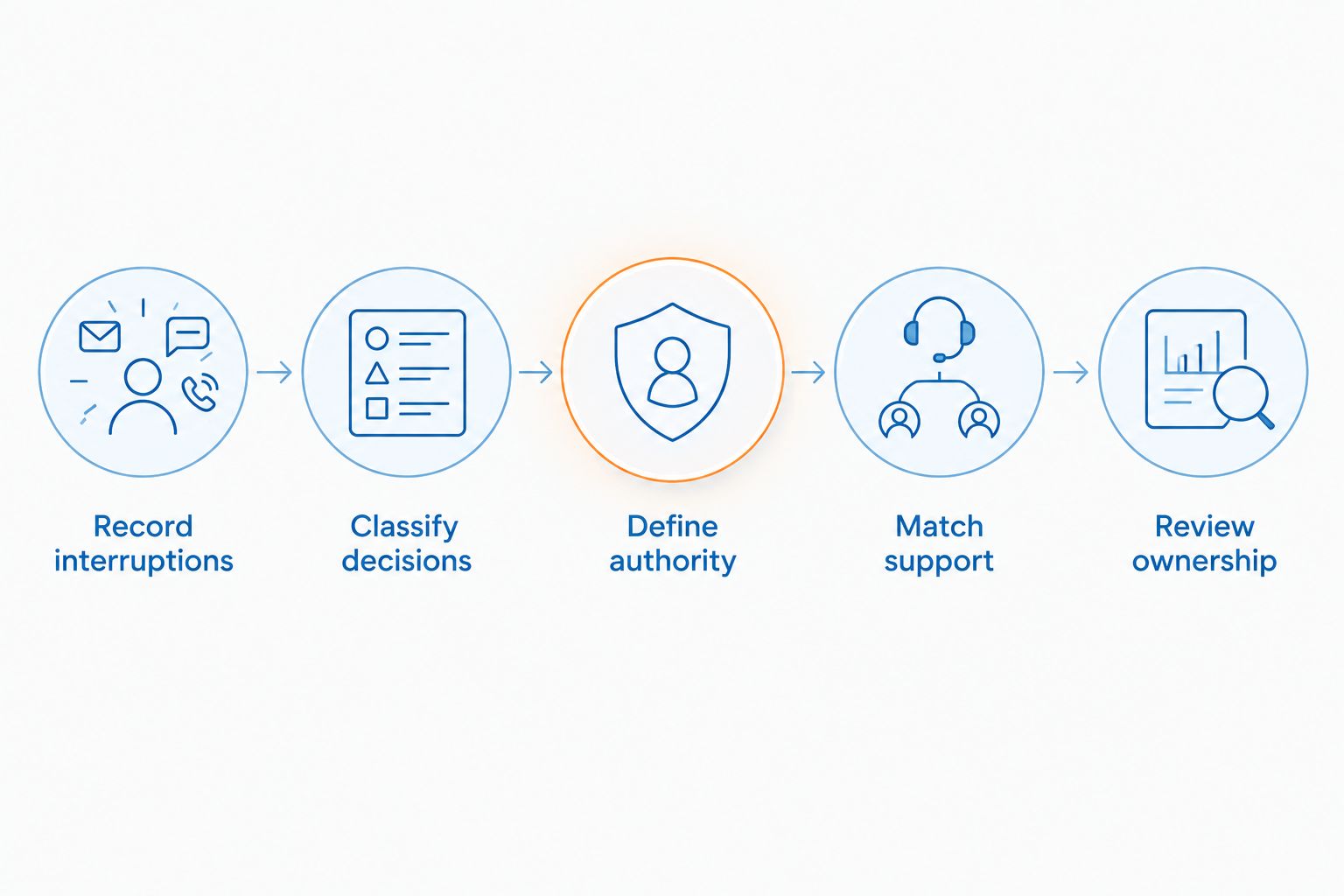
Define the responsibility before choosing the person or service.
What does this look like in a service business?
Consider a hypothetical home-services business where the owner approves every schedule change. The service offering is clear, the team knows how to deliver, and accepted jobs need coordination. The immediate issue is operational authority: define who owns scheduling and which changes require escalation.
Now consider a hypothetical professional-services business accepting enquiries without a clear view of which work fits the team. Staff cannot resolve capacity conflicts because the owner has not settled service priorities. Start by clarifying the work you want, the work you should decline and the responsibilities that can move.
These examples illustrate different decisions, not client results. Neither requires assuming that more advertising is the next move. Marketing should attract work your team can deliver profitably, not create another queue of problems for the owner.
Can a business mentor replace an operations manager?
A business mentor does not replace an operations manager unless daily management is explicitly included in the agreed role. Reviewing decisions and holding the owner accountable are different responsibilities from coordinating staff and delivery.
Ask who handles operational exceptions between meetings. If the answer is still you, mentoring has not transferred that responsibility.
Should you fix your systems before hiring an operations manager?
Define the essential responsibilities and decision boundaries before hiring; the operations manager can then have an agreed role in improving the systems. You do not need to write every instruction before the person starts, but you do need a clear handover brief.
Specify which processes the manager will maintain, which they can change and which require approval. Otherwise, system improvement becomes another undefined expectation.
Do you need marketing coaching if your team is already stretched?
Marketing coaching is relevant when you need to change lead quality, service priorities or the connection between bookings and delivery capacity. It is not a reason to increase enquiry volume without checking fulfilment.
Elevatory's business coaching with done-with-you implementation is best for established Australian owners seeking support with offers, funnels, paid advertising and systems. Its stated model is collaborative implementation, not an employed operations manager taking over daily delivery.
FAQ
What's the difference between a business mentor and an operations manager?
A business mentor helps you assess decisions and priorities; an operations manager owns agreed daily delivery responsibilities. Confirm the actual scope because titles alone do not establish authority or implementation duties.
Should I hire a business mentor or an operations manager first in 2026?
Choose a business mentor first when priorities and delegation boundaries are unclear; choose an operations manager first when agreed work needs daily ownership. Start by identifying which decisions still depend on you.
Can I use a business mentor and an operations manager together?
Yes, provided their responsibilities are separate. Give the mentor an advisory scope and the operations manager clear delivery authority, with an agreed process for turning recommendations into decisions.
How do I know whether I need a business mentor?
You need mentoring support when you want help resolving business priorities, delegation choices or strategic decisions. If your main need is someone to coordinate staff and jobs each day, assess operational management instead.
What should an operations manager be allowed to decide?
An operations manager should be allowed to make the routine decisions required by their agreed responsibilities. Define approval boundaries and escalation rules rather than requiring owner permission for every action.
Is Elevatory a done-for-you operations management service?
Elevatory provides business coaching and done-with-you marketing implementation, not a stated done-for-you operations management service. Its scope includes offers, funnels, paid advertising and systems strategy.
Should I increase advertising before fixing team capacity?
Do not increase advertising without connecting the campaign to delivery capacity. First decide which bookings fit the team and how accepted work will be scheduled and fulfilled.
One last thing
Before choosing support in 2026, write a handover brief for the responsibility you most want off your desk. Include the outcome, the decisions the person can make, the information they need and the exceptions that return to you.
If you cannot define the responsibility, clarify it first. If you can define it but keep taking it back, change the authority and handover. Neither a mentor nor a manager can remove owner dependence while the owner remains the approval point for everything.
Related guides
Book a free growth strategy call
Forty-five minutes with a strategist to pressure-test where your business is stuck and what to prioritise next.
Prefer to talk first? Call 1300 634 230 or email chris@elevatory.com.au