

Yes—a business growth consultant can help fix team capacity bottlenecks by identifying where work stalls, clarifying responsibilities and connecting marketing to what your team can deliver. The consultant provides diagnosis and implementation support; your business still needs to change how decisions and work get handled. For established Australian service businesses in 2026, the aim is profitable bookings without making the owner the default problem-solver.
TL;DR
- A business growth consultant should address delegation and delivery capacity before recommending more leads.
- Elevatory business coaching suits established Australian owners seeking done-with-you marketing and systems support.
- Business coaching and marketing coaching should connect lead quality with the team's ability to deliver.
- Choose support that turns diagnosis into assigned actions, decision rules and delivery checks.
Why this matters
More enquiries do not fix a team that already waits for your approval. They add work to the same queue. Before increasing marketing activity, establish whether the constraint sits in demand, scheduling, delivery, specialist skills or owner decisions.
For businesses turning over $150K–$5M, revenue alone does not tell you whether the team has room to grow. You need to know which bookings contribute profit, which jobs absorb scarce skills and which routine decisions still come back to you.
Elevatory provides business coaching with done-with-you marketing implementation. That distinction matters: advice identifies the change, while implementation support helps you put it into practice. Neither replaces the need for clear responsibilities inside your business.
Your 2026 growth plan should explain who will deliver the extra work, not just where the next enquiry will come from.
Can a business growth consultant fix team capacity bottlenecks?
A business growth consultant can help you identify and address capacity bottlenecks when the engagement includes operational diagnosis and implementation. Marketing advice alone does not resolve unclear roles, approval queues or delivery rework. Ask for a process that follows work from the first enquiry through to completion.
Use this sequence to assess the consultant's approach and organise your own team discussion.
1. Map delivery
Trace a typical booking from enquiry to quote, scheduling, service delivery and payment. Record who handles each stage, what information they need and where work stops. Include the handovers between people, not just their individual tasks.
Choose a recent completed job and a job that stalled. Compare the actual sequence rather than the process you intended to follow. A documented procedure is not evidence that the team uses it.
For trades and home services, inspect quote approvals, job preparation and scheduling. For professional services, inspect scoping, client information, review and sign-off. Keep the exercise specific to the work your customers buy.
2. Locate delays
Separate waiting time from working time. A job waiting for your approval is a different problem from a job that requires specialist skills nobody else has. The first calls for decision rules; the second calls for a skills or resourcing decision.
Record the reason each stalled job cannot move. Avoid vague descriptions such as being too busy. Name the missing information, approval, equipment, skill or available person.
A useful diagnosis identifies the handover causing the delay. It does not stop at saying that the team needs better systems.
3. Assign ownership
Give each recurring decision a clear owner. Specify the decisions that person can make, the boundaries they must follow and when they should escalate. Assigning a task without decision authority leaves you in the same approval chain.
Start with routine work where the rules are clear. Keep unusual, high-risk or commercially significant decisions with the appropriate senior person. Delegation does not mean removing oversight; it means making oversight deliberate.
Ask the consultant to help turn responsibilities into instructions your team can use. A role description that nobody consults will not settle tomorrow's scheduling dispute.
4. Set standards
Define what must be ready before work passes to the next person. That can include a complete scope, customer details, access instructions, materials or an agreed deliverable. Use the requirements relevant to your service.
Set a clear completion standard too. Otherwise, people can disagree about whether a job is finished, creating another approval loop. Keep standards practical enough to check during normal work.
Test the process with the person doing the job. If following it requires repeated interpretation from you, simplify the instructions before adding more work.
5. Match demand
Only then decide what marketing should promote. Direct enquiries towards services your team can deliver profitably, and make qualification reflect your actual service scope. Do not judge a campaign solely by the number of enquiries it creates.
Check the consequences of increased bookings before changing campaign activity. The relevant questions include who can deliver the work, what preparation it needs and whether it displaces better-fit bookings.
The 2026 decision is not simply whether to increase leads. It is whether the next booking fits the delivery system.
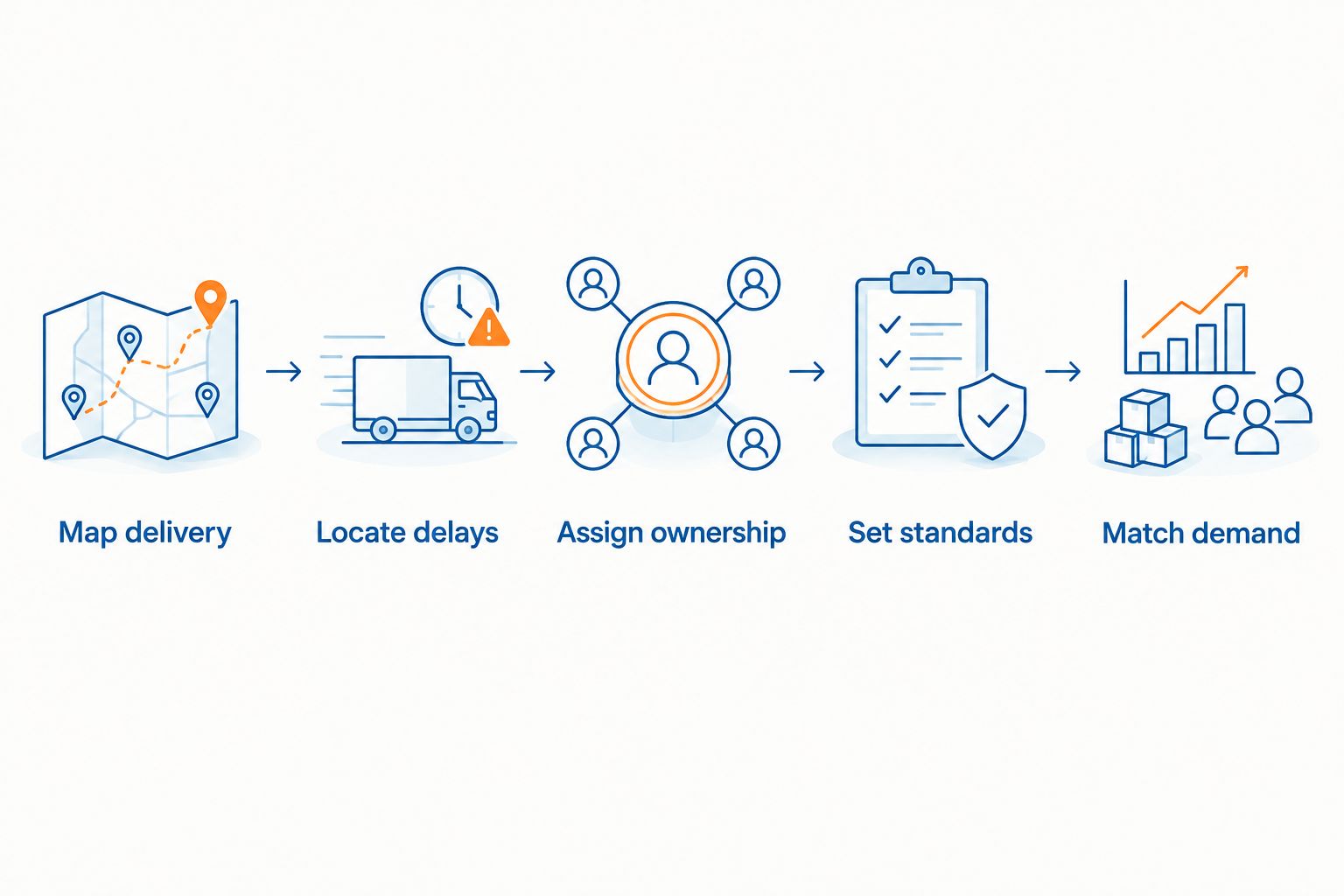
Clarify delivery and decision ownership before increasing demand.
Why team capacity bottlenecks vary
Capacity problems require different fixes because not every delay comes from a shortage of people. Use these factors to frame the diagnosis, then check them against actual jobs and decisions.
- Owner approvals: Routine decisions queue behind you. Define approval boundaries before assuming another hire will remove the delay.
- Unclear responsibilities: Tasks move between people without a clear owner. Assign responsibility for the outcome and the handover.
- Specialist skills: Work depends on expertise that other team members do not have. Assess training, supervision or resourcing separately from general workload.
- Incomplete handovers: Missing scope or customer information sends work backwards. Set entry requirements for each delivery stage.
- Lead quality: Enquiries fall outside your service scope or require work your team cannot deliver well. Tighten qualification and marketing messages.
- Job economics: Bookings consume capacity without contributing enough to justify the effort. Review pricing, scope and delivery requirements together.
Do not apply every fix at once. Choose the constraint that currently blocks work, assign an action and check whether jobs move through that point more reliably.
A new scheduling process will not solve missing technical expertise. Better lead qualification will not solve a team waiting for routine approvals. Match the intervention to the cause, not to the consultant's favourite service.
Which type of support fits your capacity problem?
Choose support by the work you need done, not by the title on a proposal. A business mentor, marketing strategy consultant and business consultant can offer overlapping advice. Check their scope, implementation responsibilities and limits before choosing.
| Support | Best for | Strength to look for | Limitation to check |
|---|---|---|---|
| Business coaching | Owners changing delegation and management habits | Accountability tied to practical team decisions | Advice needs internal follow-through |
| Marketing coaching | Businesses improving offers, qualification and campaign decisions | Connecting demand with delivery capacity | Marketing scope alone leaves operational problems unresolved |
| Business growth consulting | Businesses needing diagnosis across commercial and operational constraints | A prioritised plan with responsibilities and implementation support | A broad brief needs clear boundaries to avoid scattered work |
Ask every provider the same question: what will change inside the business during this engagement? A useful answer names decisions, responsibilities or processes. A promise to help you scale does not define the work.
For your 2026 shortlist, request an explanation of how progress will be assessed. Distinguish business activity from business outcomes. Completing a workshop is activity; removing an unnecessary approval from routine work is an operational change.
Do I need to hire before working with a consultant?
Do not make hiring the automatic first response to a capacity bottleneck. First establish whether the missing resource is time, skills, information or decision authority. Another person still needs a workable role and a clear way to get work done.
If qualified people are fully occupied with necessary delivery work, assess additional capacity. If they repeatedly wait for instructions or redo incomplete work, address those issues first. Hiring and process changes are different decisions, even when both belong in the plan.
Give a prospective consultant the job description you intend to recruit for. Ask which constraint the role removes and what the person needs to work independently. An answer that cannot connect the role to a specific constraint is not enough to support the decision.
How do I know whether marketing is making the bottleneck worse?
Marketing adds pressure when it attracts work your team cannot deliver within the agreed scope and schedule. Check enquiries against actual bookings and delivery requirements. Enquiry volume alone does not show whether the work is a good fit.
Review which services customers request, why suitable enquiries fail to book and what happens after acceptance. Distinguish a qualification problem from a scheduling problem. They require different changes.
Ask your marketing consultant to connect campaign decisions with team availability and job economics. That can mean changing the offer, clarifying service boundaries or directing attention towards suitable work. It should not default to increasing advertising activity.
A hypothetical service-business example
Consider a hypothetical plumbing business where the owner approves routine quotes, answers scheduling questions and checks every completed job. The technicians have assigned work, but office staff cannot confirm standard bookings without contacting the owner. This is an illustrative example, not a client result.
Buying more advertising would add enquiries to that approval queue. The first practical intervention is to define which jobs office staff can book, which information they need and which exceptions require the owner.
Next, clarify job preparation and completion requirements. The technician needs enough information to deliver the service; the office needs a clear basis for closing the job. Neither handover should depend on guessing what the owner wants.
Then review marketing against the work the team can accept. If specialist jobs still depend on the owner, distinguish those enquiries from routine service bookings. The lesson is sequencing: clarify decisions, improve handovers, then assess additional demand.
Where Elevatory fits
Elevatory business coaching suits established Australian owners seeking done-with-you marketing and systems support. Its stated scope includes offers, funnels, paid advertising and systems strategy. For a service-business owner, the buying question is how that scope connects to the constraint in your team.
Elevatory is not positioned as a done-for-you agency that takes over your business. Done-with-you implementation requires participation. Before engaging, establish who inside your business will make decisions, supply information and put agreed changes into daily use.
Ask how the proposed work connects marketing with delivery capacity. Also confirm whether your particular operational issue sits inside the engagement. A specialist staffing, technical or compliance problem needs the appropriate expertise, not a broader promise of growth.
The practical advantage of this model is support that connects advice with implementation. The trade-off is your involvement: you still need an internal owner for the work. Buy support for the constraint you have, not the outcome you hope somebody else will deliver.
What should I prepare before the first conversation?
Bring evidence of how work moves, not a polished presentation. Use your current quote process, schedule, role responsibilities and examples of jobs that stalled. Include the decisions your team escalates repeatedly.
Prepare these questions for a 2026 consulting conversation:
- What evidence will you use to identify the main constraint?
- Which decisions need to move away from the owner?
- Who will implement each proposed change?
- How will marketing decisions reflect delivery capacity?
- What is outside the engagement's scope?
- How will we check whether the change works?
Ask for a clear answer about your responsibilities as well as the consultant's. If implementation depends on your team, make that commitment explicit before starting. A plan without someone responsible for using it remains a document.
FAQ
Can a business growth consultant help me stop making every team decision?
A business growth consultant can help clarify decision ownership, delegation boundaries and escalation rules. Your team still needs the authority and instructions to use those changes.
What's the best support for a business with plenty of leads but delayed jobs?
Support focused on delivery and decision-making fits that problem better than a lead-generation brief. Check where accepted jobs stall before increasing marketing activity.
Is business coaching better than hiring another employee?
Business coaching and hiring address different needs. Clarify whether the constraint is management, process or missing skills before choosing either.
Can marketing coaching help with team capacity?
Marketing coaching can help align offers, qualification and campaign decisions with team capacity. It does not replace the operational changes needed to resolve unclear responsibilities or delivery delays.
Does Elevatory provide done-for-you business management?
Elevatory provides business coaching and done-with-you marketing implementation, not done-for-you business management. Confirm the engagement scope and your implementation responsibilities before starting.
What should I ask a business growth consultant in 2026?
Ask how the consultant will identify the constraint, assign implementation responsibilities and check progress. Request clear boundaries on what the engagement covers.
Can a consultant guarantee that my team capacity will improve?
No consultant can guarantee that your team capacity will improve. Assess the proposed work, implementation requirements and evidence rather than a growth promise.
One last thing
Write down the routine decisions your team brought to you this week. Choose one and define who should make it, what information they need and when they should escalate. Test the rule with the person who will use it.
That gives you a concrete starting point for a consultant conversation. Your 2026 capacity plan should make decisions clearer, not add another layer of approvals. Start by removing one unnecessary dependency on the owner.
Related guides
Book a free growth strategy call
Forty-five minutes with a strategist to pressure-test where your business is stuck and what to prioritise next.
Prefer to talk first? Call 1300 634 230 or email chris@elevatory.com.au