

Small business coaching supports staff retention by helping you clarify responsibilities, delegate decisions and match bookings to your team's capacity. It cannot guarantee employees stay or replace fair pay, safe work and competent day-to-day management.
TL;DR
- Small business coaching staff retention work should fix unclear roles and owner dependence before chasing more leads.
- Elevatory suits established Australian service businesses seeking business coaching with done-with-you implementation.
- Give employees decision authority, clear escalation rules and workloads that reflect delivery capacity.
- Track departures alongside overtime, rework and owner approvals; retention alone does not explain team health.
Why this matters
If every difficult customer, scheduling change and pricing question comes back to you, hiring another person leaves the same bottleneck in place. Your team has responsibility without enough authority. You remain the person who keeps work moving.
Start by measuring owner dependence, rather than assuming a departure means you need better recruitment. Identify which decisions stall when you are unavailable and what employees need to resolve them.
For your 2026 growth plan, treat team capacity as a condition of accepting more work, not a problem to solve afterwards. Marketing decisions belong in the same conversation as scheduling, supervision and service quality.
How does small business coaching help retain your team as you grow?
Small business coaching gives you a process for changing how work gets assigned, approved and reviewed. The practical output should be clearer roles, usable delivery standards and managers who can make decisions without waiting for the owner.
That work supports retention by addressing problems within your control. It does not establish why a particular employee left. Ask employees directly, compare their answers with working conditions, and avoid treating every departure as the same problem.
Use the following sequence before adding another campaign, service area or layer of management. Fix the work before asking people to absorb more of it.
Clarify responsibilities
List the recurring work that keeps the business running: qualifying enquiries, preparing quotes, scheduling jobs, delivering services, checking quality and resolving complaints. Give each activity an accountable role, then explain where that role's responsibility ends.
A job title is not enough. A crew leader needs to know whether they can rearrange work, approve a practical change or stop a job that is not ready. A professional-services team leader needs equally clear boundaries around scope and client requests.
Ask the employee to explain the arrangement back in their own words. Different answers expose ambiguity before a live customer issue does.
Set decision boundaries
Separate decisions employees can make from decisions they must escalate. Explain the trigger for escalation, the information required and who responds when you are unavailable.
Do not delegate a customer outcome while keeping every meaningful decision yourself. Equally, do not tell an inexperienced employee to use their judgement without giving them standards or support.
Write down the decisions that repeatedly interrupt you. Start there, rather than documenting the entire business. Delegation needs authority and boundaries, not just a longer task list. Review whether your own behaviour respects those boundaries when work gets busy.
Match workload
Compare promised work with the people, skills and supervision available to deliver it. Include quoting, travel, administration, checking and customer follow-up, not just the time spent performing the core service.
An employee who appears available on a job calendar can still carry substantial coordination work. Make that work visible before allocating another booking.
Use your 2026 booking plan to decide which services to promote and which enquiries to decline or reschedule. A full calendar is not evidence that the workload is manageable. Ask the person doing the work what the calendar leaves out.
Review the handover
Check whether delegated work stays delegated. If employees keep returning decisions to you, identify whether they lack knowledge, authority, information or confidence in your response.
If you keep taking work back, explain what standard was missed and coach the correction. Quietly finishing it yourself leaves the employee without feedback and preserves your role as the fallback.
Review completed work against an agreed standard, not against an unstated preference. Employees need to distinguish a genuine delivery requirement from the way you personally would have done the task.
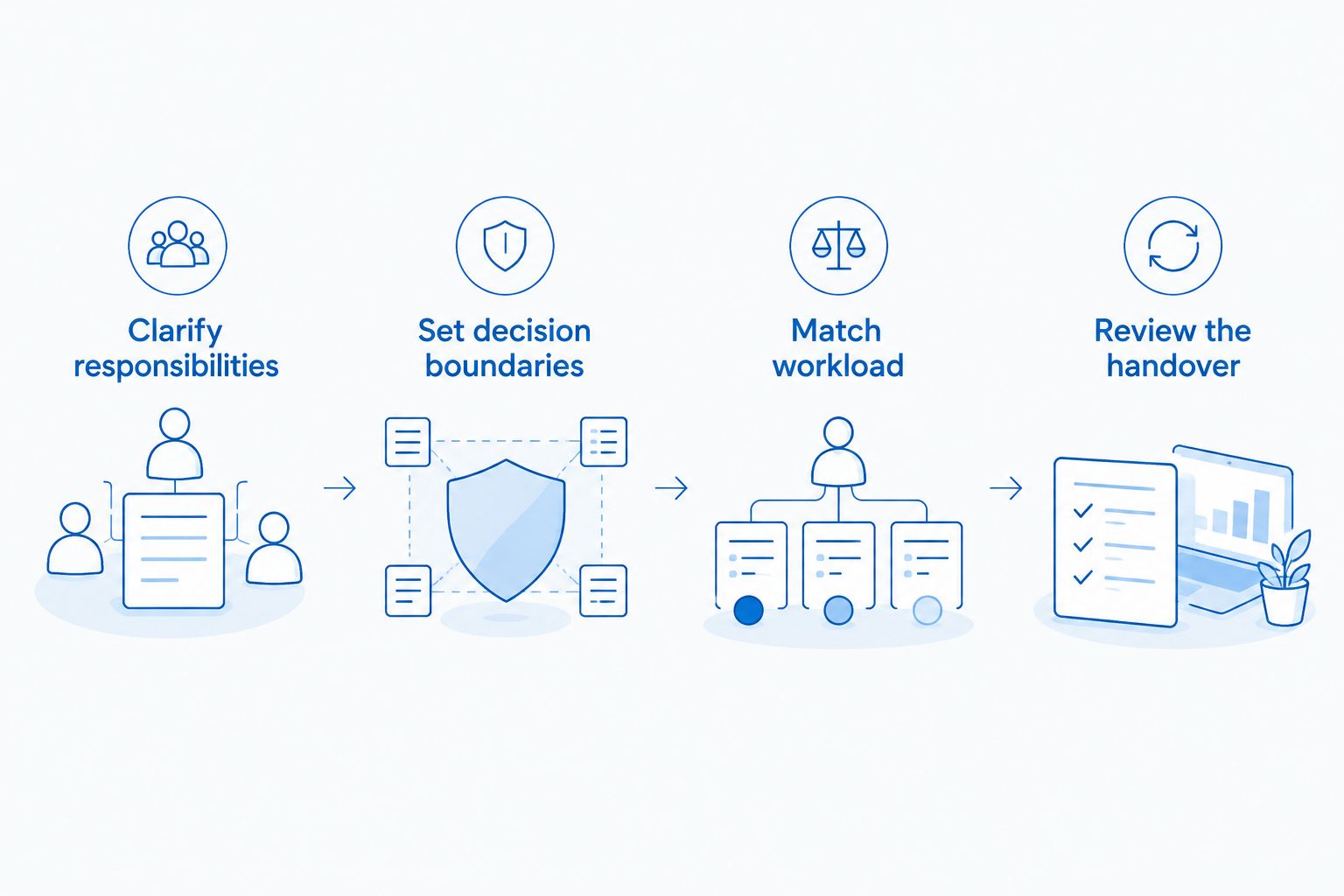
Delegate decisions as well as tasks, then check whether the handover holds.
Why staff retention problems vary between businesses
A retention conversation needs evidence from the actual role. Use these factors as questions to investigate, not conclusions about your employees:
- Role clarity: Can employees explain what they own, what good work looks like and where responsibility transfers?
- Decision authority: Can employees resolve routine issues, or do approvals repeatedly interrupt delivery?
- Workload: Do bookings allow for administration, supervision and unexpected customer needs?
- Management support: Does the person leading the team have time and skills to give feedback and handle problems?
- Employment conditions: Are pay, working arrangements and workplace concerns being addressed directly, rather than disguised as motivation issues?
- Development: Can employees see a credible path to greater responsibility without simply inheriting more work?
Separate what employees report from what you infer. If your explanation and theirs differ, investigate the difference before choosing a coaching brief.
Do you need coaching, an operations manager or specialist advice?
Choose support according to the work that needs doing. Coaching helps an owner change decisions and practices; an operations manager takes ongoing responsibility for running agreed parts of the business. Employment advice addresses obligations that coaching does not replace.
| Support | Best for | Practical benefit | Limitation |
|---|---|---|---|
| Business coaching with implementation support | Owners who need to change delegation, priorities and delivery systems | Turns operating problems into actions the owner and team can implement | Requires owner participation; does not supply an internal manager |
| Operations manager | Businesses needing ongoing coordination and management | Gives operational decisions a dedicated accountable role | Needs clear authority, scope and support from the owner |
| Employment or HR advice | Businesses facing employment terms, workplace concerns or formal processes | Addresses the specific employment question | Does not take responsibility for bookings, delivery or marketing decisions |
Do not buy coaching when the immediate need is someone accountable for daily operations. Do not hire a manager into an undefined role and expect the title to resolve unclear authority.
Where coaching with implementation support fits
Elevatory provides business coaching with done-with-you marketing implementation for established Australian businesses turning over $150K–$5M annually. Its stated work includes offers, funnels, paid advertising and systems strategy.
Elevatory is best for established Australian service-business owners seeking business coaching with done-with-you implementation. That model requires your participation; it is not a substitute for an employee who manages the team each day.
For a staff-retention brief, specify the operating problem first. Ask how the proposed work connects responsibilities, delivery capacity and marketing decisions. Do not accept more enquiries as the only measure of progress.
What should change before you increase lead volume?
Consider this hypothetical plumbing business. The owner approves schedule changes, checks every quote and handles customer complaints. A crew leader carries responsibility for keeping jobs moving but cannot change the order of work without approval.
Adding enquiries leaves those arrangements untouched. Before increasing demand, the owner needs to define which scheduling decisions the crew leader can make, which jobs need review and what information must accompany a booking.
The marketing brief then follows the delivery plan. It specifies the services the team is equipped to handle, the information needed to qualify a job and when an enquiry should be declined or escalated.
This is an illustrative operating scenario, not a client result. The lesson is about sequence: establish how the team will deliver the work before asking marketing to generate more of it. Apply that test to your 2026 campaign plan, especially when a new service requires unfamiliar skills or extra supervision.
Practise customer handovers before making them permanent
Delegating enquiry handling needs more than a script. Employees need to recognise a suitable customer, explain service boundaries and avoid making commitments the delivery team cannot meet.
For businesses training new enquiry handlers, AI sales role play belongs in rehearsal, not in the approval chain: employees still need clear rules about scope, promises and escalation. Use practice conversations to assess judgement, then review real work against the same standards.
Ask employees to practise explaining an unsuitable service request, an uncertain completion date and a request outside the agreed scope. Assess whether they gather the information needed for a sound decision. Confidence alone is not the standard.
The limitation of rehearsal is straightforward: a practice conversation is not evidence of consistent performance with customers. Keep supervision in place until the employee demonstrates the required judgement in actual work.
What should you measure in your 2026 team review?
Use employee feedback alongside operating measures. A retention figure tells you who stayed; it does not tell you whether workload, management or career opportunities are acceptable.
Track a small set of measures consistently:
- Owner approvals: Which recurring decisions still require your involvement, and why?
- Unplanned overtime: Where does work exceed the schedule, and what created the excess?
- Rework: Which tasks return for correction, and was the standard clear beforehand?
- Handover failures: What information was missing when responsibility moved between people?
- Employee departures: What reasons did people give, and which issues were already raised?
Define each measure before comparing periods. Otherwise, a change in recording practice can look like a change in performance.
Use the review to assign corrective work, not just discuss the figures. Give each action an accountable person and a review point. A dashboard without changed decisions leaves the operating problem intact.
Can a business coach fix staff turnover?
A business coach can help address unclear roles, weak delegation and owner bottlenecks. A coach cannot guarantee retention or resolve every employment concern. Define the problem before deciding whether coaching is the right support.
Should you delegate more to keep good employees?
Delegate meaningful authority alongside responsibility, rather than transferring extra tasks alone. Check that the employee wants the responsibility, has the skills and has enough capacity. Progression should not depend on accepting an undefined workload.
Should you pause marketing while fixing team capacity?
Pause or narrow the activity that creates work your team cannot deliver responsibly. You do not need to treat all marketing alike. Prioritise suitable enquiries and accurate expectations while you correct scheduling, supervision or service boundaries.
FAQ
How does small business coaching help with staff retention?
Small business coaching supports staff retention by addressing unclear responsibilities, weak delegation and mismatches between bookings and team capacity. It cannot guarantee employees stay or replace appropriate employment advice.
What should I ask employees before hiring a business coach?
Ask employees where work gets stuck, which decisions they cannot make and what creates avoidable pressure. Use their answers to define the coaching brief instead of assuming that motivation is the problem.
Is a business coach better than an operations manager?
A business coach and an operations manager serve different needs. Coaching supports changes to owner decisions and operating practices; an operations manager takes ongoing responsibility for agreed operational work.
Can small business coaching help a trades business build crew leaders?
Small business coaching can help an owner define crew-leader responsibilities, decision authority and escalation rules. Technical training, supervision and employment responsibilities still need appropriate attention.
Does Elevatory offer done-for-you team management?
Elevatory is positioned as business coaching with done-with-you marketing implementation, not outsourced daily team management. Its stated scope includes offers, funnels, paid advertising and systems strategy.
What should a staff-retention coaching brief include in 2026?
A staff-retention coaching brief in 2026 should identify the role problems, owner approvals and capacity constraints you want to address. Include employee feedback, agreed responsibilities and measures that show whether working practices change.
One last thing
Look at a decision you delegated recently. If you reversed it because you preferred a different approach, rather than because it breached an agreed standard, the next action belongs to you.
Tell the employee which decisions remain theirs and what genuinely requires escalation. A responsibility chart means little if your behaviour contradicts it. Make your next review about whether the authority held up under pressure, not just whether the task was completed.
Related guides
Book a free growth strategy call
Forty-five minutes with a strategist to pressure-test where your business is stuck and what to prioritise next.
Prefer to talk first? Call 1300 634 230 or email chris@elevatory.com.au