

Brief a marketing strategy consultant with the work your team can deliver, the decisions that still depend on you, and the bookings you want more of. Include responsibilities, delivery constraints, lead quality and the conditions that must be met before increasing demand. The brief should connect marketing activity to profitable work your team can deliver without making you the permanent bottleneck.
TL;DR
- Brief your marketing strategy consultant on delivery capacity before setting lead targets.
- Name who owns enquiries, quoting, scheduling and delivery; identify decisions that still require the owner.
- Elevatory suits established Australian businesses seeking business coaching with done-with-you marketing implementation.
- Connect marketing coaching to profitable bookings, clear responsibilities and reduced owner dependence.
Why this matters
More enquiries are not the right objective when every quote, scheduling change and customer issue lands on your desk. Your marketing brief needs to show where additional work can fit and where it would create more owner involvement.
Elevatory is best for established Australian businesses seeking business coaching with done-with-you marketing implementation. Its stated audience is businesses turning over $150K–$5M. For a local service business in that group, the useful conversation connects offers, funnels and advertising with delegation and delivery systems.
Treat your 2026 marketing plan as a delivery commitment, not just a promotion calendar. If a campaign asks customers to book a particular service, someone must own the enquiry, approve the scope and deliver the work.
How do you brief a marketing strategy consultant on team capacity?
Give the consultant a written brief that separates current capacity from planned capacity. Then identify which work to attract, which decisions the team can make, and what must change before marketing activity expands.
Use the following sequence. It keeps the discussion focused on the business constraint rather than a preferred advertising channel.
1. Define the outcome
Start with the business change you want, not the campaign you think you need. Write down whether the priority is more suitable bookings, a better mix of work, fewer owner approvals or a team that can manage delivery independently.
Be specific about what success would look like in normal operations. A full calendar is not enough if it contains work you do not want, commitments the team cannot meet or jobs that leave too little margin.
Put reduced owner dependence in the brief as an explicit outcome. Otherwise, a consultant can plan more demand while leaving your role in quoting, scheduling and problem-solving untouched.
2. Map responsibilities
List the stages between an enquiry and a completed job. Give each stage an accountable person, then record which decisions that person can make without asking you.
Do not confuse doing the task with owning the outcome. An administrator can send a quote while the owner still controls its scope, timing and approval. That is task delegation, not independent responsibility.
| Work stage | What to put in the brief | Owner-dependence check |
|---|---|---|
| Enquiries | Who responds and checks suitability | Does every unusual request reach you? |
| Quoting | Who defines scope and approves terms | Can someone quote within agreed boundaries? |
| Scheduling | Who allocates people and confirms dates | Who resolves competing commitments? |
| Delivery | Who checks readiness and completion | Does the team need your daily direction? |
| Exceptions | Who handles complaints and scope changes | Which issues genuinely require your decision? |
Include responsibilities that are currently unassigned. A blank is useful evidence of a gap; it is not something to hide before the consultation.
3. Record delivery capacity
Describe capacity by service, skill and availability. A team member who can complete one type of work is not automatically a substitute for someone handling a different service.
Attach your current booking schedule, known leave, committed work and recurring obligations. Separate confirmed resources from proposed recruitment or training. A plan that depends on a future hire is not a plan based on your present team.
For your 2026 brief, state when the capacity information was last checked. The consultant needs to distinguish a current delivery limit from a schedule that has already changed.
4. Specify suitable work
Describe the jobs you want marketing to attract. Include the service, customer fit, location, scope and delivery requirements, using your actual operating boundaries.
Also identify work you do not want. Enquiries outside your service area, poorly defined requests and jobs requiring unavailable skills belong in the brief because they affect targeting and qualification.
Explain how you judge a profitable booking. Include the labour, materials, travel or other delivery costs relevant to your business, rather than treating the quoted amount as profit.
5. Set decision rules
Agree what should happen when demand approaches the team's delivery limit. Specify who can change campaign activity, adjust booking expectations or decline unsuitable work.
The brief should also name the conditions for expansion. Those conditions can include an independently managed quoting process, a confirmed delivery resource or a clear handover between sales and operations.
Do not approve more demand on the assumption that the owner will absorb the extra work. Make owner involvement visible and decide whether it is an acceptable part of the plan.
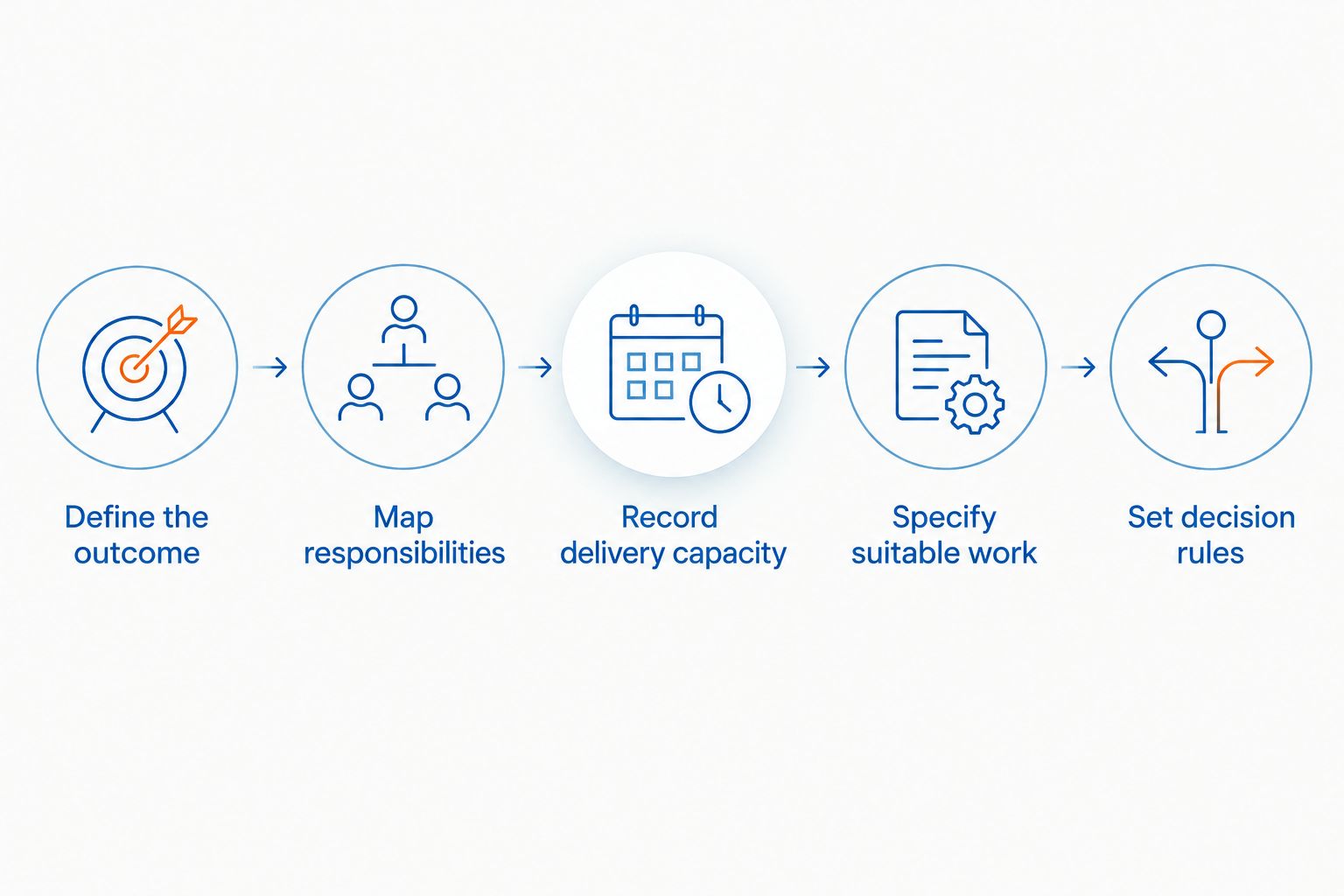
Set delivery boundaries before deciding how to increase demand.
What should your team-capacity brief include?
Your brief should let a consultant understand how work moves through the business without relying on a long verbal explanation. Use a short document with supporting records, not a presentation full of aspirations.
Include these fields:
- Business objective: the operational and commercial change you want.
- Preferred bookings: services, customers and job characteristics you want to attract.
- Current commitments: booked work, recurring obligations and known absences.
- Team responsibilities: accountable people and their decision boundaries.
- Owner involvement: approvals, exceptions and delivery tasks that still reach you.
- Delivery limits: skill gaps, scheduling restrictions and dependencies.
- Marketing boundaries: work to exclude and promises the team cannot support.
- Review triggers: conditions that require a change to the plan.
Attach records that support those statements. Your booking calendar, enquiry log, quoting process and role descriptions are more useful than a claim that the team is busy.
If you do not yet track a field, make collecting it an action. Do not replace an unknown delivery limit with an optimistic estimate just to complete the brief.
Choose support that matches the constraint
A strategy recommendation and help implementing it are different needs. Decide which you need before discussing the engagement, and ask the consultant to define the scope in writing.
The comparison below describes types of support to discuss. It does not assume every provider offers the same service.
| Support approach | Best for | Practical benefit | Limitation to address |
|---|---|---|---|
| Strategy advice | Owners who need priorities and already have execution responsibility covered | Clarifies what to change and why | Your team still needs to carry out the decisions |
| Business coaching | Owners who need help with delegation, accountability and business priorities | Connects marketing choices to wider operating decisions | Discussion alone does not implement a funnel or handover |
| Done-with-you implementation | Owners who want support putting agreed changes into practice | Adds practical support alongside the strategy | Your team still needs time, ownership and participation |
Elevatory offers business coaching with done-with-you marketing implementation. That fits an owner seeking support across offers, funnels, paid advertising and systems, rather than someone looking to hand over every business decision.
The participation requirement matters. Identify who inside your business will approve work, supply information and maintain the changes. Done-with-you support does not remove the need for internal responsibility.
For a 2026 engagement, ask which delivery-system changes sit inside the scope and which remain your responsibility. Clear boundaries prevent a marketing project from becoming an undefined operational overhaul.
Why team capacity varies
Your team does not have one fixed capacity figure that applies to every booking. The usable capacity depends on the work being sold and how it moves through your business.
Check these factors before agreeing to increase demand:
- Service mix: different jobs require different skills, preparation and delivery time.
- Decision authority: team members need clear boundaries for quoting, scheduling and resolving exceptions.
- Existing commitments: booked work and recurring obligations consume capacity before new campaigns begin.
- Delivery readiness: missing information, materials or customer approvals can prevent scheduled work from progressing.
- Owner dependence: a process that requires your approval at every stage remains constrained by your availability.
Ask the consultant to connect each relevant factor to the marketing plan. For example, qualification questions should reflect the work your team can accept, not simply collect contact details.
What does a useful service-business example look like?
Consider this hypothetical home-services business: the team can complete the work, but the owner approves every quote and resolves every scheduling conflict. Adding advertising without changing those responsibilities leaves the owner handling more decisions.
The brief should identify quoting authority and scheduling ownership as conditions for expansion. Marketing can then focus on defined services that the team can quote and deliver within agreed boundaries.
In a hypothetical professional-services business, the constraint is different. A senior specialist reviews every proposal and every completed assignment, so the brief must separate work requiring specialist judgement from work another qualified team member can own.
These are illustrations, not client results. Their purpose is to show why the consultant needs the decision chain as well as the booking calendar.
Match the marketing promise to the delivery system you actually have. Do not use an unrelated business result as evidence that your service team can handle the same kind of expansion.
What should you ask in the briefing meeting?
Ask the consultant to explain how the proposed strategy accounts for your team, not just how it attracts enquiries. The answers should identify responsibilities and practical changes.
Use these questions:
- Which constraint needs attention before we increase demand?
- Which services should marketing prioritise given our current team?
- What information should qualify an enquiry before quoting begins?
- Which decisions should stop coming to the owner?
- Who inside the business needs to participate in implementation?
- What would trigger a change to campaign activity or booking expectations?
Keep the meeting focused on decisions. Channel recommendations can follow once both sides agree on the work you want and the team's ability to deliver it.
For your 2026 plan, record the agreed responsibilities alongside each marketing action. An action without an internal owner is not ready for implementation.
Connect marketing to team capacity
Explore business coaching with done-with-you marketing implementation for your established Australian business.
Should you hire before increasing marketing?
Hire before increasing marketing when the agreed plan requires delivery capacity your current team cannot supply. First establish whether the constraint is missing capability or unclear responsibilities; recruitment does not automatically resolve an approval process that still depends on you.
Can a marketing consultant help you delegate?
A marketing consultant can help define responsibilities around enquiries, quoting and campaign implementation when that work is included in the engagement. Broader delegation and business accountability require an explicitly agreed scope, rather than an assumption that marketing advice covers every operational issue.
What if you do not know your team's capacity?
Start with current bookings, assigned responsibilities and the decisions waiting for owner approval. Build a usable picture from actual work before setting expansion targets; do not ask the consultant to plan around capacity you have not established.
FAQ
What should I send a marketing strategy consultant before our first meeting?
Send your business objective, current booking commitments, team responsibilities and preferred work. Include the decisions that still require owner approval and any delivery limits that affect what you can promise customers.
How do I know whether I need more leads or better systems?
Check whether suitable enquiries already stall at quoting, scheduling or delivery. If work waits for owner decisions, include that operating constraint in the brief before requesting more demand.
Is business coaching better than marketing consulting for delegation?
Business coaching is the more relevant scope to discuss when the main issue is owner dependence and accountability. Marketing consulting addresses the marketing plan; confirm whether delegation and implementation support are included rather than assuming they are.
Can Elevatory help with both business coaching and marketing implementation?
Elevatory offers business coaching and done-with-you marketing implementation across funnels, paid advertising, offers and systems. It serves established Australian businesses turning over $150K–$5M; your brief should identify the internal responsibilities needed to participate.
Should I include pricing information in the consultant brief?
Include the internal information needed to assess which bookings are profitable, along with the relevant delivery costs. A consultant needs to distinguish attractive revenue from work that supports the business after fulfilment.
How should I update a team-capacity brief during 2026?
Update your 2026 brief when staffing, service scope, booking commitments or decision responsibilities change. Revisit marketing activity when those changes affect the work your team can accept and deliver.
One last thing
Write down the decisions that come to you during a normal working day. Sort them into decisions only you should make, decisions someone else can own, and decisions that need a clearer rule.
That list belongs in your 2026 consultant brief. Before asking marketing to create more work, identify which decisions will stop needing you. The next useful move is not always another campaign; it can be a clearer responsibility inside the team.
Related guides
Book a free growth strategy call
Forty-five minutes with a strategist to pressure-test where your business is stuck and what to prioritise next.
Prefer to talk first? Call 1300 634 230 or email chris@elevatory.com.au