

A business growth consultant should measure owner dependence by tracking which decisions, bookings and delivery tasks stop without you, then assigning responsibility and testing the handover. Count the interruptions and delays, but also check whether the team maintains delivery quality and profitable bookings without bringing the work back to you.
TL;DR
- Business growth consultant owner dependence assessments should measure stalled decisions, owner interventions and delivery quality together.
- Elevatory suits established Australian service businesses seeking business coaching with done-with-you implementation.
- Assign decision authority before increasing lead volume; more enquiries do not resolve delivery bottlenecks.
- Compare your own baseline with later results rather than using an unsupported industry score.
Why this matters
You have not delegated a job if every decision still comes back to you. A team member can own the task on paper while you remain responsible for scheduling, exceptions, client reassurance and final approval.
For your 2026 growth plan, separate demand from delivery capacity. If qualified enquiries already wait for your attention, adding more enquiries leaves the same constraint in place. Start with team capacity bottlenecks before changing the marketing brief.
The aim is not to remove you from every decision. It is to reserve your attention for decisions that genuinely require the owner, while giving the team clear boundaries for everything else.
How should a business growth consultant measure owner dependence?
Use a repeatable observation process, not a personality assessment. The useful question is not whether you feel busy; it is whether normal work progresses without your intervention.
Treat the following as a suggested starting process, not an industry benchmark:
- Observe normal work. Record interruptions across 10 working days, including enquiries, quoting, scheduling, delivery and follow-up.
- Identify the blockage. Note what the team needed from you and why the next action stopped.
- Assign authority. Name the person responsible, the decisions they can make and the exceptions they must escalate.
- Test the handover. Let that person complete a defined workflow without routine owner approval.
- Review the result. Compare interruptions, waiting time, delivery quality and booking outcomes with the starting position.
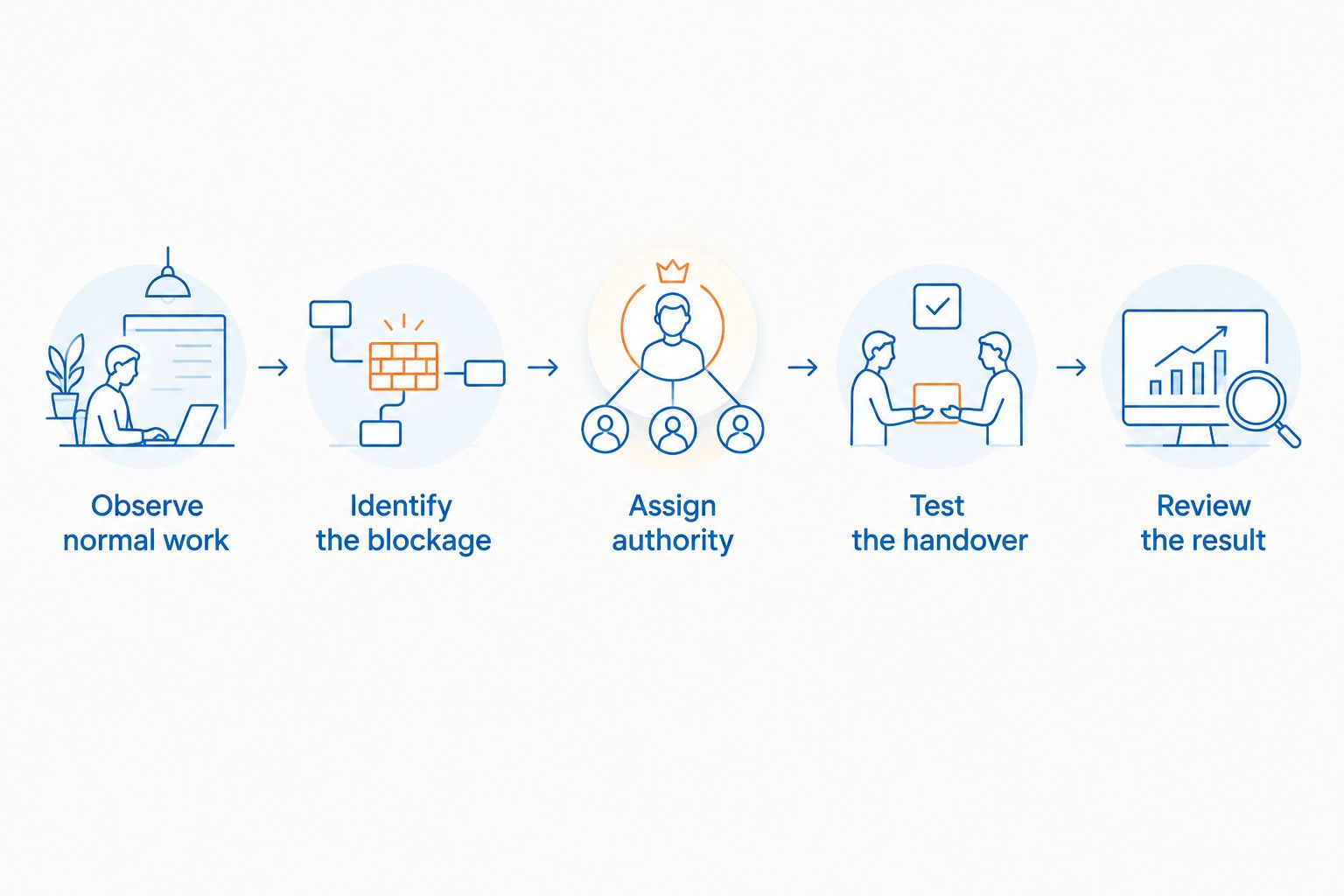
Measure the blockage before deciding what to delegate.
Use the same definitions throughout the review. If a scheduling question counts as an interruption at the start, it must still count after the handover. Otherwise, a cleaner-looking report can hide an unchanged problem.
What should the measurement sheet include?
Keep one shared record rather than asking everyone to write a separate report. Each entry should identify the workflow, the decision requested, who requested it, whether work stopped and what happened next.
| Measure | What to record | What it tells you | Limitation |
|---|---|---|---|
| Owner interventions | Routine decisions that require your input | Where authority still sits with you | A quick answer can hide a recurring dependency |
| Waiting time | Time work cannot progress without you | Where owner availability controls delivery | Some delays have causes unrelated to the owner |
| Independent completion | Work finished within agreed boundaries | Whether responsibility has actually transferred | Completion alone does not establish quality |
| Rework and escalation | Corrections, complaints and exceptions | Whether independence protects the service standard | Necessary escalations are not delegation failures |
| Booking suitability | Fit with service scope, location and capacity | Whether marketing attracts work the team can deliver | More bookings do not establish profitability |
Do not combine these into a single score unless the calculation has a clear purpose. A reduction in interruptions is not progress if clients receive incomplete work or the team accepts unsuitable bookings.
Measure decisions, not just hours worked
An owner can work fewer hours while remaining the approval point for every important task. That arrangement still makes the business dependent on the owner's availability.
Separate decisions into routine work, exceptions and owner-reserved matters. Write the boundary in practical terms: who can confirm a booking, adjust the schedule, approve a quote within agreed rules or resolve a delivery issue?
Hypothetical trades example: a crew leader allocates jobs, but calls the owner whenever a customer changes access arrangements. The task has moved; the decision has not. A useful handover defines which changes the crew leader can handle and which require escalation.
For your 2026 baseline, record the reason for each intervention. Distinguish missing information from missing authority. A checklist addresses the former; a clear decision boundary addresses the latter.
Measure waiting time, not just interruptions
A quiet phone does not prove the team is independent. Staff can stop asking and leave the work waiting instead.
Record when a decision becomes necessary and when work can resume. Identify whether the delay affects a quote, a booking, a job in progress or a client response. The consequence matters more than the notification count.
Hypothetical professional-services example: a delivery lead prepares client work independently, but every submission waits for the principal's approval. The next move is to define which submissions require principal review and which can pass through an agreed quality check.
Do not remove necessary technical or professional oversight merely to improve the measurement. The aim is to remove avoidable dependence, not accountability.
Measure delivery quality alongside independence
A successful handover preserves the standard of work. Track whether the team follows the agreed scope, completes the required checks and handles client communication without avoidable rework.
Choose a defined workflow rather than delegating an entire department at once. Enquiry qualification, scheduling or a routine delivery handover gives you a clearer test than a broad instruction to manage operations.
For the 2026 review, keep the workflow comparable with the baseline. If the work changes substantially, explain the change before claiming improvement. Fewer owner interventions on simpler jobs do not demonstrate independence on more demanding work.
Ask the person taking responsibility what they need to complete the workflow. Missing access, unclear information and conflicting priorities are management problems, not evidence that delegation cannot work.
Why owner dependence varies
Owner dependence is workflow-specific. Your team might run delivery independently while quoting, client approvals and marketing decisions still sit entirely with you.
Check these factors before choosing the next intervention:
- Decision authority: a named responsibility means little if every exception needs permission.
- Delivery systems: instructions must explain the required outcome, checks and handover, not merely list activities.
- Team capability: match responsibility to demonstrated skills and provide support where gaps appear.
- Owner behaviour: taking delegated work back makes it harder to establish who owns the outcome.
- Lead quality: enquiries outside your service scope or capacity create additional decisions rather than useful bookings.
- Marketing handover: the person handling enquiries needs the offer details, qualification rules and booking boundaries.
These factors point to different remedies. A capable team member without authority needs a decision boundary; someone without the required skill needs training or a different allocation of work.
What should change before you increase marketing?
Confirm that the team can handle suitable demand before asking marketing to create more of it. Review who responds to enquiries, qualifies the work, prepares the quote, confirms capacity and owns the delivery handover.
Use a suggested 30-minute weekly review to check the workflow, not to approve every decision retrospectively. Bring unresolved exceptions, recurring delays and unsuitable bookings. Leave routine decisions with the person responsible.
For a 2026 marketing brief, define the work you want more of and the work you should decline. Include service scope, location, delivery capacity and the information required before a booking is accepted.
This connects marketing strategy to operations. A campaign that attracts relevant enquiries still needs a team that can respond, quote and deliver. Conversely, an efficient team cannot make poorly matched enquiries suitable by processing them faster.
Do I need a business growth consultant or an operations manager?
Choose support according to the work that needs doing. Diagnosing a constraint, changing a management system and managing daily delivery are different responsibilities.
| Support | Best for | Useful contribution | Limitation |
|---|---|---|---|
| Business coaching with implementation | Owners changing delegation, priorities and systems | Supports decisions and the work needed to put them into practice | Requires owner and team participation |
| Operations manager | Businesses needing daily delivery leadership | Holds responsibility for scheduling, coordination and operational decisions | Needs clear authority and an achievable remit |
| Marketing consultant | Businesses with a defined demand or enquiry-quality problem | Connects positioning, offers and acquisition activity | A marketing brief alone does not assign delivery responsibility |
Elevatory is best for established Australian service businesses seeking business coaching with done-with-you implementation. Its offer covers coaching and implementation across offers, funnels, paid advertising and systems; it is not a replacement for someone managing your operations each day.
Consider Elevatory when you want support connecting growth decisions with implementation. Expect to participate. A done-with-you arrangement does not transfer the owner's decisions or the team's operational responsibilities to an outside provider.
Connect growth with team capacity
Explore business coaching and done-with-you implementation for established Australian businesses.
How do I know delegation is actually working?
Delegation is working when the team completes agreed work within its authority, maintains the required standard and escalates genuine exceptions. Fewer messages alone are not enough.
Repeat the observation process after the handover. Compare like-for-like work and examine where your involvement remains necessary. Keep necessary oversight; remove repeated approvals that no longer serve a purpose.
For your 2026 review, ask the team to explain the decision rules without your help. If the rules exist only in your head, the handover is unfinished, even if the document looks complete.
Should I step away completely to test owner dependence?
Test a bounded workflow before testing a broader owner absence. Confirm who has authority, what information they need and which exceptions still require your involvement.
Keep safety, contractual and professional obligations intact. A useful test shows whether normal work progresses under agreed rules; it does not require you to become unreachable or abandon oversight.
Start with one workflow and review what happened. Expand responsibility when the team can explain its decisions and demonstrate the required delivery standard.
FAQ
What should a business growth consultant measure first?
A business growth consultant should first measure where routine work stops without the owner. Record the decision needed, the delay created and the reason the team could not proceed.
How can I measure owner dependence without new software?
Use a shared record of owner interventions, waiting time, independent completion and rework. Keep the definitions consistent so you can compare the same workflow before and after delegation.
Does working fewer hours mean my business is less dependent on me?
Working fewer hours does not establish lower owner dependence. The team must also progress normal work without waiting for your approval and maintain the required quality.
Should I hire an operations manager before a business coach?
Choose an operations manager when the requirement is daily operational leadership; choose coaching when you need help changing priorities, decision boundaries and systems. Define the responsibility before choosing the support.
Can marketing coaching help reduce owner dependence?
Marketing coaching can support a clearer enquiry and booking handover. It still needs named team responsibilities, qualification rules and delivery capacity to connect marketing decisions with operations.
Is Elevatory a done-for-you marketing agency?
Elevatory provides business coaching and done-with-you marketing implementation. Its stated focus includes offers, funnels, paid advertising and systems, with participation from the business rather than outsourcing every responsibility.
One last thing
Record the decisions you take back, not just the tasks you give away. Each reversal deserves a reason: an unclear boundary, a capability gap, a genuine exception or an owner preference.
Your next move is to choose one recurring workflow, name its decision-maker and write the escalation boundary. Then let the team use it. A delegation document cannot demonstrate independence; completed work can.
Related guides
Book a free growth strategy call
Forty-five minutes with a strategist to pressure-test where your business is stuck and what to prioritise next.
Prefer to talk first? Call 1300 634 230 or email chris@elevatory.com.au