

A business mentor helps you move employee onboarding out of your head and into a team-owned process: named trainers, clear task standards, supervised practice and explicit sign-off. You still set expectations and handle genuine exceptions, but your team takes responsibility for teaching routine work and checking that new staff can do it.
TL;DR
- Business mentor employee onboarding support should build team-owned training, not another approval queue for the owner.
- Elevatory suits established Australian service-business owners seeking business coaching with done-with-you implementation.
- Give each new employee a training lead, task standards and clear escalation rules.
- Connect hiring and marketing plans to the team's capacity to train and deliver.
How can a business mentor help onboard staff without the owner doing it all?
Give the team responsibility for training, while keeping the owner accountable for the standard. A business mentor helps you define that split, turn routine work into teachable steps and review where decisions still return to you.
Start by identifying why previous handovers failed. If you keep correcting work yourself, use the principles in stop taking delegated work back before adding another onboarding checklist.
The practical sequence is:
- Define what competent work looks like.
- Assign a training lead with time to teach.
- Demonstrate the task and supervise practice.
- Sign off against observable evidence.
- Review exceptions and improve the instructions.
Why this matters
Your 2026 hiring plan needs a training plan beside it. A new employee needs access, instruction, practice and feedback; leaving those duties unassigned sends them straight back to the owner.
For a local service business, onboarding also affects what you can promise customers. A full booking calendar does not mean your team has room to supervise someone new. Before increasing marketing activity, decide who can train, who can deliver and which work the new starter is ready to handle.
Define the work before you hand over the training
Write the role around outcomes, not a list of things you hope someone will help with. Separate the work into tasks the employee can learn, decisions they can make and situations they must escalate.
For each task, record:
- The trigger: what starts the task, such as an accepted quote or a customer enquiry.
- The inputs: information, access and materials needed before work starts.
- The standard: what an acceptable finished task contains.
- The boundary: what the employee cannot approve or change.
- The evidence: what the trainer checks before signing off.
Keep the first task guide to 1 page as a starting constraint, with supporting material elsewhere when needed. This is a drafting recommendation, not a limit on safety instructions or technical requirements.
A new employee should not need to guess what you mean by done properly. If the trainer cannot explain the acceptance standard, the task is not ready to delegate.
Separate induction from task competence
Completing an induction checklist does not demonstrate competence in every part of a role. Treat workplace orientation, required training and permission to perform specific tasks as separate checks.
Have the appropriate person confirm applicable safety, licensing, supervision and employment requirements. A business mentor supports the management process; mentoring does not replace qualified technical instruction or professional advice.
Choose who owns employee onboarding
Give each new starter a named training lead. That person coordinates the plan, checks progress and answers routine questions, even when other team members teach individual tasks.
The following division makes the trade-offs clear:
| Approach | Best for | Advantage | Limitation |
|---|---|---|---|
| Owner-led training | Owner-specific judgement and business expectations | Gives direct access to the person setting the standard | Keeps routine teaching dependent on owner availability |
| Team-lead training | Repeatable daily work with an agreed standard | Places instruction close to delivery | Requires protected training time and the ability to teach |
| Mentor-supported onboarding design | Owners building responsibilities, delegation and accountability | Helps structure the process and challenge unclear ownership | Does not replace an internal trainer or technical supervisor |
Use the owner for judgement that genuinely belongs to the owner, not every demonstration and reminder. Give the training lead authority to schedule practice, check work and request corrections within agreed boundaries.
Choose the trainer for their ability to explain and assess work, not simply their tenure. A strong practitioner still needs a clear brief about what to teach and how to judge readiness.
Build a repeatable training sequence
Use the same basic sequence for routine tasks, then adjust the supervision to the work involved. Do not use a calendar date alone as permission to work independently.
1. Task standard
Show the new employee the expected output before demonstrating the steps. Explain the customer promise, relevant boundaries and what an unacceptable result looks like.
For a booking role, the standard might include complete customer details, a confirmed service requirement and a recorded handover. The exact requirements belong to your business, not a generic template.
2. Named trainer
Put the trainer's name beside each task. Where different people teach different activities, the training lead remains responsible for making sure nothing falls between them.
Remove competing expectations. A trainer cannot give a new starter full attention while also being expected to maintain an unchanged delivery workload.
3. Supervised practice
Let the employee perform the task while the trainer observes. Ask the employee to explain decisions, not merely repeat the steps from memory.
As a planning exercise, reserve a 30-minute observation session for a suitable routine task, then adjust the time to its complexity. This is a suggested scheduling block, not a claim about how quickly someone should become competent.
4. Task sign-off
Record which task was checked, who checked it and what supervision remains necessary. Be specific about the scope: handling a routine booking does not automatically authorise someone to resolve a disputed quote.
An unfinished task stays in supervised practice. Avoid signing someone off because the team is busy or the owner needs to leave.
5. Exception review
Review questions that reached the owner. Decide whether each question needs a clearer instruction, a different decision boundary or continued escalation.
Use this sequence in your 2026 onboarding template so responsibility stays visible as the team changes. The template should show who teaches, who assesses and who handles exceptions.
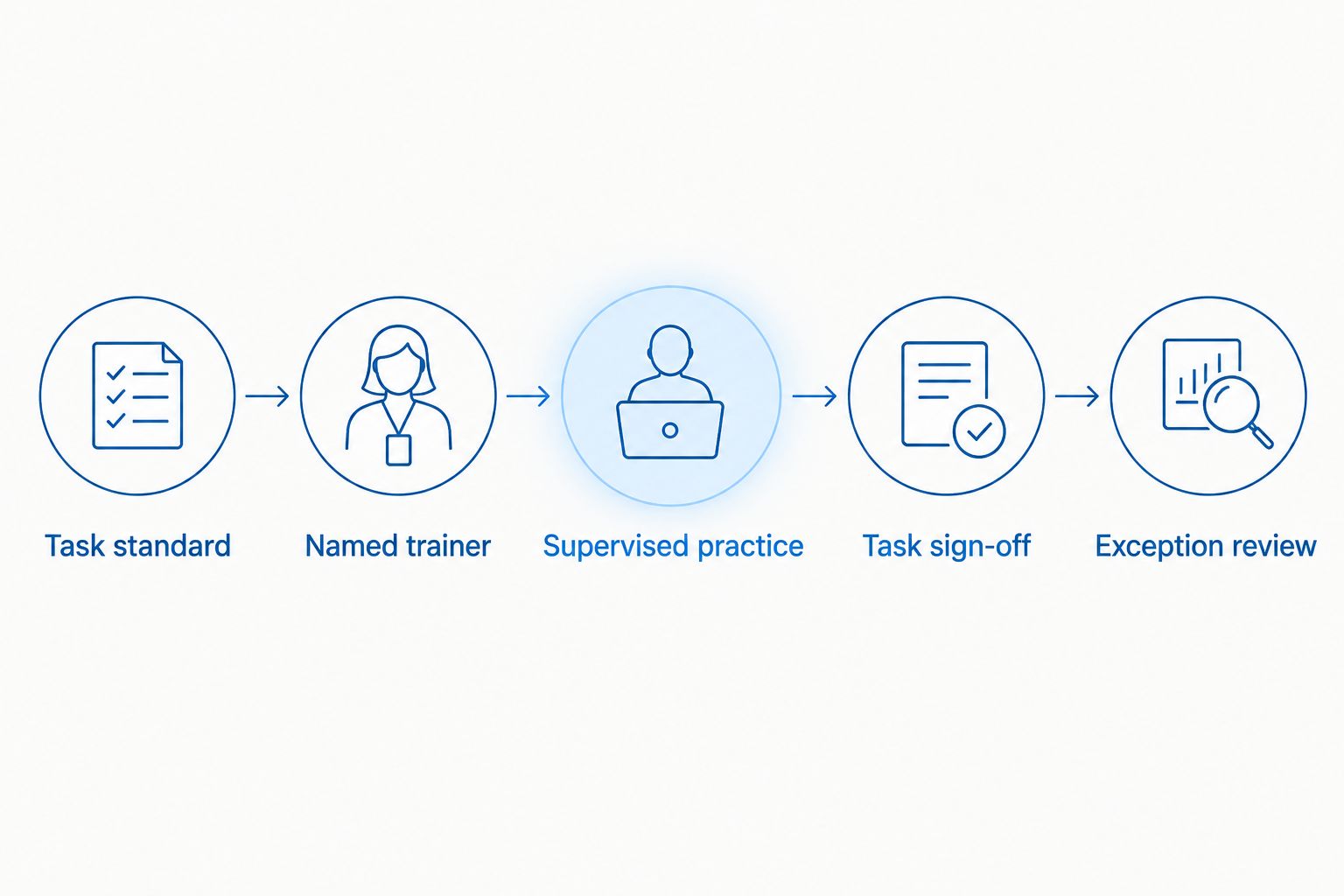
Sign off demonstrated work, then use exceptions to improve the training instructions.
Why employee onboarding keeps returning to the owner
Check these causes before concluding that your new employee needs more initiative. Each has a different fix.
- Unclear standards: the trainer explains their preferred method, while the owner expects something else. Agree on the required outcome before training starts.
- Unassigned questions: nobody knows who should answer routine queries. Name the first point of contact and their backup.
- Conflicting instructions: team members teach different versions of the task. Nominate the person authorised to update the guide.
- Missing authority: the employee has responsibility but cannot make routine decisions. Define what they can approve without permission.
- No training capacity: the trainer has no room in their workload. Reassign delivery work or change the training schedule.
- Owner intervention: the owner fixes every error personally. Return routine corrections to the training lead unless immediate intervention is necessary.
In your 2026 capacity review, count training as work rather than spare-time help. The key question is not whether someone has been assigned as trainer; it is whether their schedule allows them to do it.
What would this look like in a service business?
Consider a hypothetical plumbing business hiring an office administrator. The owner currently explains every enquiry, checks booking details and decides which jobs go to which crew.
Start with routine enquiries. The office lead teaches the administrator to collect the required information, identify requests outside the agreed scope and pass a complete booking record to the person allocating work.
The administrator practises using sample enquiries before handling suitable live work under supervision. Questions about technical suitability go to the designated technical decision-maker, not automatically to whoever owns the business.
Sign-off covers that defined booking task. It does not authorise technical advice, changes to quoted work or promises the delivery team has not approved.
The same structure applies to a professional services firm onboarding a client coordinator. Teach the agreed intake and handover process, while leaving professional judgement with the appropriately qualified person. These are illustrative workflows, not client results.
Connect onboarding to marketing and profitable bookings
Before increasing enquiries, check whether your team can qualify, book and deliver the work you want. A new starter still learning the handover process is not yet a substitute for an experienced team member.
Bring these questions to a marketing planning meeting:
- Which services can the current team deliver within the promised scope?
- Who checks lead quality before a booking is accepted?
- Who has authority to discuss pricing or approve changes?
- What information must reach the delivery team?
- Which bookings require supervision or specialist involvement?
Review the answers when responsibilities change. Your 2026 marketing plan should reflect actual delivery capacity, including time reserved for training, rather than treating every available calendar slot as saleable.
Keep the new employee's learning tasks separate from commercial targets. Assess whether they can complete a sound handover before expecting them to handle more enquiries independently.
When should you bring in a business mentor?
Bring in a mentor when you need help deciding what to delegate, defining responsibilities and following through on implementation. If the main gap is daily scheduling and supervision, assign an operational owner rather than expecting mentoring sessions to run the workplace.
Elevatory suits established Australian service-business owners seeking business coaching with done-with-you implementation. Its offer combines business coaching with work on marketing, offers, funnels and systems; that is relevant when team capacity and marketing decisions need to be considered together.
Elevatory is not a substitute for your internal training lead. Bring a specific management problem to the engagement: unclear responsibilities, repeated owner approvals or a handover process nobody owns.
Before choosing support, ask who will draft the process, who will implement it and how progress will be reviewed. Advice without an internal owner still leaves you responsible for chasing every action.
Discuss your team handover priorities
Explore business coaching with done-with-you implementation for your business.
How do I know when someone can work independently?
Use observed performance against the agreed task standard, not time served. Ask the employee to complete the work, explain their decisions and identify when they would seek help.
Make independence task-specific. Someone can be ready for routine bookings while still needing supervision for exceptions or unfamiliar work.
What should the owner still do during onboarding?
Set expectations, confirm decision boundaries and make sure the training lead has authority and capacity. Stay available for defined exceptions without becoming the default help desk.
Reserve a 15-minute review meeting as a starting point to discuss blocked tasks and decisions needing owner input. Adjust the meeting to the work; do not use a short meeting as a reason to rush unresolved safety or competence issues.
How do I stop taking delegated work back?
When routine work needs correction, ask the training lead to identify the gap and supervise the fix. Step in directly when necessary, then return responsibility with a clear explanation.
If the same issue repeats, revise the instruction or decision boundary. Quietly fixing it yourself hides the problem from the person responsible for training.
FAQ
Can a business mentor train my new employees for me?
A business mentor can help design responsibilities, training steps and accountability, but your business still needs someone responsible for instruction and supervision. Confirm the engagement scope rather than assuming it includes employee training.
What's the best way to onboard staff without doing everything myself?
Assign a training lead, define acceptable work and require supervised practice before task sign-off. Keep owner involvement focused on expectations and genuine exceptions.
Is a business mentor better than an operations manager for onboarding?
A mentor supports the owner with decisions and implementation accountability; an operations manager owns agreed day-to-day responsibilities. Choose according to whether you need help designing the process or someone responsible for running it.
How long should employee onboarding take?
Set onboarding around role requirements and demonstrated competence, not a universal deadline. Separate workplace induction from permission to perform specific tasks independently.
What should go in my employee onboarding checklist?
Include access, responsibilities, required instruction, task standards, named trainers, supervised practice and sign-off. Record escalation rules so new staff know where questions belong.
Can Elevatory help with business mentor employee onboarding priorities?
Elevatory offers business coaching with done-with-you implementation for established Australian businesses. Discuss your delegation and systems priorities and confirm the onboarding work included in the engagement.
Should I increase marketing while a new employee is onboarding?
Base marketing decisions on the team's capacity to qualify, book and deliver work while training continues. Account for the trainer's workload before increasing demand.
One last thing
Make the training lead's work visible, not just the new starter's progress. A checklist can look complete while the owner still supplies every answer that matters.
For your next 2026 onboarding review, examine the questions that reached you. Keep genuine owner decisions; assign routine questions to the right person and update the instructions. That gives you a specific handover problem to solve instead of another vague goal to delegate more.
Related guides
Book a free growth strategy call
Forty-five minutes with a strategist to pressure-test where your business is stuck and what to prioritise next.
Prefer to talk first? Call 1300 634 230 or email chris@elevatory.com.au