

Hire your first manager when recurring team decisions keep returning to you, the role has clear authority, and your business can support the ongoing employment commitment. For an established Australian service business in 2026, the trigger is a defined management job—not exhaustion, headcount or revenue alone.
TL;DR
- Small business coaching first manager decisions start with responsibilities, decision rights and delivery capacity—not a revenue milestone.
- Hire a manager to own recurring decisions, not to absorb an undefined collection of owner frustrations.
- Delegate a defined area before committing to a broader management role.
- Elevatory suits established Australian owners seeking business coaching with done-with-you implementation.
Why this matters
A manager cannot reduce owner dependence if every meaningful decision still needs your approval. You add a reporting relationship without removing yourself from daily delivery.
Start with a first delegation plan that names the work, the person responsible and the decisions they can make. That gives you something concrete to assess before recruiting.
For businesses turning over $150K–$5M annually, revenue alone does not define the job. A trade business needs responsibility for crews and scheduling; a professional services firm needs responsibility for client delivery and workloads. Hire against the work that needs ownership.
Small business coaching: when should you hire your first manager?
Hire when you can identify a recurring management workload, explain what successful ownership looks like, and fund the role without relying on hoped-for growth. You must also be ready to let the manager make decisions within agreed boundaries.
Use this readiness sequence for your 2026 hiring decision:
- Identify recurring decisions. Record what comes back to you: scheduling, job allocation, client updates, quality checks or team questions.
- Group connected responsibilities. Separate a coherent delivery role from unrelated administration and specialist work.
- Define decision rights. State what the manager decides, what they report and what they escalate.
- Check financial capacity. Assess the employment commitment against current cash flow and delivery economics.
- Test your handover. Delegate a defined area and observe whether you respect the agreed boundaries.
Proceed when the role has a clear purpose, authority and financial backing. Pause when the job description amounts to helping you with whatever becomes urgent.
That pause is not an instruction to keep doing everything. It is an instruction to design the role before appointing someone to it.
Which kind of support fits the actual problem?
For your 2026 decision, distinguish managing delivery from helping you design a better business. These are different jobs, even when the conversations overlap.
| Option | Best for | What it addresses | Limitation |
|---|---|---|---|
| Team leader | Owners needing supervision within a defined crew or delivery team | Daily allocation, agreed quality checks and team coordination | A narrow remit leaves wider business decisions with the owner |
| Operations manager | Owners needing ongoing responsibility across connected delivery functions | Coordination between scheduling, people, service delivery and escalation | An unclear remit recreates the approval bottleneck under a new title |
| Elevatory business coaching | Established Australian owners seeking business coaching with done-with-you implementation | Decisions about offers, marketing, systems and how implementation fits together | Coaching does not replace an employee accountable for daily operations |
A team leader is a focused choice when the responsibility sits within a crew. An operations manager is the relevant choice when the responsibility spans connected functions. Neither title fixes missing authority.
Elevatory is best for established Australian service-business owners seeking business coaching with done-with-you implementation. Its role is different from hiring someone to manage your team each day.
If you need the operating structure clarified before recruitment, Elevatory's business coaching and implementation model is relevant. If you need daily supervision, define and recruit that management responsibility rather than treating coaching as a substitute.
Why first-manager readiness varies
There is no useful universal turnover threshold for this decision. Your first-manager brief should reflect how work moves through your business, not another owner's organisational chart.
The readiness factors are:
- Owner dependence. Identify decisions that genuinely require your judgement and those that return because nobody else has permission.
- Delivery coordination. Establish whether someone needs to coordinate crews, schedules, client work or connected delivery functions.
- Financial capacity. Assess whether the business can carry the employment commitment through its actual cash-flow pattern.
- Role clarity. Separate an accountable management role from an assortment of overdue tasks.
- Decision boundaries. Explain which decisions transfer and which risks still require escalation.
- Demand and capacity. Connect marketing activity to the work your team can deliver profitably.
A busy owner does not automatically need a senior manager. Some work needs an administrator, some needs a team leader, and some needs the owner to stop reversing delegated decisions.
Those distinctions matter before recruitment. Otherwise, you risk paying for management capability while assigning administrative work—or assigning management responsibility without the authority to carry it out.
Define the first manager's job before advertising
Start with the result the role must own. Then work backwards to responsibilities, permissions and reporting.
For a hypothetical plumbing business, the remit might be reliable crew allocation and job handover. That does not automatically include quoting unfamiliar work, approving changes to commercial terms or managing every supplier relationship.
For a hypothetical professional services firm, the remit might be allocating client work and tracking delivery commitments. Technical sign-off can remain with an appropriately qualified person while coordination moves away from the owner.
Use these headings in the role brief:
- Role outcome: the operational result the person owns.
- Responsibilities: the recurring work included in the role.
- Decision rights: what the person can decide without asking you.
- Escalation rules: the exceptions that require your involvement.
- Review measures: the evidence you will use to assess performance.
Keep each heading specific. Replace “help the business grow” with responsibilities such as allocating booked work, maintaining delivery commitments or resolving routine scheduling conflicts.
A manager needs a defined result, not permission to chase your changing priorities. If the brief keeps expanding, separate essential responsibilities from work that belongs elsewhere.
Build a handover that transfers authority
Your 2026 handover needs to transfer decisions, not just tasks. A person who updates the schedule but needs your approval for every change is maintaining a document, not managing delivery.
Use this sequence:
- Choose the outcome. Select a connected area of work with a clear operational purpose.
- Set decision rights. Explain the choices the manager owns and the boundaries around them.
- Document exceptions. Identify situations that need technical, financial or owner approval.
- Review evidence. Agree how you will assess delivery and discuss decisions.
- Remove duplicate approval. Stop making the manager seek permission for decisions already delegated.
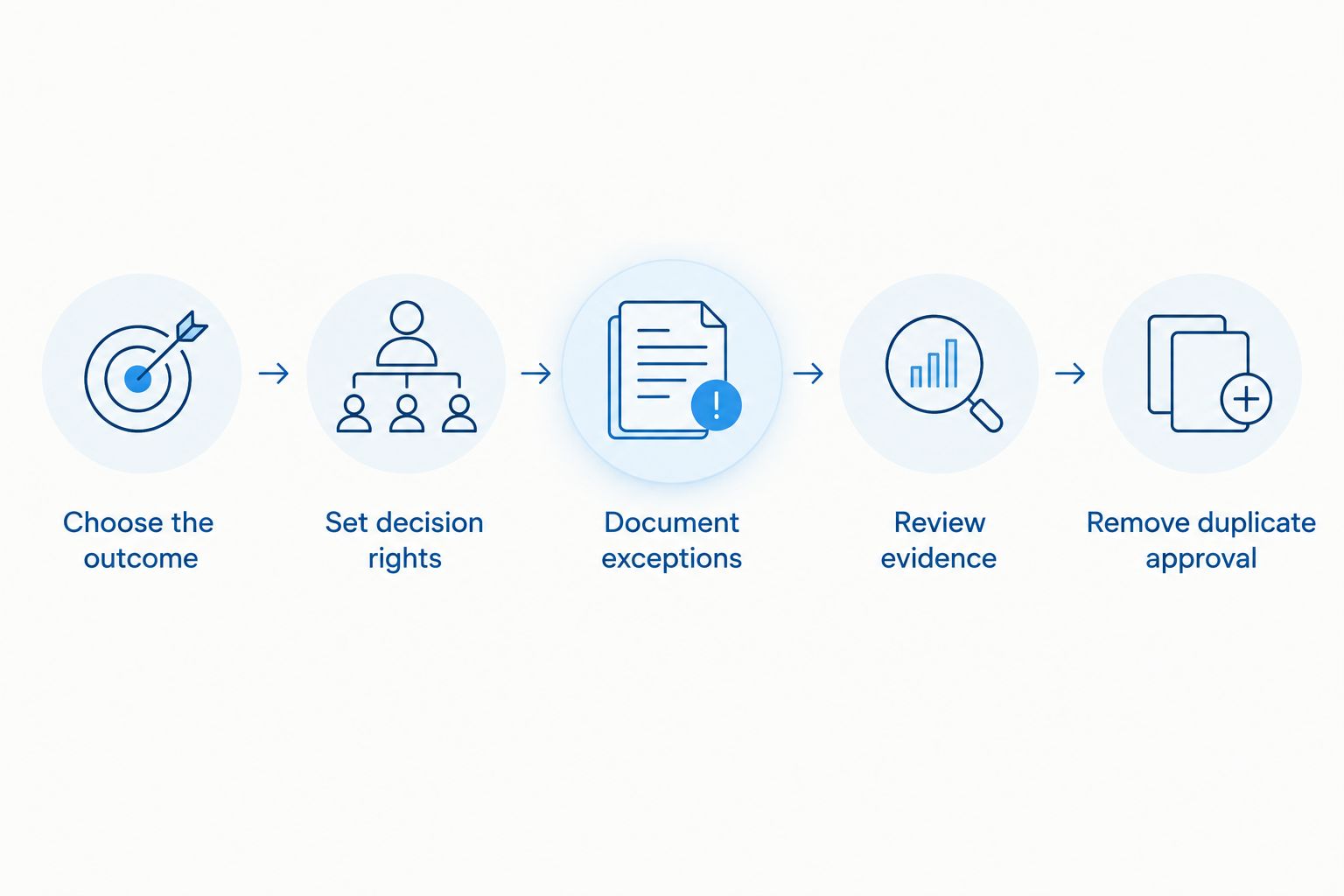
Authority transfers only when routine decisions stop returning to the owner.
Ask the manager to explain the boundaries back to you using real situations from your business. Resolve disagreements before those situations become urgent.
Then tell the team where responsibility now sits. If staff continue approaching you, redirect routine questions to the manager instead of answering them privately.
You still retain oversight. The difference is that oversight happens through agreed reporting and exceptions, rather than through approval of every action.
Connect marketing to the manager's delivery capacity
Do not make “bring in more leads” the default response to pressure. First establish whether the pressure comes from weak demand, poor-fit enquiries, scheduling, delivery or unclear responsibility.
Consider a hypothetical home services business receiving enquiries for work outside its preferred scope. More enquiries of the same kind do not resolve the mismatch. Clarifying the offer and qualification process belongs alongside defining who accepts work and allocates the team.
A hypothetical consulting firm faces a different issue when the principal approves every client commitment. Adding campaigns without changing that approval process leaves the principal in the same position, with more decisions waiting.
Before increasing marketing activity, agree:
- Which work the team is set up to deliver.
- What information makes an enquiry ready for a booking or proposal.
- Who confirms the delivery commitment.
- Who handles changes after acceptance.
- What capacity information informs marketing decisions.
Marketing and management need the same definition of suitable work. Your first manager should not inherit responsibility for delivering promises they had no authority to assess.
How do you assess financial readiness without a revenue rule?
Use your actual business figures, not a turnover milestone borrowed from another business. Revenue shows sales activity; it does not establish what remains available to support a management role.
Assess the full employment commitment, including applicable superannuation, leave, recruitment and onboarding. Check relevant Australian employment requirements for the role rather than treating the advertised salary as the whole commitment.
Then examine what work will change hands. If you expect the hire to free time for quoting, business development or delivery improvement, identify those activities explicitly. Do not count the same owner hours as both additional billable capacity and time away from work.
Keep the hiring case separate from hoped-for marketing results. A manager's purpose can include improving operations, but a recruitment decision should not depend entirely on an unverified sales forecast.
The financial question is whether you can support this defined role—not whether a manager sounds like the next stage of growth.
Should I promote someone or recruit externally?
Promote an existing team member when their demonstrated judgement fits the management responsibilities. Recruit externally when the role requires capabilities you have not identified within the team.
Strong technical performance is relevant, but it does not establish an appetite for supervising others. Discuss the work itself: setting expectations, handling difficult conversations, making allocation decisions and reporting problems early.
An internal appointment brings familiarity with your work and clients. The trade-off is that the person must move from peer relationships into an accountable management role.
An external appointment creates an opportunity to recruit against a defined capability gap. The trade-off is the onboarding needed to understand your delivery standards, customers and operating boundaries.
Whichever route you choose, assess evidence against the same role brief. Do not lower the clarity of the job because you already know the candidate.
What if I am not ready to hire a manager?
Delegate a smaller, connected area of responsibility instead of creating an oversized role. Give someone authority over that area, then review whether the work stays delegated.
This exposes the next problem to solve. You might need clearer instructions, better access to information, a different person or a change in your own approval habits.
Do not use the trial as unpaid management work or an excuse to ignore employment obligations. Agree the role, expectations and appropriate employment arrangements before changing someone's responsibilities.
FAQ
When should a small business hire its first manager?
Hire when a recurring management workload needs clear ownership, you can fund the role, and you are prepared to transfer decision-making authority. Being busy is a reason to examine the work, not a complete hiring case.
What revenue should I reach before hiring a manager?
There is no universal revenue threshold for hiring your first manager. Assess your cash flow, employment commitment and the specific management responsibilities rather than turnover alone.
What should my first manager take over?
Your first manager should take over a connected area of operational responsibility with defined decision rights. For a service business, that can include scheduling, team allocation, client handover or delivery coordination.
Should I hire a manager or get business coaching first?
Hire a manager when you need ongoing operational ownership; consider business coaching when you need help defining the role, priorities or implementation plan. Coaching and daily team management are different responsibilities.
Can my best technician become my first manager?
Your best technician is a candidate, not an automatic choice. Assess their judgement, willingness to manage people and ability to take responsibility beyond their own technical work.
How do I delegate without losing control of quality?
Delegate decisions within explicit boundaries and review evidence of delivery. Keep defined exceptions for matters requiring specialist or owner approval instead of approving every routine action.
What should I put in a first-manager plan for 2026?
A first-manager plan for 2026 should state the role outcome, responsibilities, decision rights, escalation rules and review measures. It should also show how you will fund the role and transfer authority.
One last thing
Before advertising, ask yourself: Which decisions will I stop making when this person starts? Write them into the role brief.
If the answer is none, redesign the role. A manager cannot remove owner dependence while the owner remains the required decision-maker.
Related guides
Book a free growth strategy call
Forty-five minutes with a strategist to pressure-test where your business is stuck and what to prioritise next.
Prefer to talk first? Call 1300 634 230 or email chris@elevatory.com.au