

Build your first delegation plan by assigning a recurring task to a named person, defining the finished result, setting decision limits and checking the work before handing over full responsibility. Small business coaching should help you put that plan into practice—not leave you with another list of jobs to manage yourself.
TL;DR
- Small business coaching should turn owner-dependent tasks into clear responsibilities, decision limits and repeatable delivery systems.
- Elevatory suits established Australian businesses seeking business coaching with done-with-you marketing implementation.
- Delegate a complete responsibility, not isolated errands that still require your approval.
- Match marketing activity to team capacity before asking for more leads.
How do you build your first delegation plan with small business coaching?
Start with a repeatable responsibility that your team can complete without asking you to make every decision. Define the outcome, assign an owner, document the process and agree on when the task comes back to you. Then review real work against the agreed standard.
For your 2026 delegation plan, choose a responsibility that exposes the problem clearly. Enquiry handling, quote follow-up and appointment preparation are useful candidates to examine. Do not hand over a task just because you dislike it; first establish whether someone else has the information, authority and capacity to complete it.
Elevatory provides small business coaching with done-with-you marketing implementation for established Australian businesses turning over $150K–$5M. That combination fits a practical question: can your team deliver the work your marketing brings in without routing every decision through you?
Why this matters
Delegation is not simply moving work off your desk. It changes who owns the result and which decisions require your involvement. If a team member completes the steps but still needs your permission at every junction, you have transferred activity without transferring responsibility.
That distinction matters when you connect delegation to marketing. A campaign can bring enquiries into a process that still depends on the owner for quoting, scheduling and follow-up. Before increasing demand, identify where the delivery process stops until you respond.
Your first delegation plan should remove a recurring decision bottleneck, not create another person for you to chase.
Choose the right level of delegation
Not every responsibility belongs at the same level. Match the handover to the task, the person's competence and the consequences of an error. Keep specialist, regulated or safety-critical decisions with appropriately qualified people.
| Delegation approach | Best for | What the team member owns | Benefit | Limitation |
|---|---|---|---|---|
| Task handover | A defined activity with a clear finish | Completing the specified task | Makes the immediate instruction clear | Leaves related decisions with you |
| Recommendation first | Work that needs judgement while someone learns | Preparing a proposed action for approval | Lets you check reasoning before action | Keeps an approval dependency |
| Responsibility handover | Repeatable work with agreed standards and limits | Completing the outcome within those limits | Gives the team room to act | Requires clear boundaries and review |
Use task handover when the work genuinely is a discrete task. Use recommendation first when judgement needs development. Aim for responsibility handover where the person can manage the full process safely and consistently.
Do not confuse independence with unlimited authority. A team member can own appointment preparation without deciding which services the business offers. A person handling enquiries can own follow-up without changing pricing or making promises outside the agreed scope.
Build the plan around a complete outcome
Use the following sequence to write your 2026 delegation plan. Keep the first version short enough to use during work. A document nobody opens is not a delivery system.
Define the outcome
Choose a responsibility with an observable finish. Replace vague instructions such as helping with bookings with a clear result: every accepted booking has the required customer information, an agreed scope and a confirmed place in the schedule.
Start with 1 recurring responsibility, rather than attempting to hand over every owner-dependent task together. This is a starting recommendation, not a claim about the ideal size of your team. A narrow handover makes it easier to identify missing instructions and unresolved decisions.
Write down:
- What starts the work.
- What a completed result looks like.
- What information must be recorded.
- Who receives the result next.
- What makes the work incomplete or unacceptable.
For a professional services business, appointment preparation might finish when the practitioner has the agreed brief and supporting documents. For a trade business, job preparation might finish when the team has the approved scope and access details. These are hypothetical examples, not client results.
Name the owner
Assign the responsibility to a person, not to the team in general. State who handles the work and who covers it when that person is absent. Also identify who receives escalations; otherwise a named task owner can still be left guessing.
Check capacity before making the assignment. Ask what the person already owns, which deadlines compete and what work needs to move. Delegation that simply adds responsibilities without addressing workload does not resolve the delivery problem.
Authority matters too. Give the person access to the information and permissions the responsibility requires. Do not make someone accountable for maintaining the schedule while withholding the ability to update it within agreed boundaries.
Set decision limits
Separate routine decisions from exceptions. Write what the task owner can decide, what needs approval and what must stop immediately. Use conditions the person can recognise while doing the work.
For example, routine follow-up can sit with the task owner while requests to change an agreed scope return to the person authorised to approve them. Keep pricing changes, contractual commitments and specialist decisions within the correct authority.
Avoid an escalation rule that says ask whenever unsure. It sends every uncertainty back to you. Instead, explain which missing information the person should collect, which approved source to consult and which unresolved issue needs escalation.
An escalation should arrive with the issue, the relevant facts and the proposed next action. That gives you a decision to make rather than a problem to investigate from scratch.
Document the process
Record the steps in the order the work happens. Include the actual tools, documents and approved templates your business uses. Do not add a new system merely to make the handover look organised.
A useful process explains both the normal path and the exception path. Where does an incomplete enquiry go? Who handles a request outside your service scope? What happens when the delivery team cannot meet the requested booking?
Demonstrate the task, then ask the person taking it over to perform it using the instructions. Watch for gaps in the document rather than assuming every question reflects a lack of ability. Instructions that depend on your memory are not ready for independent use.
Review the work
Agree on how you will inspect completed work and how feedback will be recorded. Review the output against the standard, not against your personal preference for doing each step. Correct the process where the same misunderstanding repeats.
Start with a 15-minute review focused on completed work, exceptions and decisions that still returned to you. Adjust that review to the complexity of the responsibility; the duration is a practical starting point, not a performance benchmark.
Do not take the responsibility back at the first mistake. Identify whether the cause was an unclear standard, missing information, insufficient training or a decision outside the person's authority. Then address that cause before repeating the handover.
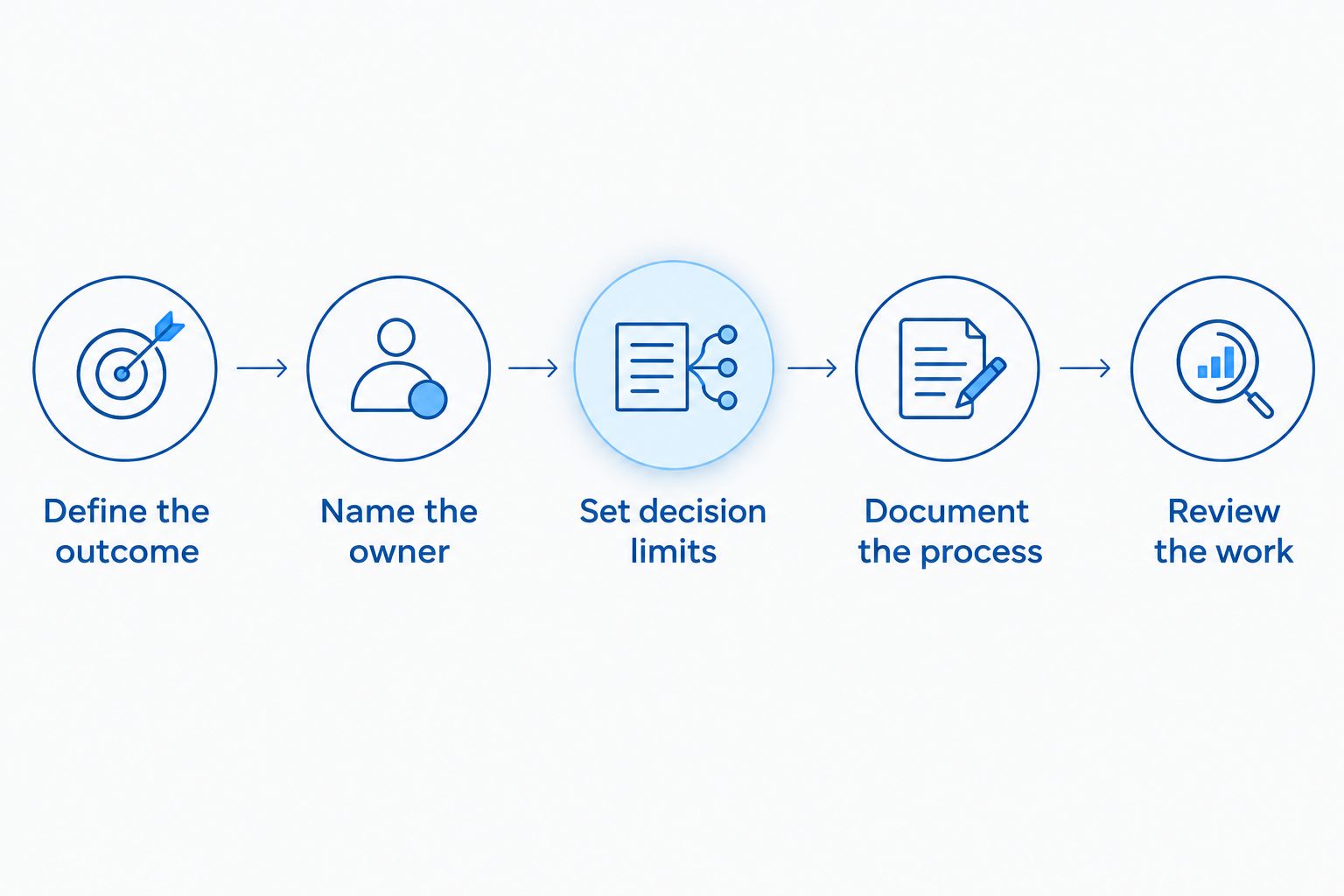
Agree on the outcome and decision limits before expecting independent delivery.
Write a delegation brief you can actually use
Your 2026 delegation brief should answer the questions someone encounters while doing the work. Keep explanations specific to the responsibility. Broad statements about taking initiative do not tell a person how to handle an incomplete booking.
Use this structure:
- Responsibility: Name the complete area of work being handed over.
- Task owner: Name the person accountable for completing it.
- Trigger: State when the process begins.
- Finished result: Describe the evidence that the work is complete.
- Inputs: List the information, access and documents required.
- Decision limits: Separate independent decisions from approvals.
- Escalation: State which exceptions return to whom.
- Review: Agree on what gets checked and how feedback is captured.
Then test the brief against a real piece of work. Ask the task owner to explain the next action without prompting. If they need information that only exists in your head, add it to the brief.
Avoid documenting every imaginable exception before starting. Cover the normal process and the exceptions already known to your business. Add new instructions when actual work reveals a gap, and remove instructions that no longer match how the responsibility operates.
Why delegation plans vary between businesses
The right handover depends on the work and the boundaries around it. A booking process for home services is not interchangeable with a professional services engagement. Keep the plan specific to your delivery model.
- Owner dependence: Identify which decisions genuinely require your expertise and which return to you out of habit.
- Team capacity: Assign responsibilities alongside existing workload, not separately from it.
- Service scope: Define what the business agrees to deliver and which requests need approval.
- Decision authority: Match independence to competence, qualifications and the consequences of an error.
- Marketing demand: Connect enquiry handling and bookings to the team's ability to deliver the promised work.
For your 2026 plan, check these factors before increasing the amount of work delegated. A clear process cannot compensate for a responsibility assigned to someone without the necessary authority or capacity.
Connect delegation to profitable bookings
More leads are not the answer to every constraint. Inspect how an enquiry becomes an accepted job, how the job reaches the delivery team and where the owner still has to intervene. Marketing and delivery need to agree on what a suitable booking looks like.
Consider a hypothetical home services business where the owner approves every appointment change. The first delegation project is not necessarily generating more enquiries. It can be defining which schedule changes the bookings owner can make, what capacity information they need and when a customer request requires approval.
Consider a hypothetical professional services business where the owner reviews every new enquiry. A useful handover can define service-fit criteria, required information and escalation conditions. The team member handles the agreed process; the authorised professional retains decisions that require specialist judgement.
In both examples, inspect pricing, service fit and delivery requirements before calling a booking successful. Recording an appointment is not the same as confirming that the business can deliver the agreed scope on acceptable terms.
Connect marketing activity to the team's capacity to deliver, not just its capacity to answer enquiries.
What should small business coaching help you implement?
Small business coaching should help you identify the constraint, choose the responsibility to hand over and establish accountability for implementing the plan. Ask a prospective coach how the work moves from discussion into documented responsibilities and reviewed delivery.
Elevatory combines business coaching with done-with-you marketing implementation. That positioning suits owners who want support connecting offers, funnels, paid advertising and systems—not a provider presented as taking over every business responsibility.
The advantage is the connection between business priorities and implementation. The boundary is equally important: done-with-you support still requires owner and team participation. Ask how responsibilities are divided, what implementation involves and what you must contribute before agreeing to an engagement.
How do I know whether delegation is working?
Check whether the responsibility reaches the agreed finish without routine owner intervention. For an initial baseline, record interruptions for 5 working days, noting the task, the decision requested and why it returned to you. This is a suggested observation period, not an industry benchmark.
Repeat the same observation after the handover. Compare the reasons for interruptions, not just the total. Fewer questions are not progress if incomplete work reaches the next person unchecked.
Should I delegate before increasing marketing?
Delegate the work blocking reliable delivery before increasing demand through that process. If quoting, booking or preparation still stops at your desk, address that dependency alongside the marketing plan.
For 2026 planning, ask the team what happens after a suitable enquiry arrives. Follow the work through to delivery before deciding that lead volume is the main constraint.
FAQ
What's the first thing I should delegate in my small business?
Start with a recurring responsibility that has a clear finish and does not require your specialist judgement at every step. Check that the person taking it over has the information, authority and capacity to complete it.
Can small business coaching help me stop making every daily decision?
Small business coaching can help you define responsibilities and decision limits so routine work stops depending on owner approval. The plan still needs implementation, training and review within your business.
How do I delegate when my team keeps asking questions?
Identify why each question returns to you before changing the handover. Missing information, unclear authority and genuine exceptions need different responses.
Should I write a process before handing over a task?
Write the normal process and decision limits before expecting independent delivery. Test the instructions during real work and update them when an actual gap appears.
Is delegation the same as hiring someone?
Delegation is assigning responsibility and authority; hiring is bringing someone into the business. A new employee still needs a defined outcome, the right access and clear escalation rules.
What does Elevatory offer established Australian business owners?
Elevatory offers business coaching and done-with-you marketing implementation for established Australian businesses. Its stated scope includes offers, funnels, paid advertising and systems strategy.
What should I ask a business coach about delegation?
Ask how the coach helps you turn owner-dependent work into named responsibilities, documented processes and reviewed outcomes. Also ask which implementation tasks remain with you and your team.
One last thing
The strongest test of a delegation plan is what happens when you are unavailable. Before handing over the next responsibility, ask the task owner to explain what they would do with an exception using only the agreed instructions.
If the answer is wait for you, inspect the decision limit. Some decisions belong with the owner; routine work should not stop simply because nobody knows where authority sits.
Related guides
Book a free growth strategy call
Forty-five minutes with a strategist to pressure-test where your business is stuck and what to prioritise next.
Prefer to talk first? Call 1300 634 230 or email chris@elevatory.com.au