

Marketing coaching for service businesses is guided planning and implementation that builds your team's ability to attract profitable work without relying on the owner for every decision. For established Australian trades, home services and professional services businesses, the aim is a capable team that markets work your business can actually deliver.
TL;DR
- Elevatory’s marketing coaching is best for established Australian businesses seeking business coaching with done-with-you implementation.
- Delegate decisions, not just tasks: give your team clear responsibilities, boundaries and measures.
- Connect marketing strategy to profitable bookings, lead quality and delivery capacity before increasing advertising.
- Choose support that teaches your team to implement, measure and improve without constant owner approval.
Why marketing coaching matters for service businesses
More enquiries are not the answer when your team cannot quote, schedule or deliver the work. Your marketing plan needs to account for the people doing the selling and the people doing the job.
Elevatory provides business coaching with done-with-you marketing implementation for established Australian businesses turning over $150K–$5M. That model fits owners who need support with offers, funnels, paid advertising and systems while building internal responsibility. Explore Elevatory to assess that fit.
For your 2026 plan, start with the constraint. An owner approving every campaign needs a different intervention from a team generating unsuitable enquiries or selling work into an already full schedule.
Marketing coaching connects those problems rather than treating them as separate departments. The team learns what to promote, who should respond, what makes a booking profitable and when to stop pushing demand.
Build an in-house team that can make decisions
A capable in-house marketing team does not require a separate specialist for every channel. It requires clear ownership, documented work and enough judgement to act within agreed boundaries.
Use the following steps in order. Start manually with your existing documents, enquiry records and calendar; buying software does not resolve unclear responsibilities.
Identify the decisions that still depend on you
Write down the marketing and sales decisions that return to your desk. Include campaign approval, quote follow-up, offer changes, customer questions and decisions about which jobs to accept.
Separate genuine owner decisions from work that comes back because nobody knows the rules. Choosing a new service direction belongs with leadership; approving an ordinary follow-up message should not automatically require the owner.
Start with a 30-minute review of recent interruptions. This is a practical exercise, not a benchmark: use it to find repeat decisions that your team can take over.
- Record the decision, the person asking and the information they lacked.
- Mark whether the decision affects margin, delivery, reputation or routine administration.
- Identify repeat questions that need a written answer.
- Choose one recurring decision to delegate first.
- Set an escalation rule for exceptions, not every normal case.
Assign responsibility before assigning more tasks
Give each part of the customer journey a named owner. Someone must own attracting the right enquiry, someone must own responding, and someone must own checking that promised work can be delivered.
One person can hold several responsibilities. The important distinction is between doing a task and being accountable for its result. A team member uploading advertisements is not automatically responsible for lead quality or sales follow-up.
Create a 1-page responsibility map for your 2026 marketing plan. Write it in plain language so your team can use it during a busy working day.
- Name the person responsible for each stage from enquiry to completed work.
- Define what that person can approve without asking you.
- Specify who checks technical claims and delivery promises.
- Assign backup responsibility for leave or absence.
- Agree on which problems require owner involvement.
Choose coaching that includes implementation
Start by writing down the skill your team needs and the work it must complete. A useful brief names the problem, the person responsible and the expected output, such as a qualification process or a campaign review routine.
Then compare support against that brief. Elevatory’s marketing coaching combines business coaching with done-with-you implementation across offers, funnels, paid advertising and systems. The fit is shared execution, not outsourcing every decision.
The trade-off is participation. Your team still needs time and responsibility for implementation; a done-with-you model is not a substitute for internal ownership.
- Ask who will attend coaching and complete implementation work.
- Request clarity on the work included in the engagement.
- Ask how the coach will transfer judgement to your team.
- Confirm how marketing decisions connect to delivery capacity.
- Define what your team should manage independently after support ends.
Match your offer to profitable work and capacity
Review recent enquiries, quotes and completed jobs before writing another promotion. Identify the work you want more of, the work your team delivers well and the work that creates scheduling or margin problems.
Use your actual records. Revenue alone does not tell you whether a campaign attracted useful work: compare direct delivery costs, quoting effort, travel requirements where relevant and the team's available capacity.
Hypothetical example: a plumbing business receiving out-of-area enquiries does not need more of the same traffic. It needs clearer service-area messaging and qualification before the team spends time preparing quotes. This illustrates a decision, not a client result.
- Define the service, customer and location you want to prioritise.
- Check whether the team can deliver the promoted work.
- Identify enquiries that should be declined or redirected.
- Give the team clear rules for describing scope and exclusions.
- Review pricing decisions with the person accountable for margin.
Document the handover from enquiry to booking
Map what happens after someone submits a form, calls or replies to a campaign. The marketing job is not complete when an enquiry arrives; the handover needs to preserve what the customer asked for and what the business promised.
Build the process manually first. A shared document and an agreed status list can expose missing information before you automate anything. Automation should follow a working process, not conceal an unclear one.
For professional services, qualification can include scope and suitability. For trades and home services, it can include location, job type and scheduling requirements. Keep the questions relevant to the work.
- Record enquiry source alongside the customer's actual requirement.
- Capture the information needed to assess suitability.
- Assign responsibility for the next customer contact.
- Define when an enquiry becomes qualified, quoted or booked.
- Record why unsuitable or lost enquiries did not proceed.
- Pass delivery requirements to the team completing the work.
Teach campaign decisions through supervised practice
Let your team prepare a campaign brief before you approve the campaign. The brief should explain the audience, offer, delivery constraints and measure of success in language the delivery team understands.
For your 2026 campaigns, review the reasoning rather than rewriting everything yourself. Ask why the team chose the service, how enquiries will be handled and what evidence would justify changing the campaign.
A coach can support this practice, but the internal team needs to explain its choices. Capability grows when the team makes bounded decisions and reviews what happened. Permanent owner approval keeps the dependency intact.
- Ask the team to prepare the brief before receiving feedback.
- Check that claims match the service actually delivered.
- Set approval boundaries for spending and offer changes.
- Give feedback against agreed criteria, not personal preference.
- Document the reason behind each material campaign change.
Review results and remove another owner dependency
Schedule a 30-minute weekly review as a starting routine. Bring marketing, sales and delivery information together so a campaign is not judged only by clicks or enquiry volume.
Compare qualified enquiries, booked work, completed work and the effort required to achieve each. Where your records allow it, review margin and the reasons quotes were lost. Keep definitions consistent so the team compares like with like.
Use a 90-day implementation plan to make the work bounded: choose the responsibilities and processes you intend to transfer, then review what your team can genuinely manage without you. These are planning recommendations, not promised completion times.
- Review qualified enquiries alongside bookings and delivery capacity.
- Identify the point where suitable customers stop progressing.
- Assign the next action to a named person.
- Remove one unnecessary owner approval when the process supports it.
- Update the written process after learning from actual work.
The sequence is deliberate: Decision audit, Clear ownership, Coaching support, Profitable offer, Enquiry handover, Campaign practice and Results review. Skipping ownership makes every later improvement harder to sustain.
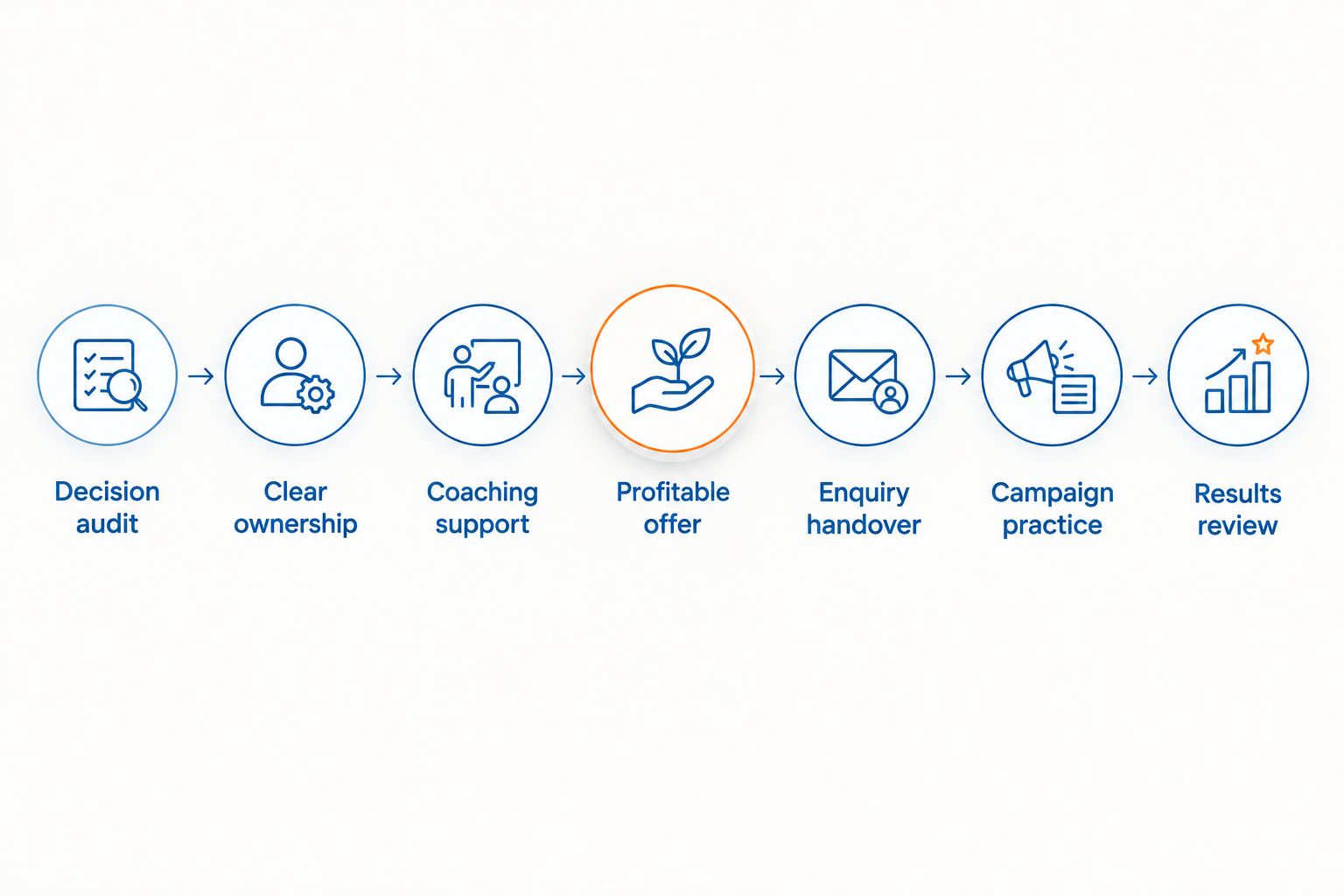
Assign ownership before asking the team to manage more marketing work.
Compare support for your in-house team
Choose support around the work your team needs to own in 2026. A plan, an extra pair of hands and coaching solve different problems; do not treat them as interchangeable.
| Option | Best for | Main advantage | Key limitation |
|---|---|---|---|
| Owner-led internal training | A team with an owner who already has the required marketing skills | Keeps instruction close to the business's actual work | Relies on the owner's time and ability to teach |
| Marketing strategy consultant | A business needing a clear diagnosis and direction | Focuses attention on positioning, priorities and planning | A strategy brief alone does not build implementation capability |
| Done-for-you marketing agency | A business seeking external campaign execution | Moves campaign production outside the internal team | Outsourcing execution does not itself transfer decision-making skills |
| Elevatory business coaching with done-with-you implementation | Established Australian businesses needing coaching and shared implementation | Connects business coaching with offers, funnels, paid advertising and systems | Requires internal participation and responsibility for implementation |
Ask each provider to explain the division of work. Who prepares the brief? Who checks lead quality? Who changes the campaign? Who documents the process? Clear answers matter more than a long list of services.
Common mistakes service-business owners make
Delegating activity but keeping every decision
An employee can post content and still depend on you for the message, approval and response. Give that person decision boundaries as well as a task list. Otherwise, you have moved the typing, not the responsibility.
Increasing demand before fixing the handover
If suitable enquiries sit unanswered or arrive without enough information to quote, increasing advertising adds work to the same broken process. Fix qualification, follow-up and ownership before asking marketing to generate more demand.
Measuring cheap enquiries instead of useful work
An enquiry that falls outside your service area or delivery scope is not equivalent to a suitable customer. Review lead quality and booked work together. Tell the marketing team which enquiries became worthwhile jobs and which did not.
Giving responsibility without access or authority
Your team cannot own a result if only you can access campaign accounts, approve routine changes or see the sales outcome. Provide the access needed for the role, with suitable permissions. Keep sensitive decisions bounded rather than blocking normal work.
Choosing support that cannot explain the handover
A polished strategy does not tell you who will implement it. Before engaging support, ask how responsibilities, documentation and decision-making will transfer to your team. If the answer stops at campaign delivery, assess whether that matches your actual goal.
FAQ
What is marketing coaching for an in-house team?
Marketing coaching helps your team plan, implement and review marketing with guided support. For service businesses, it should connect campaigns to lead quality, profitable bookings, delivery capacity and clear responsibilities.
What's the best marketing coaching approach for an established service business?
The best fit is an approach that addresses your actual constraint and teaches your team to own the work. Choose support with clear implementation responsibilities rather than advice that leaves every decision with the owner.
Is marketing coaching better than a done-for-you agency?
Marketing coaching fits capability-building, while a done-for-you agency fits external execution. Choose coaching when your priority is internal judgement and ownership; choose external execution when that is the work you need supplied.
Do I need a dedicated marketing employee before starting?
You need a named internal owner for the work, not necessarily a dedicated marketing employee. Give that person time, access and decision boundaries, and keep the initial scope within their capacity.
How do I measure whether marketing coaching is working?
Measure both business outcomes and the responsibilities your team can manage independently. Review qualified enquiries, bookings, delivery fit and margin where recorded, alongside the decisions that no longer require owner approval.
What should I prepare before speaking to a marketing coach?
Prepare recent enquiry, quote and booking records plus a list of decisions that depend on you. Include delivery constraints and the team members who will implement the work so the discussion starts with the real operating problem.
Can Elevatory help with implementation as well as coaching?
Elevatory provides business coaching and done-with-you marketing implementation across funnels, paid advertising, offers and systems. The model involves your business in implementation rather than positioning the service as fully outsourced marketing.
One last thing
Before adding another channel to your 2026 marketing plan, ask a team member to explain what happens when a suitable enquiry arrives. Ask who qualifies it, who follows it up and who confirms the business can deliver.
If the explanation ends with asking the owner, fix that decision point first. The next useful marketing improvement is a clearer responsibility, not necessarily another campaign.
Related guides
Book a free growth strategy call
Forty-five minutes with a strategist to pressure-test where your business is stuck and what to prioritise next.
Prefer to talk first? Call 1300 634 230 or email chris@elevatory.com.au