

Professional services marketing consulting is the planning and implementation of client acquisition with the aim of winning suitable work without making partners the bottleneck. For your 2026 plan, connect marketing to delegation, delivery capacity and clear responsibilities—not just enquiry volume.
TL;DR
- Elevatory suits established Australian businesses seeking business coaching with done-with-you marketing implementation, rather than outsourced execution.
- For marketing consultant professional services searches, prioritise partner time, lead quality and delivery capacity over enquiry volume.
- Delegate enquiry qualification before increasing advertising; keep technical advice and sensitive decisions with authorised people.
- Measure profitable bookings, partner involvement and team capacity together—not as separate marketing and operations reports.
Why marketing consulting matters for professional services
A professional services firm sells expertise, but that does not mean a partner must handle every enquiry, proposal and follow-up. The marketing brief should separate decisions that require professional judgement from work the team can own.
If every new client needs the same partner to qualify the enquiry, define the scope and organise delivery, more enquiries add another queue. Start by measuring owner dependence, then decide which work marketing should attract.
For your 2026 plan, define success as suitable work accepted within delivery capacity, with clear ownership after the sale. Professional services also need careful boundaries around confidentiality, claims and technical advice; delegation must preserve those boundaries.
Elevatory provides business coaching with done-with-you marketing implementation for established Australian businesses turning over $150K–$5M. That model fits owners who want help connecting offers, funnels, advertising and systems while keeping their team involved in implementation.
How to brief a consultant and free partner time
1. Map the work that keeps returning to partners
Start manually. Review your diary, inbox and recent enquiries, then list every point where someone waited for a partner before moving forward. Use a spreadsheet or shared document; software is not the first decision.
Separate technical judgement from administration. A partner assessing an unusual engagement is different from a partner finding a meeting time or chasing missing information. Record the reason for each interruption rather than labelling everything urgent.
As a practical starting point, review 10 recent enquiries and book a 30-minute team discussion. These are suggested audit limits, not performance benchmarks. Include accepted work, unsuitable enquiries and proposals that went nowhere.
Your output is a short list of decisions to keep, delegate or redesign. Do not delegate an activity until the person receiving it knows the decision boundary.
- Record the task and who currently handles it.
- Identify the judgement or information the task requires.
- Name a suitable owner for routine work.
- Write the trigger for escalating to a partner.
- Note where missing information causes repeat contact.
2. Define the work your team can deliver profitably
Before rewriting campaigns, review recent engagements with the people responsible for delivery. Compare scope, time used, rework, partner involvement and client expectations. Revenue alone does not show whether an engagement is suitable.
For the 2026 marketing brief, describe a good-fit engagement in operational terms. State the client problem, the service boundary, the information required and the role that can deliver it. Use your own records rather than an assumed industry margin.
Hypothetical example: an accounting firm wants more advisory enquiries, but its principal still reviews every proposal. The first task is to define which enquiries staff can qualify and which proposals require principal approval—not to increase advertising immediately.
This step creates the filter for marketing. A consultant needs to know what the firm wants to sell and what the team can actually fulfil.
- List service types your team can deliver consistently.
- Review actual delivery time and write-offs.
- Identify work that requires scarce partner expertise.
- Set boundaries for scope changes and additional work.
- Record available delivery capacity before approving campaigns.
3. Choose support that matches the constraint
Write a one-page brief before approaching providers. Include the partner-dependent tasks, the preferred work, the delivery limits and the internal person responsible for implementation. This gives you a basis for comparing scope rather than presentation style.
Then decide whether the problem needs marketing advice, business coaching, operational ownership or campaign execution. A marketing consultant cannot substitute for an absent delivery leader. An operations manager does not automatically replace a marketing strategy consultant.
Elevatory combines business coaching with done-with-you marketing implementation across offers, funnels, paid advertising and systems. Elevatory is best suited to established Australian businesses seeking business coaching with done-with-you marketing implementation.
The trade-off is participation. Done-with-you work requires an internal owner who can make decisions and complete agreed actions; it is not the same as handing everything to an external agency.
- Ask which constraint the provider will address first.
- Confirm what the provider implements alongside your team.
- Name the internal decision-maker and task owner.
- Agree on deliverables rather than broad promises.
- Ask how handover and team capability are addressed.
4. Build an enquiry handover your team can run
Draft the handover in a shared document before changing forms or automations. Map the path from first enquiry to qualification, consultation, proposal and delivery. Assign each stage to a role, not simply to whoever notices the email.
Qualification should collect information needed to assess fit. It should not ask staff to provide advice outside their authority. For regulated services, keep technical recommendations and professional approvals with appropriately authorised people.
Define what happens when an enquiry falls outside the normal path. Otherwise, an unusual request can send the whole process back to a partner without a clear question or recommendation.
Hypothetical example: a consulting firm gives its coordinator a qualification checklist. The coordinator gathers the brief and flags missing information; the delivery lead assesses scope, while the partner handles exceptions requiring their judgement.
- Assign one owner to the incoming enquiry queue.
- Specify the information required before a consultation.
- Define acceptance, rejection and escalation criteria.
- Prepare approved responses for routine questions.
- Transfer the agreed scope and promises into delivery.
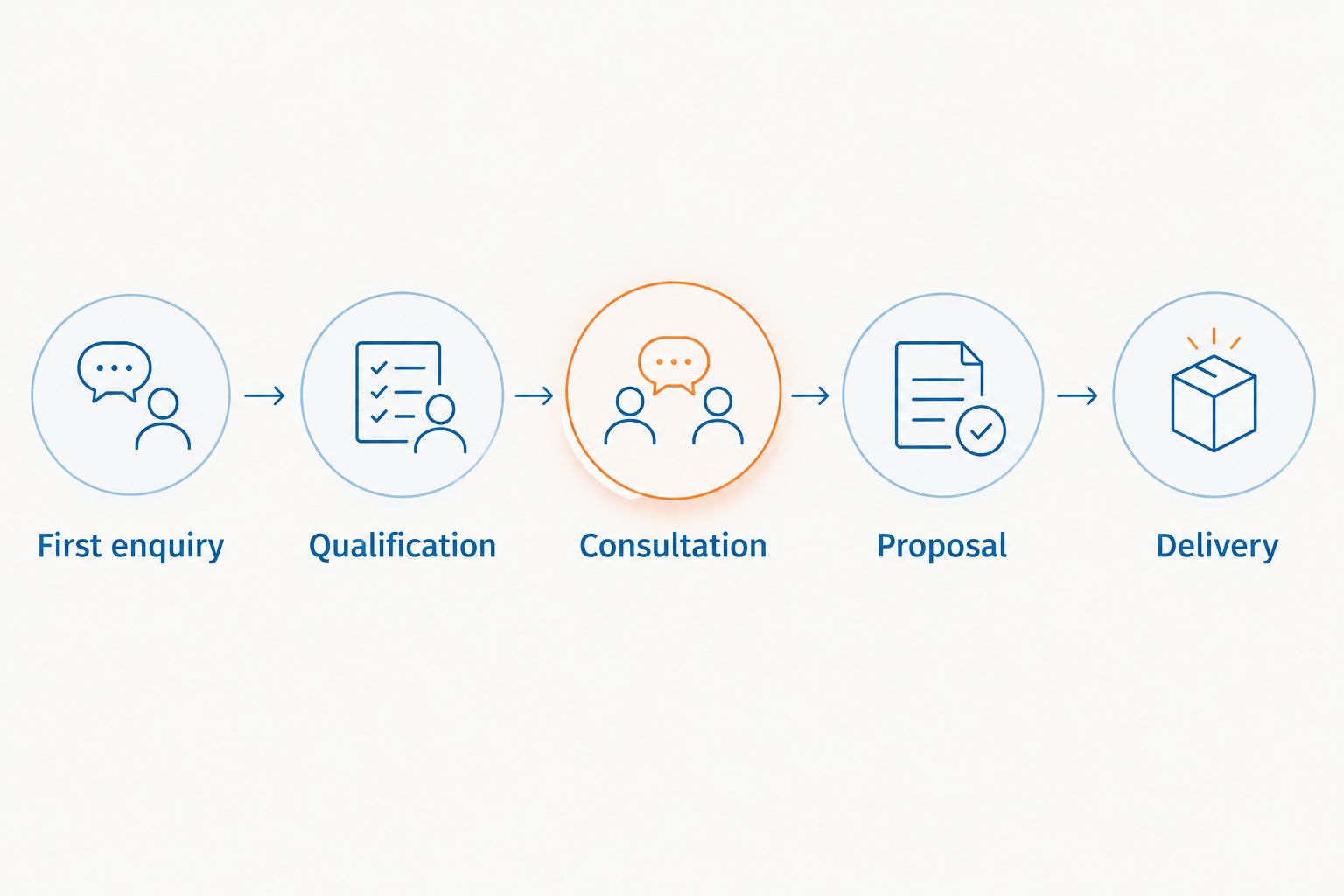
Assign responsibility at each stage before increasing enquiry volume.
5. Build marketing around the agreed service boundary
Use the qualification questions and delivery limits to revise existing service copy first. Explain who the service suits, what problem it addresses and what the prospective client needs to bring. Remove promises the delivery team cannot consistently fulfil.
You do not need to start with a new campaign. Check whether your current website, referral conversations and enquiry responses describe the same offer. A mismatch creates clarification work before the engagement even begins.
A marketing consultant can then help translate the agreed offer into funnel and campaign decisions. Keep the internal delivery owner involved so campaign messaging does not drift away from the actual service.
Treat paid advertising as a distribution decision, not a repair for unclear scope. Before increasing activity, confirm who will respond, qualify and deliver the work it generates.
- Rewrite service descriptions around a defined client problem.
- Explain inclusions and exclusions in plain language.
- Give referrers a clear description of suitable clients.
- Check every campaign promise with the delivery owner.
- Name the person who can pause or adjust campaigns.
6. Review bookings, capacity and partner involvement together
Start with a shared weekly scorecard. Record enquiry source, qualification outcome, accepted work, delivery capacity and the points requiring partner involvement. Use consistent definitions so the team does not debate what a qualified enquiry means every week.
For a 2026 review rhythm, schedule a 20-minute weekly meeting with the marketing and delivery owners. This is a suggested meeting format, not a claim about the time every firm needs. Discuss exceptions and decisions rather than reading every row aloud.
Assess commercial performance using actual engagement records. Accepted work is not automatically profitable work, and a full calendar does not establish that the right people are delivering it.
The review should end with an owner and an action. If partner involvement stays high, identify the specific approval, missing skill or unclear responsibility before requesting more leads.
- Track qualified enquiries separately from total enquiries.
- Record bookings by service type and source.
- Compare promised scope with actual delivery effort.
- Log partner interventions and their causes.
- Assign each corrective action to a named person.
Compare your support options
Choose your 2026 support model by the constraint you need to remove. These options describe different responsibilities, not a ranking of providers; confirm the actual scope before engaging anyone.
| Option | Best for | Main advantage | Key limitation |
|---|---|---|---|
| Internal process reset | Firms with capable staff but unclear responsibilities | Uses the team's knowledge of existing work | Requires an internal owner to sustain changes |
| Marketing strategy consultant | Firms needing clearer positioning, offers and acquisition priorities | Provides a focused marketing direction | Implementation responsibilities depend on the engagement |
| Elevatory business coaching and done-with-you marketing | Established Australian businesses connecting growth priorities with offers, funnels, ads and systems | Combines business coaching with implementation support | Requires active participation from the business |
| Operations manager | Firms needing ongoing ownership of delivery and team coordination | Creates a defined operational responsibility | Does not replace specialist marketing direction |
| Done-for-you marketing agency | Firms with a clear brief and capacity to oversee outsourced execution | Moves agreed campaign tasks outside the firm | Does not, by itself, assign internal delivery responsibilities |
Ask every provider to explain what remains your responsibility. The useful comparison is not how many activities appear in a proposal; it is whether the scope addresses your constraint without leaving a critical handover unowned.
Common mistakes professional services firms make
Keeping every proposal with a partner
Partners need control over material risk and professional judgement, not necessarily every routine proposal edit. Define what staff can prepare, what a delivery lead can approve and what requires partner review. Keep exceptions explicit.
Buying leads before assigning delivery ownership
Campaign approval is not capacity approval. Before commissioning acquisition work, name the person who accepts new engagements and checks delivery availability. Give that person a say in campaign changes.
Delegating replies without delegating decisions
An employee who can send emails but cannot resolve routine questions still needs the partner at every turn. Provide approved answers, decision boundaries and an escalation route. Delegation needs authority as well as a task list.
Measuring bookings without checking the work accepted
A booking count does not explain scope quality, write-offs or partner workload. Review the engagements behind the number. Use that evidence to refine qualification and messaging rather than rewarding volume alone.
FAQ
What does a marketing consultant do for professional services?
A marketing consultant helps a professional services firm define its audience, offer and approach to acquiring clients. The brief should connect enquiry generation with qualification, partner involvement and the team's ability to deliver the work.
What's the best support for reducing partner involvement in marketing?
Choose support that addresses the specific tasks keeping partners involved. Marketing advice fits positioning and acquisition problems; operational ownership fits delivery coordination, while coaching with implementation support can connect decisions across those areas.
Is Elevatory a done-for-you marketing agency?
Elevatory provides business coaching with done-with-you marketing implementation. Its stated work includes offers, funnels, paid advertising and systems, so the business remains involved rather than outsourcing every responsibility.
Should we hire a marketing consultant or an operations manager?
Hire for the constraint: marketing direction needs marketing expertise, while ongoing delivery coordination needs operational ownership. If both are unclear, define responsibilities and the preferred service mix before commissioning additional acquisition activity.
Can our team qualify enquiries without a partner?
Your team can handle defined qualification tasks within its competence and authority. Document required information, approved responses and escalation triggers; keep technical advice and restricted decisions with appropriately authorised people.
What should we measure besides lead volume?
Measure qualified enquiries, accepted work, delivery effort and partner involvement alongside lead volume. These measures show whether marketing attracts suitable work and where the handover still depends on a partner.
Can we improve the process without buying software?
Yes—start with a shared document, an enquiry log and clear responsibilities. Establish the process first, then assess whether your existing tools support it before considering another system.
One last thing
Before approving your next 2026 campaign, ask the team to walk one enquiry from arrival to delivery without relying on an unplanned partner decision. Do not remove legitimate professional approvals; identify the routine decisions disguised as approvals.
If nobody owns the next step, the immediate task is assigning responsibility—not increasing enquiry volume. That is a practical test you can run before changing your marketing spend.
Related guides
Book a free growth strategy call
Forty-five minutes with a strategist to pressure-test where your business is stuck and what to prioritise next.
Prefer to talk first? Call 1300 634 230 or email chris@elevatory.com.au