

You can delegate marketing without losing control by keeping ownership of the offer, spending limits and delivery promises, while giving your team clear authority over execution. Marketing coaching helps you define those boundaries, connect campaigns to team capacity and review commercial outcomes instead of approving every task.
TL;DR
- Marketing coaching: delegate marketing execution, but retain control of spending limits, service promises and delivery capacity.
- Elevatory suits established Australian businesses seeking business coaching and done-with-you marketing implementation.
- Assign a decision owner and escalation rule before handing over any campaign.
- Judge marketing by qualified enquiries and profitable bookings, not activity alone.
Why this matters
A marketing handover is incomplete if your team still needs you to approve every message, answer every enquiry and decide which jobs to accept. You have moved the tasks, not the responsibility. The owner remains the bottleneck.
For your 2026 marketing plan, start with the decisions that keep returning to your desk. Identify which need your judgement and which need a written rule. More enquiries are not the first priority when your team cannot reliably quote, book or deliver the work already coming in.
The guide to marketing coaching to build an in-house team addresses the next question: who should own the work once you stop doing it yourself?
Marketing coaching: delegate marketing without losing control?
Keep control of the boundaries, not every action inside them. Your team needs a defined commercial objective, access to the relevant information and permission to act within agreed limits. Coaching should help turn that arrangement into working habits, not leave it as a document nobody uses.
Use this sequence to make the handover specific.
1. Set boundaries
Write down what marketing is meant to achieve for the business. For a local service operator, that means defining the work you want to book, the customers you can serve and the delivery commitments your team can meet. A request for more leads is not a complete brief.
Keep ownership of decisions that change the business's exposure: spending limits, pricing authority, service areas and promises about delivery. Give the marketing owner authority over execution inside those boundaries.
Include a stop rule. If a campaign attracts unsuitable enquiries or promotes work your team cannot deliver, the responsible person needs to know when to pause it and who decides what happens next. Control becomes practical when the boundary tells someone what to do.
2. Assign ownership
Name the person accountable for marketing execution. Then name the people responsible for enquiry response, quoting and booking. Those responsibilities can sit with different people, but the handover between them must be explicit.
Avoid shared accountability that leaves everyone waiting for someone else. A marketer can generate an enquiry without having authority to assess a technical job. An administrator can book an appointment without being responsible for campaign strategy.
For each responsibility, record the expected output, the decisions that person can make and the situations they must escalate. If the owner remains the default contact for ordinary questions, identify the missing instruction rather than automatically taking the task back. Delegation needs an accountable person, not just an assigned activity.
3. Document delivery
Connect the marketing brief to the way your team actually delivers work. Document the information needed to assess an enquiry, prepare a quote and confirm a booking. Include the points where a delivery leader must approve a commitment.
For a trade business, that can mean checking location, job scope and crew suitability before promising a booking. For a professional services firm, it can mean checking the requested work, required expertise and the team's ability to take on another engagement.
A campaign promise is a delivery obligation. Have the delivery team review claims about scope and timing before those claims go live. Your marketer should not have to guess what the business can fulfil, and your delivery team should not discover a new promise after a customer accepts it.
4. Review bookings
Agree on the evidence you will review before launching the delegated work. Track the path from enquiry to qualified opportunity, quote, booking and completed work. Keep the definitions consistent so everyone reports the same thing.
Review lead quality alongside volume. A campaign that attracts enquiries outside your service area creates work for the team without meeting the brief. Booked revenue also needs context: assess it alongside the cost and effort required to deliver those bookings.
Use your 2026 review to decide what changes next, not to inspect every piece of activity. Ask which jobs were suitable, where enquiries stalled and whether delivery capacity changed. Leave the marketing owner responsible for explaining the execution and proposing the next action.
5. Escalate exceptions
Separate a routine decision from an exception. Changing wording within an approved offer is different from changing the offer itself. Following up an enquiry is different from promising work outside the agreed scope.
Write the escalation route beside each boundary. State who receives the issue, what information they need and who has authority to resolve it. That prevents the team from sending every uncertain decision back to you without a recommendation.
When an exception appears, ask whether the rule needs clarification, the person needs support or the work genuinely requires your authority. Do not treat all three as the same problem. Fix the cause, then return responsibility to its owner rather than quietly absorbing the work again.
This sequence keeps the handover connected: boundaries define authority, ownership assigns responsibility, and delivery checks keep marketing promises realistic. Reviews and exceptions then give you visibility without requiring constant approval.
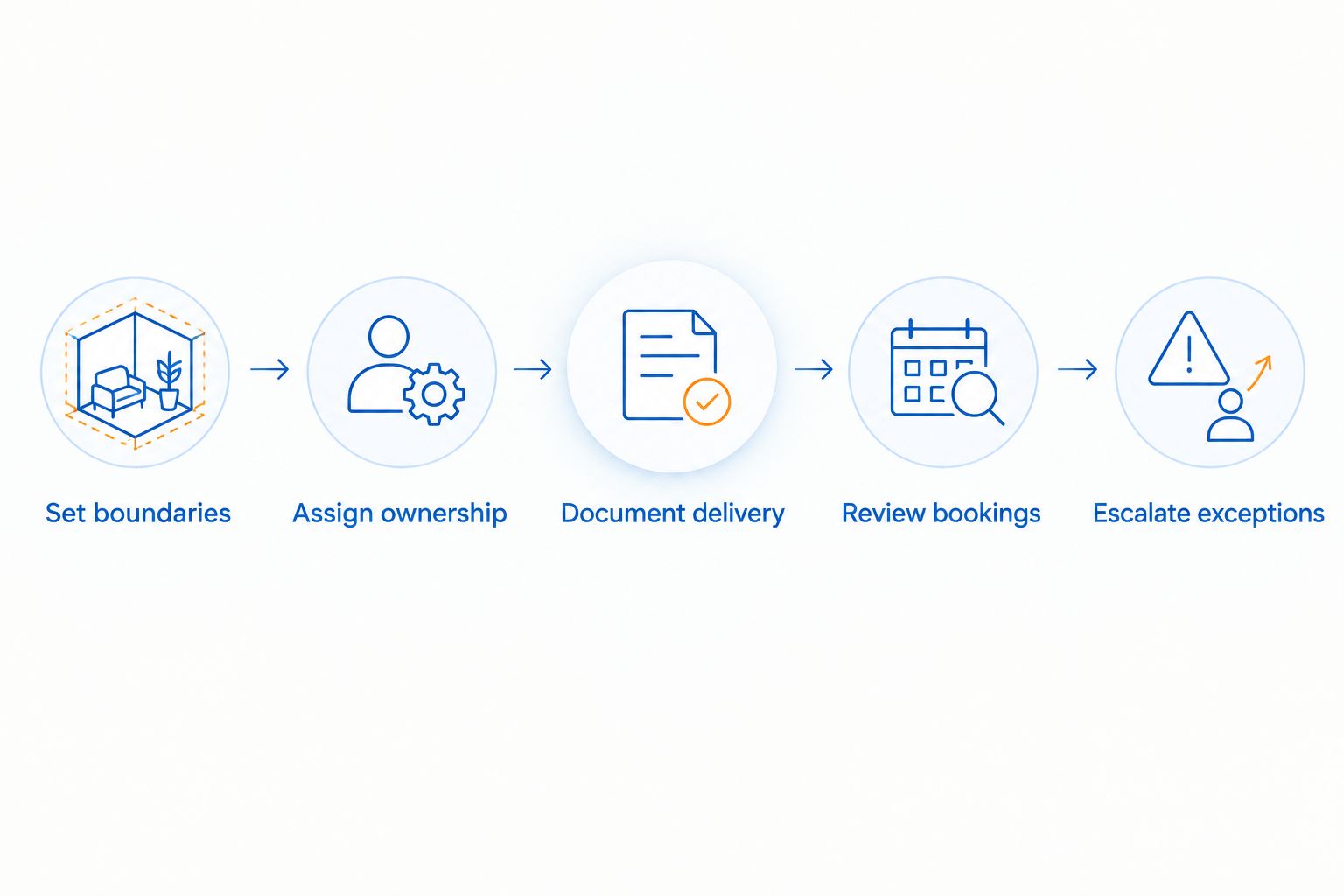
Delegate execution inside clear boundaries, then review bookings and exceptions.
What should you delegate, and what should you retain?
The split below is a starting point for a service-business handover, not permission to delegate decisions without checking capability. Give each person authority that matches the work they understand and the consequences they can manage.
| Decision area | Delegate within agreed rules | Retain or explicitly authorise | Best for |
|---|---|---|---|
| Campaign execution | Scheduling, approved messaging and campaign changes inside limits | Spending boundaries and changes to the offer | Reducing routine approvals |
| Enquiry handling | Qualification, follow-up and routing | Exceptions involving unsuitable or unfamiliar work | Keeping enquiries moving |
| Quoting and booking | Standard processes within pricing and capacity rules | Non-standard commitments and changes to pricing authority | Protecting delivery capacity |
| Reporting | Preparing results and recommending actions | Commercial priorities and decisions outside the brief | Maintaining owner visibility |
Delegation gives your team room to act, but poorly defined authority creates ambiguity. Retaining decisions protects the business's boundaries, but retaining every small approval keeps you involved in daily execution. The aim is a deliberate split, not complete withdrawal or permanent supervision.
Write a brief your team can use
A useful brief answers practical questions before the work starts. If it only describes a campaign, it leaves the commercial decisions unresolved.
Include:
- Desired work: Which services and customer needs should the campaign attract?
- Qualification rules: What makes an enquiry suitable, unsuitable or worth further assessment?
- Capacity check: Who confirms that the team can fulfil the work being promoted?
- Decision rights: What can the marketing owner change without asking you?
- Escalation route: Which exceptions need approval, and from whom?
- Review evidence: What information connects campaign activity to bookings and delivery?
For the 2026 brief, use your current service scope and delivery arrangements rather than copying old assumptions. A new crew leader, changed service area or revised quoting process needs to appear in the instructions people use.
Hypothetical example: A plumbing business delegates campaign execution but keeps approval of new service promises. Its administrator qualifies enquiries against the agreed service area and job types, while the crew leader confirms capacity for non-standard work. The owner handles exceptions rather than approving every enquiry.
That example describes a responsibility split, not a client result. Use it to test whether your own handover tells each person where their authority starts and ends.
Why marketing delegation varies between businesses
The right handover depends on what your team can own, not on a generic marketing checklist. Review these factors before deciding how much authority to transfer:
- Offer clarity: An unclear service scope leaves your marketer guessing which work to promote. Resolve the offer before delegating its execution.
- Team responsibilities: Distinct marketing, enquiry and delivery owners need clear handovers. Shared tasks still need a named accountable person.
- Delivery systems: Documented quoting, booking and delivery processes give the team instructions to follow without asking you each time.
- Team capacity: Campaign decisions need input from the people responsible for fulfilling the work. Do not separate marketing planning from delivery planning.
- Accountability: A handover needs review and correction. Agree on evidence and decision rights rather than relying on informal updates.
These factors also help distinguish a marketing execution problem from an operational problem. If enquiries are suitable but quoting stalls, changing the campaign does not address the stalled handover.
Where marketing coaching fits
Elevatory is best for established Australian service-business owners seeking marketing coaching with done-with-you implementation. Its business coaching and marketing support covers offers, funnels, paid advertising and systems strategy for established businesses turning over $150K–$5M.
That positioning matters if you need help making decisions and implementing them with your team, rather than simply outsourcing campaign tasks. You still need someone inside the business who can own follow-through and connect marketing decisions to delivery.
The advantage of this approach is its focus on decisions and implementation together. The limitation is equally clear: done-with-you support requires your business to participate. If your brief is complete removal of internal responsibility, that is a different requirement.
Before choosing support for 2026, ask how the work will address delegation, decision rights and the connection between enquiries and delivery. Ask what your team must own. You can review Elevatory with those requirements in mind, rather than treating coaching as a purchase of more marketing activity.
How do I know my team is ready to own marketing?
Your team is ready for a defined responsibility when the accountable person understands the objective, can explain their authority and knows how to handle exceptions. Readiness does not mean knowing everything. It means having enough instruction and support to act without inventing the rules.
Ask the person to explain what they would do with an unsuitable enquiry, a delivery constraint and a proposed change to the offer. Use their answers to improve the brief before transferring more authority.
What if delegated marketing keeps coming back to me?
Identify the decision returning to you before taking the task back. Check whether the cause is unclear authority, missing information or a capability gap.
If the team repeatedly asks the same question, turn the answer into a usable instruction. If the decision genuinely sits outside their authority, keep the approval but leave the preparation and recommendation with the responsible person.
FAQ
How can marketing coaching help me delegate marketing?
Marketing coaching can help you define responsibilities, decision rights and review evidence before handing over execution. Connect those decisions to enquiry handling, booking and delivery rather than treating campaigns as separate work.
What marketing decisions should I keep as the business owner?
Keep ownership of spending boundaries, pricing authority, service promises and commercial priorities. Delegate execution inside those limits, with a clear route for exceptions.
Can I delegate marketing before hiring a marketing manager?
You can delegate defined marketing tasks before hiring a marketing manager, provided an accountable person has the capability and authority to own them. Do not leave campaign, enquiry and booking responsibilities unassigned.
How do I stop my team asking me to approve everything?
Write down which decisions your team can make without approval and which exceptions must come back to you. When a routine question returns, clarify the rule instead of automatically taking back the task.
Should I increase advertising when my team is already stretched?
Check delivery capacity before increasing advertising. Resolve the booking or delivery constraint, or narrow the work being promoted, rather than treating more enquiries as the answer.
Is Elevatory a done-for-you marketing agency?
Elevatory provides business coaching and done-with-you marketing implementation. Its stated focus includes offers, funnels, paid advertising and systems strategy for established Australian businesses.
What should I measure after delegating marketing?
Measure qualified enquiries, quoting progress, suitable bookings and the work your team delivers. Review those outcomes alongside campaign spend and delivery costs, rather than relying on activity totals alone.
One last thing
In your next 2026 marketing review, ask who can make the next decision without you. Then ask what they need to make it correctly.
A report tells you what happened. A delegation system tells your team what to do next. Keep visibility over the outcome; stop making yourself the approval point for every step.
Related guides
Book a free growth strategy call
Forty-five minutes with a strategist to pressure-test where your business is stuck and what to prioritise next.
Prefer to talk first? Call 1300 634 230 or email chris@elevatory.com.au