
Yes—business coaching is generally tax deductible in Australia when it directly relates to running your existing business and meets the usual business-expense rules. For a 2026 claim, exclude private expenses and check whether any capital component needs different treatment. The business purpose of the work—not the coach’s job title—determines the tax treatment.
TL;DR
- Is a business coach tax deductible Australia? Generally yes, for eligible expenses connected to an existing business.
- Business coaching for delegation, delivery systems and marketing needs a documented business purpose.
- Private coaching is not deductible; mixed-purpose programs need a reasonable allocation.
- Elevatory provides business coaching with done-with-you implementation, not a substitute for advice from your tax agent.
Why this matters
A deduction does not make coaching free. You still need to decide whether the work addresses a real business constraint: unclear responsibilities, decisions stuck with the owner, unreliable delivery or marketing that brings the wrong enquiries.
Elevatory provides business coaching with done-with-you marketing implementation. Keep the buying decision separate from the tax decision: choose useful work first, then establish how your business should account for it.
This is general information for Australian business owners in 2026, not personal tax advice. Your registered tax agent should confirm the treatment of your actual agreement, business structure and circumstances.
Is hiring a business coach tax deductible in Australia?
Business coaching expenses are generally deductible to the extent they are incurred in carrying on a business to earn assessable income, provided the relevant exclusions do not apply. Section 8-1 of the Income Tax Assessment Act sets out the general deduction test, including exclusions for capital, private and domestic expenses.
The Australian Taxation Office’s guidance on business deductions, private expenses and record keeping provides the practical starting point for a 2026 claim. Apply those rules to the actual services supplied—not just an invoice labelled business coaching.
| Coaching scope | Potential tax treatment | Evidence to retain |
|---|---|---|
| Delegation and delivery systems for an existing business | Generally deductible where it is an ordinary business expense | Scope, responsibilities, process documents and invoices |
| Marketing and lead qualification for current services | Generally deductible where it supports existing business activity | Campaign plans, enquiry criteria and implementation records |
| Personal confidence or lifestyle goals unrelated to business | Private expenses are not deductible | Separate scope and allocation records |
| A program combining business and private work | Only the eligible business portion is deductible | Itemised services and a reasonable allocation method |
| Advice connected with establishing or acquiring a business | Requires separate assessment; not automatically an immediate deduction | Agreement, transaction details and tax-agent advice |
These are categories for assessment, not automatic approvals. A business-related expense can still be capital in nature, and paying through a business account does not establish deductibility.
Start with the business connection
Describe the operational problem before describing the coaching. For example, an established electrical business might need crew leaders to approve routine site decisions without calling the owner.
That is a hypothetical example, not a client result. A scope covering decision authority, handover procedures and supervisor responsibilities gives the tax agent a clearer business connection than a broad promise to improve the owner’s life.
Identify who incurred the expense
Give your accountant the agreement and invoice showing which person or entity engaged the coach. A sole trader, company and trust are not interchangeable for tax purposes.
If the owner paid personally for work commissioned by a company, ask how to record the transaction correctly. Do not assume the expense belongs in the owner’s individual return simply because the payment came from a personal card.
Coaching for an existing business
Coaching focused on current operations has a clearer connection to business activity than unrelated personal development. Relevant work can include assigning responsibilities, documenting delivery standards, improving quoting processes and teaching a team to qualify enquiries.
For an established service business, start with the work that keeps coming back to the owner. Record what the coach will help change and which team member will own the process afterwards.
The benefit of this scope is its connection to identifiable business activities. Its limitation is that a sensible commercial objective does not settle every tax question: bundled services, capital work and private components still need review.
Before increasing advertising, assess team capacity bottlenecks. More enquiries are not useful if nobody can quote, schedule or deliver the work reliably.
Mixed business and personal coaching
A program can contain both deductible business work and non-deductible private work. You need a reasonable allocation that reflects what was actually supplied.
Ask for separate descriptions of business strategy, implementation and personal sessions. Keep session agendas and deliverables rather than relying on memory at tax time.
The advantage of an itemised program is clarity. The limitation is that an invoice breakdown does not make an otherwise private expense deductible; the underlying purpose still matters.
If the provider cannot separate the components, give your tax agent the full agreement and supporting records. Do not invent a business-use percentage because the program helped you feel more effective at work.
Coaching before starting or acquiring a business
Pre-business coaching is not automatically deductible under the same rules as an ordinary operating expense. Work connected with starting, buying or materially restructuring a business can require a different assessment.
Some qualifying business-related capital expenditure has specific deduction rules, while other expenditure receives different treatment or no deduction. The correct answer depends on the expense and the circumstances.
The practical advantage of early advice is that you can clarify the treatment before committing. The limitation is timing: a commercially useful expense does not necessarily produce an immediate deduction.
Give your tax agent the proposed scope before signing, particularly where the program covers both a new venture and an existing business.
Why business coaching tax treatment varies
The same service label can describe very different work. For 2026 planning, assess these factors before recording the entire invoice as a deductible expense:
- Business connection: Identify how the work relates to earning assessable income or carrying on your existing business.
- Private use: Separate personal goals and domestic matters from business activities.
- Capital character: Check whether the work concerns establishing, acquiring or restructuring a business rather than ordinary operations.
- Entity and payer: Establish who engaged the coach and who incurred the expense.
- Timing: Check the relevant income year and whether prepayment rules affect the deduction.
- Supporting records: Retain enough detail to explain the service, business purpose and any allocation.
None of these factors works alone. A detailed invoice helps prove what you bought, but it cannot turn private coaching into a business expense.
What should you keep to support the deduction?
Build the evidence while the work happens. Reconstructing a coaching engagement months later leaves avoidable gaps.
- Define the scope. Write down the business problem, planned work and expected deliverables. Use operational language such as quoting responsibilities or enquiry follow-up.
- Confirm the entity. Ensure the agreement and invoice identify the correct business or person. Resolve payment arrangements with your accountant where necessary.
- Retain the invoice. Keep the service description, supplier details and payment record. Obtain a valid tax invoice where required for a GST credit.
- Keep work records. Save agendas, action plans, process documents and implementation notes showing the connection to your business.
- Separate private work. Record any mixed-purpose components and the basis for allocating the expense.
- Confirm tax treatment. Give the records to your registered tax agent, including details of prepayments and any work connected with a new business.
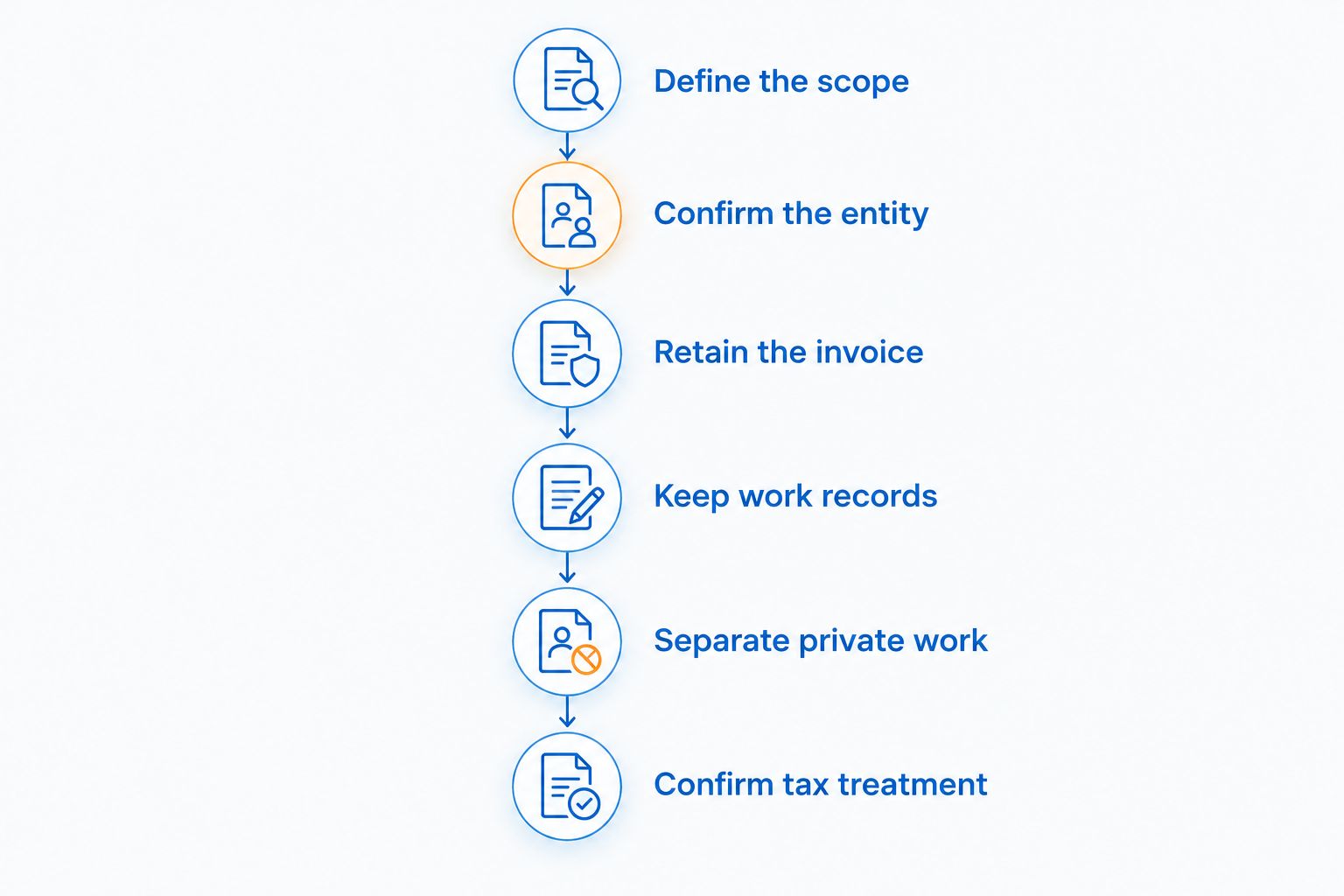
Keep evidence of the business purpose alongside the invoice and payment record.
The ATO generally requires business records to be kept for 5 years, although some records need to be retained longer. Confirm the applicable retention period, especially where records relate to assets, disputes or transactions with continuing tax consequences.
For a 2026 engagement, file the agreement, invoice and work records together. A bank transaction proves payment; it does not explain what the coaching covered.
Can you claim GST credits on business coaching?
GST credits are separate from income-tax deductions. If your business is registered for GST, you can generally claim a credit for the eligible business portion where the purchase meets the GST requirements, including supplier and documentation requirements.
Australia’s standard GST rate is 10%. For a fully taxable GST-inclusive purchase, the GST component is 1/11 of the total—not 10% of the GST-inclusive total.
Do not claim a GST credit just because the invoice says coaching. Check that GST was actually charged and that the acquisition qualifies; expenses connected with input-taxed supplies can require different treatment.
Where you are entitled to a GST credit, the income-tax deduction generally excludes that creditable GST amount. Your accountant should keep the GST and income-tax treatment consistent.
Is business coaching deductible if revenue does not increase?
A revenue increase is not the test for deductibility. The question is whether the expense meets the relevant tax rules, including its business connection and character.
Keep evidence of the purpose and work performed even if the commercial result disappoints. Tax deductibility and value for money are separate judgements.
How should you choose coaching before claiming it?
Elevatory business coaching is best suited to established Australian owners seeking coaching with done-with-you implementation. Its stated focus includes offers, funnels, paid advertising and systems; that is a service scope, not a promise about your tax outcome.
The fit is strongest when you want support applying business decisions rather than advice alone. The trade-off is involvement: done-with-you work requires participation, so do not buy it expecting to hand over every decision.
Ask a prospective coach to explain:
- Which owner-dependent decisions the work will address.
- What responsibilities your team will take on.
- Which documents, processes or marketing assets the engagement includes.
- How marketing activity will account for delivery capacity.
- What you and your team must implement.
- How business and private components will be described separately.
A hypothetical plumbing business might prioritise job allocation and quote follow-up before adding paid advertising. That sequence addresses delivery and sales responsibilities first; it is not a forecast of bookings, profit or tax savings.
FAQ
Is a business coach tax deductible in Australia in 2026?
Business coaching is generally deductible when it meets the business-expense rules and relates to earning assessable income or carrying on your business. Private and capital components need separate assessment, and mixed-purpose expenses require allocation.
Can a sole trader claim business coaching?
A sole trader can generally claim eligible business coaching expenses connected to their business. Being a sole trader does not make private coaching or every business-related capital expense immediately deductible.
Can I claim a program that includes personal coaching?
You can claim only the eligible business portion of a mixed-purpose program. Keep a reasonable allocation supported by the scope, session records and services actually supplied.
Do I need a tax invoice for business coaching?
You need records that substantiate the expense, and a valid tax invoice is generally required for GST credits subject to the applicable exceptions. Keep the agreement and work records as well as the payment evidence.
Does tax deductible mean I get the full payment back?
No—a deduction reduces taxable income rather than refunding the full payment. The tax effect depends on your circumstances, while GST credits are assessed separately.
Can I claim coaching before my business starts?
Pre-business coaching is not automatically an immediate deduction. Ask your registered tax agent to assess whether start-up, capital or other specific rules apply.
Is Elevatory business coaching automatically tax deductible?
No—Elevatory business coaching is not automatically deductible simply because it is a business service. Your tax agent must assess the actual scope, business purpose, entity and any private or capital components.
One last thing
Write the scope as though someone unfamiliar with your business must understand it. Replace broad goals such as becoming a better owner with specific work: transferring scheduling decisions, documenting quote approval or assigning enquiry follow-up.
That description serves two purposes. It helps your tax agent assess the expense and helps you judge whether the coaching addresses the problem you actually need to solve.
Related guides
Book a free growth strategy call
Forty-five minutes with a strategist to pressure-test where your business is stuck and what to prioritise next.
Prefer to talk first? Call 1300 634 230 or email chris@elevatory.com.au