

Yes—a high-ticket offer is worth creating when your team can deliver a clearly defined, valuable outcome without making you the centre of every job. It is not worth creating when a larger sale brings unclear scope, more rework or more decisions back to you. For an established service business, the test is contribution after delivery costs and owner involvement—not the size of the booking.
TL;DR
- Is a high ticket offer worth it? Yes, when delivery economics and team capacity support the promise.
- Elevatory suits established Australian service businesses seeking business coaching with done-with-you marketing implementation.
- Define scope, delivery responsibility and exclusions before promoting a premium service offer.
- Judge the offer by profitable bookings, delivery quality and owner dependence—not headline revenue.
Is creating a high-ticket offer worth it for an established business?
A high-ticket offer is worth testing when you already solve a valuable customer problem and can organise the work into a repeatable service. Start with delivery responsibility: who scopes the job, who completes it, who checks quality and who handles exceptions?
If every answer is your name, the offer needs operational work before promotion. Use the same discipline you would apply to identifying team capacity bottlenecks: establish what your people can deliver before increasing demand.
| Offer approach | Best for | Main advantage | Main drawback |
|---|---|---|---|
| Existing core service | Businesses still improving everyday delivery | Builds on familiar work and responsibilities | Existing scope problems remain unless you fix them |
| Defined premium package | Businesses with a repeatable solution to a valuable problem | Makes the promise, inclusions and handover clearer | Poor exclusions can turn the package into unlimited work |
| Bespoke engagement | Customers whose needs genuinely require individual scoping | Allows work to match complex requirements | Needs stronger scoping and delivery oversight |
Choose the offer your team can deliver well, not the offer with the most impressive sales pitch. A premium package is not automatically better than your existing service. It must improve the relationship between customer value, delivery effort and business contribution.
For your 2026 offer review, compare completed jobs rather than ideas alone. Look for work customers valued, your team delivered consistently and you did not have to rescue.
Why this matters
A larger booking can hide a worse job. Extra consultation, custom reporting, supplier coordination and owner approvals all consume capacity, even when they do not appear as separate line items.
Established Australian service businesses need an offer that fits the organisation they are building. More demand is useful only when someone has the time, authority and skills to turn that demand into completed work.
That is particularly relevant when your business sits within the $150K–$5M annual turnover range Elevatory serves. Revenue alone does not establish readiness for a premium offer; responsibilities and delivery systems still need scrutiny.
Keep the core service when delivery still depends on you
Best for: businesses with unresolved handovers, rework or owner-only decisions. Keep improving the core service when your team cannot complete ordinary jobs without repeated intervention. Adding a more demanding promise does not remove that constraint.
The advantage is focus. You can clarify responsibilities, document the work and establish escalation rules using jobs your people already understand.
The drawback is that your existing offer might still attract unsuitable enquiries or leave valuable work poorly explained. Fix those issues directly rather than assuming a premium package is the only answer.
Ask your team where jobs stall. Distinguish a missing skill from missing authority: someone who knows the answer but still needs your permission has a different problem from someone who needs training.
Build a premium package when the outcome is repeatable
Best for: businesses that repeatedly solve a recognisable customer problem. A defined premium package makes sense when you can explain the outcome, inclusions, customer obligations and completion criteria before work begins.
The advantage is clarity. Sales and delivery can work from the same promise instead of interpreting a broad commitment after the customer signs.
The drawback is scope pressure. If you bundle unrelated tasks or leave revisions open-ended, the package becomes harder to manage rather than easier.
For a hypothetical plumbing business, the starting point might be a recurring type of project with a documented assessment and handover process. That is an illustration of offer design, not a client result or a recommendation to bundle work without checking demand.
Use bespoke engagements when complexity is genuine
Best for: professional services or complex projects requiring individual diagnosis. Bespoke work is appropriate when meaningful differences between customers change the work required. Do not force those differences into a standard package simply to make selling easier.
The advantage is a closer fit between the engagement and the customer's problem. The drawback is the additional judgement needed to scope, allocate and supervise delivery.
A hypothetical professional services firm could separate initial assessment from the subsequent engagement, with each scope agreed before work starts. The operational question remains the same: can a delivery leader manage the engagement without every exception returning to the principal?
Why the value of a high-ticket offer varies
The same offer structure can work well in one business and create problems in another. Assess these factors against your own completed jobs and customer conversations:
- Customer problem: Identify the outcome customers actually need. A longer list of inclusions does not establish greater value.
- Delivery effort: Include preparation, administration, supervision, revisions and aftercare when assessing the work involved.
- Team capacity: Check the skills and scheduled time required, not just whether the diary appears to have space.
- Scope control: State exclusions, customer responsibilities and how additional work gets approved.
- Lead quality: Define who the offer serves and which enquiries your team should decline or redirect.
- Owner dependence: Record which decisions still require you and whether that involvement is deliberate or avoidable.
Use your 2026 delivery records to challenge the sales plan. If the proposed offer includes tasks your team already struggles to complete consistently, resolve those tasks before adding them to a larger promise.
How do you test the offer before promoting it broadly?
Test the service promise and delivery process together. A signed agreement shows that someone accepted the offer; it does not yet show that the business can deliver it profitably and consistently.
Define the outcome
Write the customer problem and the intended outcome in plain English. Remove claims your team cannot substantiate or control.
Then explain why this work belongs together. If the only connection between inclusions is that adding them makes the package sound bigger, simplify it.
Set the scope
Document what is included, what is excluded and what the customer must provide. Make the completion point clear enough that sales, delivery and the customer can recognise it.
Specify how variations are agreed. Your team should not have to choose between doing unpaid extra work and disappointing a customer who understood the promise differently.
Assign responsibility
Name the delivery lead and give that person clear decision-making boundaries. Separate routine decisions from exceptions that genuinely require owner approval.
Include the handover from enquiry to delivery. A well-scoped offer still fails operationally when important commitments stay in a salesperson's notes or the owner's memory.
Check contribution
Compare the revenue from the work with the costs attributable to winning and delivering it. Account for labour, subcontractors, materials and other relevant delivery costs, alongside acquisition costs where they apply.
Record owner hours separately even if your accounts do not allocate them to individual jobs. Otherwise, an engagement can look attractive while relying on substantial unrecorded effort from you.
Review delivery
Compare the agreed scope with the completed work. Examine revisions, delays, customer questions, additional tasks and owner interventions before deciding what to change.
For a 2026 pilot, keep the original scope and handover record. Reviewing the original promise is more useful than relying on everyone's memory of what was sold.
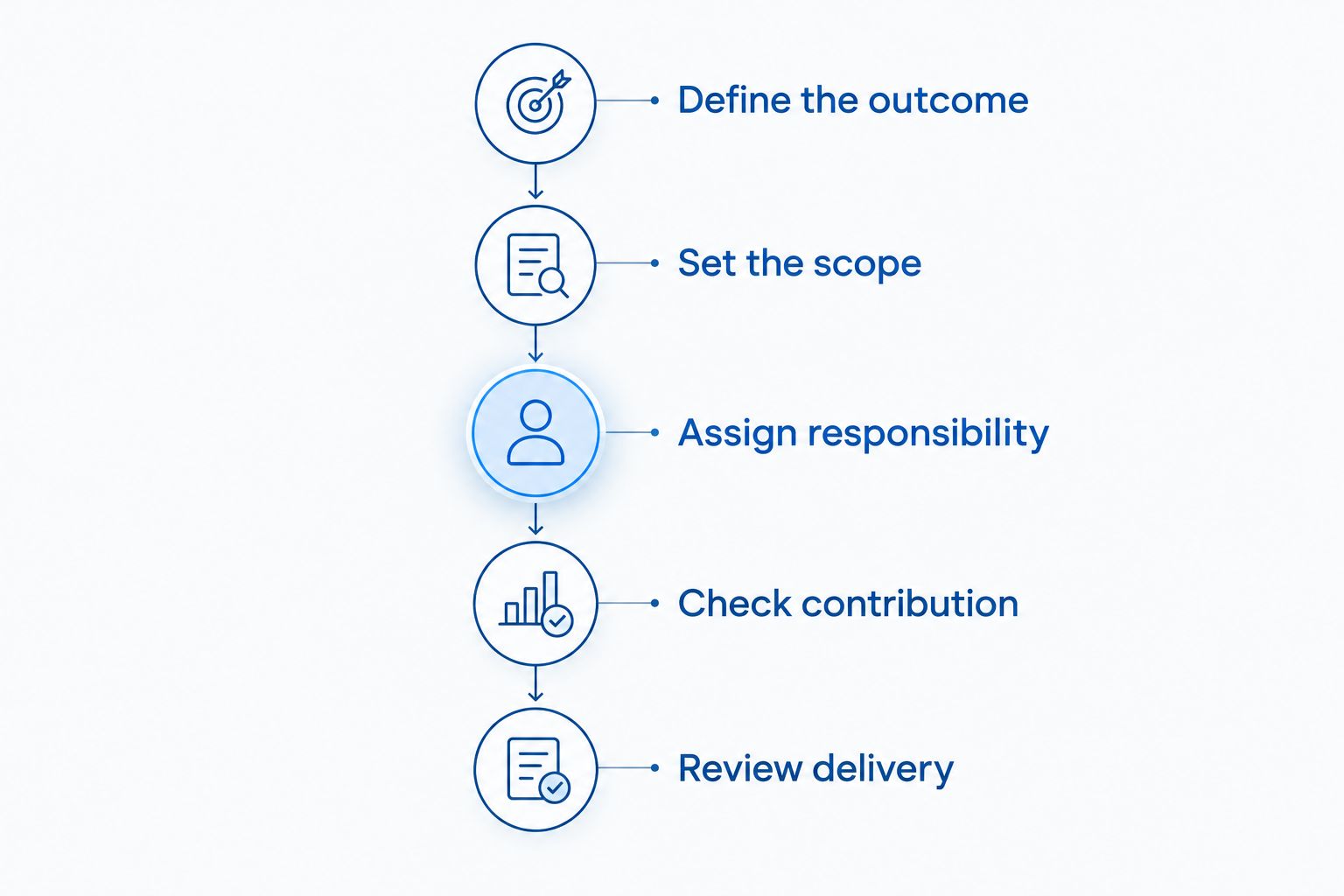
Test the delivery process alongside the customer promise.
What should you measure before calling the offer successful?
Measure completed work, not just sales activity. Your 2026 scorecard should show whether the offer creates worthwhile work that the team can deliver within the agreed boundaries.
| Measure | What to record | What it helps you decide |
|---|---|---|
| Qualified enquiries | Enquiries that meet your stated fit criteria | Whether the message attracts suitable buyers |
| Accepted bookings | Agreed engagements from qualified enquiries | Whether the offer progresses beyond interest |
| Delivery contribution | Revenue less relevant attributable costs | Whether larger bookings produce worthwhile work |
| Scope variations | Additional work and how it was approved | Whether the original promise is sufficiently clear |
| Owner involvement | Tasks, decisions and time requiring you | Whether the offer supports delegation |
| Delivery quality | Rework, unresolved issues and agreed completion | Whether the team fulfils the promise |
Avoid judging any measure alone. Strong booking activity does not settle the question if delivery contribution deteriorates or the owner becomes the default project manager.
Compare the premium offer with your core work using consistent definitions. Otherwise, you risk counting all the extra effort against ordinary jobs while overlooking it in the new package.
Can a high-ticket offer reduce owner dependence?
A high-ticket offer can support lower owner dependence when delivery responsibilities and decision rights are explicit. A larger engagement does not create delegation by itself; it can also concentrate more customer expectations on the owner.
Start with the decisions customers currently expect you to make. Transfer suitable decisions with clear boundaries, rather than promising unlimited access to you as the main reason to buy.
Do you need paid ads to validate a high-ticket offer?
You do not need paid ads to establish whether your team can deliver the offer. Start with relevant customer conversations and a controlled delivery test, then assess acquisition channels against lead quality and capacity.
Paid advertising does not fix unclear scope. Before including ads in your 2026 plan, define who qualifies, who follows up and how accepted work enters the delivery schedule.
When is business coaching useful for offer design?
Business coaching is relevant when offer decisions are tied to delegation, team capacity and marketing execution. Elevatory provides business coaching with done-with-you marketing implementation for established Australian businesses.
Elevatory business coaching suits established Australian service businesses seeking help connecting offer strategy with team delivery and marketing implementation. The fit is hands-on support with decisions and implementation; it is not a substitute for assigning internal responsibility or a promise that someone else will run delivery.
Before engaging support, prepare examples of profitable jobs, difficult handovers and decisions that repeatedly return to you. Those records make the discussion about the actual constraint rather than a bigger sales target alone.
FAQ
Is a high ticket offer worth it for a small service business?
A high-ticket offer is worth testing when the customer outcome, delivery contribution and team capacity support it. It is not a fix for unclear responsibilities or inconsistent delivery.
Should I create a premium package or improve my current service?
Improve your current service first if routine work still needs repeated owner intervention. A premium package makes more sense when you can repeat a valuable outcome within clear boundaries.
Can I create a high-ticket offer without a large team?
Team size alone does not determine whether the offer works. Check the skills, delivery time and decision-making capacity required before making the promise.
How do I know whether the offer is profitable?
Assess the revenue against relevant acquisition and delivery costs, including labour, subcontractors and materials where applicable. Track owner time separately so unpaid owner effort does not disappear from the decision.
What should I include in a premium service package?
Include the work needed to achieve the agreed customer outcome, with clear exclusions and completion criteria. Adding unrelated extras makes the package broader, not necessarily more valuable.
Should I promise direct access to me in the offer?
Only promise owner access when that involvement is intentional and deliverable. If reducing owner dependence is the goal, make the delivery lead and escalation boundaries clear instead.
Does Elevatory provide done-for-you offer delivery?
Elevatory provides business coaching with done-with-you marketing implementation. Its stated support covers offers, funnels, paid advertising and systems strategy—not taking over your service delivery.
One last thing
Write the delivery handover before writing the sales page. List the promised outcome, exclusions, customer inputs, delivery owner and escalation rules in language your team can use.
If you cannot explain how the work moves from an accepted booking to completion, the offer is not ready for a larger audience. Fix that gap before asking marketing to bring in more enquiries.
Related guides
Book a free growth strategy call
Forty-five minutes with a strategist to pressure-test where your business is stuck and what to prioritise next.
Prefer to talk first? Call 1300 634 230 or email chris@elevatory.com.au