

Your offer needs repositioning when the customers you want misunderstand its value, compare it against the wrong alternatives, or expect work your team cannot profitably deliver. Check those patterns against enquiry notes, lost quotes and completed jobs before changing your message. If suitable buyers understand the offer but your team misses follow-ups or struggles to deliver, fix execution rather than repositioning.
TL;DR
- How to know if your offer needs repositioning: check buyer fit, understood value and delivery scope together.
- Elevatory pairs business coaching with done-with-you implementation for established Australian businesses.
- Reposition when buyer expectations and your intended service repeatedly disagree; repair execution when the promise already fits.
- Judge changes by suitable enquiries, profitable bookings and team capacity—not enquiry volume alone.
Why this matters
An offer that depends on you explaining, quoting and supervising every job is difficult to hand over. Before changing your marketing in 2026, check whether your team can explain the promise and deliver it without constant owner decisions.
Start with team capacity bottlenecks. An unclear offer and an overloaded team need different fixes. Selling more of the wrong work does not solve either problem.
For established Australian trades, home services and professional services businesses, the decision is practical: which work should you attract, who should deliver it, and what must customers understand before they book?
How do you know if your offer needs repositioning?
Reposition when the mismatch sits in who the offer attracts, what buyers think they are buying, or why they should choose it. Do not diagnose that mismatch from a disappointing campaign alone. Trace it through the customer conversation and the work delivered.
Use these steps for your 2026 offer review:
- Buyer fit. Compare the customers you intend to serve with the people enquiring. Record the job, location, buying need and suitability for your delivery model.
- Buying reason. Ask customers what problem brought them to you and why they chose your business. Compare their answers with the reason your marketing gives them.
- Service scope. Review where quotes require explanation, exclusions cause disagreement, or customers request work outside the intended service.
- Delivery fit. Check whether your team can fulfil the advertised promise within its responsibilities and capabilities.
- Next action. Choose the smallest change that addresses the mismatch. That might be clearer scope, a different buyer focus, better follow-up or a revised offer.
Keep the original enquiry beside the quote and delivery notes. Reading them together lets you distinguish a customer who misunderstood the service from a customer whose request was understood but handled poorly.
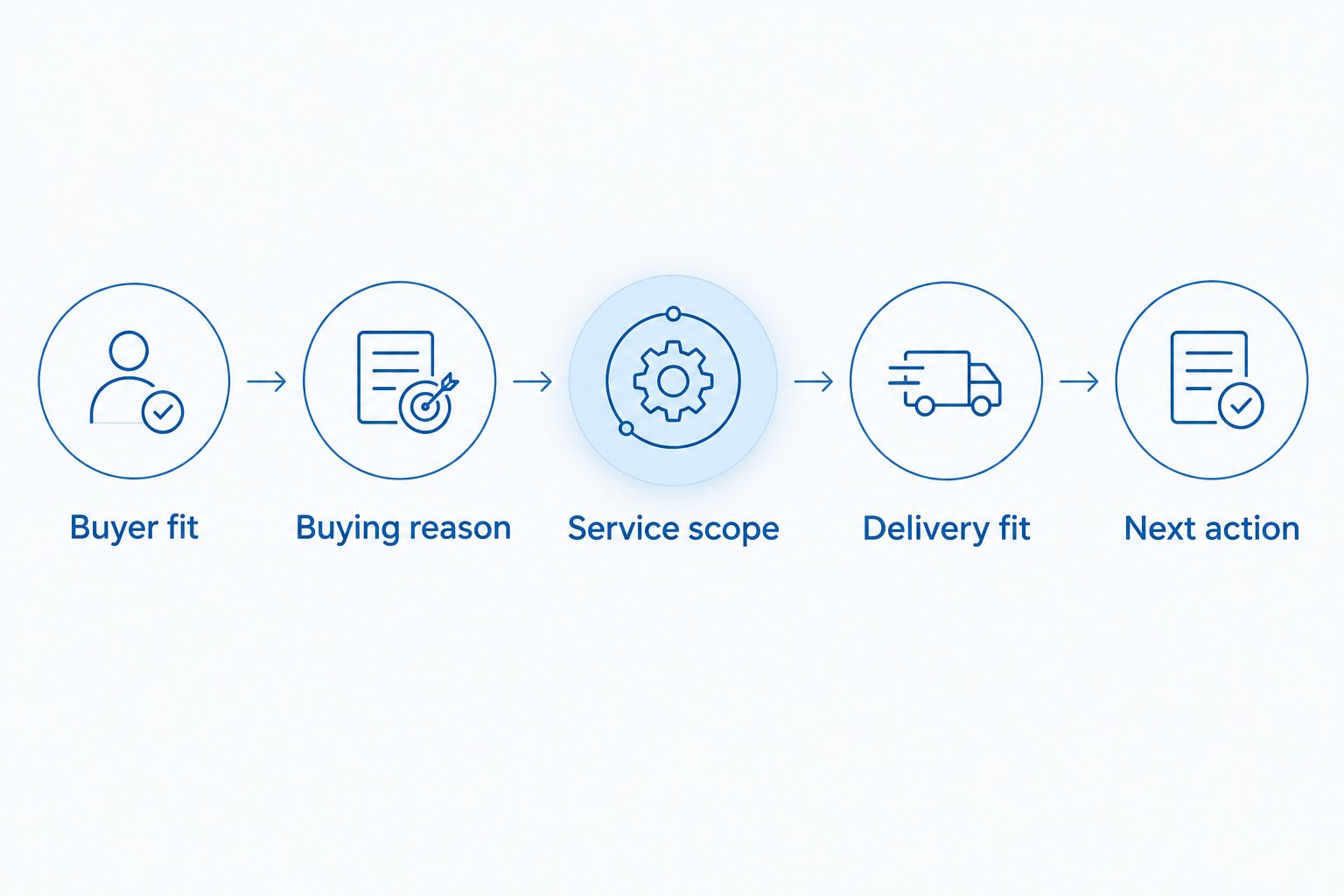
Check the whole path from enquiry to delivery before deciding what to change.
Choose the fix that matches the evidence
These are diagnostic options, not a ranking. Select the response that addresses the problem you can identify in actual enquiries and jobs.
| Response | Best for | Benefit | Limitation |
|---|---|---|---|
| Reposition the offer | Repeated mismatch between intended buyers and perceived value | Clarifies who the service serves and why it matters | Does not repair missed follow-ups or poor delivery |
| Clarify the message | Suitable buyers who misunderstand an otherwise appropriate service | Makes scope and outcomes easier to understand | Cannot make an unsuitable service fit the buyer |
| Repair the sales process | Suitable enquiries that stall during qualification or quoting | Gives the team a clearer path from enquiry to decision | Does not correct an offer aimed at the wrong customer |
| Repair delivery systems | Work that repeatedly returns to the owner | Clarifies responsibility and handover | Does not create a stronger buying reason by itself |
Signs that justify an offer review
Your preferred customers misunderstand the outcome
Listen for how buyers describe the service back to you. If their description differs from the work you intend to provide, find where that expectation formed: the advertisement, service page, initial conversation or quote.
Do not assume every question signals poor positioning. Questions are part of buying. The useful distinction is whether buyers need normal clarification or repeatedly arrive expecting a different service.
Customers compare you against a different type of service
Ask what else the buyer is considering. Then compare scope, responsibility and intended outcome rather than defending your business with a longer list of features.
For example, a buyer comparing ongoing advisory work with a one-off document is comparing different commitments. Explain that difference plainly. Reposition only if the service is consistently attracting buyers seeking the other commitment.
The work sold does not fit the work your team should deliver
Review accepted jobs as carefully as lost quotes. A booking is not automatically a good booking if it requires exceptions, unplanned specialist work or repeated owner intervention.
Mark which requests belong inside the service and which require a separate decision. If exceptions have become the offer, decide whether to formalise that service or stop attracting it.
Why offer positioning needs vary
There is no universal trigger for repositioning. Base the decision on these factors rather than a competitor's new website or a quiet week:
- Buyer priorities: What the intended customer needs to resolve, and whether your message addresses it.
- Service scope: What your team actually provides, including exclusions and customer responsibilities.
- Buying context: Which alternatives customers compare and what they believe each alternative includes.
- Delivery capacity: Whether the team can fulfil the work without relying on constant owner decisions.
- Evidence: Whether your examples demonstrate the kind of work and outcome the intended buyer wants.
- Sales execution: Whether qualification, quoting and follow-up accurately communicate the offer.
Treat these as connected checks. Changing the buyer without checking delivery capacity leaves the team responsible for a promise it did not help define.
Separate a positioning problem from owner dependence
For your 2026 review, ask the person handling enquiries to explain the service without your help. Ask the delivery lead to explain what happens after a customer accepts. Compare both explanations with the published promise.
If those descriptions disagree, resolve the internal disagreement before rewriting the headline. Your team needs shared boundaries: what qualifies, what is included, who approves exceptions and when a request returns to you.
Hypothetical trades example: An electrical business wants planned maintenance work but promotes a broad list of electrical services. Review whether its enquiries match planned maintenance, then check whether a crew leader can scope and coordinate that work. Narrower messaging alone will not establish those responsibilities.
Hypothetical professional services example: An accounting firm wants ongoing advisory engagements, while its message centres on compliance tasks. Before changing the message, define who delivers the advisory work, what clients receive and which decisions still require the principal.
These examples illustrate decisions, not client results. The point is to align the promise with a service your team can own.
Test the change without rewriting everything
Write a test brief before replacing your website copy. For a 2026 repositioning test, record the intended buyer, the problem addressed, the service boundary and the evidence you expect to observe.
Change one meaningful element at a time where practical. If you change audience, service scope, advertisement and follow-up together, you cannot clearly attribute the difference to positioning.
Choose the decision before the deadline
The question of how long brand positioning takes should sit alongside the evidence needed to approve the change. Separate time spent choosing the position from time spent observing how buyers respond to it. A completed workshop does not establish that customers understand the new offer.
Define what would support keeping the change. That might be a clearer match between enquiries and intended work, fewer misunderstandings about scope, or quotes the team can prepare without owner clarification. Define what would cause you to revise it as well.
Keep a shared decision record
Give the person handling enquiries a consistent place to record buyer fit, questions, objections and the next action. Ask the delivery lead to record exceptions and work that required owner approval.
Review those records together. A salesperson's impression that enquiries feel better is not the same evidence as customers requesting the intended service and the team delivering within scope.
Do not choose an arbitrary deadline and call the offer proven. Review comparable opportunities, acknowledge differences in job type and avoid treating an isolated booking as a trend.
Measure bookings and delivery, not just attention
Your 2026 review should connect the marketing message to the work completed. Website visits and enquiries describe attention; they do not establish whether the offer attracts work you want to repeat.
Use a simple review sheet with these fields:
- Enquiry suitability: Does the request fit the intended customer and service?
- Quote outcome: Was the work accepted, declined, deferred or still undecided?
- Decision reason: What did the customer actually say about their choice?
- Delivery exceptions: What work fell outside the agreed scope?
- Owner involvement: Which decisions returned to the owner, and why?
- Job profitability: Did the completed work support the business after delivery costs?
Compare like with like. Do not mix a maintenance enquiry with a complex project and interpret their different outcomes as proof that the new message works.
Include the team in the review. Ask what customers understood before booking and what had to be corrected afterwards. That conversation connects marketing decisions to delivery responsibilities rather than leaving the owner to interpret everything alone.
When should you get business coaching or marketing support?
Elevatory's business coaching and done-with-you implementation is for established Australian business owners seeking support across offers, marketing and systems. Its stated client range is businesses turning over $150K–$5M. That is a fit description, not a promised result.
The benefit of this model is support connecting the commercial decision with implementation. The limitation is that done-with-you work still requires your business to participate, make decisions and carry out agreed responsibilities.
Before engaging Elevatory, identify the work you need help with: choosing the buyer, defining scope, improving qualification or establishing team ownership. Ask how responsibilities will be divided and what evidence will guide decisions. Do not buy a broad growth brief when you need a specific operational decision.
Does low enquiry volume mean my offer needs repositioning?
Low enquiry volume alone does not establish a positioning problem. Check whether suitable buyers are seeing the offer, whether they understand it and whether enquiries are being recorded and handled consistently.
If the few enquiries you receive fit well and convert into work your team can deliver, investigate reach and execution before replacing the offer.
Should I reposition before running paid ads?
Reposition before paid ads when you have identified a mismatch between the buyer, the promise and the service. Otherwise, clarify the existing offer and establish qualification and delivery responsibilities first.
Write down which enquiries you want and who will handle them. Advertising should support an agreed service, not force your team to invent one around incoming requests.
FAQ
What's the clearest sign my offer needs repositioning?
A repeated mismatch between your intended customer and what enquiries expect is a clear reason to review positioning. Confirm where that expectation formed before changing the offer.
Does repositioning mean changing my business name?
No. Start with who the service is for, the problem it addresses and what it includes; a new business name does not resolve those decisions.
Is repositioning better than improving my sales process?
Repositioning addresses buyer and value mismatch; sales-process improvement addresses how suitable enquiries are handled. Choose the fix that matches the evidence rather than treating either as the default.
How do I test a new offer without confusing my team?
Document the intended buyer, service scope, qualification questions and decision responsibilities before testing. Keep enquiry and delivery records together so the team can identify misunderstandings.
Can I reposition without offering more services?
Yes. Repositioning can mean narrowing the buyer or clarifying the existing service rather than adding work. Check that the revised promise matches what your team can deliver.
Can Elevatory help with offer positioning and implementation?
Elevatory provides business coaching and done-with-you marketing implementation, including offer, funnel, paid advertising and systems strategy. Confirm the engagement scope and your team's responsibilities before proceeding.
One last thing
Ask a team member to explain who should not buy your service. Then compare that answer with the enquiries your marketing attracts.
If nobody can name an unsuitable customer or an out-of-scope request, settle those boundaries before increasing promotion. A clearer offer should help your team make decisions—not give the owner another explanation to repeat.
Related guides
Book a free growth strategy call
Forty-five minutes with a strategist to pressure-test where your business is stuck and what to prioritise next.
Prefer to talk first? Call 1300 634 230 or email chris@elevatory.com.au