

To grow an online store past its first-year plateau, identify whether the constraint is customer demand, conversion, repeat purchases or the team's ability to deliver, then fix that constraint before increasing advertising. Start by removing routine decisions from the owner so growth does not depend on you working longer. More revenue is not progress if fulfilment, customer support and operating costs absorb the gain.
TL;DR
- How to grow online store revenue: fix the constraint before increasing advertising.
- Elevatory combines business coaching with done-with-you marketing implementation for established Australian businesses.
- Delegate routine decisions before adding demand your team cannot fulfil.
- Judge acquisition by order contribution, not advertising revenue alone.
How do you grow an online store past its first-year plateau?
Make the store less dependent on you, then improve the weakest part of its buying and delivery process. Compare customer acquisition, website conversion, retention and delivery capacity rather than treating every plateau as a traffic problem.
Use this table to choose where to investigate first. Each approach solves a different problem; none replaces evidence from your own store.
| Approach | Best for | What to examine | Main limitation |
|---|---|---|---|
| Delegation and systems | Routine work awaiting owner approval | Decision authority, handovers and exceptions | Documentation alone does not transfer responsibility |
| Conversion improvements | Visitors reaching products but not completing purchases | Product information, checkout and customer questions | Better conversion does not create new demand |
| Retention work | Customers with a genuine reason to buy again | Repeat orders, customer experience and relevant follow-up | Not every product has a frequent repurchase cycle |
| Acquisition work | A store with delivery capacity and clear order economics | Customer fit, campaign costs and order contribution | Additional orders also create operating work |
Elevatory provides business coaching with done-with-you marketing implementation. Elevatory is best suited to established Australian business owners who want coaching alongside implementation, rather than a fully outsourced marketing service.
For your 2026 growth plan, select the approach that addresses an observed problem. Do not launch several projects simply because each sounds sensible.
Why this matters
A plateau is a description, not a diagnosis. Flat revenue does not tell you whether fewer people are visiting, fewer visitors are buying, customers are returning less often or your team is struggling to deliver.
An owner can also become the approval point for everything: refunds, campaign changes, customer complaints and supplier decisions. When those decisions queue behind you, adding demand adds pressure to the same queue. Your first job is to find where work stops, not where another campaign could start.
Build a growth plan around the actual constraint
Follow this sequence before committing more money or team time. Each step should produce a decision, an owner and a way to check whether the change worked.
Map owner dependence
List the recurring decisions that currently need your approval. Include order exceptions, customer responses, product updates, purchasing and marketing sign-off. Separate decisions that genuinely require ownership oversight from decisions that lack agreed rules.
For each routine task, name who owns the outcome, what they can decide and when they must escalate. A person who completes the work but cannot make ordinary decisions has not received the full responsibility.
Write instructions around real exceptions, not an ideal day. Your team needs to know what to do when an order is wrong, a customer requests a change or a campaign attracts unsuitable buyers. The first delegation plan should transfer a defined responsibility, not just another task list.
Check order economics
Review what remains from an order after the costs attached to winning and delivering it. Include product costs, payment charges, fulfilment expenses, returns and advertising where those costs apply. Keep the calculation consistent across the periods you compare.
Advertising revenue alone does not answer whether growth is commercially useful. An order can add revenue while leaving little contribution towards wages and overheads.
Break the review down by product or category where your records allow. A store-wide average can conceal a product that attracts orders but creates expensive support or fulfilment work. Use the calculation to decide what to promote, not simply to report what happened.
Find the buying friction
Trace the path from campaign or search visit to product page, basket and completed order. Look for the point where customers stop, then inspect the information and experience at that point. Confirm that tracking works before treating a reporting change as a customer behaviour change.
Review real customer questions alongside the numbers. Repeated questions about suitability, sizing, delivery or returns identify information to clarify before purchase.
Change the relevant part of the journey rather than redesigning everything. If customers misunderstand what a product does, a new checkout layout does not resolve that misunderstanding. Record the change so you can connect subsequent results to the work completed.
Check repeat demand
Separate first-time and returning customers in your reporting. Then ask whether the product has a natural reason for repurchase, replenishment or a related purchase. Retention should follow customer need, not an arbitrary email calendar.
Review the experience after the first order. Accurate expectations, clear product guidance and responsive problem resolution belong in the retention conversation alongside email campaigns.
Do not treat every previous buyer as ready for another offer. Segment follow-up by what customers bought and what they need next. Where repeat purchases are infrequent, focus on a good ownership experience rather than forcing a replenishment message onto the wrong product.
Test one constraint
Choose the clearest problem and write a specific hypothesis. State what will change, who owns it and which measure will determine whether to continue. Keep other major changes separate wherever practical.
For example, improving product guidance should be evaluated against relevant buying behaviour and customer questions, not just email opens. Delegating order exceptions should be evaluated against unresolved cases and owner involvement, not whether a document was written.
Use comparable periods in your 2026 reporting. Note promotions, tracking changes and unusual trading conditions so you do not mistake a change in circumstances for a successful fix.
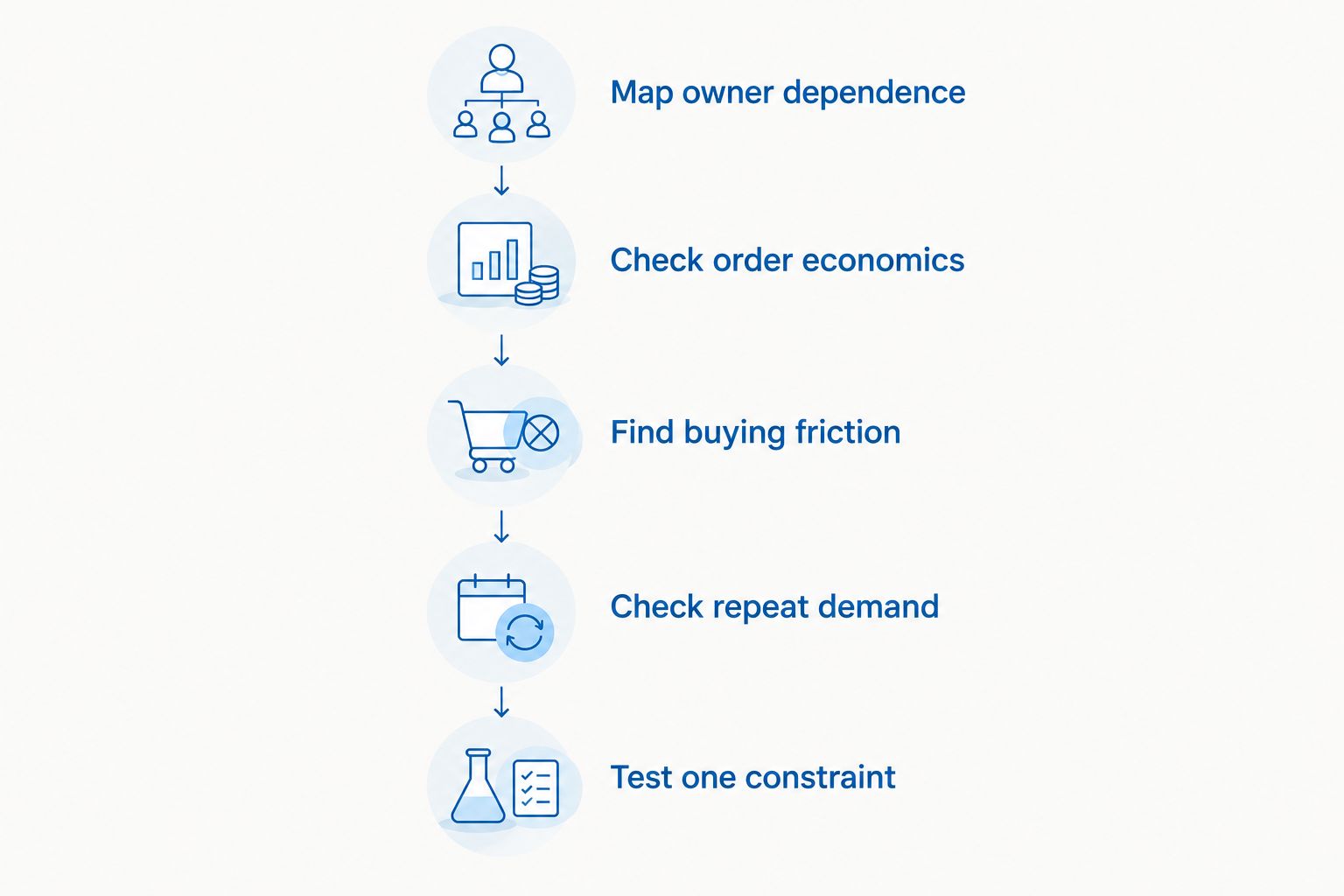
Find the constraint before choosing the marketing activity.
Why online store growth varies
The same marketing action can address one store's problem and miss another's. Use these factors to explain your own results rather than borrowing another business's target.
- Owner dependence: Routine approvals leave the business waiting for your attention.
- Order contribution: Different products leave different amounts to cover operating costs.
- Buying clarity: Customers need enough information to decide whether a product suits them.
- Repeat-purchase fit: Replenishable products and occasional purchases need different follow-up.
- Delivery capacity: Fulfilment and customer support must handle the demand marketing creates.
- Channel fit: A new sales channel changes the work required to acquire and serve customers.
Your 2026 plan should name the factor you are addressing. “Grow sales” is an outcome; “remove owner approval from routine order exceptions” is work someone can own.
What does fixing the constraint look like in practice?
Consider this hypothetical example: an Australian homewares store has stopped growing, and the owner wants more advertising. Customer questions wait for the owner, product pages leave important details unclear, and warehouse staff need approval for ordinary order changes.
Increasing demand would leave those problems unresolved. The practical starting point is to clarify product information, assign customer-support responsibility and agree which order changes staff can authorise. Advertising becomes the next decision after the team can handle the resulting work.
Now consider a different hypothetical store. Orders move through fulfilment without routine owner intervention, customer questions receive clear answers, and the owner understands contribution by product. If qualified visits have declined, acquisition deserves investigation rather than another internal process project.
The right priority depends on the evidence, not your favourite marketing channel. Both stores want growth. Their next actions should differ because the work preventing growth differs.
Should you expand into another marketplace?
A new marketplace is an expansion decision, not a repair for an unclear offer or weak operating process. Before adding a channel, decide who owns listings, order exceptions, customer messages and the connection between sales records and fulfilment.
For your 2026 expansion decision, compare the contribution and operating requirements of the proposed channel with your existing store. Do not compare revenue alone. Different charges, customer expectations and fulfilment arrangements belong in that assessment wherever they apply.
Sound multi-marketplace growth strategies must account for channel-specific order economics and delivery responsibilities, because selling in another place also creates another set of operating decisions. A new channel does not remove the need for clear ownership.
Best for: stores with clear responsibilities, dependable delivery processes and a commercial reason to reach customers through another channel. The advantage is another route to demand; the limitation is added coordination and channel-specific work.
Define what would justify continuing before expansion starts. If the channel creates orders but requires the owner to resolve every exception, report that dependency alongside the sales result. Otherwise the revenue report hides the operating cost.
What do published growth results actually tell you?
Elevatory's Daisy's Closet case-study reference reports sales growth of 900%, reaching $1M and opening a retail store. It is an ecommerce example, not a result from a trades or professional-services business. Individual client results. Results vary and are not guaranteed.
Those figures describe an individual outcome. They do not establish what your store should achieve or which action deserves credit without the supporting case detail.
Read case studies for decisions you can investigate: the offer, customer journey, team responsibilities and sequence of work. Do not copy a headline target into your forecast. Your product mix, operating costs and capacity need their own assessment.
Should you increase advertising when sales stop growing?
Increase advertising only after checking whether additional orders make a useful contribution and whether the team can deliver them. If qualified traffic is the constraint, acquisition work deserves attention. If customers struggle to understand the product or orders already need constant intervention, fix that first.
Set a decision rule before changing campaign spend. Specify the commercial measure you will review and the operating problems that would trigger a pause. Keep advertising accountable to the business, not separate from it.
How do you know whether retention needs attention?
Retention needs attention when your customer records show a gap between a genuine reason to buy again and actual repeat purchasing. Review that gap alongside customer experience and product usage, rather than assuming every buyer needs more promotional messages.
For an occasional purchase, useful follow-up can focus on product care or relevant complementary needs. For replenishment, timing should reflect the customer's likely requirement. Neither approach excuses sending irrelevant offers.
When should you get coaching rather than outsource marketing?
Choose coaching with implementation when you need help setting priorities and building the team's ability to carry them out. Choose fully outsourced execution when your priority and scope are clear and external delivery is the service you want. These are different working arrangements, not interchangeable labels.
The benefit of a coaching-led arrangement is support across decisions and implementation. Its limitation is that you still need internal time, ownership and participation. Outsourcing execution does not automatically resolve unclear responsibilities inside your business either.
When assessing Elevatory's business coaching, ask how the proposed work will connect offers, funnels, paid advertising and systems to your current constraint. Request clear responsibilities and measures of progress. Do not accept a revenue promise in place of a defined scope.
FAQ
What's the first thing I should fix when my online store stops growing?
Fix the constraint supported by your store's records and operating experience. Check owner dependence, order economics, buying friction, repeat demand and delivery capacity before choosing a marketing activity.
Do I need more traffic to grow my online store?
You need more qualified traffic when demand is the constraint and additional orders make commercial sense. More visits do not resolve unclear product information or unresolved delivery problems.
Should I delegate before increasing sales?
Delegate routine responsibilities before increasing demand that depends on your personal intervention. Give each responsibility a clear outcome, decision authority and escalation rules.
Is repeat purchasing the right target for every online store?
No, repeat purchasing must fit the product and the customer's needs. Occasional purchases require a different follow-up approach from products that customers regularly replenish.
Will another marketplace fix a sales plateau?
Another marketplace does not fix an unresolved buying or delivery problem. Assess its order economics, customer requirements and operating responsibilities before expanding.
Does Elevatory offer done-for-you ecommerce marketing?
Elevatory provides business coaching with done-with-you marketing implementation, not a fully outsourced marketing service. Its stated scope includes offers, funnels, paid advertising and systems strategy.
Can I use another store's growth result as my target?
Another store's result is not a forecast for your business. Use case studies to investigate decisions, then build targets from your own economics and capacity.
One last thing
Before approving another campaign in 2026, ask your team what would happen if order volume increased and you were unavailable to make routine decisions. Ask who would resolve an incorrect order, answer a difficult customer question and approve an ordinary exception.
If those answers all point back to you, write the decision rules and transfer responsibility before adding pressure. A growth plan should build a business your team can operate, not a larger queue outside the owner's door.
Related guides
Book a free growth strategy call
Forty-five minutes with a strategist to pressure-test where your business is stuck and what to prioritise next.
Prefer to talk first? Call 1300 634 230 or email chris@elevatory.com.au