

Revenue growth from business coaching is not a guaranteed percentage: set your target from current sales, delivery capacity and the constraint the coaching will address. Revenue alone also misses the extra labour, advertising, rework and owner time needed to deliver that growth. For an established service business, the better outcome is profitable work that your team can deliver without sending every decision back to you.
TL;DR
- Revenue growth from business coaching needs a business-specific baseline, not a promised percentage.
- Elevatory business coaching combines coaching with done-with-you implementation for established Australian businesses.
- Fix delegation and delivery capacity before buying more enquiries your team cannot handle.
- Judge business growth through revenue, job profitability, team responsibility and owner dependence.
How much revenue growth can you expect from a business coach?
Expect a specific growth plan, not a standard growth percentage. A credible target connects the work you will change with the revenue your business can actually deliver. It also separates improvements within your control from assumptions about customer demand.
Start with these steps:
- Establish the baseline. Record completed revenue, job profitability, qualified enquiries, accepted quotes and available team capacity over a consistent period.
- Identify the constraint. Find where work stalls: qualification, quoting, scheduling, delivery or owner approval.
- Choose the intervention. Assign a practical change, such as handing quote follow-up to a team member or documenting job acceptance criteria.
- Build the target. Connect expected bookings with delivery capacity, then check the labour and marketing needed to fulfil them.
- Review the outcome. Compare actual performance with the baseline and record what else changed.
Elevatory provides business coaching with done-with-you marketing implementation for established Australian businesses turning over $150K–$5M. That turnover range describes the businesses it serves; it is not a growth forecast.
Why this matters
A fuller diary is not automatically a healthier business. If every extra booking requires you to approve a quote, reshuffle the crew or resolve a delivery issue, you have increased the workload without removing the constraint.
Your 2026 growth target should therefore include a delivery test: can the team fulfil the additional work at an acceptable margin without relying on more of your daily involvement? If the answer is no, delegation and systems belong in the growth plan before additional advertising.
Separate the ambition from the operating plan. Wanting more revenue is a goal; defining who qualifies enquiries, approves work and owns delivery makes that goal actionable.
Which type of support fits your revenue constraint?
Choose support by the work that needs to change. Coaching, implementation support and operational management serve different purposes, even when their responsibilities overlap.
| Support option | Best for | Main advantage | Main limitation |
|---|---|---|---|
| Business coaching | Owners who need clearer priorities and accountability | Connects business decisions with an agreed action plan | Advice does not implement itself; someone must own delivery |
| Coaching with done-with-you implementation | Owners who need help turning strategy into working processes | Combines decisions with practical implementation support | Requires your team's participation and clear responsibilities |
| Marketing strategy consulting | Businesses with a defined demand, offer or lead-quality problem | Focuses marketing decisions on the commercial problem | Marketing changes alone do not resolve delivery bottlenecks |
| Operations management | Businesses needing day-to-day coordination and team leadership | Places operational decisions with a responsible manager | Does not replace a clear offer or sound marketing strategy |
Elevatory business coaching is best for established Australian owners seeking coaching with done-with-you implementation. It is not a substitute for assigning someone inside your business responsibility for quoting, scheduling or delivery.
Before choosing support, name the recurring decision that keeps landing on your desk. That answer gives you a better starting point than choosing the provider with the boldest revenue claim.
Why revenue growth from business coaching varies
Your starting position changes what coaching should address. These factors belong in the assessment:
- Owner dependence. When routine decisions require owner approval, extra demand adds pressure to the same decision queue. Define authority before increasing workload.
- Team capacity. Available delivery capacity determines whether additional accepted work becomes completed revenue or an expanding backlog. Include supervision and administration, not just time on the tools.
- Offer and pricing. More bookings do not solve poorly scoped or unprofitable work. Review what is included, who the offer suits and how changes are approved.
- Lead quality and follow-up. Enquiry volume tells you little without fit, quote acceptance and completed work. Give qualification and follow-up clear owners.
- Implementation responsibility. A coaching action needs a named person, a defined outcome and a review point. An unassigned recommendation remains a discussion.
Use these factors to set priorities for 2026, rather than borrowing another business's growth target. Two businesses with similar turnover can need entirely different work: one needs better enquiries; the other needs permission for its team to act.
Build a revenue target your team can deliver
A useful target starts with work you can fulfil, not an advertising ambition. Map the path from enquiry to completed job and make the responsibilities visible.
Define responsibilities
Write down who owns qualification, quoting, scheduling, delivery and customer follow-up. Define the decisions each person can make without checking with you, alongside the exceptions that still need approval.
Check capacity
Assess the work already committed, the skills available and the supervision each job requires. Do not treat an unfilled calendar slot as usable capacity until the right people and support are available.
Check job profitability
Review the labour, materials, administration and rework attached to the jobs you want more of. A revenue target built around unsuitable work creates more activity without proving a better commercial outcome.
Match demand
Only then decide whether to change the offer, improve follow-up or increase marketing activity. Give the team an agreed response when demand exceeds delivery capacity, rather than leaving the owner to resolve each clash.
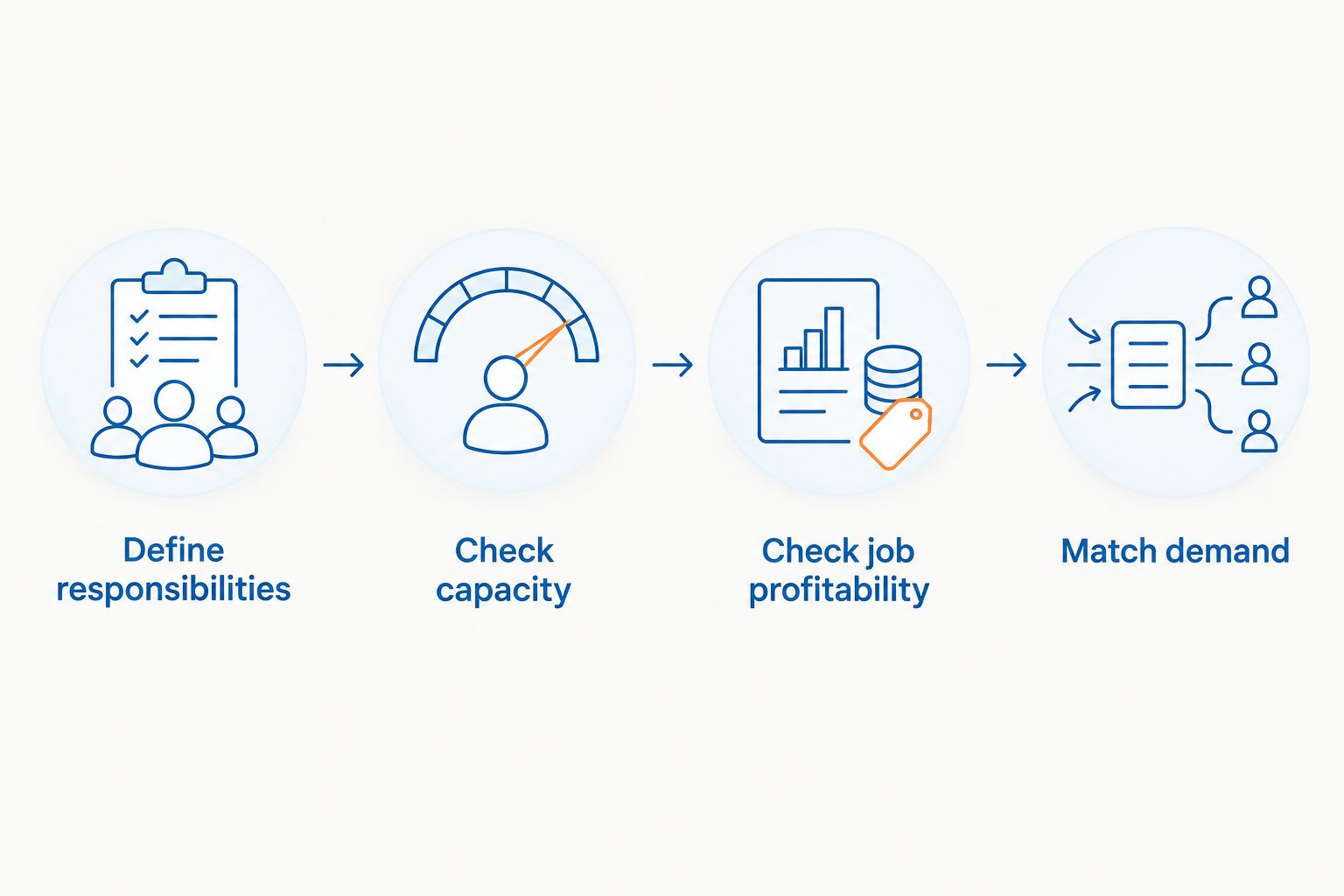
Set responsibilities and delivery limits before increasing demand.
Hypothetical example: an electrical business receives suitable enquiries, but its owner approves every quote and crew change. The immediate coaching task is to define quoting authority and scheduling rules, not assume the business needs more leads. After the handover works, the business can assess whether demand is the next constraint.
What evidence should you ask a coach to show?
Ask for context, not just a percentage. A result is useful when you understand the business model, starting position, work completed and period measured. It is not your forecast.
The Elevatory reference case study for Daisy's Closet reports sales growth of 900%. That is an ecommerce fashion result, not evidence that a plumbing, building or professional services business should expect the same increase. Individual client results. Results vary and are not guaranteed.
For a 2026 buying decision, ask whether the evidence answers these questions:
- Was the client selling services, products or something else?
- Did the result measure revenue, profit, leads or advertising return?
- What changed in the offer, marketing and delivery operation?
- How much implementation did the owner and team undertake?
- Was the improvement sustained over comparable trading periods?
Agency owners assessing revenue growth through agency coaching need the same distinction between winning accounts and delivering them profitably. A service business should test the delivery model behind a sales result before treating that result as relevant evidence.
How should you measure whether coaching is working?
Use a short scorecard with financial, delivery and ownership measures. Keep the definitions consistent so an apparent improvement does not come from changing what you count.
| Measure | What it tells you | What to check alongside it |
|---|---|---|
| Completed revenue | Whether fulfilled work is increasing | Margin, credits and the period in which work was delivered |
| Job profitability | Whether the work supports the business | Labour, materials, rework and other delivery costs |
| Quote acceptance | Whether suitable prospects accept the offer | Lead quality, scope and available capacity |
| Delivery performance | Whether commitments are being met | Rescheduling, quality issues and unfinished work |
| Owner involvement | Whether responsibility is moving into the team | Decisions returned to the owner and work taken back |
Record a consistent baseline for 2026 before attributing a revenue change to coaching. Note other changes too, including staffing, advertising activity, pricing decisions and unusual customer demand.
Review the scorecard alongside completed actions. If follow-up improved but bookings did not, inspect lead quality and the offer rather than declaring the entire plan successful or unsuccessful from one measure.
Do not count delegation as complete because someone received a task. Count it when the person can deliver the agreed outcome, handle routine exceptions and report back without you taking the work over.
What should you expect in the coaching scope?
Ask for a written explanation of the problem being addressed, the work included and the responsibilities on both sides. Agree how progress will be reviewed and what happens when the original diagnosis changes.
For Elevatory, the relevant distinction is business coaching with done-with-you implementation, not a promise that an outside agency takes over the business. The advantage is practical support connecting strategy with execution; the limitation is that your team still needs time, responsibility and authority to participate.
Before committing, ask:
- Who owns each action between coaching sessions?
- Which implementation tasks are included?
- What information must the business provide?
- How will delivery capacity influence marketing decisions?
- What evidence triggers a change in priorities?
For your 2026 agreement, keep the commercial outcome and the delivery scope separate. A revenue ambition does not explain what a provider will do, and a long task list does not prove those tasks address your constraint.
Can revenue increase while the business becomes harder to run?
Yes. Revenue can increase while rework, overtime and owner involvement also increase. That is why completed revenue needs to sit beside job profitability and delivery measures.
For a trade business, examine whether crew leaders can resolve routine site issues. For a professional services firm, examine whether client work advances without constant partner approval. These are operating questions, not proof of any promised result.
Should you fix team capacity before increasing advertising?
Fix team capacity first when delivery is already the constraint. Increasing demand does not assign responsibilities, train a supervisor or remove an approval bottleneck.
If the team has usable capacity and suitable work is scarce, marketing becomes a more relevant priority. Diagnose the constraint rather than applying the same sequence to every business.
Is a revenue guarantee a good reason to choose a coach?
No. A revenue guarantee does not replace checking the scope, conditions and evidence behind the claim. Your decision should rest on a relevant diagnosis, clear implementation responsibilities and a credible way to measure progress.
Choose a provider who can explain what needs to change and who will change it. A confident forecast without that explanation is not an operating plan.
FAQ
How much revenue growth should I expect from business coaching?
Set a business-specific target rather than expecting a standard percentage. Base it on current revenue, job profitability, delivery capacity and the constraint the coaching will address.
Can a business coach guarantee my revenue will increase?
Do not treat a revenue promise as evidence of your likely outcome. Check the conditions, implementation responsibilities and relevance of the provider's client results.
Is business coaching worth considering if my team is already busy?
Business coaching is relevant when being busy exposes unclear responsibilities, poor handovers or excessive owner involvement. The first priority should address those constraints rather than automatically adding more demand.
Should I measure revenue or profit when judging coaching?
Measure both revenue and profitability. Higher completed sales do not establish a better outcome if delivery costs, rework or owner involvement also rise.
Does a successful ecommerce case study prove coaching will grow my trade business?
An ecommerce case study does not establish an expected growth rate for a trade business. Ask for evidence that matches your service model, delivery requirements and starting constraint.
What's the difference between coaching and done-with-you implementation?
Coaching focuses on decisions, priorities and accountability; done-with-you implementation adds practical support to put agreed changes into operation. Confirm the exact tasks and responsibilities in the provider's scope.
What should I prepare before speaking to a business coach?
Prepare your revenue records, job profitability information, enquiry and quoting records, and an outline of team responsibilities. Identify the recurring decisions that still require your approval.
One last thing
Before your next growth discussion, write down the last routine decision your team returned to you. Identify what was missing: authority, information, training or a clear standard.
Fixing that decision will not prove a revenue result. It will make the growth conversation specific: what needs to change, who owns it and how you will know the change works.
Related guides
Book a free growth strategy call
Forty-five minutes with a strategist to pressure-test where your business is stuck and what to prioritise next.
Prefer to talk first? Call 1300 634 230 or email chris@elevatory.com.au