

Business coaching has no fixed results timeline: judge it by whether your team makes decisions without you, delivery improves and those changes produce profitable bookings. An agreed action is not a result, and a revenue increase alone does not show whether the business is less dependent on you.
TL;DR
- How long does it take to see results from business coaching? Measure completed changes before expecting financial outcomes.
- Elevatory business coaching suits established Australian owners who want coaching with done-with-you implementation.
- Track owner dependence, team capacity and profitable bookings together; more leads alone are not proof of progress.
- Agree on evidence and review dates before starting, rather than accepting a guaranteed growth timeline.
Why this matters
If you run an established service business, coaching needs to change what happens between appointments. Your team should know what it owns, which decisions it can make and when something genuinely needs your attention.
Elevatory provides business coaching with done-with-you marketing implementation for established Australian businesses turning over $150K–$5M. That approach requires participation from your business; it is not a handover to a done-for-you agency.
For your 2026 coaching plan, separate early operational evidence from later commercial outcomes. Start by measuring owner dependence, so you can distinguish a better-run business from a busier owner.
How long does it take to see results from business coaching?
There is no defensible universal deadline for business coaching results. The useful question is what must change before the result you want becomes possible, and what evidence will show that change has happened.
A coaching timeline should follow the work, not a sales promise. Agree on milestones for implementation, team behaviour and commercial performance, then assess each separately.
| Result stage | Evidence to look for | What it does not prove |
|---|---|---|
| Implementation | A responsibility is assigned, a decision rule is documented or a handover is completed | The team can use the change without help |
| Operational progress | Staff handle relevant decisions and complete work without routine owner intervention | Revenue or profit has improved |
| Commercial progress | Completed work produces stronger margins, better-fit bookings or improved revenue | Coaching alone caused the change |
Treat this table as an assessment sequence, not a timetable. A documented process is an early output; a team using that process during ordinary work is stronger evidence.
Before starting, ask your coach to explain what happens between sessions. Identify who completes the work, who checks it and what happens when implementation stalls. If those responsibilities remain vague, a promised results date tells you very little.
Early results: completed changes, not better intentions
Start with a constraint you can observe. That might be quotes waiting for your approval, bookings accepted without checking capacity, or staff bringing routine questions back to you.
Choose a change that addresses that specific constraint. Write down the current process, the intended change and the evidence you will accept as progress. Keep the scope narrow enough for someone to own it.
For example, a hypothetical plumbing business might give its scheduling lead clear authority to allocate routine jobs within agreed service areas and staff capabilities. The early result is not increased revenue. It is the scheduling lead making those decisions correctly without asking the owner each time.
Look for changed behaviour, not a longer action list. A useful coaching session ends with an owner for the work, a clear boundary and an agreed review point.
Keep your 2026 baseline simple enough to maintain. Record owner interruptions, unresolved decisions and the work waiting for approval. Use the same definitions when you review progress; otherwise, you are comparing different things.
Operational results: the team works without constant approval
Delegation is not complete when you tell someone to take responsibility. Check whether that person has the information, authority and ability to carry it.
For each delegated task, establish:
- Ownership: who is responsible for completing the work.
- Authority: which decisions that person can make independently.
- Standards: what acceptable work looks like.
- Escalation: which exceptions require your involvement.
- Review: how you will check outcomes without taking the task back.
These are practical checks, not a claim that every business needs the same management structure. A trade crew and a professional services team have different work, but both need clear decision boundaries.
Watch what happens when an exception occurs. If every unusual booking or client request returns to you, the handover still needs work. Refine the rule, explain the boundary and let the responsible person apply it again.
There is also a limit to what coaching can solve through advice. If nobody has capacity to own the work, documenting a process does not create that capacity. Your plan must address who will actually do the job.
Commercial results: connect capacity to profitable work
Revenue is a useful measure, but it is not the only test. Review whether the business can deliver the work, retain an acceptable margin and avoid pulling the owner back into daily decisions.
A hypothetical professional services firm might improve enquiry qualification before increasing advertising. Staff would establish the client's needs, check whether the work fits the firm and confirm delivery capacity before a partner prepares a proposal.
That example illustrates a process, not a client result. Its purpose is to show what you would measure: suitable enquiries, proposals accepted, completed work and the partner time required.
For a 2026 marketing plan, connect each campaign to the team's ability to fulfil the promise. More enquiries are not a useful result if nobody follows them up or the business cannot deliver the bookings profitably.
Ask your business coach or marketing consultant to separate activity from outcomes:
- A campaign launched is implementation.
- An enquiry answered and qualified is a process outcome.
- A suitable booking accepted within capacity is a sales outcome.
- Completed work with an acceptable margin is commercial evidence.
Do not credit coaching automatically for every improvement. Check what else changed, including pricing, staffing, demand and the mix of work you accepted.
Why business coaching timelines vary
The work required determines what you can evaluate and when. These factors belong in the plan because each affects whether advice becomes a completed business change.
- The constraint you are addressing. Clarifying a decision boundary is different work from changing how enquiries move through quoting, booking and delivery.
- Your team's capacity. A plan needs someone with time and responsibility to carry it out. An already overloaded owner cannot treat implementation as spare-time work.
- Your starting systems. Existing records, documented responsibilities and consistent handovers give you something to assess. Missing records require baseline work first.
- The type of outcome. A completed handover and a change in profit require different evidence. Avoid using a financial deadline to judge an unfinished operational change.
- Your booking and delivery cycle. Follow the work through to completion before judging its commercial outcome. An accepted quote is not the same as a completed job.
- Your implementation arrangement. Clarify what the coach helps build, what your team completes and what remains outside the engagement.
None of these factors excuses indefinite delay. They give you a basis for setting milestones and identifying the specific reason work has stopped.
How should you measure progress between coaching sessions?
Use a short review that follows the same sequence each time. Bring actual work records, not just your impression of how busy the business feels.
Establish the baseline
Choose the outcome that matters and record the starting position. For an owner-dependence problem, use a defined measure such as decisions requiring owner approval or time spent resolving routine delivery questions.
Avoid collecting every available metric. Select evidence that helps you decide whether the agreed change is working.
Assign responsibility
Name the person who will make the change and the person who will review it. Describe the finished work clearly enough that both people recognise completion.
If implementation needs your approval, put that approval into the plan. Do not leave it as an invisible dependency.
Check live use
Review whether the team uses the change during actual bookings, quotes or client delivery. Ask for examples of decisions made within the agreed boundaries, as well as exceptions that exposed a gap.
Review outcomes
Compare the evidence with the baseline and decide what happens next. Keep a useful change, revise an unclear rule or stop an approach that is not addressing the constraint.
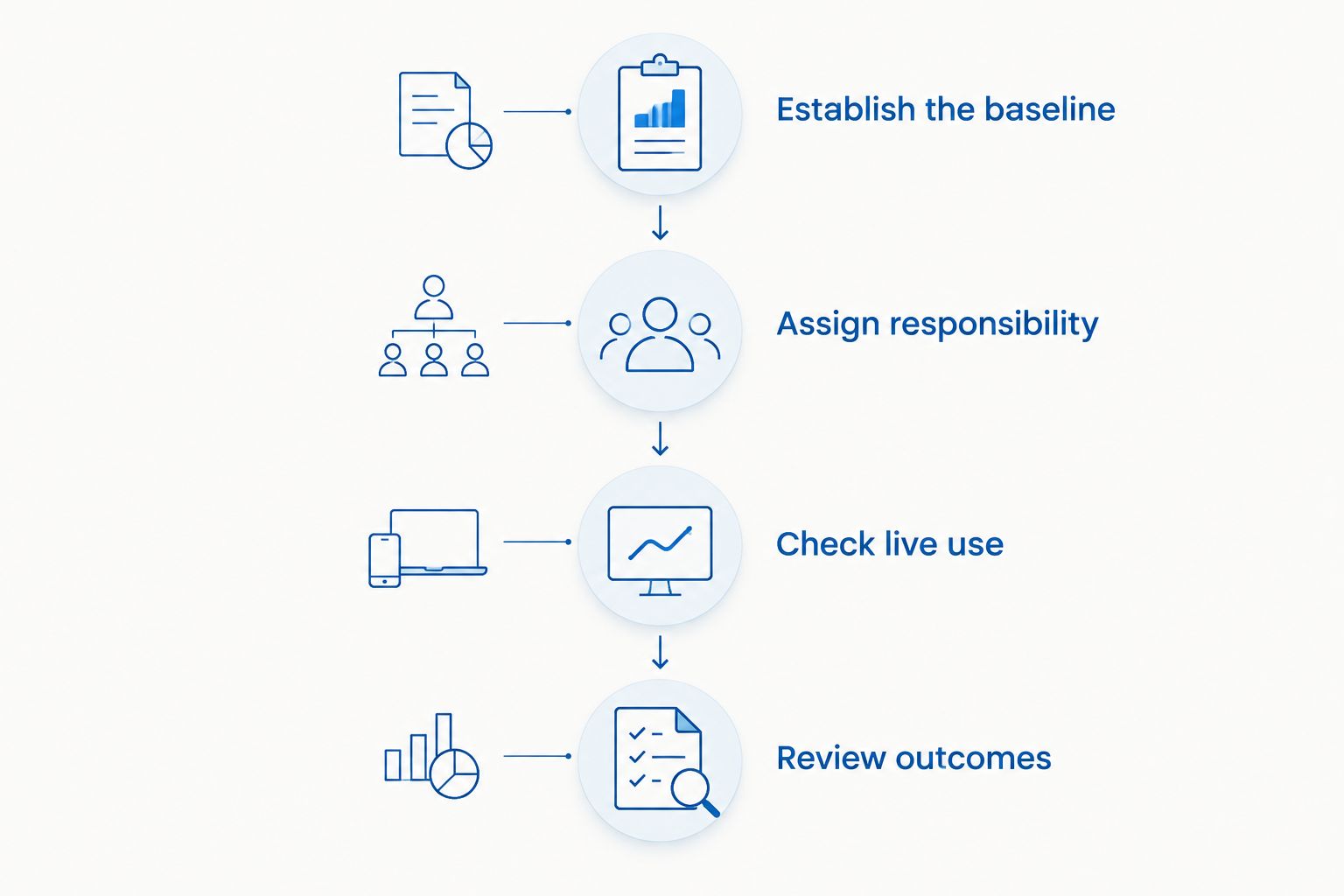
Check whether the team uses the change before judging its commercial outcome.
Use this review sequence throughout your 2026 engagement rather than replacing the measures whenever progress is uncomfortable. If the original measure was wrong, explain why and record the replacement explicitly.
The purpose is a decision, not another report. You should leave knowing what changed, what remains blocked and who owns the next action.
How do you know if business coaching is working?
Business coaching is working when agreed changes are completed, used by your team and linked to the outcome you set out to improve. Positive conversations and useful ideas are not enough on their own.
Check for practical evidence: staff resolve relevant questions, handovers contain the information people need, and work moves without avoidable owner approval. Then examine the commercial measures connected to those changes.
Be equally direct about setbacks. If the same problem keeps returning, identify whether the issue is the advice, the implementation, an unclear responsibility or a constraint the plan has not addressed.
When should you question a business coaching engagement?
Question the engagement when nobody can explain what has changed or what evidence will determine the next decision. You do not need to wait for a promised revenue milestone to ask for that clarity.
Raise the issue when:
- Sessions generate new priorities before previous work is reviewed.
- Actions have no named owner or completion standard.
- Your team cannot explain what it is authorised to decide.
- Lead generation increases without checking delivery capacity.
- Missed milestones receive explanations but no revised implementation plan.
A missed milestone calls for a specific conversation, not an automatic cancellation. Establish what blocked the work and whether the revised plan addresses that cause. If the engagement remains advice without implementation, reassess whether its scope matches what you need.
FAQ
Can a business coach guarantee results by a particular date?
A guaranteed results date is not a sound basis for choosing business coaching. Ask for defined deliverables, implementation responsibilities and review milestones instead; financial outcomes depend on what changes in the business and how those changes perform.
What's the first result I should look for from business coaching?
Look for a completed change that addresses your agreed constraint. That might be a clear quoting responsibility or a booking decision rule; check that your team uses it, rather than treating the document itself as success.
Should revenue improve before I spend less time in the business?
Do not assume revenue must improve first. If reducing owner dependence is the objective, track delegated decisions and owner involvement directly, then review revenue and margin alongside those operational measures.
Is business coaching useful if my team is already busy?
Business coaching needs an implementation plan that accounts for your team's existing workload. Start by identifying who can own the work and what must change to give that person capacity; adding tasks without that decision leaves the constraint unresolved.
Is coaching with implementation support the same as hiring an agency?
Coaching with done-with-you implementation is not the same as handing all execution to an agency. Elevatory business coaching includes done-with-you marketing implementation, so clarify your responsibilities and the agreed scope before starting.
What should I ask a business coach before signing up in 2026?
Ask what will change, who will complete the work and how progress will be assessed in 2026. Also ask how the coach will respond when implementation stalls and how marketing decisions will account for your team's delivery capacity.
One last thing
Do not judge delegation only while you are available to rescue it. Review whether the responsible person can complete the work, handle an agreed exception and explain the decision without needing your approval.
That is a more useful test than counting coaching sessions. For your next review, bring a real decision the team handled and another that came back to you. The difference will help identify what needs fixing next.
Related guides
Book a free growth strategy call
Forty-five minutes with a strategist to pressure-test where your business is stuck and what to prioritise next.
Prefer to talk first? Call 1300 634 230 or email chris@elevatory.com.au