

Rebranding cost in Australia depends on the scope: changing your visual identity is a different project from changing your positioning, website and customer-facing materials. For an established service business planning a rebrand in 2026, get a scoped quote rather than treating a national average as your budget. Include the team's implementation time, supplier changes and customer communication—not just the creative work.
TL;DR
- Rebranding cost Australia: compare defined deliverables, implementation responsibilities and exclusions, not headline quotes.
- Fix unclear offers and owner-dependent delivery before commissioning a new identity.
- Elevatory business coaching suits established Australian owners seeking done-with-you marketing implementation.
- Separate brand strategy, creative work and rollout so you can compare equivalent proposals.
How much does rebranding cost for an established Australian business?
Your rebranding budget should cover the work needed to change how customers understand, recognise and engage your business. Start by deciding whether you need clearer positioning, a visual refresh or a wider business-wide rollout. These are different briefs, not interchangeable packages.
If the concern is attracting the wrong enquiries, first assess whether your offer needs repositioning. A new logo does not resolve an unclear service promise.
Use this comparison to define the project before asking suppliers for proposals.
| Scope | Best for | Main work to specify | Benefit | Limitation |
|---|---|---|---|---|
| Visual refresh | Businesses keeping their audience and offer | Identity updates, guidelines and selected templates | Updates presentation without requiring a new market position | Does not resolve an unclear offer or weak delivery |
| Repositioning | Businesses changing their target customer or service emphasis | Customer definition, offer structure and messaging | Gives sales and marketing a clearer direction | Requires decisions about which work to pursue and decline |
| Full rebrand and rollout | Businesses changing identity across customer touchpoints | Strategy, identity, website requirements, materials and transition | Brings customer-facing assets into alignment | Adds coordination, replacement work and implementation demands |
Compare proposals against the same scope. A design-only proposal and a strategy-plus-rollout proposal do not answer the same brief.
Why this matters
A rebrand takes attention from the same people responsible for quoting, scheduling and delivering customer work. If every approval comes back to you, the project becomes another owner-dependent process.
Before commissioning work in 2026, name a project lead and define what that person can approve. Keep decisions about business direction with the appropriate owner, but delegate routine coordination and asset checking. Your team needs clear responsibilities before it needs another presentation.
Visual refresh: keep the business direction, update the presentation
A visual refresh is the narrower option when your customers, service offer and positioning remain unchanged. Specify the assets that need updating and the files your team needs to use afterwards.
For a service business, that might mean quote templates, uniforms, signage and website graphics. Do not assume a proposal includes all of them simply because it includes a visual identity.
Best for: a business with a clear offer whose existing presentation needs updating. The advantage is a bounded project; the limitation is that changing appearance leaves commercial and operational problems untouched.
Ask the supplier to distinguish between creating an asset and applying it. Designing a vehicle graphic is not the same task as arranging its production and installation. Assign responsibility for both before approving the brief.
Repositioning: clarify the work you want to win
Repositioning starts with decisions about customers and services, rather than colours or typography. Define which enquiries you want, what makes a job suitable and what your team can consistently deliver.
Best for: an established business whose messaging no longer matches the work it wants to attract. The benefit is clearer direction for sales and marketing; the trade-off is that your team must make choices, including which requests fall outside the offer.
Consider a hypothetical plumbing business that wants more planned maintenance work. The brief should address how that service is explained, how enquiries are qualified and who manages bookings. Changing the logo alone would leave those questions unanswered.
Label those decisions separately in the proposal. You need to see whether the supplier is helping shape the offer or simply writing new copy about the existing one.
Full rebrand and rollout: change the identity across the business
A full rebrand combines strategic and creative decisions with the practical work of changing customer touchpoints. Your brief should identify what changes, what stays and who handles the transition.
Best for: a business making a substantial change that requires a consistent new identity. The benefit is alignment across materials; the limitation is the coordination required across staff, suppliers and customer communication.
A 2026 rollout plan should cover working materials, not just launch assets. Include proposals, email signatures, booking messages, forms, invoices, signage and any other materials your business actually uses.
Do not replace everything automatically. Review each asset for accuracy and usefulness first. Reproducing an outdated sales process in a new design preserves the underlying problem.
Why rebranding scope varies
The work changes according to the decisions and deliverables involved. Ask suppliers to explain these drivers explicitly:
- Business direction: retaining your audience and offer requires a different brief from changing them.
- Strategy responsibility: distinguish research and positioning work from design execution against an existing strategy.
- Website scope: separate visual changes from new copy, page structures, forms and technical implementation.
- Physical materials: identify signage, vehicles, uniforms and printed materials that genuinely need replacement.
- Approval process: define decision-makers, feedback responsibilities and what constitutes an approved stage.
- Rollout ownership: state whether your team, the supplier or another specialist implements each change.
Ask what happens when the scope changes. A written change process makes the decision visible before extra work begins.
How do you build a rebranding brief that produces comparable quotes?
Write the brief around business decisions and deliverables. Keep it short enough that your team can use it, but specific enough that suppliers are quoting the same job.
Define problem
State the problem in observable terms. Examples include customers misunderstanding your service, enquiries falling outside your target work, or sales materials describing services you no longer provide.
Avoid making the diagnosis purely aesthetic. If the problem is missed follow-up or inconsistent delivery, investigate that directly rather than asking a designer to solve it through presentation.
Set scope
List the required outputs and separate essential work from optional work. Specify whether the project includes positioning, messaging, identity, website implementation, templates and physical rollout.
Record exclusions too. If photography, copywriting or technical work sits elsewhere, name the responsible person or supplier. An exclusion without an owner is unfinished planning.
Assign responsibility
Choose a project lead, an approver and the people responsible for implementation. Give the project lead authority to collect feedback and resolve routine questions within the agreed brief.
Set a clear boundary for owner involvement. You should approve the business direction without becoming the person who checks every email signature and chases every file.
Plan rollout
Map the order of changes around customer use and operational needs. Check that enquiry forms, phone details, booking messages and staff instructions remain accurate throughout the transition.
Ask each supplier what they need from your team before work starts. Access, content, approvals and production arrangements belong in the plan—not in a last-minute request.
Check outcomes
Choose measures connected to the original problem, such as enquiry suitability, quote acceptance or time spent explaining the service. Record the starting position before making changes.
Review delivery measures alongside marketing measures. More suitable enquiries are useful only when your team can respond, book and deliver the work.
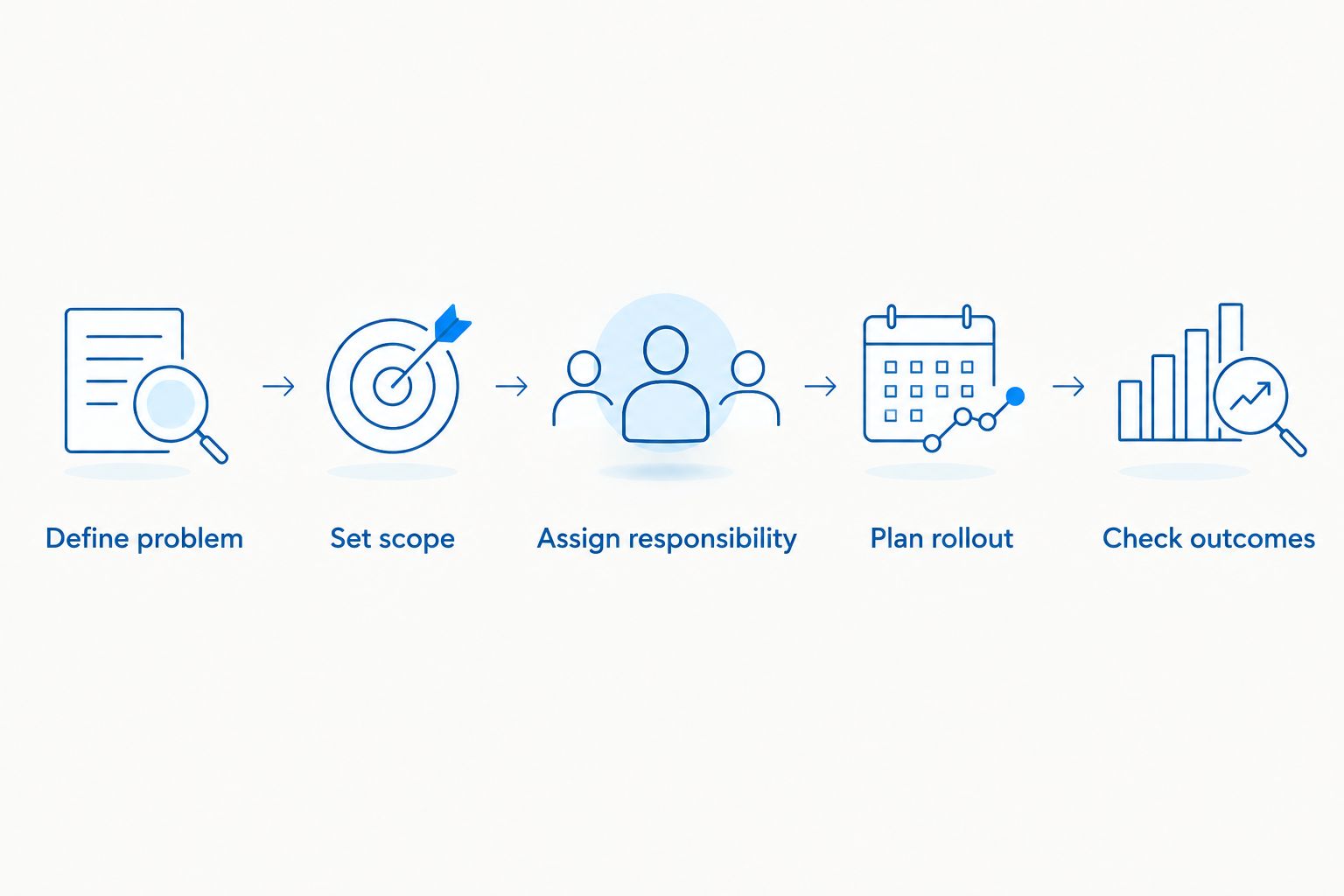
Agree on the business problem and responsibilities before commissioning creative work.
Should you rebrand before fixing team capacity?
Fix delivery constraints first when the business cannot reliably handle its existing work. Review scheduling, handovers, responsibilities and escalation rules before commissioning marketing intended to increase demand.
For a hypothetical professional services firm, unclear project ownership might be causing the principal to check every client update. New branding does not assign delivery responsibility. That requires a named lead, agreed standards and clear authority.
You can still document a future brand brief while addressing those issues. Keep the projects separate so that a design milestone does not get mistaken for an operational improvement.
Can you rebrand without rebuilding your website?
A website rebuild is not automatically part of a rebrand. Assess whether the existing site can accurately present the revised offer, support enquiries and accommodate the required content.
Ask for a clear distinction between design changes and structural work. Updating presentation is different from changing page organisation, booking processes or integrations.
For a 2026 website project, include a handover requirement. Your team should know who maintains content, checks enquiries and handles future changes after launch.
How do you judge whether a rebrand worked?
Judge the rebrand against the problem it was commissioned to address. If the goal was clearer service positioning, review enquiry suitability and the questions customers ask—not just reactions to the design.
Record other changes made during the same period. Changes to advertising, staffing, sales follow-up or service scope complicate any claim that branding alone caused a result.
Do not treat increased revenue as proof that a new identity caused growth. Review bookings, delivery capacity and job profitability together before deciding what to change next.
Where business coaching fits
Elevatory business coaching suits established Australian owners who want done-with-you marketing implementation. Elevatory works with businesses turning over $150K–$5M, with support spanning offers, funnels, paid advertising and systems strategy.
That support is relevant when the question extends beyond design into business priorities and implementation. It is not a substitute for a clearly scoped specialist brief: ask who is responsible for brand design, production and rollout rather than assuming those services are included.
FAQ
How much should an established Australian business budget for rebranding?
Build the budget from a written scope covering strategy, creative work and implementation. Compare equivalent deliverables and include internal team time, physical replacements and customer communication.
Is a logo redesign the same as a full rebrand?
A logo redesign changes one part of the visual identity; a full rebrand can also change positioning, messaging and customer-facing materials. Ask suppliers to define exactly which of those tasks their proposal covers.
Do I need to change my business name when I rebrand?
A rebrand does not require a name change. Retain the name when it still fits the intended positioning, and assess any proposed change separately from the visual design brief.
Should a service business rebrand before running more advertising?
Resolve unclear offers and delivery constraints before using advertising to increase demand. Advertising and rebranding do not replace clear responsibilities, enquiry follow-up or reliable service delivery.
What should I ask a branding supplier before accepting a proposal?
Ask for deliverables, exclusions, approval stages, implementation responsibilities and a change process. Confirm which usable files and instructions your team receives at handover.
Can my team manage the rebranding rollout?
Your team can manage assigned rollout tasks when it has the capacity, access and authority to do them. Name a project lead and separate routine implementation decisions from owner approvals.
Can Elevatory help me decide whether rebranding is the right priority?
Elevatory provides business coaching with done-with-you marketing implementation across offers, funnels, paid advertising and systems. Discuss the business problem and required scope before assuming a rebrand is the right project.
One last thing
Before approving a rebrand in 2026, ask the person who handles enquiries to explain your core service using the current materials. Note where they need to improvise, clarify or ask you for help.
That exercise gives you a practical starting point for the brief. Make the service easier for your team to explain and deliver—not just different to look at.
Related guides
Book a free growth strategy call
Forty-five minutes with a strategist to pressure-test where your business is stuck and what to prioritise next.
Prefer to talk first? Call 1300 634 230 or email chris@elevatory.com.au