

The cost to build a sales funnel for a small business depends on what the build includes: the offer, enquiry page, follow-up, booking process, tracking and team handover. A build quote is not the full operating commitment; account separately for software, advertising, maintenance and the time your team spends qualifying and converting enquiries.
TL;DR
- Sales funnel cost small business: compare scope, ongoing responsibilities and qualified bookings, not page count.
- Start with one offer, one enquiry route and one responsible owner before adding automation.
- Elevatory combines business coaching with done-with-you marketing implementation for established Australian businesses.
- Match lead generation to team capacity; more enquiries do not fix an overloaded delivery team.
Why this matters
A funnel should help your team turn suitable enquiries into profitable work without routing every decision through you. If the owner still approves every quote and chases every prospect, the project has left an operational problem unresolved.
Before commissioning a build in 2026, check whether your constraint is demand, qualification or delivery. The guide to team capacity bottlenecks helps frame that decision before you add another source of enquiries.
Buy a defined path to a booking, not a collection of pages. That means assigning responsibility for what happens after someone submits the form, not just deciding how the form looks.
How much does it cost to build a sales funnel for a small business?
There is no useful single figure without an agreed scope. Compare proposals against the same deliverables, ongoing responsibilities and definition of completion.
For a local service business, the useful endpoint is not necessarily an online purchase. It might be a qualified inspection, a consultation or an accepted quote. Your brief should name that endpoint before anyone recommends a platform.
| Build scope | Best for | What to specify | Advantage | Limitation |
|---|---|---|---|---|
| Enquiry funnel | A defined service with a straightforward enquiry process | Offer, page, form, confirmation and enquiry owner | Keeps the customer path focused | Leaves qualification and quoting with your team |
| Qualification funnel | Services requiring fit checks before quoting | Qualification questions, routing rules and booking criteria | Gives staff information for the next decision | Adds questions and rules to maintain |
| Follow-up funnel | Businesses losing track of open enquiries or quotes | Follow-up stages, message ownership and stop rules | Makes outstanding actions visible | Depends on accurate updates from staff |
These are scope choices, not fixed packages. A business can need qualification and follow-up without needing a new website.
Ask each supplier to separate initial construction from ongoing operation. A proposal should explain what gets built, what gets tested, who owns the accounts and who handles changes after handover.
Break the quote into work you can inspect
Use this checklist when comparing proposals:
- Offer and audience: the service, suitable customer and reason to enquire.
- Page and copy: the information customers need before taking the next step.
- Enquiry handling: form fields, notifications, qualification and assignment.
- Follow-up: messages, triggers, stop rules and staff actions.
- Tracking: the enquiry source and movement towards an accepted booking.
- Handover: access, instructions, training and responsibility for maintenance.
Ask where each item appears in the scope. Do not assume that writing the copy, connecting the booking process or training your staff comes with the page build.
A focused enquiry funnel: define the handover first
A focused enquiry funnel suits a service with a clear customer need and a straightforward next step. The page explains the offer, gathers relevant details and directs the enquiry to the person responsible for responding.
The advantage is clarity. Your team has fewer moving parts to manage, and the customer knows what happens next. The limitation is that staff still need a reliable qualification and quoting process.
For a hypothetical plumbing business, the form might gather the service requested, location and information needed to assess the job. That is an illustrative workflow, not a client result. The test is whether those details help the office make a booking decision.
Keep the form tied to an action. If nobody uses an answer, question whether you need to collect it.
A qualification funnel: write the decision rules
A qualification funnel suits services where enquiries need screening before a consultation or quote. Define what makes an enquiry suitable and what staff should do when it falls outside your scope.
The advantage is a more deliberate handover. The limitation is ongoing upkeep: qualification rules need to reflect the services you actually deliver.
For a hypothetical professional services firm, qualification might cover the work requested, the decision-maker and the information required before a meeting. Do not ask for detail simply because a form builder allows another field.
Before approving the build, have the employee handling enquiries explain each rule back to you. If the rule needs the owner's judgement every time, it is not ready to delegate.
A follow-up funnel: define when messages stop
A follow-up funnel suits a business that receives enquiries but loses visibility after the first conversation or quote. Specify the stages, the next action at each stage and the person responsible.
The advantage is a visible process for unfinished conversations. The limitation is dependence on accurate records. A system cannot distinguish an open opportunity from an accepted job unless someone or something updates it correctly.
Include stop rules for accepted work, declined quotes and people who no longer need the service. Test the process from the customer's side before launch.
Automation should support staff judgement, not send messages that contradict it. A personal conversation and an automated reminder need to agree about the next step.
Why sales funnel scope varies
For a 2026 brief, these are the decisions to settle before comparing proposals. Each changes the work required rather than simply changing the appearance of a page.
- Offer readiness: A defined service and customer make a different brief from an unresolved offer.
- Qualification requirements: Routing a straightforward enquiry differs from assessing suitability before a consultation.
- Existing systems: Specify whether the build connects to your current records or changes how the team works.
- Content requirements: Identify who supplies service explanations, evidence, images and follow-up messages.
- Team responsibilities: Decide who responds, quotes, follows up and approves exceptions.
- Measurement requirements: Define whether reporting stops at enquiries or follows them through to accepted work.
Separate necessary work from optional additions. Ask what business decision each feature supports and who will maintain it.
Choose the implementation model your team can support
The delivery model changes your workload. Compare who makes decisions, who builds the funnel and who maintains it after launch.
| Implementation model | Best for | Advantage | Limitation |
|---|---|---|---|
| Self-managed build | A business with internal ownership and implementation skills | Keeps decisions and changes inside the team | Requires staff time and technical responsibility |
| Done-with-you implementation | An owner building internal capability with outside guidance | Connects implementation with team learning | Requires active participation from the business |
| Outsourced build | A business with a clear brief and an internal project owner | Moves construction work outside the team | Still requires approvals, access and operational handover |
Elevatory is best for established Australian service-business owners seeking business coaching with done-with-you marketing implementation. Its stated focus is businesses turning over $150K–$5M, with support across offers, funnels, paid advertising and systems strategy.
That model requires involvement. Elevatory's business coaching and implementation approach fits an owner prepared to make decisions and develop team capability; it is not a substitute for appointing someone internally to own enquiry handling.
How to brief a funnel build in 2026
Write the brief around how work moves through your business. Use the following sequence before discussing design or automation.
- Choose the offer. Start with one offer your team can explain and deliver. State who it serves and which enquiries sit outside its scope.
- Check capacity. Identify who can deliver the work and what currently limits bookings. Decide what happens when suitable enquiries exceed available capacity.
- Assign ownership. Name one responsible owner for the enquiry process. Give that person authority to make routine decisions without asking you.
- Map the handover. Choose one enquiry route to test first. Document how an enquiry becomes a conversation, quote and booking, including exceptions.
- Test the process. Submit test enquiries, check notifications and confirm that staff can complete the next action. Test accepted and declined outcomes as well.
The point is not to make every business use the same funnel. It is to make the customer journey explicit enough that your team can operate it.
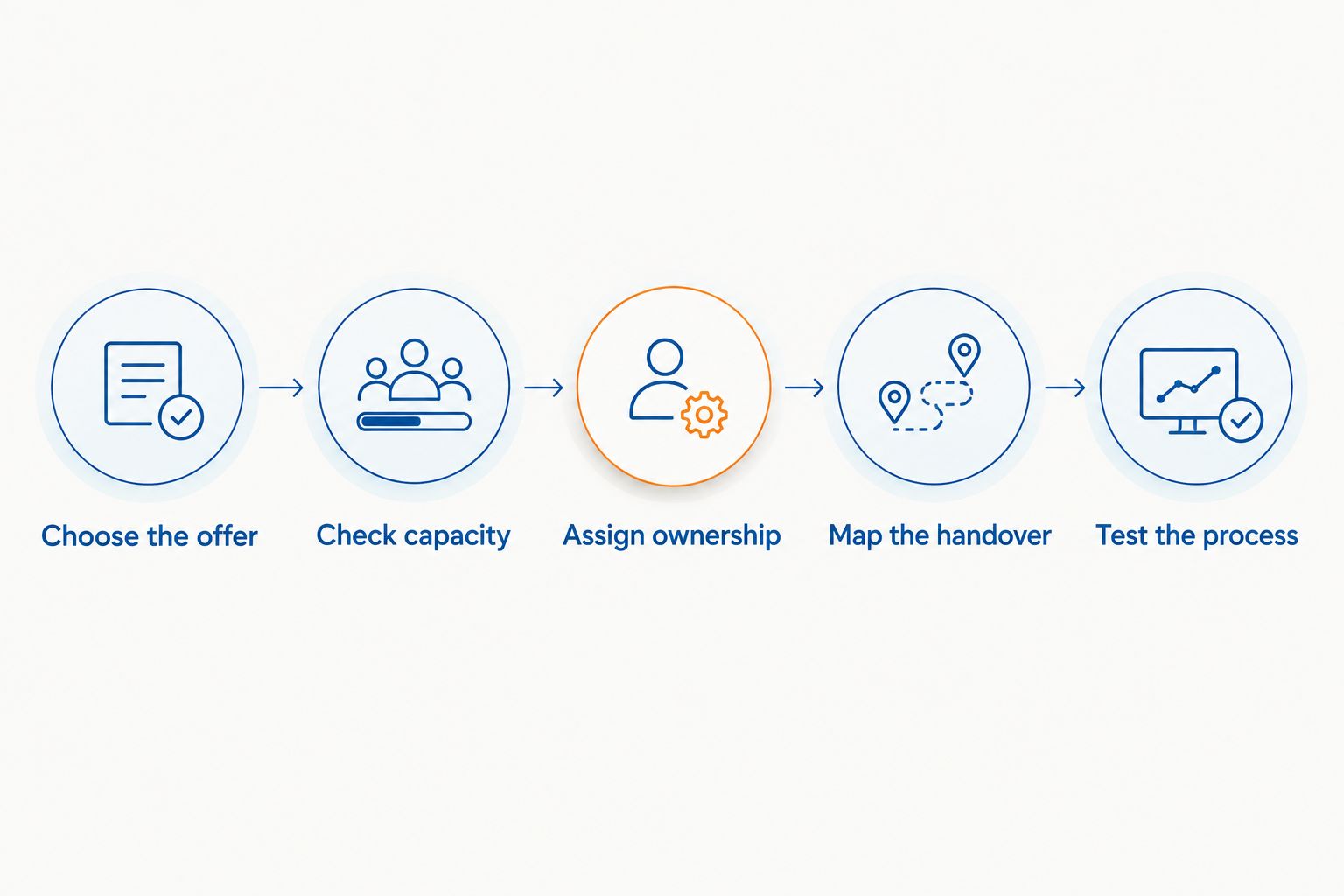
Assign responsibility before adding automation.
Set acceptance criteria before approving the work
For your 2026 project, define completion through observable actions. The page works, the enquiry reaches the right person, the record shows the next step and the team knows what to do.
Include ownership of accounts and access in the handover. Ask who can edit copy, change routing and inspect reporting without relying on the original builder.
Training also needs an outcome. Have the responsible employee demonstrate the process rather than simply attend a walkthrough.
What should you measure after launch?
Track enquiries through to accepted work rather than treating form submissions as the final result. Define qualified enquiries, quotes issued and bookings accepted consistently so your team uses the same labels.
Review these alongside delivery capacity and the effort required to serve the work. A funnel that attracts unsuitable jobs needs a different response from one that attracts suitable jobs your team cannot schedule.
For 2026 reporting, separate a marketing problem from a handover problem. If suitable enquiries arrive but remain unanswered, changing the advertisement does not fix the missed action.
Do not attach a growth promise to the build. A working funnel is a process your team can operate and assess; business results also depend on the offer, sales handling and delivery.
Does a sales funnel build include advertising?
A sales funnel build and advertising are separate scopes unless the proposal explicitly includes both. Ask who creates campaigns, manages them and connects campaign reporting to the enquiry process.
Decide how you will attract suitable visitors before approving the build. Also decide whether the team can respond and deliver before increasing demand.
Can you build a sales funnel yourself?
You can manage the build internally when someone owns the offer, construction, testing and maintenance. The trade-off is staff time and responsibility, not just the choice of a page builder.
Choose the implementation model around your team's capabilities. Do not leave follow-up ownership unresolved while comparing software features.
Do you need a new website to build a sales funnel?
A new website is not automatically part of a funnel project. Ask whether your existing site can support the required offer, enquiry route and handover before approving a replacement.
Judge the proposed change against the customer action it supports. A larger website scope needs its own justification.
FAQ
What's included in a small business sales funnel build?
The agreed scope determines what is included. Ask for separate detail on the offer, copy, page, forms, follow-up, tracking, testing and team handover.
Is a sales funnel the same as a website?
A sales funnel defines a path towards a specific customer action; a website can serve several purposes. Specify the desired booking or enquiry outcome before deciding what needs building.
Should I fix my sales process before building a funnel?
Fix unclear ownership and handover rules before automating them. Your team needs to know who qualifies enquiries, issues quotes and follows up.
Is done-with-you support better than outsourcing the build?
Done-with-you support fits a business that wants internal capability and will participate in implementation. Outsourcing construction still requires an internal owner for decisions and ongoing operation.
Can Elevatory help with funnels and team systems?
Elevatory provides business coaching with done-with-you marketing implementation across offers, funnels, paid advertising and systems strategy. Its focus is established Australian businesses.
What should I ask before accepting a funnel proposal?
Ask what gets built, what remains your team's responsibility and what counts as completion. Confirm account ownership, testing, handover and ongoing maintenance before approving the work.
One last thing
Ask the employee who will handle enquiries to review the brief before you approve it. Have them explain what happens when an enquiry is unsuitable, a quote needs approval or the diary is full.
If every exception comes back to you, fix decision authority before adding more enquiries. That is the practical test of whether the funnel supports a team or adds another task to the owner's desk.
Related guides
Book a free growth strategy call
Forty-five minutes with a strategist to pressure-test where your business is stuck and what to prioritise next.
Prefer to talk first? Call 1300 634 230 or email chris@elevatory.com.au