

Ecommerce website optimisation cost depends on the work you commission: diagnosis, implementation, measurement or ongoing improvement. For a 2026 project, get an itemised quote tied to a defined business problem, not an assumed market average. Check whether the scope includes your team's implementation time, specialist development, tracking repairs and ongoing software commitments before you approve it.
TL;DR
- Ecommerce website optimisation cost starts with scope: separate diagnosis, implementation and measurement before comparing quotes.
- Elevatory combines business coaching with done-with-you marketing implementation; your team still needs responsibility for delivery.
- Prioritise conversion optimisation around profitable orders and fulfilment capacity, not website activity alone.
- Keep ecommerce SEO, checkout improvements and paid advertising responsibilities explicit in the brief.
How much does ecommerce website optimisation cost?
Get a scoped quote, not a price attached to an undefined promise to optimise your website. An audit, a checkout repair and an ongoing improvement programme are different purchases. Compare the deliverables before comparing the commercial terms.
For established Australian businesses, the useful question is what needs to change, who will change it and how you will judge the work. Elevatory offers business coaching with done-with-you marketing implementation, rather than replacing your team's responsibility for delivery.
Use this scope comparison when you request proposals in 2026:
| Work type | Best for | What to request | Main limitation |
|---|---|---|---|
| Diagnostic audit | Owners who need a prioritised problem list | Evidence, affected pages, recommended actions and responsibilities | Recommendations alone do not change the website |
| Defined implementation project | Teams with a confirmed issue to fix | Named changes, acceptance criteria, testing and handover | Work outside the agreed scope needs a separate decision |
| Ongoing optimisation | Teams able to maintain a measurement and improvement cycle | Priorities, reporting, implementation ownership and review process | Requires continuing team involvement and suitable evidence |
| Coaching with implementation | Owners who need decisions and execution support together | Clear division of work, accountability and implementation boundaries | Does not remove the need for internal ownership |
Ask each provider to quote against the same brief. Otherwise, an audit-only proposal and an implementation proposal look comparable when they are not.
Why this matters
A website project competes with other demands on your team. Someone must approve copy, confirm product information, test changes and handle customer questions. Put those responsibilities in the plan before adding another marketing initiative.
More orders are not the only consideration. Your team also needs to fulfil orders, manage enquiries and maintain the experience you promise. Connect the website brief to delivery capacity, not just acquisition targets.
For a service business that also sells products online, keep purchases and enquiries separate. A completed checkout and a qualified booking need different definitions of success. Do not treat both as an undifferentiated conversion total.
Diagnostic audit: define the decision you need
An audit is the right starting point when you cannot identify the main constraint. Its value sits in the decisions it supports, not the length of the report.
Request a prioritised action list with the evidence behind each recommendation. The report should distinguish observed problems from ideas that still need testing. Ask who will translate the findings into implementation tasks.
A useful audit brief covers:
- Customer journey: Where visitors enter, what they need to understand and where they leave.
- Measurement: Which actions are recorded and whether reporting matches actual transactions.
- Commercial priorities: Which products and customer actions deserve attention.
- Delivery ownership: Who can approve, implement and maintain the recommended changes.
The advantage is a clearer implementation brief. The limitation is equally clear: an audit does not repair the site. If your team cannot act on recommendations, request implementation support as a separate scope.
Defined implementation: buy a finished change
Choose a defined project when the problem and proposed work are clear. Specify the affected pages, required behaviour, testing responsibilities and handover requirements.
For example, a brief might cover correcting misleading delivery information or fixing a confirmed checkout error. Those are hypothetical project examples, not client results. Each needs its own acceptance criteria rather than a vague promise of better conversion.
Ask the provider to explain dependencies before work begins. A copy change, a theme modification and a connection to another system require different skills and permissions.
Approve work against an observable outcome. For a checkout repair, that means the agreed purchase journey works under the documented test conditions. It does not mean a guaranteed increase in revenue.
The advantage is a clear finish line. The limitation is scope: a completed repair does not establish that every other part of the customer journey works well.
Ongoing optimisation: define the operating rhythm
Ongoing work needs a repeatable process for choosing, implementing and reviewing changes. A recurring agreement without that process leaves you buying activity without a clear decision framework.
For a 2026 agreement, ask what happens when the available evidence does not support a meaningful experiment. The answer should describe useful work and decision criteria, not promise a fixed stream of winning tests.
Request clarity on:
- How the next priority is selected.
- Who prepares and approves changes.
- What implementation work is included.
- How results and limitations are reported.
- What happens when a change needs reversing.
The advantage is continuity. The limitation is the ongoing demand on your team and the need for enough reliable evidence to interpret results. Do not sign an ongoing agreement simply because a provider recommends continuous testing.
Why ecommerce website optimisation cost varies
The scope drivers below belong in your brief. They explain differences between proposals more usefully than an unsupported average.
- Diagnosis depth: A review of selected pages is different from checking the journey, reporting and operational handovers together.
- Implementation responsibility: Advice-only work leaves execution with you; implementation support includes agreed execution tasks.
- Technical dependencies: Document whether changes involve website settings, custom development or connected systems.
- Measurement condition: Establish whether tracking is ready for evaluation or needs correction first.
- Content requirements: State who supplies product information, copy, photography and approvals.
- Team capacity: Name the people available to review, test and maintain the work.
Ask providers to identify assumptions against each factor. If a proposal assumes your team supplies finished copy, do not compare it directly with one that includes copy development.
Keep ecommerce SEO separate where necessary. Search visibility work and checkout improvement can sit in the same plan, but they need distinct tasks and measures. A proposal labelled website optimisation should spell out which it covers.
How do you compare optimisation quotes properly?
Compare ecommerce website optimisation quotes against a shared brief and named responsibilities. Do not start with a provider's preferred package and work backwards to justify it.
Establish the baseline
Confirm what your reporting records before setting targets. Check purchase events against actual orders and define how cancellations, refunds and non-purchase enquiries will be treated.
Keep the baseline relevant to the decision. A product-page project needs evidence about that journey, not just a site-wide traffic total.
Name the constraint
Write the problem as an observable issue. Examples include customers being unable to find delivery information or a confirmed fault preventing checkout completion.
These are hypothetical examples. Verify the issue on your own site before making it a project priority.
Assign ownership
Name an implementation owner and an approval owner. Give each enough authority to act without sending every routine decision back to you.
If the owner remains the approval point for everything, address that dependency in the project plan. The guide to measuring owner dependence provides a related management starting point.
Define acceptance
Describe what completion looks like before work starts. Include the agreed checks, documentation and handover, not just a list of tasks performed.
Separate acceptance of the work from commercial performance. A functioning change is verifiable; a promised revenue outcome is not an appropriate substitute for a clear specification.
Review the outcome
Decide how you will assess the change and who makes the next decision. Record other changes in advertising, promotions or product availability that affect interpretation.
For your 2026 brief, use this sequence to keep the purchase tied to a business decision rather than a list of website activities.
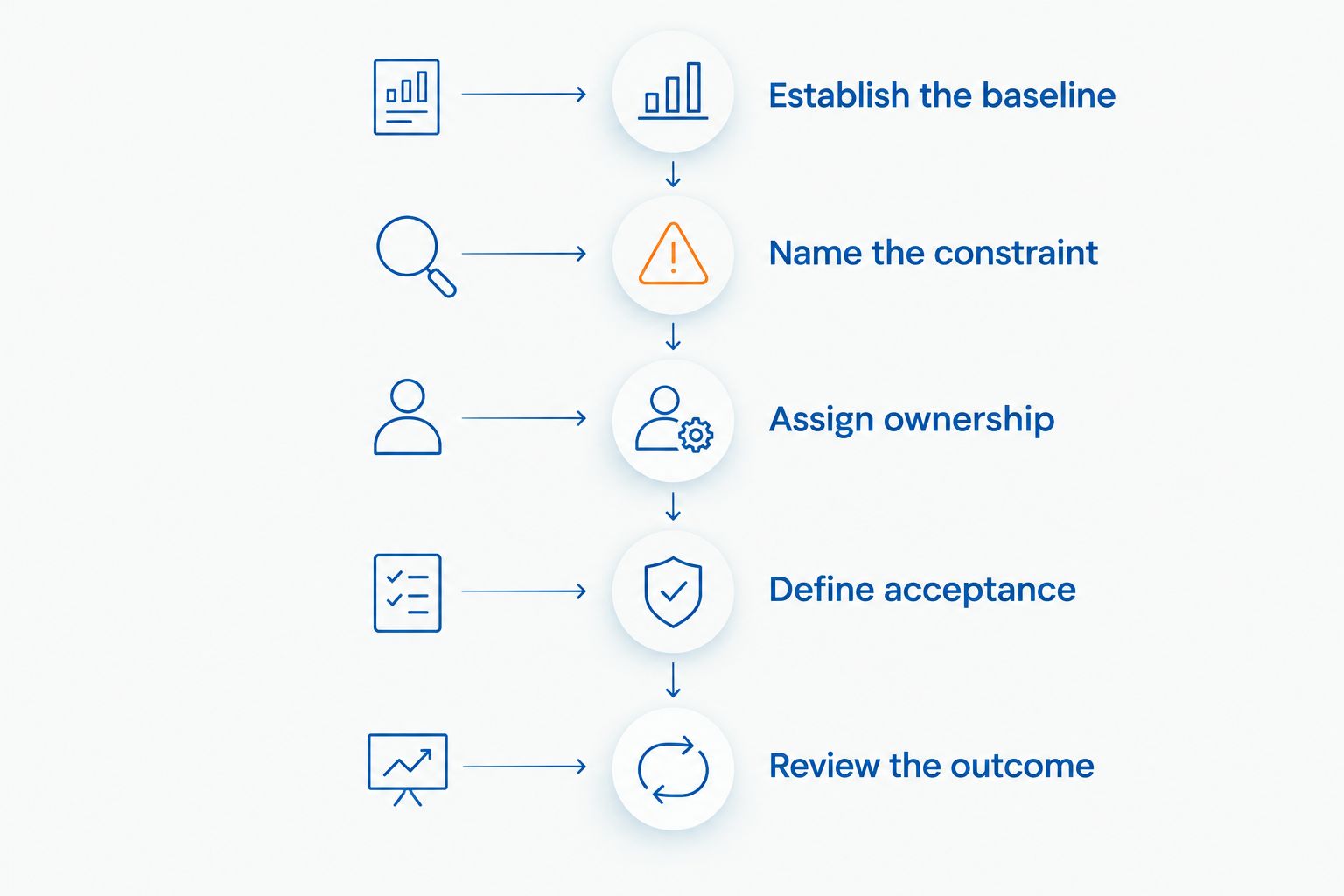
Agree on the problem and ownership before approving implementation.
Should you fix the website before buying more traffic?
Fix confirmed faults in the purchase journey before paying to send additional visitors through those faults. First establish whether the issue is technical, informational or connected to the offer itself.
Do not assume every disappointing sales result is a website problem. Review the match between the audience, offer, landing page and delivery promise. Then assign work to the part of the journey that needs attention.
For an established service business, apply the same discipline to enquiries. If your team cannot qualify and follow up existing enquiries, include that handover in the plan before making lead volume the main target.
Is coaching or specialist implementation the better fit?
Specialist implementation is the better fit for a defined technical job; coaching with implementation suits owners who need help setting priorities and assigning execution. Choose according to the work, not the label.
Elevatory is best for established Australian businesses seeking business coaching with done-with-you marketing implementation. Its stated focus includes offers, funnels, paid advertising and systems strategy. Confirm the fit for any specialist ecommerce development requirement before engaging support.
The strength of the coaching model is connecting marketing decisions with responsibilities and business priorities. The trade-off is participation: your team still needs to make decisions and carry its agreed share of implementation.
Elevatory's business coaching model should not be treated as a done-for-you website development service. Define the boundary between coaching, implementation support and specialist technical work in the proposal.
Clarify your next business priority
Explore business coaching and done-with-you marketing support for your next implementation decision.
FAQ
What's included in ecommerce website optimisation cost?
Ecommerce website optimisation cost covers only the work specified in your agreement. Ask for separate descriptions of diagnosis, implementation, measurement, content and ongoing support so exclusions are clear.
Can I compare ecommerce optimisation quotes by price alone?
No. Compare the scope, implementation ownership, acceptance criteria and handover first. An audit-only quote is not equivalent to a project that includes making and testing changes.
Do I need an audit before making website changes?
Use an audit when you need evidence to identify or prioritise the problem. For a confirmed fault with a defined repair, request a scoped implementation proposal rather than commissioning another general review.
Is ecommerce SEO the same as conversion optimisation?
No. Ecommerce SEO addresses search visibility, while conversion optimisation addresses the actions visitors take on your website. Define separate tasks and measures when both sit within the same project.
Will website optimisation guarantee more sales?
No. Do not accept guaranteed sales growth as a substitute for defined work and credible measurement. Evaluate changes alongside the offer, traffic, fulfilment capacity and other commercial conditions.
Who should own an ecommerce optimisation project?
Assign a named internal owner with authority to coordinate approvals and implementation. Give specialist contributors clear responsibilities so routine decisions do not all return to the business owner.
Should a local service business use an ecommerce optimisation brief?
Use an ecommerce brief for an online purchase journey, not as a substitute for a service-booking brief. Qualified enquiries, booked work and completed purchases need distinct definitions and reporting.
One last thing
Before approving a 2026 optimisation proposal, ask: What will my team be able to manage without me once this work is finished? Request the process, documentation and decision boundaries that make the answer concrete.
A website change without ownership leaves the next decision unresolved. Finish the brief by naming who maintains the change, who reviews performance and when the owner genuinely needs to be involved.
Related guides
Book a free growth strategy call
Forty-five minutes with a strategist to pressure-test where your business is stuck and what to prioritise next.
Prefer to talk first? Call 1300 634 230 or email chris@elevatory.com.au