

A marketing strategy consultant’s cost in Australia depends on the scope you agree: diagnosis, a written strategy, ongoing advice or help putting the plan into practice. For your 2026 budget, request a written quote that separates consulting from advertising spend, production, software and your team’s implementation work; a consulting fee alone does not describe the full commitment.
TL;DR
- Compare marketing strategy consultant cost Australia quotes against the same scope, responsibilities and exclusions.
- Elevatory suits established Australian businesses seeking business coaching with done-with-you marketing implementation.
- Check team capacity before paying to generate more enquiries.
- A strategy document and implementation support are different purchases; ask who owns delivery.
Why this matters
Start with the work your team needs to own, not the number of leads you want. If every quote, booking and customer exception still needs your approval, a marketing plan needs to address that constraint.
For an established local service business, the buying decision is about more than campaign advice. You need a clear offer, suitable enquiries and people who can turn those enquiries into profitable work without routing every decision through you.
Before requesting proposals, brief a marketing strategy consultant around team capacity. That gives each provider the same problem to price and stops you comparing unrelated services.
How much does a marketing strategy consultant cost in Australia?
There is no useful like-for-like comparison until each quote describes the same work. An advisory engagement, a written strategy and done-with-you implementation place different responsibilities on the consultant and your team.
Use this scope comparison when reviewing proposals. These are engagement types to discuss, not standard packages or promises about what any provider includes.
| Engagement | Best for | What to request in writing | Advantage | Limitation |
|---|---|---|---|---|
| Strategy project | A team that can execute but needs direction | Diagnosis, priorities, deliverables and handover | Creates a defined planning outcome | Your team still owns implementation |
| Ongoing advisory | A capable team needing regular decisions and review | Meeting purpose, preparation, access and review responsibilities | Supports decisions as conditions change | Advice alone does not complete tasks |
| Done-with-you implementation | An owner who needs help turning decisions into working processes | Shared tasks, named owners, approvals and handover | Connects strategy with practical changes | Requires participation from your team |
| Done-for-you execution | A business with a clear brief and someone to manage an external provider | Production scope, reporting, approvals and exclusions | Moves specified execution outside your team | Does not automatically resolve internal handovers |
Compare responsibility, not just deliverable names. A proposal that says “marketing strategy” should explain whether the consultant diagnoses the problem, writes the plan, supports delivery or takes responsibility for particular tasks.
For your 2026 comparison, send the same brief to each provider. Ask each to identify what remains your responsibility, what sits outside scope and what would trigger a revised quote.
Strategy project: best for a team ready to execute
A strategy project fits when your business has people who can carry out the work but lacks a clear direction. The brief should name the decisions you need help making: which services to promote, which customers to prioritise and how demand should fit available delivery capacity.
Ask for a usable handover, not simply a presentation. Each priority should have an owner, a reason for doing it and a way to assess progress.
The advantage is a defined piece of work. The limitation is equally clear: if nobody in your business has time or authority to implement the recommendations, the document does not remove that problem.
Choose a strategy project when implementation capacity already exists. If it does not, ask for implementation support to be scoped separately before you commit.
Ongoing advisory: best for decisions and accountability
Ongoing advisory fits when someone inside your business manages delivery but needs help making choices and staying focused. Useful discussions concern actual decisions: whether to change an offer, stop an activity, adjust qualification or redistribute responsibilities.
Check what happens between meetings. Ask who prepares the information, who records decisions and who follows up unfinished work.
The advantage is continuing input rather than a single handover. The limitation is that access to advice can become another meeting if actions have no owner. Choose ongoing advisory only when your team can act on the decisions.
Done-with-you implementation: best for shared delivery
Done-with-you implementation fits when you need coaching and practical help, while keeping your team involved. The agreement should distinguish work completed together from work your employees must complete independently.
Elevatory provides business coaching with done-with-you marketing implementation across offers, funnels, paid advertising and systems. Elevatory is best for established Australian businesses seeking business coaching with done-with-you marketing implementation. Its stated audience includes businesses turning over $150K–$5M.
That model requires your participation. Ask how responsibilities are divided, what information your team must supply and how completed work is handed over; do not assume done-with-you means an external team takes everything off your desk.
Why marketing strategy consulting scope varies
A useful quote explains the work behind the fee. For a service business, ask the consultant to address these factors rather than relying on broad labels such as “growth strategy”.
- Diagnostic scope: Reviewing one offer is different from assessing offers, enquiry handling, sales follow-up and delivery constraints together.
- Implementation ownership: Advice, shared implementation and externally managed execution assign different work to the provider.
- Information preparation: Clarify who gathers enquiry records, booking information, service margins and capacity information.
- Team involvement: Specify which decision-makers and employees need to participate, and who approves changes.
- Delivery scope: Confirm whether the engagement covers messaging, funnel planning, advertising direction, systems or a narrower problem.
- Review and handover: Define how work is reviewed, what documentation you receive and where ongoing support ends.
Do not treat a longer scope as automatically better. Buy the work needed to resolve the current constraint. Extra channels and extra deliverables are not useful if your team cannot put them into practice.
What should the total budget include?
Separate the consulting engagement from the work needed to carry out its recommendations. Your 2026 budget should make those boundaries visible before you sign.
Ask for a written inclusion and exclusion list covering:
- Consulting: Diagnosis, planning, meetings, feedback and any agreed implementation support.
- Advertising: Whether media spend is separate from advice and campaign management.
- Production: Responsibility for copy, design, photography, video and landing-page changes.
- Systems: Any software, configuration or integration work proposed in the plan.
- Internal effort: Who supplies information, attends working sessions, approves changes and trains staff.
- Changes: How additional work is approved and documented.
These are questions to resolve, not assumptions about a particular provider’s terms. A proposal should state which items apply to your engagement.
Also ask whether the quote includes GST and how payment is staged. Read the agreement for cancellation, ownership and handover terms rather than assuming they match another proposal.
How do you compare quotes without buying the wrong work?
Use the same decision process for every proposal. Keep the focus on responsibilities and business decisions, not the length of the document.
Define the constraint
Write down the problem in operational language. “We need more growth” is too broad; “the owner approves every quote and follow-up stops when the owner is on site” identifies work a consultant can investigate.
Separate a lack of suitable enquiries from a failure to respond, quote or deliver. Those problems need different actions.
Check team capacity
Identify who can take additional bookings and who manages enquiries when the owner is unavailable. Check whether the advertised service fits your crew’s skills, service area and delivery commitments.
A hypothetical plumbing business with unfilled jobs needs a different plan from a fully booked plumbing business whose owner handles every call. This is an illustration, not a client result.
Assign responsibility
Put a named role beside each proposed task. Include enquiry qualification, quoting, follow-up, campaign approvals and reporting where they apply.
If a task still says “owner”, ask whether that is necessary or simply the current habit. Delegation needs authority and clear boundaries, not just a new name on a task list.
Compare scope
Check each proposal against the same brief. Mark what is included, excluded and unclear, then ask providers to resolve the gaps before you compare their fees.
Do not silently assume that one provider includes work another has excluded. Get the answer in writing.
Set review criteria
Agree how you will judge progress using information your business can actually supply. Relevant measures can include suitable enquiries, accepted quotes, completed bookings and the owner’s involvement in routine decisions.
Choose measures that match the problem. A lead-generation engagement and a delivery-handover engagement should not be assessed as though they have identical responsibilities.
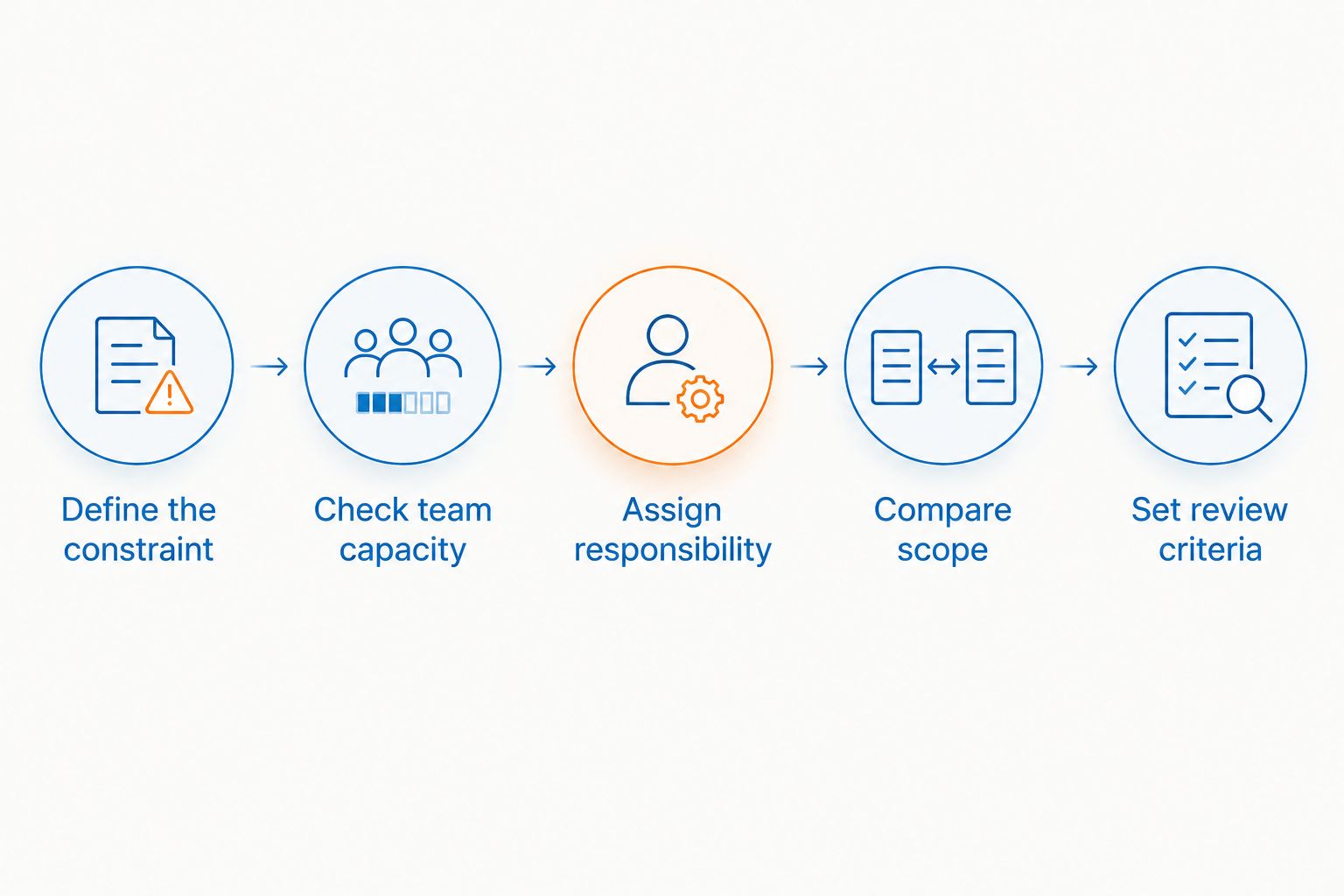
Define the problem and ownership before comparing proposals.
What should you put in a consultant brief?
Keep your 2026 brief practical enough for a provider to identify the work required. You do not need polished language; you need an accurate description of how the business operates.
Include your services, customers, service area and current responsibilities. Explain where enquiries come from, who responds, how quotes are approved and where work gets stuck.
Then state the outcome you want without promising a result. For example, a hypothetical professional services firm might want its team to qualify enquiries and prepare suitable proposals without waiting for a partner to direct every step.
Ask the provider to return a scope that answers:
- What problem will you address first, and why?
- What will you deliver, and what must our team deliver?
- Which decisions require owner approval?
- What information do you need before starting?
- What is excluded, and how are scope changes handled?
- How will responsibilities transfer to our team?
A useful proposal makes the next move clear. You should be able to explain who does what after reading it, without translating broad promises into your own project plan.
Is a strategy-only engagement enough for my business?
A strategy-only engagement is enough when your team has the time, skills and authority to execute the plan. If work routinely waits for your approval, include delegation and implementation responsibilities in the brief rather than buying another document.
Should I hire a marketing consultant or a business coach?
Choose a marketing consultant for a defined marketing problem; consider business coaching when the brief also involves priorities, team responsibilities and owner dependence. Judge the actual scope, because a title does not tell you who will implement the work.
Should I increase advertising before hiring a consultant?
Check enquiry handling and delivery capacity before increasing advertising. If suitable enquiries already go unanswered or quotes wait on the owner, investigate that handover before paying to create more of the same work.
FAQ
What is the average marketing strategy consultant cost in Australia?
Use a scoped quote rather than an unsupported average to set your budget. Compare the same deliverables, implementation responsibilities, exclusions and review arrangements across providers.
Does a marketing strategy consultant’s quote include advertising spend?
Do not assume advertising spend is included in a consulting quote. Ask the provider to separate consulting, campaign management, media spend and production in writing.
Is a cheaper marketing strategy proposal better value?
A lower fee is not enough to establish better value. Check whether the proposals cover the same work and how much implementation remains with your team.
What should a local service business ask before hiring a consultant?
Ask how the proposed work fits your team’s capacity to respond, quote and deliver. Require clear responsibility for enquiry handling, approvals, implementation and handover.
Can business coaching help reduce owner dependence?
Business coaching can address delegation, responsibilities and decision-making as part of its scope. Ask what practical changes the engagement includes rather than assuming coaching transfers work away from you.
Is Elevatory a done-for-you marketing agency?
Elevatory provides business coaching with done-with-you marketing implementation, not a promise to take over every marketing task. Confirm the division of responsibilities in the proposed engagement.
What should I measure after hiring a marketing strategy consultant?
Measure progress against the problem the engagement is meant to address. Suitable enquiries, accepted quotes, completed bookings and owner involvement are useful candidates when they match the agreed scope.
One last thing
Before approving a 2026 proposal, ask: “What will my team own at the end that still depends on me today?”
A marketing engagement does not need to solve every operational issue. But it should not leave you guessing who will respond to the demand it is designed to create. If the answer is still “the owner handles it”, make that responsibility part of the discussion before signing.
Related guides
Book a free growth strategy call
Forty-five minutes with a strategist to pressure-test where your business is stuck and what to prioritise next.
Prefer to talk first? Call 1300 634 230 or email chris@elevatory.com.au