

Your business is ready for a growth consultant when you have established demand, a clear growth constraint and someone responsible for putting decisions into practice. Start with team responsibilities, delivery capacity and owner dependence—not a bigger lead target; outside advice does not replace the time and authority needed to implement it.
TL;DR
- When is a business ready for a growth consultant? When growth needs clear responsibilities, not just more leads.
- Elevatory suits established Australian owners seeking business coaching with done-with-you marketing implementation.
- Choose business coaching around a specific constraint: owner dependence, delivery capacity, offer clarity or marketing strategy.
- Wait if nobody can own implementation; recommendations need time, responsibility and follow-through.
Why this matters
More work is not the same as a better business. If every quote, scheduling change and customer exception comes back to you, increasing enquiries adds work to the same decision queue.
Before you commission a 2026 growth plan, identify where work stops without your involvement. Use this guide to measure owner dependence to turn a broad complaint about being busy into a specific discussion about responsibilities.
For an established Australian service business, the useful question is not simply whether you want more revenue. It is whether your team can sell, schedule and deliver the right work without needing you at every handover. Build the capacity to handle growth before you pay to accelerate it.
How do you know when your business is ready for a growth consultant?
You are ready when you can describe the problem, show how it affects the business and commit someone to changing it. You do not need a perfect dashboard or a finished operations manual. You need enough evidence to distinguish a demand problem from a delivery problem.
Work through these steps before approaching a business growth consultant.
- Name the decision that keeps returning to you. Look at quoting, scheduling, customer questions, purchasing and quality checks. Identify the decisions your team cannot currently make without approval.
- Trace the effect on delivery. Record what waits, what gets repeated and which customer commitments depend on your intervention. Bring actual examples rather than describing the whole business as chaotic.
- Check the commercial consequence. Review whether the affected work produces profitable bookings, consumes time without enough return, or prevents your team from accepting suitable work. Revenue alone does not answer that question.
- Assign implementation responsibility. Decide who can change the process, communicate the change and review whether it works. Give that person authority as well as a task list.
- Set a decision to review. Specify what you need to resolve: transferring quoting authority, improving enquiry qualification or matching advertising activity to delivery capacity. Avoid an open-ended brief to grow everything.
Readiness means you can act on advice—not that you already know the answer. A useful brief exposes uncertainty clearly enough for a consultant to investigate it.
For your 2026 assessment, separate evidence from assumptions. A full calendar proves that work is scheduled; it does not establish whether that work is profitable, appropriately priced or deliverable without excessive owner involvement.
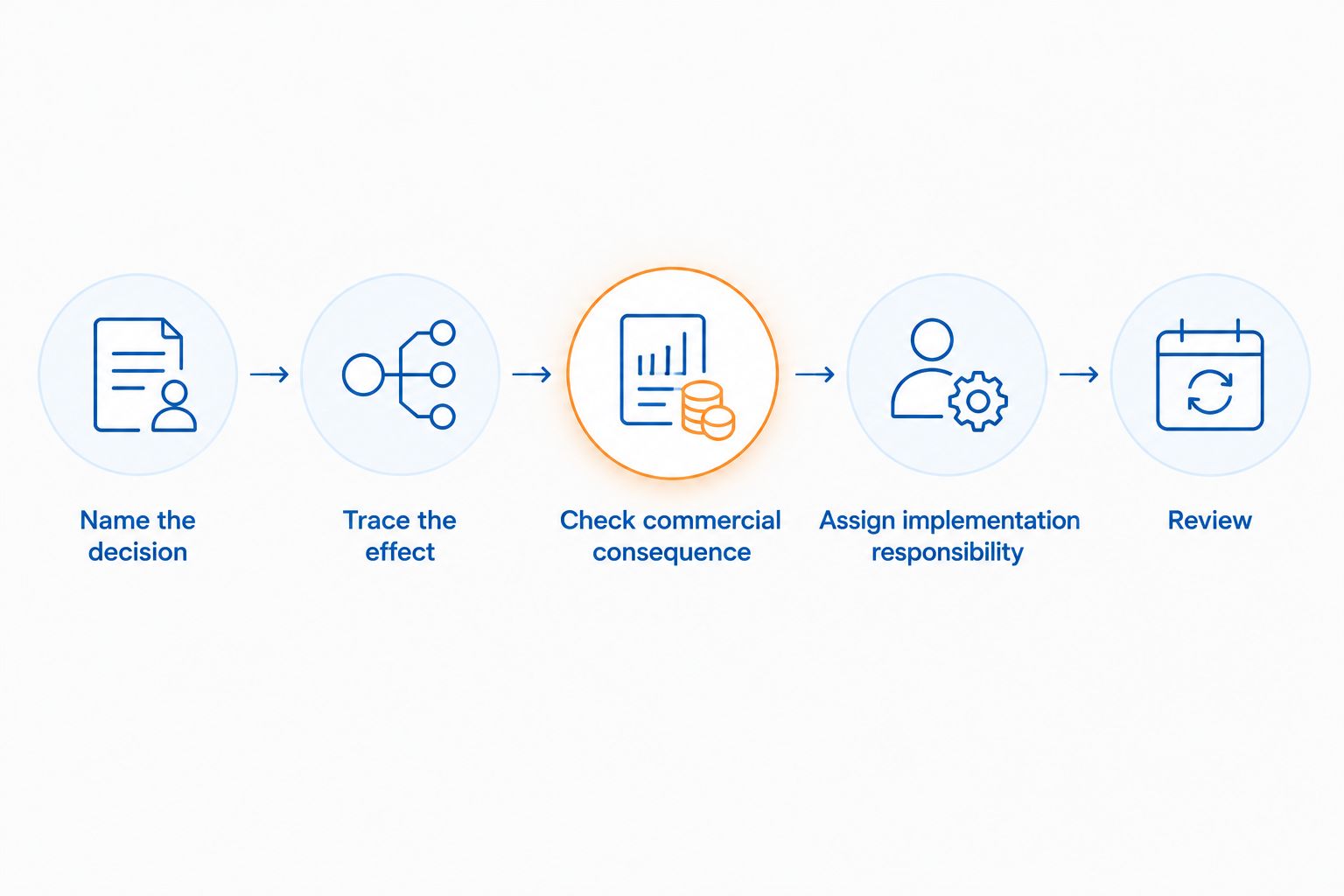
Define the constraint and its owner before commissioning a broader growth plan.
Ready for growth advice: a defined constraint and implementation owner
Best for: owners who know where progress stalls but need help choosing and implementing the next move.
You have paying customers and an established service. The difficulty sits between demand, delivery and management: inconsistent qualification, unclear responsibilities, an offer that is difficult to deliver, or decisions that stay with the owner.
This is a useful starting point for business growth consulting because the work has a practical focus. Ask the consultant to explain what they would examine, which decisions you must make and how your team would participate.
The trade-off is involvement. Coaching and done-with-you implementation require your business to supply information, make decisions and complete agreed work. Do not choose this model if you expect to hand over the problem and remain absent.
Ready for operational help: the plan exists but nobody runs it
Best for: owners whose main gap is day-to-day responsibility rather than strategic direction.
You already know what needs to happen. Quotes need follow-up, schedules need managing and staff need a clear escalation path. Yet you remain the person coordinating all of it.
In that situation, compare consulting with appointing or developing an operational leader. Advice can help define the role, decision boundaries and handover. It cannot occupy an ongoing management role unless that responsibility is explicitly included in the engagement.
The benefit of operational ownership is clear accountability for execution. The limitation is equally clear: assigning a manager does not automatically fix an unclear offer, weak pricing decisions or poorly qualified enquiries. Diagnose the job before choosing the support.
Not ready yet: no capacity to implement
Best for: owners who first need to protect time and assign responsibility internally.
Delay a broad consulting engagement if every proposed change will sit in your inbox. Start by removing an unnecessary approval, documenting a recurring task or giving an existing team member a clear area of responsibility.
This is preparation, not a demand to solve everything alone. You can seek a tightly scoped discussion to clarify the problem, but distinguish that from committing to an ongoing programme of change.
Waiting protects attention when the business cannot absorb more work. The downside is allowing the current problem to continue. Set a specific action that changes your readiness, rather than postponing indefinitely.
Which type of support fits the problem?
Choose support by the responsibility you need filled. Do not treat a business mentor, a marketing consultant and an operations manager as interchangeable simply because each discusses growth.
| Support | Best for | Main benefit | Main limitation |
|---|---|---|---|
| Business growth consultant | Connecting commercial priorities with team capacity | Examining the relationship between offer, demand and delivery | Recommendations still need an implementation owner |
| Business coach or mentor | Owner decisions, delegation and accountability | Creating a structured process for decisions and follow-through | Does not automatically provide daily management |
| Marketing strategy consultant | Offer clarity, lead quality and demand planning | Defining which enquiries to pursue and how marketing supports delivery | Cannot resolve every operational constraint |
| Operations manager | Running an agreed delivery process | Taking responsibility for routine coordination and escalation | Does not automatically provide marketing strategy |
For a 2026 engagement, ask which responsibilities are included rather than relying on the role title. Request a written explanation of who diagnoses, who decides, who implements and who reviews progress.
Why readiness varies between businesses
Turnover provides context, not permission to grow. A business with established sales still needs to understand how work moves through its team.
These factors change what support you should seek:
- Owner dependence. Identify routine decisions that require your approval. A delegation problem needs a different brief from a shortage of suitable enquiries.
- Delivery capacity. Check whether the team can fulfil additional commitments before expanding marketing activity. Include supervision, administration and quality checks—not just time on the job.
- Offer and pricing clarity. Establish which work you want to sell and what it requires to deliver. Do not ask advertising to compensate for an unclear service scope.
- Lead quality. Separate enquiries that fit your services from those that consume quoting time without matching your scope. Define qualification before increasing volume.
- Implementation ownership. Give someone responsibility for each agreed change. A task without decision authority still returns to the owner.
- Decision evidence. Bring financial records, examples of lost or unsuitable work, and the team's recurring questions. Use them to challenge assumptions about the constraint.
For your 2026 review, choose the constraint that blocks the next useful decision. A long list of weaknesses is less useful than a clear starting point your team can act on.
How should marketing connect to team capacity?
Marketing should pursue work your team can deliver profitably, not enquiries in isolation. Start with the service you want to sell, the customer it suits and the delivery responsibilities it creates.
Consider a hypothetical plumbing business. The owner approves every quote and allocates every job, while the office team passes all enquiries through unchanged. Increasing advertising would leave those responsibilities untouched.
A practical brief would first define which enquiries the office team can qualify, which jobs a crew leader can accept and which exceptions require owner approval. Marketing can then focus on work that fits those boundaries. This is an illustrative scenario, not a client result.
A professional services firm can apply the same reasoning to partner involvement. Define which client questions require professional judgement and which can be handled through an agreed process. Keep genuine exceptions with the appropriate decision-maker without routing every routine matter through them.
Where Elevatory fits
Elevatory is best for established Australian owners seeking business coaching with done-with-you marketing implementation. Its stated focus is businesses turning over $150K–$5M, with support across offers, funnels, paid advertising and systems strategy.
The fit is strongest when you want business decisions connected to practical implementation, rather than a marketing plan detached from delivery. Elevatory combines business coaching with done-with-you support; it is not a substitute for assigning responsibilities inside your business.
The model also has a clear limitation: your participation matters. Ask how the proposed scope will address your particular constraint, what your team must contribute and which responsibilities remain with you. Choose against that brief, not a promise of growth.
Do you need more leads before hiring a growth consultant?
You do not need more leads before hiring a growth consultant if the current problem is qualification, conversion or delivery capacity. First establish what happens to the enquiries you already receive.
Review where suitable prospects stop progressing and where unsuitable work enters the schedule. That gives the consultant a more useful starting point than an instruction to increase enquiry volume.
Should you hire a consultant before your first manager?
Hire a consultant before your first manager when you need help defining the role, decision authority and operating priorities. Hire for operational responsibility when those decisions are already clear and the missing piece is someone to run them.
Avoid using coaching as a substitute for a management position. Equally, avoid appointing a manager without specifying which decisions the owner will genuinely hand over.
FAQ
When is a business ready for a growth consultant?
A business is ready for a growth consultant when it has established demand, a specific constraint and someone responsible for implementation. Start with owner dependence and delivery capacity before setting a larger lead target.
Does my turnover tell me whether I need a consultant?
Turnover alone does not establish readiness for a growth consultant. Review profitability, delivery capacity, decision ownership and your ability to implement changes alongside revenue.
What should I prepare before speaking to a business consultant?
Prepare a clear problem statement, relevant financial records and examples of work that stalls or returns to the owner. Identify who can make decisions and take responsibility for implementation.
Is business coaching better than hiring an operations manager?
Business coaching and an operations manager address different responsibilities. Coaching supports decisions and accountability; an operations manager takes responsibility for running agreed processes.
Can a marketing consultant help if my team is already stretched?
A marketing consultant can help define suitable work, qualification criteria and demand priorities. If delivery capacity is the constraint, the brief should address that before increasing enquiry volume.
Who is Elevatory's business coaching designed for?
Elevatory's business coaching serves established Australian businesses turning over $150K–$5M. Its stated offer combines coaching with done-with-you marketing implementation across offers, funnels, paid advertising and systems strategy.
What should make me delay a growth consulting engagement?
Delay a broad engagement if nobody has the time or authority to implement agreed changes. First assign responsibility and define a specific problem the engagement should address.
One last thing
Before signing a 2026 consulting agreement, write down a recurring decision you want to stop making. Name the person who should make it, the information they need and the exceptions that still require your involvement.
Then ask the prospective consultant how their proposed work would help make that handover happen. If the scope cannot connect strategy to a decision your team will own, tighten the brief before committing.
Related guides
Book a free growth strategy call
Forty-five minutes with a strategist to pressure-test where your business is stuck and what to prioritise next.
Prefer to talk first? Call 1300 634 230 or email chris@elevatory.com.au