
Choose business coaching when the work centres on how you lead, delegate and hold your team accountable; choose a growth consultant when you need a defined commercial problem diagnosed and a plan to address it. If you need both, look for coaching with done-with-you implementation. For your 2026 decision, compare the work each provider will deliver—not the title on their website.
TL;DR
- Business coach vs growth consultant: choose by the constraint, not the job title.
- Business coaching suits owners who need clearer delegation, responsibilities and accountability.
- Growth consulting suits a defined commercial problem with an agreed scope and implementation owner.
- Elevatory suits established Australian owners seeking business coaching with done-with-you marketing implementation.
Why this matters
More leads are not the answer when every booking, quote and delivery decision still needs you. Before choosing outside support, establish whether your business needs better leadership habits, a stronger commercial plan or help putting that plan into practice.
Start by examining how to measure owner dependence. Identify the decisions that stop when you leave, the work that comes back to you and the responsibilities nobody clearly owns.
That gives your search a useful brief. Instead of asking who can grow your business, ask who can help remove the specific constraint without creating another job for you.
How do you choose between business coaching and a growth consultant?
Choose by the outcome and working arrangement you need. Use this comparison as a buying framework, then ask each provider to confirm their actual scope: titles alone do not establish what is included.
| Support model | Best for | Work to request | Limitation to check |
|---|---|---|---|
| Business coaching | Owners changing how they lead and delegate | Clear responsibilities, decision boundaries and accountability | Advice alone leaves implementation with your team |
| Growth consulting | Businesses addressing a defined commercial constraint | Diagnosis, priorities and an actionable project scope | A plan does not establish who will implement it |
| Coaching with done-with-you implementation | Owners needing decisions and practical support | Shared implementation tasks, named responsibilities and progress reviews | Your team still needs time and ownership |
Buy the scope, not the label. A business coach might include practical implementation, while a growth consultant might include ongoing accountability. Ask for those commitments in writing rather than assuming they come with the title.
For a 2026 engagement, require a clear connection between the proposed work and your current constraint. A presentation about growth is not a substitute for explaining what changes inside your business.
Business coaching: best for reducing owner dependence
Choose business coaching when you know what needs to change but keep becoming the person who decides, fixes or finishes everything. The immediate work is setting responsibilities and changing how you manage them—not simply adding a marketing campaign.
Ask a prospective coach how they would help you:
- Assign responsibility for quoting, scheduling, delivery and follow-up.
- Set boundaries around decisions staff can make without approval.
- Stop taking delegated work back when it becomes uncomfortable.
- Review performance without checking every task yourself.
- Connect team responsibilities to commercial priorities.
The advantage is a direct focus on how the business operates around you. The limitation is equally clear: a coaching conversation does not write a handover document, brief a campaign or train a team member unless that work is included.
Best for: an established owner who needs to lead through other people. Ask what happens between sessions and who owns each agreed action before you commit.
Growth consulting: best for a defined commercial constraint
Choose a growth consultant when you can describe a commercial problem and need help diagnosing it. That problem might involve unsuitable enquiries, an unclear offer, a weak booking process or a mismatch between marketing demand and delivery capacity.
Request a scope that explains what the consultant will examine, what decisions the work will support and what you will receive. A useful brief connects the diagnosis to an action your team can carry out.
For example, asking why enquiries fail to become suitable bookings is more specific than asking for growth. It creates a reason to examine qualification, quoting, follow-up and the work your team can actually deliver.
The advantage is focus. The limitation is that a completed recommendation still needs an implementation owner, access to the relevant systems and time from your team.
Best for: a business with a defined problem and someone responsible for acting on the findings. Do not commission a plan that nobody has capacity to use.
Combined support: best for decisions plus implementation
Choose coaching with done-with-you implementation when the leadership problem and the marketing problem are connected. You need to decide what changes, give people responsibility and put the agreed work into practice.
Elevatory is best for established Australian business owners seeking business coaching with done-with-you marketing implementation. Its stated focus includes businesses turning over $150K–$5M annually, with support across offers, funnels, paid advertising and systems strategy.
Elevatory positions that support as done-with-you, not done-for-you. Treat that distinction as a buying condition: ask what your team must supply, approve and maintain, alongside the provider's responsibilities.
The benefit is access to coaching and implementation support within the same service approach. The trade-off is that you remain involved; this is not a substitute for internal ownership or delivery capacity.
Best for: owners who want practical support but will still make decisions and assign work internally. Confirm the exact scope rather than assuming every marketing or operational task is included.
Diagnose the constraint before comparing providers
Use this sequence to build your brief. Keep it grounded in what happens during actual work, rather than what you hope a provider will solve.
Map decisions
Write down which decisions currently require your approval. Include quoting exceptions, scheduling changes, customer complaints and work-quality decisions where relevant.
Separate decisions that genuinely require owner judgement from decisions that lack a clear rule. That distinction helps you explain whether you need leadership support, a documented process or specialist advice.
Check capacity
Identify who can deliver the work your marketing attracts. Look at skills, responsibility, scheduling and the handover from enquiry to delivery.
If the team cannot confidently accept suitable work without you, put that problem in the brief. Do not ask an adviser to increase demand while leaving delivery responsibility undefined.
Define outcomes
Describe the change you want in observable terms. Examples include routine quotes handled without owner approval, enquiries assigned to a named person or delivery exceptions escalated under an agreed rule.
These are proposed outcomes, not promised results. Choose measures that let you distinguish useful progress from a busy calendar of meetings.
Assign ownership
Name who will implement each part of the work. Ask what the provider does, what you do and what your team does.
Your 2026 brief should identify the constraint, the intended change and the implementation owner. Without those, comparing proposals becomes a comparison of language rather than work.
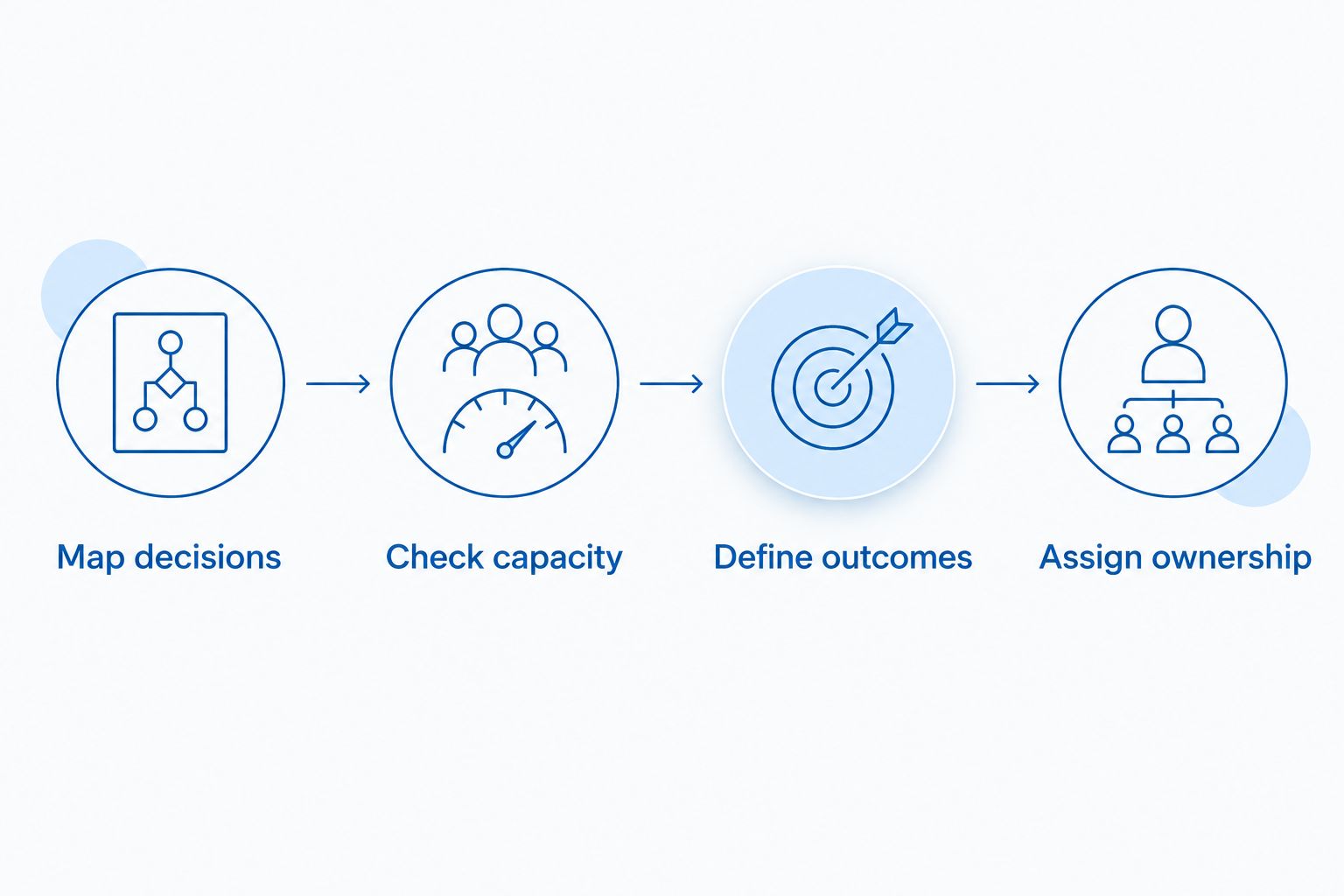
Define the work before choosing the provider's title.
Why the right choice varies between businesses
The right support depends on what prevents your team from delivering profitable work without constant owner involvement. Use these factors to explain your situation, not as a reason to buy a larger engagement.
- Owner dependence: If routine decisions still return to you, request help with delegation and decision boundaries.
- Delivery capacity: If suitable bookings are difficult to fulfil, include scheduling, responsibilities and delivery systems in the brief.
- Lead quality: If enquiries do not match the work you want, request a review of the offer, targeting and qualification process.
- Commercial clarity: If you cannot explain which work contributes profit, clarify that before making revenue growth the main objective.
- Implementation capacity: If nobody can act on recommendations, request practical implementation support or assign an internal owner first.
A hypothetical plumbing business illustrates the difference. If the owner approves routine site decisions, the brief should address crew authority and escalation; if crews have capacity but enquiries are unsuitable, the brief should address the offer and lead qualification.
Neither situation justifies assuming that more advertising is the first move. The support should follow the constraint.
What should you ask before signing?
Ask the same questions of every provider. Consistent questions make differences in scope easier to see.
- What problem are you proposing to solve first, and why?
- What will change in the way our team works?
- What will you deliver beyond meetings and recommendations?
- Which tasks remain with the owner and team?
- How will we assess progress against the starting position?
- What work sits outside the engagement?
Request relevant service-business examples when reviewing evidence. Check whether the work addressed a comparable constraint, and distinguish revenue from profit, bookings from enquiries and a client's result from a promise about your business.
For a 2026 proposal, the important detail is not how much activity appears in the schedule. It is whether the proposed activity addresses your constraint and leaves someone accountable for implementation.
Can a business coach help with marketing?
A business coach can help with marketing when marketing strategy or implementation is explicitly included in the engagement. Ask whether the work covers offers, qualification, funnels, paid advertising or team capability, rather than assuming the phrase business coaching includes them.
For a local service business, marketing support should connect enquiries to delivery. Ask who handles the lead, how suitability is assessed and whether the team can fulfil the work before approving a demand-generation plan.
Do you need a consultant or an operations manager?
Choose consulting for a defined diagnosis or project; consider an operations manager when you need ongoing internal responsibility for day-to-day delivery. Write down the recurring decisions and responsibilities before deciding which arrangement fits.
Outside advice does not automatically create internal ownership. If you need someone to manage scheduling, staff and delivery continuously, make that requirement explicit rather than burying it in a growth brief.
FAQ
What's the main difference between a business coach and a growth consultant?
Business coaching is the better brief when you need to change how you lead and delegate; growth consulting is the better brief for diagnosing a defined commercial constraint. Confirm the actual deliverables because the titles do not establish implementation responsibilities.
Which should I choose if my team relies on me for every decision?
Prioritise support for delegation, clear responsibilities and decision boundaries. Ask how the engagement will help your team make routine decisions without returning every task to you.
Should I hire a growth consultant if I need more leads?
First establish whether you need more suitable enquiries or a better process for converting and delivering existing demand. Request a diagnosis that connects marketing to team capacity rather than assuming additional advertising is the answer.
Is done-with-you support the same as a done-for-you agency?
Done-with-you support requires your business to participate in implementation. Agree which decisions, tasks and approvals belong to your team and which belong to the provider before signing.
What should I compare in a coaching proposal in 2026?
Compare the problem being addressed, deliverables, implementation responsibilities and method for assessing progress. Also check exclusions and the time your team must contribute.
Does Elevatory offer business coaching or growth consulting?
Elevatory describes its offer as business coaching with done-with-you marketing implementation. Its stated areas include offers, funnels, paid advertising and systems strategy for established Australian businesses.
One last thing
Delegating a task while keeping every decision is not a complete handover. Before your next provider conversation, choose a recurring responsibility and write down the decisions its owner can make, the standard they must meet and when they must escalate.
Take that example into the conversation. Ask the provider how they would help make the handover work; the answer will reveal more about their fit than another broad promise of growth.
Related guides
Book a free growth strategy call
Forty-five minutes with a strategist to pressure-test where your business is stuck and what to prioritise next.
Prefer to talk first? Call 1300 634 230 or email chris@elevatory.com.au