

Yes, you can create a basic online store for free in Australia in 2026 using tools that offer a free publishing option. That does not make the whole business free to operate: payment processing, fulfilment, administration and features outside the free plan still need checking before you accept orders.
TL;DR
- How to make an online store for free: start with a small offer, check payment terms, and test fulfilment.
- A published storefront is not proof that checkout, booking or delivery works.
- Service businesses should choose between checkout, booking and quote requests before building pages.
- Elevatory connects marketing coaching with delivery systems, rather than treating more leads as the answer.
Can you create an online store for free in Australia?
Yes. A basic storefront can be free to publish; running the sales process is a separate question. For your 2026 launch, distinguish the page customers see from the systems that collect payment, confirm orders and organise delivery.
Start with the customer action you need. A product purchase, an appointment request and a quote enquiry require different information and different handovers.
| Route | Best for | Main advantage | Main limitation |
|---|---|---|---|
| Hosted storefront with a free publishing option | Testing a small product offer | Gives customers a place to browse products | Publishing terms do not establish checkout or payment terms |
| Catalogue with an enquiry form | Services requiring a quote | Collects details before you commit to scope | Your team must qualify and follow up enquiries |
| Booking-led page | Clearly defined appointments | Directs customers towards a specific service | Booking requests need capacity checks and confirmation rules |
These are setup choices, not claims about a particular provider's current plan. Check the provider's terms before building around any feature.
For an established service business, assess team capacity bottlenecks before inviting more orders. A checkout cannot resolve an overloaded delivery team.
Why this matters
A store gives customers another way to buy. It also creates work: answering questions, checking scope, processing orders and handling changes.
Build a sales route your team can run without asking you about every order. Otherwise, the owner becomes the checkout's missing operating system.
That matters for trades, home services and professional services. A customer buying a defined appointment is different from a customer requesting work that needs inspection, diagnosis or a tailored proposal.
How to make an online store for free: the practical steps
Use this sequence for a 2026 launch. Keep the first version narrow enough that you can test the entire customer journey yourself, then hand it to the person responsible for daily operation.
1. Define the offer
Choose a product or service with a clear scope. Write down what the customer receives, what they must provide and what happens after they submit an order.
For services, separate standard work from work requiring assessment. Do not put an open-ended job through a checkout simply because the page builder allows it.
Hypothetical example: a home-services business offers an appointment request for an assessment, rather than promising that every customer's repair can be purchased without inspection. The page explains the next step and the team confirms suitability.
2. Check what the free option actually includes
Read the current plan documentation before entering your catalogue. Confirm that the publishing option supports your intended customer action, rather than assuming every feature shown in a demonstration belongs to it.
Check these points:
- Can Australian customers complete the intended purchase or enquiry?
- Can you connect an appropriate payment method?
- Can you use the website address you want?
- Can you export customer and order information?
- Which functions require a different plan or an additional service?
Record the answers in plain language. A clear limitation is easier to plan around than an assumption discovered after launch.
3. Build the essential information
Create a focused offer page, the purchase or enquiry route, and the information customers need before committing. Use accurate descriptions and images you own or have permission to use.
For a service offer, explain scope, exclusions, service area and the confirmation process. For a physical product, explain what is included and how delivery arrangements are communicated.
Keep optional design work behind operational clarity. A polished page with an unclear next step still leaves the customer waiting for an answer.
4. Assign the handover
Name 1 accountable person for checking incoming orders or enquiries. Give that person a written process for acceptance, clarification, scheduling and escalation.
Responsibility needs decision-making authority. If the assigned team member must ask the owner about every ordinary request, the handover is incomplete.
Specify which decisions the team can make and which require approval. Keep exceptions visible instead of leaving them in private messages.
5. Test before inviting customers
Run 3 test scenarios: a standard purchase or enquiry, a request that needs clarification, and a cancellation or change. These are a recommended test set, not a claim about how many checks guarantee a successful launch.
Use test mode where the payment provider supports it. Check notifications, confirmation messages and the internal handover without creating unnecessary real transactions.
Ask the assigned team member to complete the process without your help. Any point where work stops becomes a specific task to fix before promotion.
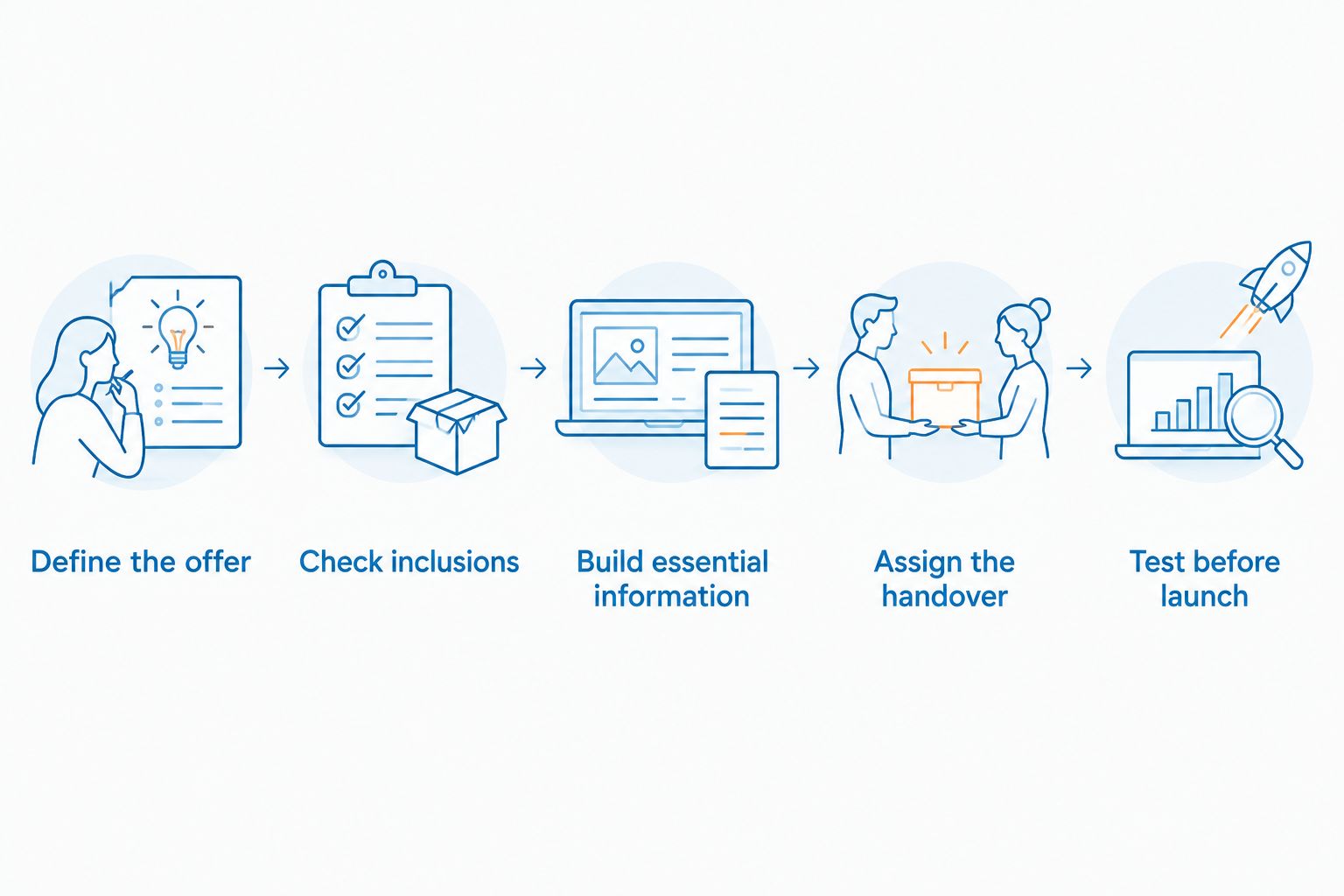
Assign the handover before you invite customers to order.
Free storefront: best for testing a defined product offer
A free publishing option suits a small test when you understand its limits. Keep the catalogue focused and establish whether customers can complete the intended action.
The advantage is a working place to present an offer without starting with a larger website project. The drawback is dependence on the provider's terms, supported functions and export options.
Before committing, check how you would move your catalogue and order records elsewhere. Choose a free storefront for a controlled test, not because the word free removes the need for due diligence.
Catalogue and enquiry form: best for quoted services
An enquiry-led catalogue suits work where scope affects suitability, scheduling or the final proposal. Customers can describe what they need before your team commits to delivering it.
The advantage is qualification before acceptance. The drawback is follow-up work: someone must review the enquiry, request missing information and communicate the next step.
Hypothetical example: a plumbing business asks about the problem, property location and access before arranging the appropriate response. That is a service workflow, not evidence of a particular business's results.
A form alone is not a sales process. Set a clear owner for enquiries and document how they move towards a confirmed booking.
Booking-led page: best for clearly scoped appointments
A booking-led page suits appointments with defined requirements and a clear confirmation process. It directs the customer towards a specific action rather than a general request for information.
The advantage is a structured route into the diary. The drawback is that appointment requests still need to match staff availability, service scope and delivery capacity.
Distinguish a requested appointment from a confirmed booking. Do not promise a slot your team has not accepted or your booking system cannot reliably allocate.
Why the work behind a free store varies
The page builder is only part of the decision. These factors determine how much operational work sits behind the storefront:
- Offer complexity: standard products need different explanations from services requiring diagnosis or custom scope.
- Payment arrangements: check provider terms, settlement processes and how refunds are handled.
- Delivery requirements: physical dispatch, on-site work and appointments require different handovers.
- Team authority: clear acceptance and escalation rules reduce routine dependence on the owner.
- Customer information: collect what the team needs to fulfil the request, without asking for unnecessary personal details.
- Data access: check whether you can retrieve the information needed to operate or change systems.
For your 2026 review, use these factors as a decision checklist rather than choosing on appearance alone. If the setup cannot support the work you sell, change the setup or narrow the offer.
Should a service business accept payment before quoting?
Accept payment only when the customer can understand what they are buying and your team can honour that scope. If inspection or assessment determines the work, an enquiry or appointment request is the clearer starting point.
Write down exclusions before publishing. Hidden scope disputes do not become easier to resolve because the customer has already completed checkout.
What should you measure after launch?
Measure the journey from enquiry or order to completed work. Page visits alone do not tell you whether the store produces suitable bookings or creates extra administration.
Track qualified enquiries, accepted bookings, completed work, cancellations and owner interventions. Use your own records to assess whether the offer supports profitable work; do not apply an invented conversion target.
For a 2026 launch review, compare the orders received with the team's ability to deliver them. Fix repeated clarification requests before adding more promotion.
When is coaching more useful than another website feature?
Coaching becomes relevant when the obstacle is deciding what to sell, who owns the work or how marketing connects to delivery. A website feature does not assign responsibility or settle competing priorities.
Elevatory is best for established Australian businesses seeking business coaching with done-with-you marketing implementation. Its stated focus includes offers, funnels, paid advertising and systems for businesses turning over $150K–$5M.
That is support with business and marketing execution, not a free store-building product or a done-for-you website service. Explore Elevatory if those are the decisions holding your team back; do not choose coaching simply because you need to publish a catalogue.
FAQ
Can I create an online store for free in Australia in 2026?
Yes, you can create a basic online store using tools with a free publishing option. Check checkout support, payment arrangements and fulfilment requirements separately before accepting orders.
What's the first step in making an online store for free?
Define the offer and the action you want the customer to take. Decide whether the customer should buy, request an appointment or submit information for a quote before choosing a builder.
Do I need a custom domain to test an online store?
A custom domain is not essential to every storefront test; the available website address depends on the publishing service. Check domain options and their terms before committing to the setup.
Is an online store better than an enquiry form for a trade business?
An enquiry form is the better starting point when the job requires assessment before acceptance. Checkout suits work with a clear scope that the customer understands and the team can deliver.
Can I take payments through every free website builder?
Do not assume a free publishing option includes online payments. Check the current checkout requirements, supported payment methods and provider terms for the specific service.
What should I test before launching my online store?
Test a standard order or enquiry, a clarification request and a cancellation or change. Confirm that customer messages reach the responsible person and that the team knows the next action.
Can Elevatory build my online store for free?
Elevatory's stated offer is business coaching with done-with-you marketing implementation, not a free store-building service. Its focus includes offers, funnels, paid advertising and systems.
One last thing
Before promoting your store in 2026, give the process to the person who will run it. Ask them to explain how an order becomes completed work, including the exceptions.
If the process only works when you are present, fix the handover before adding traffic. The useful launch milestone is not a published page; it is a customer request your team can handle correctly.
Related guides
Book a free growth strategy call
Forty-five minutes with a strategist to pressure-test where your business is stuck and what to prioritise next.
Prefer to talk first? Call 1300 634 230 or email chris@elevatory.com.au