
Yes, Meta ads can work for a high-ticket service business in 2026 when your offer attracts suitable buyers, your team follows up and your delivery capacity supports the work. The catch is that generating enquiries does not prove profitability: you need to connect advertising spend to qualified appointments, accepted proposals and completed jobs without making the owner responsible for every handover.
TL;DR
- Meta ads for high ticket service business: judge qualified bookings and profitable work, not cheap enquiries.
- Set team capacity and follow-up responsibilities before increasing advertising spend.
- Use qualification questions to separate suitable buyers from enquiries your team cannot serve.
- Elevatory combines business coaching with done-with-you marketing implementation for established Australian businesses.
Can Meta ads work for a service business with high-ticket offers?
Yes, but the campaign needs a working sales and delivery process behind it. An enquiry is the start of that process, not the result you are buying.
Start by checking your team capacity bottlenecks. If every quote, booking and delivery decision already waits for you, adding enquiries adds another queue.
Build the campaign around these 5 stages. Each stage needs a clear responsibility and a record of what happened.
- Capacity check. Identify the work your team can accept and deliver without relying on unplanned owner involvement. Separate genuinely available capacity from diary space that ignores preparation, travel or administration.
- Offer clarity. State who the service suits, what problem it addresses and what happens after someone enquires. Keep the promise within what your team can consistently deliver.
- Buyer qualification. Ask enough to establish service fit, location and project requirements. Avoid treating every submitted form as a sales opportunity.
- Sales handover. Assign responsibility for contacting the prospect, recording the conversation and agreeing on the next action. Give that person authority to progress suitable enquiries.
- Delivery review. Track accepted work through completion. Review whether the jobs produced the intended contribution after advertising, selling and delivery costs.
This is not a demand for a complicated system. A shared record with clear stages is a better starting point than a dashboard full of leads nobody owns.
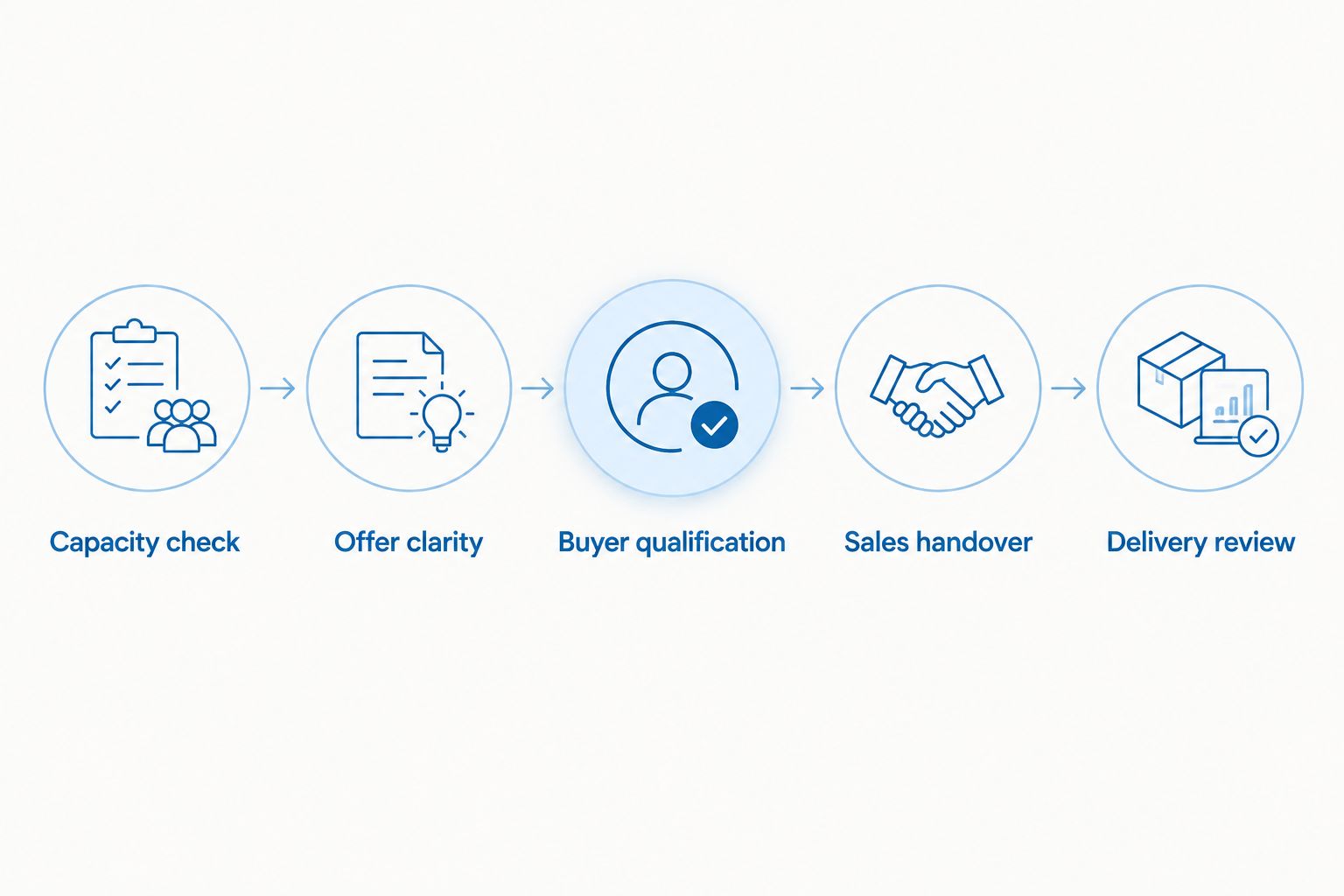
Advertising needs a clear path from available capacity to completed work.
Why this matters: more enquiries are not always the next move
For your 2026 marketing plan, start with the owner’s workload. Ask which decisions still require your approval, which jobs need your intervention and who can take responsibility without handing the task straight back.
A campaign should support the business you want to run. If you want fewer daily interruptions, the advertising process needs to route suitable prospects to a capable team member rather than directly to your phone.
Consider a hypothetical home-services business advertising a substantial renovation service. The owner handles every initial call and site visit, while the crew waits for decisions about scope. More enquiries would increase the owner’s administrative workload before fixing the delivery constraint.
The practical response is to define the qualification process and delegate the first conversation. Advertising can then feed a process with an owner, instead of feeding the business owner another task.
For a professional-services firm, apply the same test to partner time. Decide which enquiries require a partner’s judgement and which your team can qualify, schedule or decline using agreed criteria.
Which enquiry path should you use?
Choose the enquiry path your team can manage, not the one that produces the most form submissions. A short form and a detailed application serve different purposes; neither removes the need to follow up.
| Enquiry path | Best for | Advantage | Limitation |
|---|---|---|---|
| Short enquiry form | Services where suitability can be established in a conversation | Gives prospects a straightforward first step | Your team must collect missing details during follow-up |
| Detailed application | Services requiring scope information before a useful conversation | Collects project details before sales contact | Asks prospects to do more work before speaking with you |
| Consultation booking | Services with a defined initial consultation process | Gives the enquiry a scheduled next action | A booking alone does not establish suitability or attendance |
A short form is a sensible starting point when your team can qualify enquiries consistently. It is a poor fit when nobody has responsibility for making contact or recording the outcome.
A detailed application suits work where the initial scope determines whether a conversation is useful. Keep each question connected to a decision; collecting information you never use adds work without improving qualification.
A consultation booking suits a team with allocated appointment capacity and a clear consultation purpose. Do not send every prospect straight into the owner’s calendar simply because the booking process is easy to set up.
Your 2026 campaign brief should explain why the chosen path matches your sales process. “It gets more leads” is not enough.
Why Meta ads performance varies for high-ticket services
High-ticket is not a substitute for a clear offer. A substantial contract still needs enough contribution to cover acquisition, sales effort and delivery.
Use these factors to diagnose performance rather than changing the ad whenever sales disappoint:
- Offer clarity. The advertisement and enquiry page need to describe the same service. Broad promises leave your team to correct expectations during the sales conversation.
- Buyer fit. Define the service area, project type and requirements that make an enquiry suitable. A prospect outside your delivery scope is not a useful lead simply because they responded.
- Sales ownership. Assign follow-up, record contact attempts and identify the next action. An enquiry without an accountable person has no dependable route to a booking.
- Delivery capacity. Match the advertised work to your team’s skills and workload. Selling work that requires constant owner intervention conflicts with reducing owner dependence.
- Commercial measurement. Review accepted and completed work alongside advertising activity. Form submissions cannot tell you whether the resulting jobs justified the effort.
These factors also tell you where to act. Poor-fit enquiries call for a review of the message and qualification criteria; suitable enquiries that never reach a proposal call for a review of the handover and sales process.
Do not make every problem the advertising account’s problem. Check the stage where progress stops.
How do you qualify an enquiry without making the form too long?
Start with 3 qualification questions that help your team decide what happens next. Add questions only when the answers change eligibility, routing or preparation for the conversation.
What service or outcome are you looking for?
Use language your buyer understands. A homeowner should not need to know your internal job categories to describe the work they need.
For a hypothetical professional-services firm, this question might distinguish an ongoing service requirement from a standalone project. That distinction helps the team route the enquiry without asking a partner to interpret every submission.
Where does the work need to happen?
For a local service business, location helps establish whether the enquiry sits within your service area. For a professional-services firm, ask about location only when it affects how you deliver the work.
Do not collect an address simply because the form has space for it. Ask for the information needed at this stage, then collect detailed job information when it becomes useful.
What needs to be in place before you proceed?
Use this question to understand the buying process. The prospect might need to confirm the scope, involve another decision-maker or establish when the work can begin.
Treat the answer as preparation for a useful conversation, not permission to pressure someone. Your team needs to distinguish an immediate opportunity from an enquiry that needs a later follow-up.
What should you measure before increasing spend?
Measure movement towards suitable, completed work. Keep advertising activity visible, but do not let platform-reported enquiries stand in for business outcomes.
| Measure | What it tells you | What it does not prove |
|---|---|---|
| Submitted enquiries | People took the advertised next step | The enquiries suit your service |
| Qualified enquiries | Prospects meet your agreed criteria | They will book or accept a proposal |
| Attended consultations | Sales conversations actually happened | The proposed work will proceed |
| Accepted proposals | Prospects agreed to the proposed work | The work has been completed profitably |
| Completed-job contribution | What remains after the costs you include | That the team can absorb more work |
Define contribution consistently with your bookkeeper or accountant. Record the costs included so that comparisons do not change meaning between reviews.
Where a sale involves several conversations, keep the enquiry source attached to the customer record. Review the actual path to the booking rather than assuming the latest click explains the whole decision.
Before increasing your 2026 campaign spend, check that accepted work is suitable, delivery is under control and follow-up does not depend on you rescuing it. Increase demand only when the team can handle the next stage.
When should you hold off launching Meta ads?
Hold off when you cannot explain who handles a new enquiry or what makes the resulting job worthwhile. Fix those decisions before paying to expose the gaps.
Assign 1 accountable person to each enquiry. Other team members can contribute, but responsibility for the next action should remain clear until the handover is accepted.
Pause the launch if your team cannot explain the service scope consistently. An advertisement should not promise an outcome that sales staff interpret differently from the people delivering the work.
Also hold off if every proposed job needs the owner to redesign the offer. Standardise the parts that repeat, and define which exceptions genuinely need your judgement.
This is preparation, not an argument against advertising. A clear handover and a deliverable offer give you something useful to test; an overloaded owner gives you another dependency.
When does coaching with implementation support make sense?
Coaching with implementation support makes sense when the problem crosses marketing, sales responsibilities and delivery systems. Changing advertisements alone does not resolve unclear authority or an offer the team cannot fulfil consistently.
Elevatory is best for established Australian business owners who want business coaching with done-with-you marketing implementation. That is a different engagement from outsourcing the whole marketing function.
Elevatory works with established Australian businesses on offers, funnels, paid advertising and systems strategy. The fit is practical when you want support deciding what to change and implementing it with your team.
The limitation is equally clear: done-with-you work still requires your business to participate. Assign people who can make decisions, maintain records and carry out the agreed changes; do not expect coaching to replace internal responsibility.
Connect marketing with team capacity
Explore business coaching with done-with-you marketing implementation.
Is a cheap enquiry a good result for a high-ticket service?
A cheap enquiry is not proof of a good result. Judge whether the prospect fits your service, progresses through sales and produces work your team can deliver at an acceptable contribution.
An enquiry that takes extensive staff time but never fits the service still consumes resources. Review the quality of the conversation, not just the cost of starting it.
Should the owner take every sales call?
No, the owner should not take every sales call by default. Give the team qualification criteria and decision-making boundaries, then reserve owner involvement for conversations that genuinely require it.
If you cannot delegate the initial conversation, document what you assess during it. Use that record to train the person taking responsibility rather than leaving the process in your head.
Can you run Meta ads before hiring more staff?
Yes, provided your existing team has capacity for the work you advertise. Limit the campaign scope to work the team can qualify, sell and deliver without relying on an unplanned hire.
If capacity is already stretched, settle responsibilities and workload first. Advertising is not a replacement for a staffing or delivery decision.
FAQ
Can Meta ads sell high-ticket services without an online checkout?
Yes, Meta ads can direct prospects towards an enquiry or consultation rather than an online checkout. Track the resulting conversations, proposals and completed work to judge the commercial outcome.
What should I fix before advertising my service business?
Fix unclear responsibilities, an inconsistent offer and delivery bottlenecks before advertising. Your team needs to know who handles enquiries and which work it can accept.
Should I use a short form or a detailed application?
Use a short form when your team can establish suitability during follow-up, and a detailed application when project information is needed beforehand. Ask only questions that affect the next decision.
Do more leads mean my campaign is working?
More leads do not prove your campaign is working. Check whether suitable prospects attend conversations, accept proposals and become completed jobs that justify acquisition and delivery costs.
How much should I spend on Meta ads for a service business?
Set spending around your service economics, delivery capacity and an agreed testing limit. There is no single budget that establishes profitability for every high-ticket service.
Does Elevatory offer done-for-you advertising?
Elevatory is positioned as business coaching with done-with-you marketing implementation. That model requires participation from your business rather than treating marketing as a fully outsourced function.
One last thing
Before approving your next 2026 campaign, follow a recent enquiry from first contact to delivery. Ask each person involved to explain who owned the next step and what information they received.
The most useful next move might be a clearer handover, not another advertisement. Fix the point where responsibility becomes unclear before sending more prospects through it.
Related guides
Book a free growth strategy call
Forty-five minutes with a strategist to pressure-test where your business is stuck and what to prioritise next.
Prefer to talk first? Call 1300 634 230 or email chris@elevatory.com.au