

Yes, email marketing can grow an ecommerce brand without paid ads in 2026 by converting subscribers into buyers and bringing existing customers back. But email does not create its own audience: you still need a way to attract subscribers, plus a team that can fulfil the orders without routing every decision through you.
TL;DR
- Can email marketing grow ecommerce without paid ads? Yes, when subscriber acquisition, repeat purchases and delivery capacity support growth.
- Email attribution is not proof of additional sales; track total store performance alongside campaign reports.
- Elevatory offers business coaching with done-with-you marketing implementation, not a replacement for your internal team.
- Build clear campaign responsibilities before increasing send frequency or adding another acquisition channel.
Why this matters
Avoiding paid ads removes media spend. It does not remove the work of attracting customers, making offers or delivering orders. That work moves into organic search, partnerships, content, referrals and customer retention.
For your 2026 plan, separate the audience problem from the conversion problem. A store with engaged subscribers needs a different intervention from a store with almost nobody to email. The email list to loyal customers retention workflow addresses what happens after someone joins; your acquisition plan must explain how they get there.
Email can be your main sales channel without being your only source of demand. That distinction determines whether an email-led strategy has room to grow.
Can email marketing alone grow an ecommerce brand without paid ads?
Yes, provided the business already reaches potential customers or has another way to attract them. Email gives you a channel for following up with that audience, explaining products and encouraging another purchase. It cannot send a campaign to people whose contact details you do not have permission to use.
The practical choice is not simply email versus advertising. Compare the whole route from discovery to delivery.
| Approach | Best for | Main advantage | Main limitation |
|---|---|---|---|
| Email-led selling to an existing audience | Brands with engaged subscribers and relevant repeat-purchase opportunities | Builds on relationships already established | The existing audience limits your immediate reach |
| Email plus organic acquisition | Brands prepared to build search, referral, content or partnership channels | Connects new audience discovery with ongoing follow-up | Requires acquisition work as well as email execution |
| Email plus paid acquisition | Brands ready to fund and measure advertising alongside retention | Adds a paid route to reach potential customers | Adds advertising expenditure and another channel to manage |
Choose email-led growth when you can explain both where new subscribers come from and why customers would buy again. Do not choose it solely because advertising feels expensive or difficult.
Build an email-led growth system your team can run
An email strategy that depends on you writing, approving and fixing everything preserves owner dependence. Before expanding the calendar, assign responsibility for audience acquisition, campaign execution, customer support and reporting. One person can hold several responsibilities, but each responsibility needs a named owner.
Use the following sequence for your 2026 email plan. It connects marketing activity to delivery rather than treating campaign revenue as the finish line.
1. Audience acquisition
Identify how people currently discover your store. Separate search visitors, referrals, partnerships, social content and existing customer recommendations rather than grouping everything under organic traffic.
Then decide who owns each route. If nobody is responsible for attracting relevant visitors and earning email permission, your email plan has an acquisition gap. Adding another welcome message does not close that gap.
2. Relevant follow-up
Match messages to the customer's situation. A new subscriber needs a reason to trust the store; a recent buyer needs information that supports their purchase. A previous customer needs a relevant reason to return.
Start with the messages your customer journey actually requires. Avoid building automated sequences simply because a template includes them. Every message needs a purpose, an audience and someone responsible for keeping it accurate.
3. Delivery readiness
Before scheduling a campaign, confirm that fulfilment and support can handle the offer. Agree on who handles customer questions, order issues and exceptions. Set an escalation rule so ordinary decisions do not keep returning to you.
This is where marketing and operations meet. A campaign is not ready because the email is written; it is ready when the business can deliver what the email promises.
4. Commercial measurement
Review total store revenue alongside email-attributed revenue, new customers, returning customers and contribution after variable costs. Read the measures together. A channel report alone cannot tell you whether the business became healthier.
Keep your reporting definitions consistent. If the attribution window changes, record the change rather than interpreting the resulting difference as a sudden improvement in performance.
5. Clear accountability
Give the campaign owner authority to act within agreed boundaries. Document what requires approval and what does not, including offer changes, audience selection and customer-facing commitments.
Review exceptions after the campaign. If the same decision repeatedly needs your intervention, clarify the rule or responsibility before the next send. Otherwise, higher campaign volume simply creates more decisions for the owner.
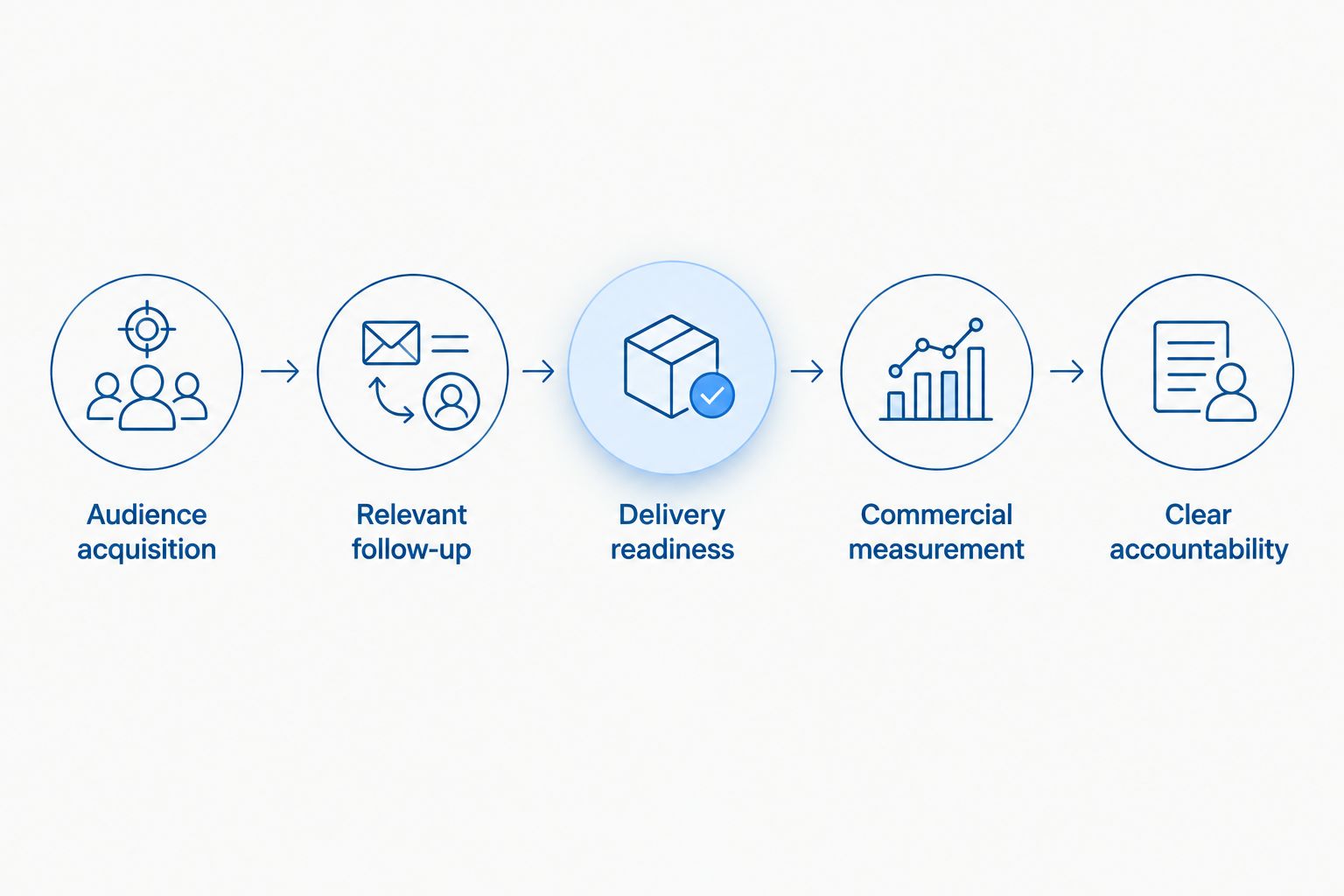
Campaign execution needs audience acquisition, delivery readiness and clear decision ownership.
Why email-led ecommerce growth varies
The same email calendar will not produce the same outcome in every store. These factors change what the channel can achieve and where your team should focus:
- Audience relevance: Subscribers who joined for a relevant product interest are different from contacts collected through an unrelated incentive. Check the source before blaming the copy.
- Repeat-purchase fit: Replenishable products and occasional purchases create different reasons to return. Build around actual customer behaviour, not an assumed buying cycle.
- Offer clarity: Customers need to understand what the product does and why it fits their needs. More reminders do not resolve an unclear offer.
- Subscriber acquisition: An existing list gives you people to contact now. Ongoing acquisition gives you new relationships to develop.
- Delivery capacity: Campaign promises must match what fulfilment and support can deliver. Assign operational checks before the campaign goes live.
- Team ownership: Clear responsibility keeps execution moving. Requiring the owner to approve every detail makes the owner part of every deadline.
How do you know whether email is creating extra sales?
Email-attributed revenue is not the same as additional revenue. Attribution assigns credit according to a reporting rule; it does not prove that every credited order would disappear without the email.
For your 2026 review, compare email reports with whole-store outcomes. Look for changes in total sales, customer mix, purchase frequency and contribution after variable costs. Include the work required to plan, write, build and manage campaigns rather than treating an unpaid advertising channel as costless.
Where practical, use a controlled holdout: retain a comparable group that does not receive the campaign and compare purchasing outcomes. Keep the comparison conditions consistent. A small or uneven comparison is a reason to avoid a confident conclusion, not a reason to invent one.
Also record what changed elsewhere. A new product, a search traffic increase or a partnership can affect sales during the same period. Your reporting should help the team make decisions, not award every improvement to the last email sent.
What should you do if your email list stops growing?
A stalled list needs an acquisition review before a more crowded sending calendar. Inspect where visitors arrive, whether the sign-up offer matches their interests and whether consent is collected appropriately. Check unsubscribes alongside new sign-ups so you can distinguish weak acquisition from poor retention.
Do not solve every audience problem with an incentive. Explain what subscribers receive and why it matters. Then make one person accountable for improving the relevant acquisition route, rather than leaving list growth as an unowned marketing objective.
Does sending more emails mean you will grow faster?
Sending more emails increases activity; it does not establish demand. Increase frequency only when you have a useful message, a relevant audience and the capacity to fulfil the resulting orders.
Use customer behaviour to shape the calendar. If campaigns generate questions your team cannot answer, fix product information and support ownership first. If people click but do not purchase, inspect the offer and purchase journey rather than automatically adding another reminder.
Build the acquisition route before adding more campaigns
An email-led business still needs a discovery channel. For your 2026 plan, choose a route your team can maintain and connect it to a clear next step: explore a relevant product, read buying information or subscribe with informed permission.
For a store using Shopify, SEO for Shopify stores belongs on the acquisition side of this system: search helps people discover relevant pages, while email follows up after they subscribe. Treating search and email as competing strategies misses their different jobs.
Assign ownership across the handover. Someone must maintain acquisition content, someone must check the sign-up journey, and someone must manage what happens after subscription. A visitor arriving from search should not receive follow-up unrelated to the interest that brought them there.
Keep the workload visible. Organic acquisition needs planning, publishing and maintenance; partnerships need coordination. Choose a manageable route rather than launching every channel and leaving the owner to keep them all moving.
Match the campaign to the team's capacity
Consider a hypothetical ecommerce business where the owner approves every email and handles every unusual customer request. Increasing campaign volume adds more approval work and more potential interruptions. The first improvement is clearer responsibility, not a longer promotional calendar.
The campaign lead needs agreed offer boundaries. Fulfilment needs notice of the campaign. Support needs accurate product information and authority to resolve routine issues. The owner should handle defined exceptions, not become the default destination for unfinished decisions.
This principle also matters for service businesses, but do not transfer ecommerce campaign results into claims about profitable bookings. A trade or professional service business has its own scheduling, qualification and delivery constraints. Measure the business model you actually run.
When coaching and implementation support fit
Elevatory is best for established Australian business owners who want business coaching with done-with-you marketing implementation. The fit is an owner who needs help connecting offers, funnels, advertising and systems rather than another disconnected list of marketing tasks.
Elevatory works with established Australian businesses turning over $150K–$5M. That scope does not make coaching a substitute for internal ownership: your team still needs responsibility for decisions and execution. It is not a done-for-you replacement for running the business.
Bring a clear problem to the conversation. Identify whether the constraint sits in audience acquisition, conversion, repeat purchases, delivery capacity or owner dependence. Agree on the scope before deciding which channel to expand.
Discuss your growth constraint
Discuss business coaching and done-with-you implementation around your current priorities.
FAQ
Can email marketing grow ecommerce without paid ads in 2026?
Yes, email marketing can grow ecommerce without paid ads in 2026 when a business has a relevant audience, a reason for customers to buy and a way to attract new subscribers. Email does not replace audience acquisition or delivery capacity.
Can I grow an ecommerce business using only an existing email list?
An existing email list gives you an audience to convert and retain, but it limits who you can reach directly. Track new subscriber acquisition separately so growth does not depend entirely on the same contacts.
Is email marketing better than paid ads for ecommerce?
Email marketing and paid ads perform different jobs, so neither is automatically better. Email follows up with subscribers; paid advertising adds a funded route to reach potential customers.
How often should an ecommerce brand send marketing emails?
Set email frequency around relevant customer needs, useful messages and delivery capacity rather than a universal schedule. Review purchases, unsubscribes and customer feedback before increasing frequency.
Does email-attributed revenue prove that a campaign generated extra sales?
Email-attributed revenue does not prove that every credited sale was additional. Review whole-store performance and use a controlled comparison where practical to assess the campaign's effect.
Should I hire someone to manage email marketing or do it myself?
Assign email marketing to someone with clear responsibility, time and decision authority. Hiring support without defining approvals and operational handovers leaves the owner as the bottleneck.
Does Elevatory provide business coaching or done-for-you email management?
Elevatory provides business coaching with done-with-you marketing implementation. Its stated scope covers offers, funnels, paid advertising and systems strategy, rather than replacing your internal team.
One last thing
Before writing the next campaign, ask who can approve it, deliver it and handle the customer response without you. If every answer is the owner, you have found a constraint that better subject lines will not fix.
For your 2026 plan, document those responsibilities alongside the acquisition and retention work. The goal is not merely to sell without paid ads; it is to build a sales system the team can run.
Related guides
Book a free growth strategy call
Forty-five minutes with a strategist to pressure-test where your business is stuck and what to prioritise next.
Prefer to talk first? Call 1300 634 230 or email chris@elevatory.com.au