

Yes, a business growth consultant can increase revenue by fixing the constraint that stops your business winning, delivering or retaining profitable work. That might mean delegating decisions before increasing leads, tightening your offer or improving follow-up; in 2026, the test is still collected revenue and delivery capacity, not a busier owner. Results vary and are not guaranteed.
TL;DR
- Can a business growth consultant increase revenue? Yes, when business coaching addresses a specific sales or delivery constraint.
- Elevatory business coaching suits established Australian businesses seeking done-with-you implementation, not outsourced ownership of every task.
- Build team capacity before increasing marketing demand; more enquiries do not fix an overloaded delivery team.
- Measure collected revenue, gross profit and owner dependence together; revenue alone does not prove the engagement worked.
Why this matters
If every quote, roster change and customer issue lands on your desk, more enquiries create more decisions for you. A growth plan that ignores that workload leaves the operating problem untouched.
Start by measuring owner dependence, then decide whether sales or delivery needs attention first. You need to know what the team can handle without your intervention before paying to fill the pipeline.
For established Australian service businesses, the useful question is not simply whether a consultant can generate growth. It is whether the proposed changes create profitable work that your team can deliver without making you the permanent bottleneck.
Can a business growth consultant really increase revenue?
Yes. A consultant can help you identify where revenue is being lost, choose a practical intervention and support implementation. The recommendation needs to connect a business problem to an observable commercial outcome.
Use this sequence to test whether a proposal has that connection:
- Find the constraint. Identify whether unsuitable enquiries, weak quoting, limited capacity or owner approvals are blocking work.
- Assign responsibility. Name the person responsible for the change and define the decisions they can make.
- Fix the handover. Make sure enquiries, accepted quotes and customer requirements reach the right person.
- Measure the result. Compare completed work, collected revenue, direct costs and owner involvement against the starting position.
The evidence should follow the same chain. If a consultant recommends better enquiry qualification, look for changes in suitable enquiries, accepted quotes and completed jobs—not just activity inside a marketing platform.
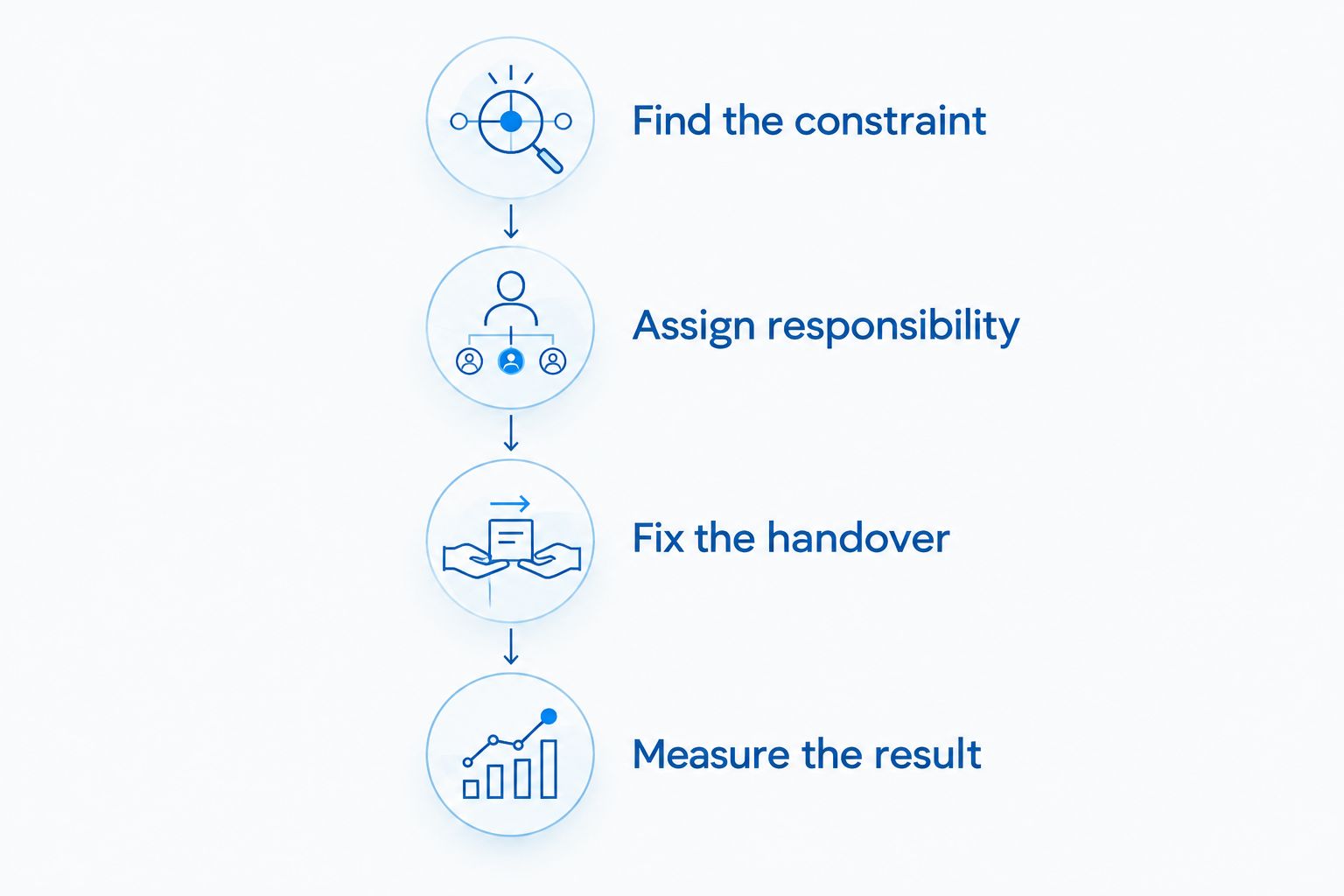
A growth recommendation needs an accountable owner and a measurable commercial outcome.
Revenue growth is not proof that every recommendation worked. Check whether the change actually reached delivery, whether customers paid and whether the work left enough margin after direct costs.
Which type of support fits your constraint?
Choose support for the problem you need solved, not the job title on the proposal. Business coaching, marketing consulting and operational management have different purposes, even when their responsibilities overlap.
| Support | Best for | Main benefit | Limitation to check |
|---|---|---|---|
| Business coaching with done-with-you implementation | Owners needing priorities, accountability and help putting changes into practice | Connects decisions with implementation | Your team still needs time and responsibility for agreed work |
| Marketing strategy consulting | Businesses with delivery capacity but an unclear offer or weak customer acquisition process | Focuses attention on positioning, demand and conversion | Does not automatically resolve scheduling or delivery problems |
| Operations management | Businesses needing daily coordination and decision ownership | Gives delivery work a clear operational lead | Does not automatically create a stronger offer or sales pipeline |
Elevatory business coaching is best for established Australian owners seeking coaching with done-with-you marketing implementation. Its stated focus includes offers, funnels, paid advertising and systems for businesses turning over $150K–$5M.
That fit also defines the boundary. Elevatory is not a substitute for assigning internal responsibilities, and done-with-you support is not a promise that someone else will run every part of the business. Choose this model when you want help implementing decisions and can commit team capacity to the work.
Where revenue improvements come from
A useful 2026 growth plan names the commercial mechanism before naming the marketing channel. Ask what changes between an enquiry arriving and the business collecting payment.
Delegation that releases delivery capacity
If routine decisions wait for you, the team needs decision rules, not another reminder to take initiative. Define what a crew leader, practice manager or administrator can approve, what requires escalation and what information must accompany that escalation.
Hypothetical example: An electrical business owner approves every scheduling adjustment. Giving the scheduler clear boundaries for routine changes removes an approval step; the commercial test is whether the team completes suitable work without creating rework or customer problems.
Delegation does not guarantee extra revenue. It creates room to operate differently, which you then need to use productively.
An offer that matches the work you want
A full enquiry inbox is not useful if the enquiries concern work you do not want or cannot deliver profitably. Review service scope, qualification questions and quote wording together.
Hypothetical example: A professional services firm receives enquiries outside its area of expertise. Clearer service descriptions and intake questions help the team identify suitable work before a partner spends time preparing a proposal.
Judge the change by the quality of accepted work. Enquiry volume alone cannot tell you whether the offer improved.
Follow-up that has a named owner
Unanswered enquiries and unallocated quotes need an operating process. Assign responsibility for the next action, record its status and define when an issue returns to the owner.
Do not assume software fixes an unclear handover. Agree on what counts as a qualified enquiry, what information the quoting person needs and who checks that the customer receives a response.
Delivery that supports repeat business
Marketing should not promise a service standard the team cannot deliver. Check the handover from sale to delivery, including agreed scope, customer expectations and responsibility for unresolved issues.
A consultant's recommendation should explain how the team will maintain that standard as work increases. Otherwise, the growth plan stops at the sale and leaves you to absorb the consequences.
Why revenue outcomes vary
The same recommendation does not produce the same result in every business. In 2026, assess these factors before agreeing to a growth target:
- The starting constraint. Improving advertising does not resolve work waiting for owner approval.
- Delivery capacity. Accepted work still needs people, time and a workable schedule.
- Offer fit. The business needs enquiries for services it can deliver profitably.
- Implementation ownership. Agreed changes need someone responsible for completing them.
- Measurement quality. Revenue reporting needs consistent definitions and comparable periods.
- Owner involvement. Delegation fails when the owner keeps reversing decisions that sit within agreed boundaries.
These are practical checks, not excuses for vague advice. Ask the consultant which factor is the current priority, what evidence supports that diagnosis and what your team must change.
If everything is labelled urgent, ask for a sequence. Your team needs a manageable priority, not a growing list of unfinished improvements.
What should you measure before hiring a consultant?
Create a baseline your team can maintain. For a 2026 engagement, agree on the reporting period, definitions and source of each measure before implementation begins.
| Measure | What it tells you | What to check alongside it |
|---|---|---|
| Collected revenue | What customers have actually paid | Completed work and payment timing |
| Gross profit | Revenue remaining after direct delivery costs | Consistent treatment of labour and materials |
| Suitable enquiries | Whether marketing attracts work you want | Qualification rules and delivery capacity |
| Quote acceptance | Whether quoted work becomes accepted work | Job fit and scope, not acceptance alone |
| Owner approvals | Where decisions still depend on you | Decision authority and escalation rules |
| Rework | Where delivery needs correction | Handover quality and customer requirements |
Do not let a lead report stand in for a business result. More suitable enquiries matter when they become profitable, deliverable work. Fewer owner approvals matter when the team makes sound decisions rather than simply escalating problems later.
Keep measurement practical. A report nobody updates cannot support a decision, and a complicated dashboard does not compensate for inconsistent records.
How do you choose a business growth consultant?
Ask for the proposed working method before being persuaded by a result headline. You need clarity about diagnosis, responsibilities and implementation—not a promise that your business will reproduce another client's outcome.
Use these questions in the conversation:
- What information do you need to distinguish a sales problem from a delivery problem?
- Which decisions will the owner need to delegate?
- What will you help implement, and what remains with our team?
- How will marketing activity reflect our delivery capacity?
- What will we review if enquiries increase but profit does not?
- How will we know whether the engagement is reducing owner dependence?
Review case studies for relevance as well as results. An ecommerce sales result is not evidence that a trade business will solve crew scheduling or that a professional services firm will reduce partner approvals.
A useful case study explains the starting problem, the changes made and the scope of the outcome. Treat it as evidence of that client's experience, not a forecast for yours.
Should you fix the team before increasing marketing?
Fix the team first when delivery or routine decisions already depend on an overloaded owner. Increasing demand before resolving that constraint adds work to the same blocked process.
If the team has capacity but not enough suitable work, offer development and marketing deserve attention. Confirm that capacity through the schedule, responsibilities and delivery requirements—not simply because the owner wants more sales.
For your 2026 plan, connect campaign decisions to whoever allocates and delivers the work. The marketing brief should explain which services the business wants, which enquiries it should decline and what happens after an enquiry qualifies.
Can revenue rise without the business getting stronger?
Yes. Higher revenue can come with weaker margins, more rework or greater owner dependence. Review the quality of growth alongside the headline figure.
A business that accepts unsuitable work to keep the team busy still needs to examine scope, direct costs and delivery pressure. Likewise, an owner who personally rescues every job has not established a repeatable delivery system.
The goal is not revenue at any operational cost. It is profitable work supported by clear responsibilities, a workable delivery process and decisions that do not all return to you.
FAQ
Can a business growth consultant increase revenue for a service business?
Yes, a business growth consultant can increase revenue by improving the constraint affecting sales or delivery. The work needs implementation, internal ownership and measurement; results are not guaranteed.
What's the best support if my team keeps asking me to decide everything?
Support focused on delegation, decision authority and delivery systems fits an owner-approval bottleneck. Marketing alone does not remove the team's need to wait for your decisions.
Is business coaching better than hiring an operations manager?
Business coaching and an operations manager solve different needs. Coaching supports priorities and implementation, while an operations manager takes responsibility for agreed day-to-day operations.
Can a marketing consultant help if we already have enough leads?
Yes, a marketing consultant can help improve enquiry quality, service positioning and the sales handover. If delivery capacity is the constraint, increasing lead volume is not the first priority.
How do I know whether business coaching is working?
Compare collected revenue, gross profit, delivery performance and owner involvement against an agreed baseline. Activity reports alone do not establish that the business improved.
Who is Elevatory business coaching for?
Elevatory business coaching serves established Australian businesses turning over $150K–$5M. Its approach combines coaching with done-with-you implementation across offers, funnels, paid advertising and systems.
Can a consultant guarantee that my revenue will increase?
No, a consultant cannot guarantee your revenue will increase. Outcomes depend on the business's starting position, implementation, delivery capacity and customer response.
One last thing
Before hiring anyone, review the decisions your team brought back to you recently. Separate genuine exceptions from routine work that lacks a clear owner or boundary.
That list gives you a concrete starting brief. Ask a prospective consultant to explain which recurring decision they would help remove from your desk, how they would do it and what commercial measure should change as a result.
Related guides
Book a free growth strategy call
Forty-five minutes with a strategist to pressure-test where your business is stuck and what to prioritise next.
Prefer to talk first? Call 1300 634 230 or email chris@elevatory.com.au