

Consulting-firm business mentoring is structured support for the owner, with the aim of building delivery leaders who can run client work without constant founder approval. A business mentor for consulting firms should connect delegation, commercial decisions and marketing to your team's delivery capacity—not just give you another growth plan.
TL;DR
- Choose a business mentor for consulting firms who turns owner-dependent delivery into clear responsibilities, decisions and review routines.
- Elevatory business coaching suits established Australian service-business owners seeking coaching with done-with-you implementation.
- Build delivery leadership before increasing demand; marketing coaching should respect your team's capacity.
- Choose an operations manager when you need daily execution ownership, not advice alone.
Why business mentoring matters for consulting firms
Your consulting firm sells expertise, but the owner should not become the approval point for every brief, recommendation and client conversation. If consultants must wait for you before progressing ordinary work, hiring more people does not remove that dependency. It gives you more people to approve.
Build responsibility before you add demand. Start with a first delegation plan that defines which decisions leave your desk and which still need your judgement.
Consulting delivery adds a specific complication: you cannot document every professional judgement as a fixed instruction. A delivery leader needs boundaries, examples of acceptable work and authority to act within the agreed scope. A checklist alone is not enough.
For your 2026 operating plan, make the immediate objective explicit: client work progresses through a named delivery leader, with the owner involved at defined checkpoints. More enquiries belong later in the plan if your existing work still depends on daily intervention.
Build delivery leaders before increasing demand
Identify the decisions that keep returning to you
Start manually. Review your calendar, project messages and recent approvals, then record the decisions you handled. Separate genuine owner responsibilities from decisions that returned because nobody knew who could make them.
Use 3 recent engagements as a starting sample. This is a practical review exercise, not an industry benchmark. Include different types of work so you do not design the entire handover around your easiest client.
Look for repeated decisions: changing the work sequence, clarifying a brief, reviewing an analysis or responding to an extra client request. Record why each decision came back. Was the team missing information, authority, capability or confidence?
A useful mentoring brief starts with this evidence. Ask a prospective mentor to help you choose the constraint to address first, rather than treating every interruption as a training problem.
- Record the decision, its current owner and why it reached you.
- Mark decisions involving scope, quality, staffing or client expectations.
- Separate commercial commitments from routine delivery choices.
- Choose one recurring decision type for the first handover.
Define delivery ownership before changing job titles
A senior consultant is not automatically a delivery leader. Technical ability and responsibility for an engagement are different things. Define the role before promoting someone into it.
Draft a one-page responsibility map yourself. State who owns the brief, work allocation, client updates, quality checks and escalation. Name a person for each responsibility; do not assign ownership to a department or assume everyone shares it.
Set decision boundaries in plain language. Your delivery leader needs to know what they can approve within an agreed engagement and what requires a commercial decision. If the owner must approve everything, the handover exists only on paper.
In 2026, judge the role by its decisions and outputs, not its title. A delivery leader should know what a satisfactory handover looks like and how to act when an engagement drifts outside its brief.
- Assign one accountable person to each engagement.
- Write down decisions the delivery leader can make independently.
- Define triggers for escalating scope, commercial and quality concerns.
- Agree who covers the role during leave or competing commitments.
Turn mentoring advice into working delivery systems
Create the first version with documents and tools you already use. Write a brief template, a delivery checklist and an escalation guide. Test them on a live engagement before building a larger process library.
Elevatory business coaching suits established Australian service-business owners seeking coaching with done-with-you implementation. Elevatory works with established Australian businesses turning over $150K–$5M across offers, funnels, paid advertising and systems strategy. For a consulting owner, the relevant choice is coaching paired with implementation support—not handing over the business to a done-for-you agency.
The limitation is clear: done-with-you support still needs your participation and someone inside your firm who owns execution. Before engaging any provider, agree the delivery-system work, responsibilities and outputs. Do not assume that every operational task sits inside a general coaching engagement.
Use a simple sequence for the handover: Brief, Delivery owner, Quality check, Escalation, Review. These stages make responsibility visible without pretending consulting work is identical from client to client.
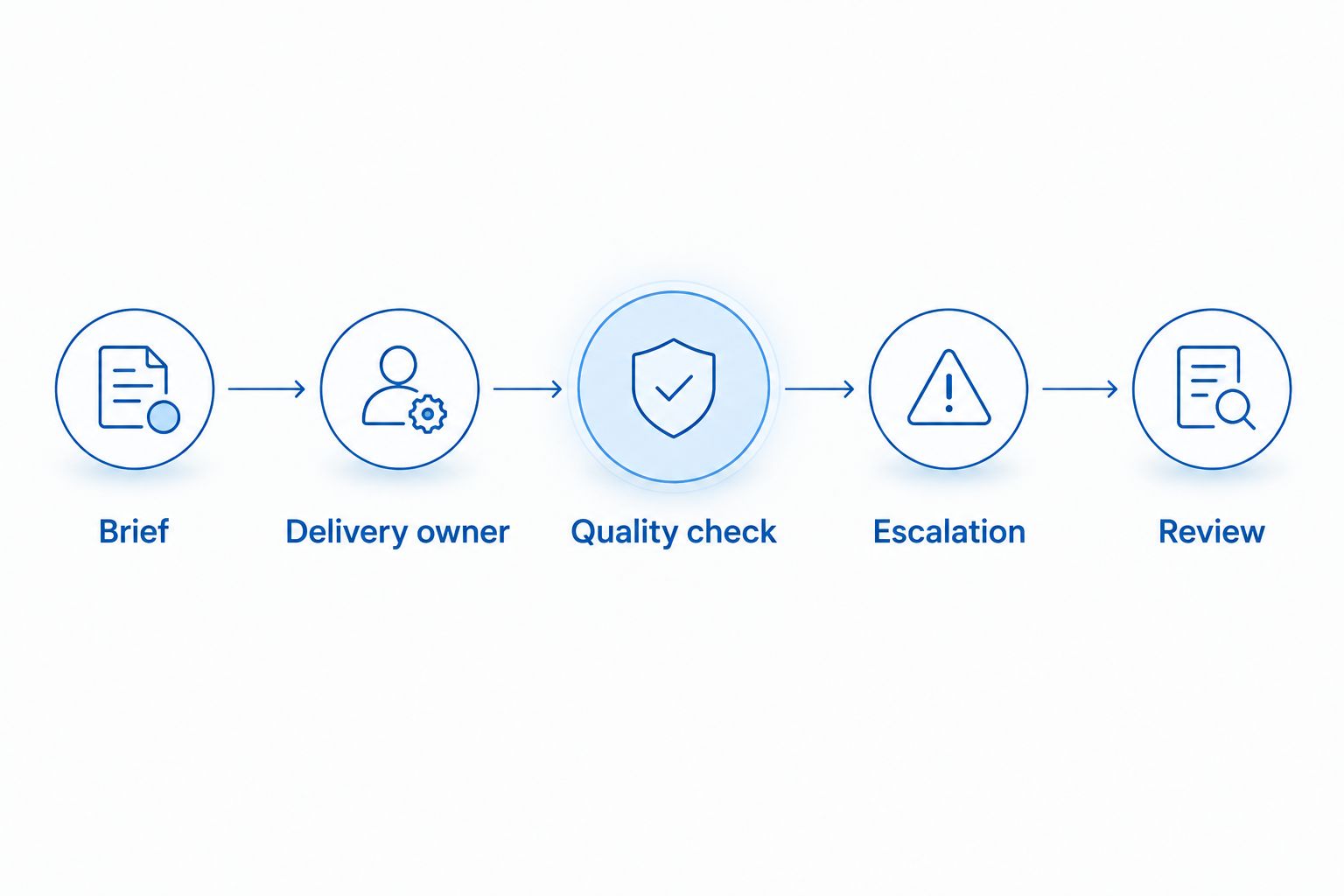
A delivery leader needs an agreed brief and decision boundaries, not just a checklist.
The system should help your team make decisions, not send every decision through another document. Remove a template field if nobody uses it to deliver, review or protect the agreed scope.
- Use a Brief that states the outcome, scope and acceptance criteria.
- Name the Delivery owner and their decision boundaries.
- Place a Quality check before client-facing work leaves the firm.
- Define Escalation triggers and the person responsible for responding.
- Close each engagement with a Review of recurring delivery friction.
Transfer decisions through supervised practice
Do not move from owner approval to complete independence overnight. Choose a bounded engagement or workstream, explain the decision boundaries and let the delivery leader make the decisions within them.
Use a 4-week practice window as an initial planning choice. Adjust it to the engagement length and risk; it is not a promised handover deadline. Review the reasoning behind decisions, not just whether the outcome matched your personal preference.
Hypothetical example: a consulting firm appoints a senior consultant to lead a defined advisory engagement. The delivery leader controls work allocation and routine client updates, while changes to the agreed scope return to the owner. This illustrates a handover structure, not a client result.
Your mentor's role is to help you make the transfer deliberate. Your role is to stop quietly reclaiming authority whenever someone approaches a problem differently.
- Choose an engagement with clear scope and acceptance criteria.
- Ask the delivery leader to explain decisions at agreed checkpoints.
- Review judgement without taking back routine approvals.
- Record unclear boundaries and update the responsibility map.
- Expand authority only after reviewing actual delivery decisions.
Connect your offer and marketing to team capacity
Start with a manual capacity view. List current engagements, the people responsible and the work already committed. Distinguish technical delivery capacity from the capacity to brief, review and manage clients.
A consulting firm can have consultants available but no delivery leader able to own another engagement. That is a different constraint from a shortage of enquiries. Do not ask marketing to solve a delivery leadership problem.
For your 2026 marketing plan, define the work your team can deliver well without rebuilding the scope around the founder. Lead quality means enquiries that fit that work—not simply people willing to book a call.
Connect pricing decisions to delivery effort and scope. A profitable booking needs an agreed outcome, a realistic workload and a team capable of fulfilling it. More bookings do not fix poorly bounded engagements.
- List committed work alongside delivery and review responsibilities.
- Define the client problems your team can address within agreed scope.
- Put fit questions into your enquiry and discovery process.
- Assign responsibility for moving qualified enquiries into a delivery brief.
- Review scope and delivery effort before increasing paid advertising.
Measure independence alongside commercial performance
Build a short scorecard before adding more reporting. Record decisions escalated to the owner, work requiring rework, scope changes and delivery commitments met. Keep definitions consistent so the review does not become a debate about what counts.
Set aside 30 minutes each week for a delivery review. This is a recommended routine, not a performance benchmark. Let the delivery leader bring the issues and proposed decisions rather than asking you to reconstruct every project.
Your 2026 scorecard should show whether responsibility is actually moving. Revenue alone cannot tell you whether the owner still approves routine work or whether a delivery leader can manage an engagement independently.
Review commercial performance separately but alongside delivery. Compare the agreed scope with the effort required, and distinguish profitable bookings from engagements that repeatedly consume unplanned owner time.
- Track the reasons routine decisions return to the owner.
- Record rework and the stage where it first became visible.
- Compare agreed scope with additional requests and delivery effort.
- Review which decisions the delivery leader handled independently.
- Choose one process correction and name its owner.
Compare support against the job you need done
Choose support by responsibility, not by the broadest promise. A mentor, a coaching-and-implementation provider and an operations manager solve different parts of the problem. Interview against the work you need transferred.
| Option | Best for | Practical advantage | Key limitation |
|---|---|---|---|
| Self-directed delegation | Owners with a clear problem and time to implement | You can begin with existing documents and live engagements | The owner must design, test and maintain the handover |
| Business mentor | Owners needing an outside challenge to priorities and decisions | Focuses discussion on owner judgement and business direction | Advice alone does not assign daily execution ownership |
| Elevatory coaching with done-with-you implementation | Established Australian service-business owners seeking coaching and implementation support | Combines business coaching with work on marketing and systems | Requires owner participation; agree operational scope before engagement |
| Operations manager | Firms needing someone to own daily coordination | Creates a named internal owner for operational execution | The role does not automatically solve offer or marketing strategy |
| Marketing strategy consultant | Firms with delivery capacity but unclear positioning or demand priorities | Concentrates support on the marketing decisions you need to make | Marketing work does not replace delivery leadership |
Ask every provider what you will implement, who will own it and what sits outside the engagement. If the answers remain abstract, you do not yet have a useful scope.
Common mistakes consulting owners make
Promoting technical expertise without transferring authority
Your strongest consultant can still lack permission to resolve routine delivery issues. Define the role's decisions, review responsibilities and escalation boundaries before expecting leadership. A title is not a delegation plan.
Documenting everything before testing anything
A large process library does not prove the team can use it. Start with one live engagement and revise the documents after observing where decisions stall. Keep exceptions visible instead of forcing different client problems into an unsuitable template.
Selling founder access that the team cannot fulfil
If your offer promises your personal involvement throughout delivery, stepping back requires a change to the offer and client expectations. State who leads the work before the engagement begins. Do not sell founder-led delivery and quietly substitute team-led delivery.
Treating every escalation as failure
Some decisions belong with the owner. The problem is unclear or unnecessary escalation, not escalation itself. Review whether the team followed the agreed boundary before telling them to become more independent.
FAQ
What's the best business mentor for consulting firms?
The best fit is a mentor whose scope covers your actual constraint: delegation, delivery leadership or commercial decisions. Ask how advice becomes assigned work, and distinguish mentoring from daily operational ownership.
Can a business mentor help me build delivery leaders?
A business mentor can support the decisions and accountability involved in building delivery leaders. Your firm still needs to assign authority, practise handovers and review live delivery work.
Is a business mentor better than an operations manager?
A business mentor is suited to owner judgement and priorities; an operations manager is suited to daily execution ownership. Choose according to whether you need help deciding what changes or someone responsible for running the work.
Does Elevatory provide done-for-you consulting delivery?
Elevatory is positioned as business coaching with done-with-you marketing implementation, not a done-for-you consulting delivery provider. Agree the systems work and implementation responsibilities before engaging support.
Should my consulting firm increase marketing before hiring a delivery leader?
Check delivery ownership and capacity before increasing marketing. If routine engagements still require constant owner intervention, address that constraint before adding more work.
What should I bring to my first business mentoring session?
Bring recent engagement briefs, examples of decisions escalated to you and a map of current responsibilities. These show where authority, information or capability needs attention.
How do I know delegation is working?
Delegation is working when the delivery leader makes agreed decisions and meets the firm's acceptance criteria without unnecessary owner approval. Track escalation reasons, rework and scope changes alongside commercial performance.
One last thing
Before replacing a process, check whether you have given someone permission to use it. Ask your delivery leader which decision they can make without you today that they could not make last week. If there is no clear answer, the next move is a decision boundary—not another meeting.
Related guides
Book a free growth strategy call
Forty-five minutes with a strategist to pressure-test where your business is stuck and what to prioritise next.
Prefer to talk first? Call 1300 634 230 or email chris@elevatory.com.au