

Plan an operations handover by transferring a defined workflow, its decisions and its checks to a named team member—not by handing over a job title. Document what good delivery looks like, practise the work together, then let the team member run it within clear decision limits. Keep exceptions visible and match your marketing activity to the team's capacity to deliver.
TL;DR
- Searching business consultant australia? Choose support that turns owner-held decisions into clear team responsibilities.
- Elevatory combines business coaching with done-with-you marketing implementation for established Australian businesses.
- Hand over a complete workflow, including decision limits, delivery checks and escalation rules.
- More leads are not the answer when quoting, scheduling or delivery still depends on the owner.
How do you plan an operations handover in Australia?
Start with the work that repeatedly pulls you back into daily operations. Your 2026 handover plan should make someone else responsible for completing that work, not just helping you with it.
For established service businesses, Elevatory provides business coaching and done-with-you marketing implementation. The practical question when choosing support is whether it helps your team own delivery as well as helping you attract customers.
Use this sequence to build the handover:
- Choose the workflow. Select a recurring process with a clear beginning and end, such as handling an enquiry through to a confirmed booking.
- Name the owner. Assign responsibility for the outcome, including follow-up and unresolved issues.
- Set decision limits. State what the person can decide independently and what needs approval.
- Practise the handover. Work through routine cases and exceptions before stepping out.
- Review delivery. Check completed work, customer issues and decisions that still return to you.
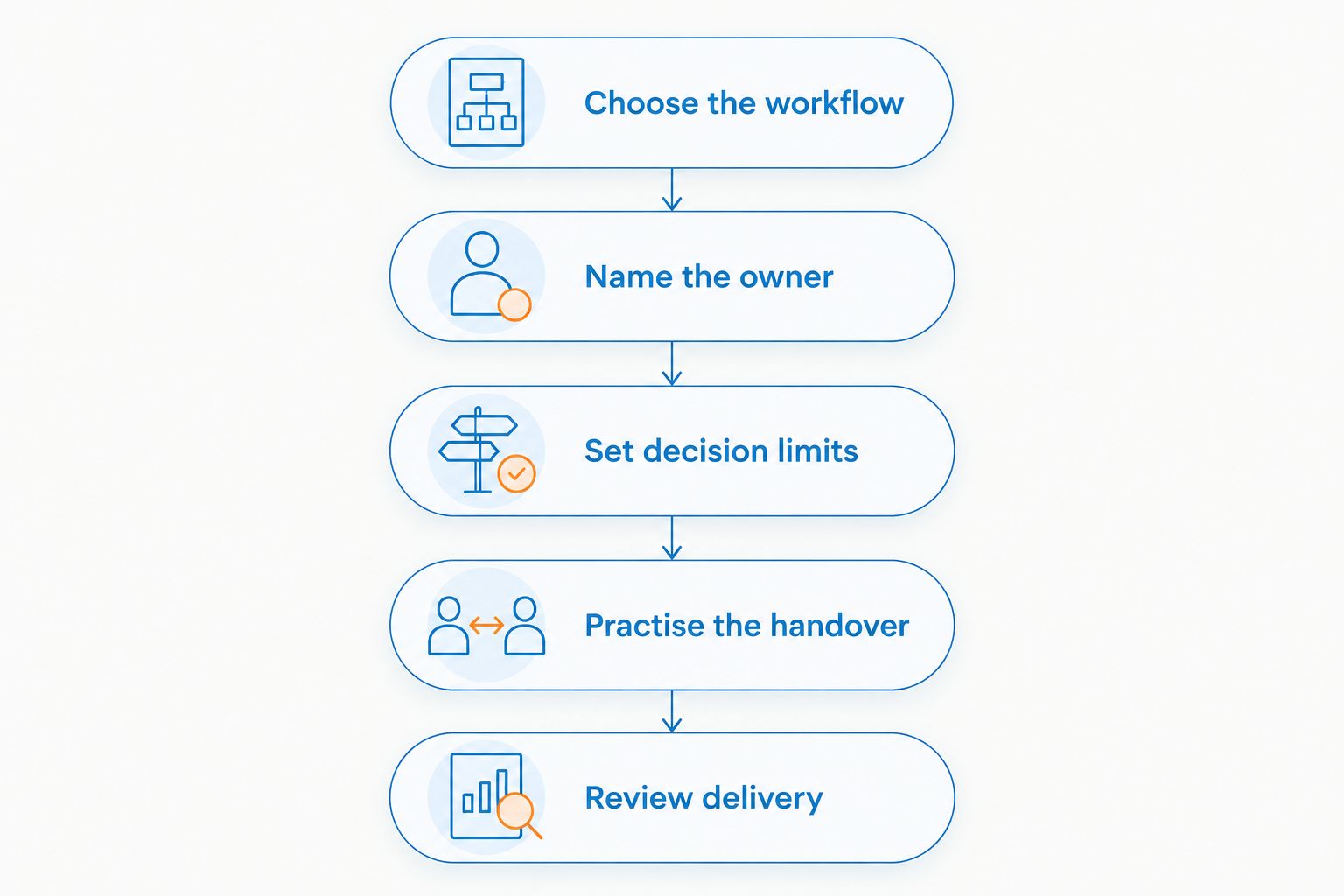
Transfer the decisions and checks with the work, not just the tasks.
A handover is complete when the team can finish the work within agreed boundaries without routine owner approval. A written procedure alone does not meet that test. Someone must have the authority, information and capacity to use it.
Why this matters
Owner dependence hides inside ordinary work: approving quotes, rearranging appointments, answering familiar customer questions and checking every completed job. Each task looks manageable. Together, they keep responsibility concentrated in you.
Marketing then sends more enquiries into the same approval queue. The issue is not necessarily lead volume; it is whether the business can turn suitable enquiries into profitable, well-delivered bookings without adding more owner involvement.
For your 2026 operating plan, separate demand from delivery. Ask whether you need more suitable enquiries, a better booking process, clearer responsibilities or capacity to fulfil the work. Those are different problems and need different actions.
Choose a workflow before choosing a new role
Do not begin with a broad instruction such as taking over operations. Begin with a process you can observe from start to finish.
For a trade or home-service business, that process might run from receiving an enquiry to confirming the job details and booking the work. For a professional-services business, it might run from a client accepting a proposal to receiving an agreed delivery schedule. These are workflow examples, not client results.
Write down the trigger, the required outcome and the point where responsibility ends. Include the information needed along the way: customer requirements, job scope, team availability and unresolved questions.
Best for: owners whose daily interruptions cluster around a recurring process. A narrow workflow gives you a clear handover boundary. Its limitation is equally clear: transferring bookings does not automatically solve pricing, staffing or delivery problems elsewhere.
Avoid assigning a new title while leaving every meaningful decision with yourself. That creates an assistant to the owner, not an accountable process owner.
Decide how much responsibility to transfer
Task delegation, workflow ownership and operational leadership are different handovers. Choose the level that matches the person's responsibilities and the business's current need.
| Handover approach | Best for | Practical advantage | Limitation to address |
|---|---|---|---|
| Task delegation | A clearly defined piece of work | Makes the instruction and completion check specific | Leaves coordination and exceptions with the owner |
| Workflow ownership | A recurring process with a defined outcome | Gives someone responsibility from start to finish | Requires access to information and clear decision limits |
| Operational leadership | Coordinating people and delivery across processes | Moves wider scheduling and delivery decisions away from the owner | Requires authority, judgement and visibility across the business |
Choose workflow ownership when you want to reduce routine owner involvement in a defined process. Choose task delegation when the work genuinely needs only a narrow instruction. Choose operational leadership when someone must coordinate across roles, not simply complete their own work.
Do not ask a team member to carry leadership responsibility while giving them only task-level authority. If they must seek approval for every adjustment, you have retained the operating role.
Build a handover brief the team can use
Your 2026 handover brief should answer the questions that otherwise become calls, messages and interruptions. Keep it close to the actual work. A long document that nobody uses is not a delivery system.
Outcome and responsibility
Name the person responsible and describe the finished result. For booking work, completion means more than entering an appointment: the scope, customer details, assigned capacity and outstanding conditions must be clear.
Distinguish responsibility from assistance. Other people can contribute, but someone must own the next action when information is missing or the process stalls.
Decision limits
Write down which decisions belong to the role. Include routine scheduling changes, customer follow-up and the handling of incomplete enquiries where relevant.
Keep decisions about pricing changes, unusual scope or commitments outside the team's authority explicit. Do not rely on someone knowing when you would want to be asked.
Escalation rules
Describe the situations that need your involvement and the information to bring with them. A useful escalation explains the issue, the available choices and the proposed next action.
Avoid making every unfamiliar situation an automatic escalation. Record how resolved exceptions should update the handover brief so the same question does not repeatedly return.
Delivery checks
State how you will verify the outcome. Review completed bookings, scope accuracy, unresolved customer issues and work that needed correction, as relevant to the workflow.
Check the result rather than approving every intermediate action. Otherwise, the handover preserves the original bottleneck under a different name.
Practise responsibility before stepping away
Explain the workflow using real work, then ask the team member to explain it back. Listen for gaps in judgement, not just missing steps. Knowing where to enter information is different from knowing whether the information is sufficient.
Next, let the team member run the process while you observe. Discuss exceptions after the work unless an immediate intervention is necessary. Constantly taking over teaches the team to wait for you.
Step back from routine decisions; stay available for defined exceptions. Review what happened and update the brief where instructions were unclear. Do not interpret every correction as evidence that delegation cannot work.
The test is practical: can the person complete the workflow, identify a problem and act within their authority? If not, identify whether the gap is instruction, capability, access, capacity or permission before changing the role.
Why operations handovers vary
The right handover depends on the work and the authority required to complete it. Assess these factors before fixing a scope:
- Owner-held knowledge: Decisions based on information only you know need to be explained or kept within a defined escalation boundary.
- Workflow complexity: Work crossing quoting, scheduling and delivery needs clear responsibility at each transition.
- Team capacity: A capable employee still needs room in their workload to take responsibility.
- Decision authority: Responsibility without permission sends routine decisions back to the owner.
- Customer commitments: Promises about scope and timing must match what the delivery team can fulfil.
- Information access: The process owner needs the job details and current status required to act.
A 2026 handover should reflect the business you actually operate. Do not copy another company's role description and assume its responsibilities, staffing or approval boundaries fit yours.
Connect marketing to delivery capacity
Before increasing marketing activity, make the path from enquiry to delivery visible. Who qualifies the enquiry? Who confirms the scope? Who checks capacity before a commitment is made?
Hypothetical example: A plumbing business receives suitable enquiries, but the owner reviews every booking and rearranges the diary. Increasing advertising leaves that approval step untouched. The handover should first define which bookings the coordinator can confirm and which job details require review.
Hypothetical example: A professional-services firm accepts work before checking who can deliver it. A handover that covers only lead follow-up misses the constraint. The booking process needs a capacity check and a clear owner for confirming the delivery commitment.
Neither example is an Elevatory client result. They show why marketing coaching and operational responsibility need to connect: the team must be able to fulfil the work that marketing brings in.
Review lead quality alongside delivery. Enquiries that do not fit your scope, location or capacity should not be treated as interchangeable with suitable bookings.
What should a business consultant help you implement?
A useful consulting engagement should leave you with decisions made, responsibilities assigned and a process your team can run. Ask what you will implement together, who will do the work and how you will check completion.
Elevatory is best suited to established Australian businesses seeking business coaching with done-with-you marketing implementation. Its stated focus is businesses turning over $150K–$5M, with support across offers, funnels, paid advertising and systems strategy.
That model requires participation. Elevatory is not a substitute for appointing an internal process owner or giving your team decision authority. Confirm that an operations handover sits within the proposed engagement rather than assuming every coaching service includes it.
Before engaging support in 2026, ask:
- Which owner-dependent workflow will the engagement address?
- What responsibilities will transfer to the team?
- What will the consultant help implement, and what remains your responsibility?
- How will marketing decisions account for delivery capacity?
- What evidence will show that the workflow works without routine owner intervention?
Choose support against those answers, not against how much activity appears in the proposal.
Can I hand over operations without hiring a manager?
You can hand over a defined workflow without immediately creating a management role. Start with an existing team member only when that person has the capability, capacity and authority to own it. Coordination across several roles is a separate responsibility that needs its own scope.
Should I fix operations before increasing advertising?
Fix the delivery constraint before increasing advertising when existing enquiries already stall in quoting, booking or fulfilment. If the team has capacity but lacks suitable work, marketing needs attention. Diagnose the constraint rather than automatically choosing either operations or advertising.
How do I know the handover has worked?
The handover has worked when the team completes routine work within agreed limits and escalates genuine exceptions with useful information. Review corrections, unresolved work and decisions still returning to you. Being less involved is not enough if delivery quality is slipping.
FAQ
What should I ask a business consultant in Australia about delegation?
Ask which workflow will transfer, who will own it and what decisions that person will be authorised to make. Request a clear distinction between advice, done-with-you implementation and your team's responsibilities.
What's the first thing to document for an operations handover?
Document the workflow's required outcome and the person responsible for achieving it. Then record the trigger, decision limits, escalation rules and delivery checks.
Is a written procedure enough to reduce owner dependence?
A written procedure is not enough to reduce owner dependence. The person using it also needs the information, capacity and authority to finish the work without routine approval.
How do I stop every team decision coming back to me?
Define which decisions the team can make and which exceptions need your involvement. When a recurring question is resolved, update the handover brief rather than answering it from scratch each time.
Can business coaching help with marketing and team capacity?
Business coaching can address how marketing decisions connect to team responsibilities and delivery capacity. Elevatory provides business coaching with done-with-you marketing implementation; confirm the specific operational scope before engaging support.
Should I delegate pricing decisions during a handover?
Delegate pricing decisions only within explicitly agreed authority. Keep changes outside that authority subject to review, and make the escalation process clear so quoting does not depend on guesswork.
What should I review after handing over customer bookings?
Review whether bookings contain the correct scope, customer information and delivery commitments. Also examine unresolved enquiries, corrections and routine decisions that still require owner approval.
One last thing
Review the questions your team sends you, not just the tasks they finish. Repeated questions show where information, authority or responsibility remains unclear.
For your 2026 handover, turn recurring questions into written decision rules. That is more useful than telling the team to show more initiative while keeping the rules in your head.
Related guides
Book a free growth strategy call
Forty-five minutes with a strategist to pressure-test where your business is stuck and what to prioritise next.
Prefer to talk first? Call 1300 634 230 or email chris@elevatory.com.au