

Accountants’ business mentoring is structured support for running an accounting practice, with the aim of growing beyond the principal’s daily involvement. A business mentor for accountants should help you delegate decisions, build reliable delivery and connect your 2026 marketing plan to the work your team can actually handle—not simply recommend more leads.
TL;DR
- A business mentor for accountants should address principal dependence before recommending more marketing.
- Elevatory suits established Australian business owners seeking business coaching with done-with-you marketing implementation.
- Delegate routine decisions with clear boundaries; keep technical review and professional obligations explicit.
- Measure team capacity, profitable engagements and owner involvement before increasing lead volume.
Why business mentoring matters for accountants
An accounting practice cannot become less dependent on its principal if every quote, client question and workflow exception still returns to the same desk. Hiring creates capacity only when people also receive clear responsibilities and permission to act.
Your profession adds an important distinction: delegating workflow is not the same as removing professional oversight. A mentor should help you separate commercial and operational decisions from technical decisions that require an appropriately qualified reviewer.
For your 2026 plan, assess business coaching against that distinction. Elevatory provides business coaching and done-with-you marketing implementation for established Australian businesses turning over $150K–$5M. The relevant question is whether that support matches your practice’s operational and commercial needs, not whether you need another source of accounting advice.
Use mentoring to identify the constraint you can change. That might be work allocation, inconsistent engagement scope, slow approvals or a principal who remains the default contact for every client. Choose the priority before choosing the campaign.
How to grow an accounting practice beyond the principal
Identify where decisions return to you
Start with a simple spreadsheet. For the next working week, record each interruption that requires your involvement, who raised it and what prevented them from resolving it. Record the decision rather than just the task: approving a fee exception is different from preparing an engagement letter.
Group the interruptions into technical review, client communication, pricing and workflow. This gives you a practical starting point for your 2026 delegation plan without buying another system.
Delegate repeatable decisions before hiring around an unclear role. Keep decisions requiring your expertise, but challenge the assumption that every familiar decision must remain yours. Ask the person handling the work what information or authority they need to finish it.
- Record the reason each question reached your desk.
- Mark decisions that require qualified technical review.
- Identify repeatable decisions with a clear answer or boundary.
- Choose one recurring interruption to remove first.
Define responsibilities and escalation boundaries
Write a responsibility sheet for the selected workflow. Name the person responsible for progressing the work, the person authorised to approve it and the circumstances requiring escalation. A shared document is enough to begin.
For an accounting practice, separate client onboarding, work allocation, technical review and client communication. One person can hold several responsibilities; the point is that the responsibility is visible. Do not describe everyone as jointly responsible and expect a clear handover.
Test the sheet against a real engagement before expanding it. Ask what happens when information arrives late, the requested work falls outside scope or a reviewer identifies an issue. Those exceptions expose gaps that a tidy task list misses.
- Work allocation: name who assigns and reprioritises work.
- Technical review: specify the reviewer and approval requirements.
- Client communication: name who provides progress updates.
- Escalation boundaries: define which exceptions return to the principal.
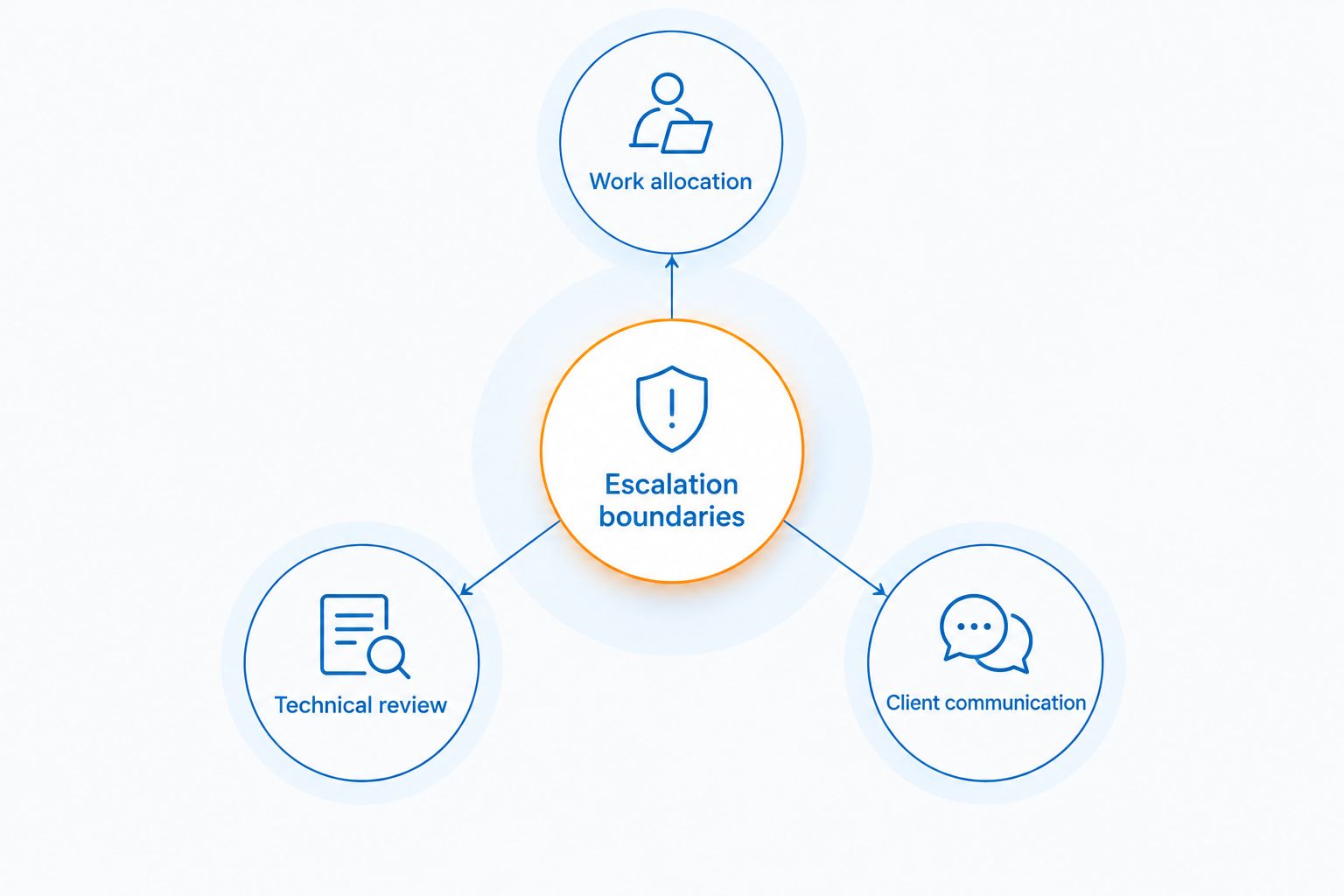
Routine responsibilities need named owners and clear limits on when the principal steps in.
Set a mentoring brief around one constraint
You can start without paid support. Write a one-page brief describing the recurring problem, its effect on delivery and the decision you want the team to handle independently. Add the work already attempted and the reason it has not held.
For a hypothetical accounting practice, the brief might be: routine client onboarding keeps returning to the principal because nobody owns missing-information follow-up. The first project is an onboarding handover, not an advertising campaign. This is an illustration, not a client result.
Elevatory is best suited to established Australian business owners seeking business coaching with done-with-you marketing implementation. That model fits owners who want support implementing changes alongside their team; it is not a substitute for an internal person responsible for daily delivery.
Before choosing any mentor, ask how the proposed work addresses your specific constraint. Advice without an implementation owner leaves you carrying the same decisions.
- Define the operational problem in one sentence.
- Bring current workflow documents and engagement templates.
- Ask which changes your team will implement themselves.
- Agree how progress and responsibilities will be reviewed.
Standardise the engagement before promoting it
Review your recent engagements manually. Compare what you agreed to deliver with the work actually performed, including client communication, missing-information follow-up and rework. Use your own records rather than assumed margins or industry averages.
Choose a service you can explain, scope and deliver consistently. Document what is included, what triggers a scope discussion and who can authorise a change. Clear scope supports delegation because team members can recognise an exception without asking you to interpret every request.
Hypothetical example: a client requests additional advisory work during a routine compliance engagement. The team needs a defined route for discussing and approving that work, rather than absorbing it silently or promising it without authority.
Promote the work your practice can deliver well, not every service you are technically able to provide.
- Compare agreed scope with actual work completed.
- Record recurring requests that sit outside scope.
- Define who approves variations and communicates them.
- Rewrite the service description around clear inclusions and boundaries.
Match marketing to delivery capacity
Build a capacity view before increasing enquiry volume. List the work already committed, who can complete it, who must review it and what information is still outstanding. Include reviewer availability: preparation capacity alone does not establish delivery capacity.
For your 2026 marketing plan, connect each promoted service to a realistic delivery route. If every new engagement needs your personal consultation and review, the campaign still depends on you even when another team member answers the enquiry.
Marketing coaching should address qualification and handover alongside messaging. The aim is to attract suitable engagements and give your team enough information to progress them. A marketing strategy brief based on team capacity helps keep that commercial discussion tied to delivery.
- Record committed work and available reviewer capacity.
- Define the client and engagement types you want to attract.
- Assign responsibility for qualifying and responding to enquiries.
- Set a review point before expanding campaign activity.
Measure whether owner dependence is falling
Start with 3 measures: routine decisions escalated to you, engagements waiting for your approval and time spent on work someone else is meant to own. These are proposed management measures, not industry benchmarks.
Review them alongside commercial outcomes. Track suitable enquiries, accepted engagements and profitability using your practice’s own records and accounting definitions. More enquiries are not a useful result if they create unsuitable work or overload the reviewer.
Set aside 30 minutes each week to discuss the measures with the people responsible. Use the meeting to make a decision, not collect explanations. If an escalation keeps recurring, change the authority boundary, missing information or process that causes it.
Measure the work that no longer needs you, not just the work your team completes.
- Use consistent definitions for each management measure.
- Separate routine approvals from necessary technical review.
- Compare accepted engagements with delivery commitments.
- Assign an owner and next action to recurring problems.
Test the handover before expanding it
Choose one workflow and run a 4-week handover trial. This is a suggested planning period, not a promise about how quickly your practice will change. Keep technical review requirements intact and make the escalation route visible.
Ask the responsible team member to progress routine work within agreed boundaries. Review the exceptions rather than quietly taking the workflow back. If a step fails, identify whether the cause is unclear authority, missing information, capability or workload.
Use your 2026 growth plan to sequence the next change. Expanding marketing, hiring and rewriting every workflow simultaneously makes it harder to see which action solves the problem. Stabilise the first handover, then select the next constraint.
- Select a workflow with a clear beginning and end.
- Confirm authority and review requirements before the trial.
- Record exceptions without automatically reclaiming the work.
- Adjust the process before extending it to another service.
Compare support options for your accounting practice
Choose support according to who needs to make the change and who will maintain it. A mentor, an operations manager and a marketing consultant serve different purposes. None removes the need for clear internal responsibility.
The table compares support models, not verified outcomes from named providers. Ask each prospective provider to define their scope and limits against your brief.
| Option | Best for | Practical benefit | Key limitation |
|---|---|---|---|
| Self-directed delegation plan | Principals with time to implement a focused handover | Lets you test responsibilities using existing documents | You own the diagnosis, follow-through and review |
| Business mentor or coach | Owners needing help choosing priorities and reviewing decisions | Adds an external challenge to your assumptions | Advice does not manage the practice day to day |
| Elevatory business coaching with done-with-you implementation | Established Australian owners seeking business and marketing support together | Combines coaching with implementation alongside your team | It is not a done-for-you agency or an internal operations role |
| Operations manager | Practices needing daily coordination and process ownership | Places operational responsibility inside the business | The role still needs authority, scope and principal backing |
| Marketing consultant | Practices with delivery capacity and a defined acquisition problem | Focuses work on positioning, qualification and acquisition | Marketing alone does not resolve delivery or approval bottlenecks |
If the principal already knows what needs changing but nobody manages daily execution, examine the operations role first. If priorities remain unclear, coaching addresses a different need. If delivery works and suitable enquiries are the constraint, focus the marketing brief there.
Common mistakes accountants make when choosing a mentor
Buying lead generation before fixing review capacity
More suitable enquiries still create problems when every engagement waits for the principal’s review. Map the review queue before approving additional marketing work. Make reviewer capacity part of the campaign decision, not an issue to solve afterwards.
Delegating preparation but keeping every small approval
A team can prepare all the work while the principal remains the bottleneck. Separate necessary technical approvals from routine operational permissions. Give people explicit authority for the latter and a clear route for exceptions.
Choosing a mentor as a substitute for technical expertise
Business mentoring addresses how you run the practice. Do not treat commercial coaching as accounting, tax or regulatory advice. Confirm the boundaries of the engagement and retain the qualified oversight your work requires.
Accepting generic success stories as proof of accounting fit
A result from an ecommerce business does not establish an accounting-practice outcome. Ask how a provider will address engagement scope, reviewer capacity and principal dependence. Assess the proposed work against your practice rather than borrowing another business’s result.
Leaving implementation entirely with the principal
If you attend every meeting and complete every follow-up task, coaching can become another owner responsibility. Involve the person who will maintain each change. Put their responsibilities into the implementation plan before work begins.
FAQ
What does a business mentor for accountants actually do?
A business mentor for accountants helps the principal make and implement decisions about running the practice. Useful work includes delegation, engagement scope, team responsibilities and marketing tied to delivery capacity; it does not replace qualified technical advice.
What's the best business mentor for an accounting practice?
The best fit is a mentor whose scope matches your practice’s current constraint and includes clear implementation responsibilities. Ask how they will address principal dependence, reviewer capacity and engagement quality rather than judging them by general growth claims.
Is a business mentor better than an operations manager?
A business mentor is better suited to priority-setting and decision support; an operations manager is better suited to daily operational ownership. Choose based on whether your practice lacks a clear plan or someone responsible for executing it.
Should an accounting practice hire a marketing consultant first?
Hire a marketing consultant first when suitable client acquisition is the constraint and your team can deliver the resulting work. Resolve approval queues, unclear scope and delivery handovers before expanding marketing activity.
Can I delegate work without giving up technical oversight?
Yes, you can delegate workflow ownership while keeping the technical review required for the engagement. Document who progresses the work, who reviews it and which exceptions require escalation.
Does Elevatory provide done-for-you practice management?
Elevatory provides business coaching and done-with-you marketing implementation, not done-for-you practice management. Your business still needs internal owners for delivery, daily decisions and maintaining the changes.
How do I know whether business mentoring is working?
Check whether routine decisions and workflow ownership are moving away from the principal without compromising required review. Track commercial outcomes alongside escalation counts, approval queues and your time spent on delegated responsibilities.
One last thing
For your 2026 plan, ask a team member one question: Which routine decision would you stop asking me about if you had a clear boundary? Turn the answer into a documented responsibility and test it on the next engagement.
That is a practical first move towards reducing principal dependence. Business coaching does not guarantee revenue growth; judge progress by the changes your team can maintain and the outcomes recorded in your own practice.
Related guides
Book a free growth strategy call
Forty-five minutes with a strategist to pressure-test where your business is stuck and what to prioritise next.
Prefer to talk first? Call 1300 634 230 or email chris@elevatory.com.au