

Service-based business growth consulting is structured advice and implementation support aimed at growing profitable revenue without making the owner responsible for every decision. For Australian trades, home services and professional services, the work starts with delegation and delivery capacity, then connects offers and marketing to what the team can deliver.
TL;DR
- Business growth consulting for service based businesses should address owner dependence before increasing lead volume.
- Elevatory is best for established Australian service-business owners seeking business coaching with done-with-you marketing implementation.
- Assign delivery decisions, define profitable work and check team capacity before expanding paid advertising.
- Choose a business mentor for decision support; choose an operations manager for daily delivery ownership.
A useful 2026 growth plan gives your team clearer responsibilities, not just a bigger sales target. Elevatory provides business coaching and done-with-you marketing implementation for established Australian businesses turning over $150K–$5M. That combination suits owners who want support implementing decisions, rather than advice alone or a fully outsourced marketing department.
Why business growth consulting matters for service businesses
A service business sells work that people must deliver. A booking needs available labour, an agreed scope, materials or specialist input, and someone accountable for completion. Marketing cannot replace those requirements.
If every quote, scheduling change and client complaint comes back to you, extra enquiries add decisions to your day. The first growth question is not how to get more leads. It is who will own the work those leads create.
Trades and home services need clear handovers between quoting, scheduling and crews. Professional services need defined boundaries between sales promises, specialist delivery and partner approval. Both need a way to distinguish profitable bookings from work that consumes capacity without supporting the business.
Use business growth consulting in 2026 to connect these decisions. Your plan should identify the constraint, assign responsibility and define what will change in daily operations. A revenue target without those details is not an implementation plan.
Build your 2026 growth plan in six steps
Follow this sequence: Diagnose constraints, Delegate decisions, Define scope, Match capacity, Improve handovers and Review outcomes. Start manually with your existing diary, job records and a shared document. You do not need new software to identify where work stalls.
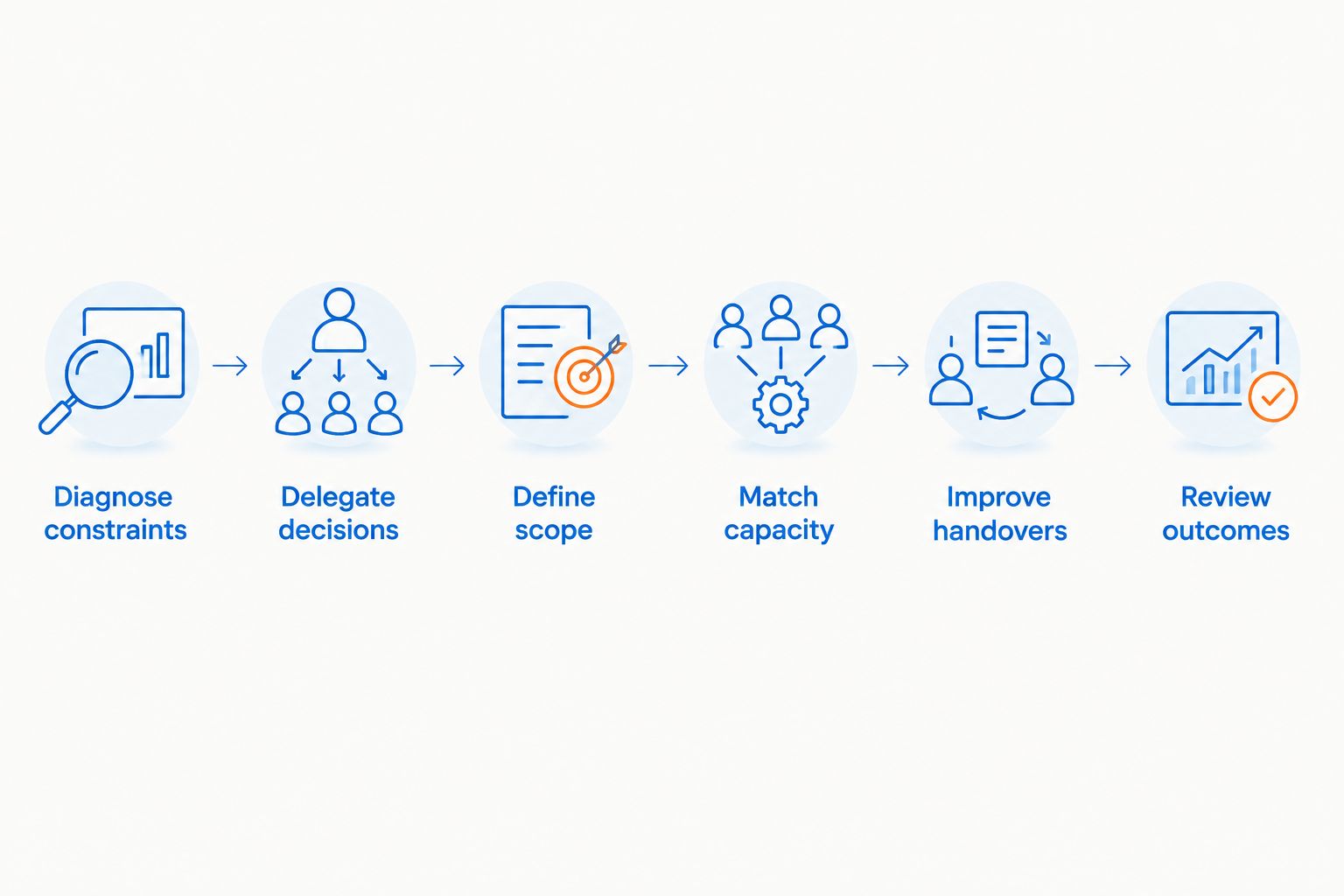
Set responsibilities and delivery limits before expanding marketing.
Diagnose constraints
Write down where work waits for you. Include quotes that need approval, jobs waiting for allocation, client questions nobody else answers and invoices delayed by missing information. Separate those delays from a genuine shortage of suitable enquiries.
Set aside 30 minutes each week to review the list with the people doing the work. That is a review schedule, not a promised improvement timeframe. Ask what stopped a job moving and whether the team lacked authority, information, capability or available hours.
For a hypothetical plumbing business, the issue might be quotes waiting for the owner after site visits. Advertising would not fix that queue. A quoting checklist and a defined approval boundary address the problem directly.
Your diagnosis should end with one priority constraint and an accountable person. Use the team capacity bottlenecks guide to frame that discussion before treating enquiry volume as the problem.
- List work currently waiting for owner approval.
- Separate lead shortages from delivery delays.
- Identify the information each stalled job needs.
- Choose one constraint for the first review cycle.
Delegate decisions
Delegation means transferring a decision, not asking someone to prepare it for you. Name the person responsible, the result expected, the boundaries they must respect and the circumstances that require escalation.
Start with a recurring decision that has a clear operating boundary. Examples include allocating routine jobs, requesting missing client information or arranging standard follow-up. Keep exceptions explicit so staff do not have to guess where their authority ends.
Write the process in a shared document and walk through a real example together. Then let the responsible person make the decision within the agreed boundary. Taking the task back whenever their approach differs from yours leaves ownership unresolved.
In a hypothetical accounting practice, a delivery lead could own workflow allocation while the principal retains technical sign-off where required. Those are different responsibilities. Documenting the distinction stops routine allocation from waiting on specialist approval.
- Assign one accountable owner to each recurring decision.
- Define the expected result and quality standard.
- Record escalation triggers in plain language.
- Review exceptions without reclaiming the whole task.
Define scope
Review the work you want more of before changing your marketing. Look at the agreed scope, direct delivery costs, staff time, travel, rework and variations. Revenue alone does not tell you which bookings deserve more capacity.
Create a simple job review sheet using completed work. Identify what was sold, what the team delivered and what changed along the way. If the records do not explain labour or variations, improve those records before drawing conclusions about profitability.
For a hypothetical electrical business, two jobs with similar invoice values could require different travel and labour commitments. The useful question is which work fits the team's capability and leaves an acceptable contribution after direct costs. Do not assume the larger invoice is the better booking.
Elevatory business coaching connects offer decisions with done-with-you marketing implementation. That support still requires your involvement: you supply the operational detail, approve the scope and help implement the changes. It is not a replacement for knowing your delivery economics.
- Define inclusions, exclusions and variation triggers.
- Review actual labour against quoted assumptions.
- Identify the service types you want to promote.
- Give sales staff clear scope and discount boundaries.
Match capacity
Build a capacity view before increasing campaign activity. Use the job diary or delivery schedule you already maintain. Record committed work, available people, specialist requirements and the time reserved for administration or corrections.
Use a 4-week planning window as a starting exercise. This is a planning choice, not an industry benchmark. Adjust the window to your booking cycle, but keep the same view available to the people responsible for sales and delivery.
A hypothetical home-services team might have space for routine maintenance but no suitable person available for a complex installation. Marketing should reflect that distinction. An empty diary slot is not useful capacity if the required skills or equipment are unavailable.
For your 2026 plan, define what happens when capacity tightens. That might mean changing the campaign focus, offering a later booking date or declining unsuitable work. Give someone authority to make that call before the pressure arrives.
- Map committed work against available delivery capacity.
- Separate routine capacity from specialist capacity.
- Include administration and correction work in the schedule.
- Set a trigger for changing campaign activity.
Improve handovers
Write the path from enquiry to completed work. At each handover, identify the responsible person and the information they need. This makes marketing part of the operating system rather than a separate source of activity.
A qualified enquiry should carry enough detail for the next person to act. For trades, that includes the requested work, location, access constraints and relevant site information. For professional services, it includes the client's objective, decision-maker, scope and relevant deadline.
Start with a shared enquiry log and a handover checklist. Review whether the team follows them before adding automation. Automating an unclear handover preserves the ambiguity and makes it harder to see who should respond.
Give a marketing strategy consultant a brief that includes capacity and service fit, not just a lead target. Ask how campaign messages, qualification questions and follow-up will support the work you want to book. A marketing consultant's recommendations should fit the delivery team's limits.
- Define what makes an enquiry suitable for your service.
- Assign ownership of the first response and follow-up.
- Record the information delivery staff need before booking.
- Return unsuitable-enquiry feedback to the marketing team.
Review outcomes
Use a short scorecard that connects marketing to completed work. Include qualified enquiries, quotes issued, bookings won, completed jobs and owner escalations. Where your records support it, review contribution after direct delivery costs.
Define each measure before using it. A booking should mean the same thing to sales and operations. A qualified enquiry should match your service, location and scope requirements, rather than simply being a form submission.
Review the scorecard alongside actual jobs, not in isolation. If enquiries increase but suitable bookings do not, examine qualification and follow-up. If bookings increase but jobs wait for approval, return to delegation and capacity rather than adding campaign activity.
Keep your 2026 review focused on a decision. Every meeting should finish with what changes, who owns it and when you will check it. Reporting is useful when it changes the work.
- Agree on definitions for enquiries, quotes and bookings.
- Track owner escalations alongside delivery outcomes.
- Compare marketing activity with suitable completed work.
- Assign an owner and review date to each change.
Compare the support options
Choose support for the responsibility you need covered. Advice, implementation support and daily operational ownership are different jobs. A business growth consultant's title does not tell you which of those responsibilities is included.
The table below compares roles, not promised outcomes. For any provider, confirm the scope and responsibilities before committing.
| Option | Best for | Main strength | Key limitation |
|---|---|---|---|
| Self-managed improvement | Owners with a defined issue and time to implement | Uses your existing knowledge and records | Planning, follow-through and review remain your responsibility |
| Business mentor | Owners needing decision support and accountability | Provides a setting to challenge priorities and decisions | Advice alone does not assign daily delivery ownership |
| Operations manager | Businesses needing someone to own daily delivery | Places scheduling, handovers and operational decisions with a defined role | Marketing strategy is not automatically part of the role |
| Marketing consultant | Businesses with delivery capacity but unclear positioning or lead qualification | Focuses attention on marketing decisions | Cannot replace operational authority or delivery capability |
| Elevatory business coaching | Established Australian owners seeking coaching and done-with-you marketing implementation | Connects coaching with offer, funnel, paid advertising and systems work | Requires owner and team participation; it is not done-for-you delivery |
Choose the role that covers the missing responsibility, not the most impressive title. If nobody owns daily scheduling, establish that responsibility. If your delivery team has capacity but attracts unsuitable enquiries, focus the brief on service fit and qualification.
Before choosing support, ask what you will implement together, what your team must own and how progress will be reviewed. Request evidence relevant to your business model. An ecommerce sales result does not establish a service-business delivery outcome.
Common mistakes service-business owners make
Buying more leads before assigning delivery ownership
If enquiries, quotes and scheduling still require your approval, more demand adds work to the same queue. Assign responsibilities first, then decide which services the team can promote and deliver.
Delegating tasks but keeping every decision
A crew leader who must call you for every routine change does not own delivery. Give the role explicit authority and escalation boundaries. Review decisions against those boundaries, not whether they copy your personal approach.
Treating revenue as proof of profitable growth
A full diary does not explain labour, travel, rework or scope changes. Review completed jobs against their delivery requirements. Promote the work that fits your team's capability and economics, rather than chasing invoice value alone.
Hiring advice when you need daily management
A mentor can help you decide how operations should work. That does not make the mentor responsible for tomorrow's roster or client handover. Decide who will manage the work before assuming coaching covers the role.
Accepting marketing plans without a capacity brief
A campaign brief that omits skills, availability and service boundaries leaves delivery out of the decision. Give your consultant that information and agree on what happens when the team reaches its limit.
FAQ
What is business growth consulting for service based businesses?
Business growth consulting for service based businesses is advice and implementation support that connects revenue goals with delegation, service scope, marketing and delivery capacity. The practical aim is to grow profitable work without routing every decision through the owner.
What's the best first step if my service business depends on me?
Identify recurring decisions that stop when you are unavailable. Assign one decision to a responsible team member, with a clear quality standard and escalation boundary, before expanding marketing.
Is a business mentor better than an operations manager?
A business mentor is better suited to decision support; an operations manager is better suited to owning daily delivery. Choose according to the responsibility you need covered, and confirm the actual scope rather than relying on the title.
When should I hire a marketing consultant for my service business?
Hire a marketing consultant when you can define the services you want to sell and the capacity available to deliver them. Brief the consultant on suitable enquiries, scope boundaries and the handover into your team.
Who is Elevatory best for?
Elevatory is best for established Australian business owners seeking business coaching with done-with-you marketing implementation. Its stated focus is businesses turning over $150K–$5M, with support across offers, funnels, paid advertising and systems.
Does Elevatory offer done-for-you marketing?
Elevatory's stated model is business coaching with done-with-you marketing implementation, not a done-for-you agency service. You and your team participate in decisions and implementation.
How should I measure whether business growth consulting is working?
Measure suitable bookings, delivery outcomes and owner dependence alongside revenue. Use consistent definitions and job records to check whether changes improve the work you want more of, rather than reporting enquiry volume alone.
One last thing
Test your next growth decision against an ordinary working day without you. Who approves the quote, assigns the work, handles the exception and confirms completion?
If the answer is still you at every stage, put those decisions into your 2026 growth plan before adding another campaign. The specific next move is to transfer one recurring decision with a written boundary and review it with the person responsible.
Related guides
Book a free growth strategy call
Forty-five minutes with a strategist to pressure-test where your business is stuck and what to prioritise next.
Prefer to talk first? Call 1300 634 230 or email chris@elevatory.com.au