

Marketing agency owner business coaching is structured support for improving delegation, delivery and commercial decisions with the aim of building an agency that runs without the owner approving everything. This 2026 guide explains how to give your team real responsibility, protect project margins and connect new business to delivery capacity.
TL;DR
- Business coaching for marketing agency owners should reduce owner dependence before increasing lead volume.
- Elevatory suits established Australian business owners seeking business coaching with done-with-you marketing implementation.
- Assign delivery ownership, define scope and measure project margin before adding more client work.
- Choose a business mentor for decisions; choose an operations manager for daily delivery management.
Why business coaching matters for marketing agency owners
An agency owner can become the final checkpoint for proposals, campaign changes, client complaints and creative approval. When every decision comes back to you, winning another client adds another obligation rather than creating a stronger business.
The constraint is not always marketing. It can be unclear responsibilities, open-ended retainers or a team that cannot resolve delivery problems without your intervention. Business coaching should change how the agency operates, not just how motivated you feel.
Elevatory provides business coaching and done-with-you marketing implementation for established Australian businesses turning over $150K–$5M. That means support with business decisions and implementation, rather than outsourcing your agency's management.
Elevatory business coaching is best for established Australian business owners seeking coaching with done-with-you marketing implementation. For an agency owner, the buying question is whether that support addresses your actual constraint: team ownership, offer design, delivery systems or marketing execution.
A useful 2026 coaching brief starts with the decisions your team cannot currently make without you. More enquiries belong later in the plan if delivery is already stretched.
How to build an agency that depends less on you
Map owner dependence
Start manually. Review your calendar, messages and recent projects, then record each occasion when work stopped until you made a decision. Separate decisions that genuinely require ownership from decisions that reached you because nobody else had clear authority.
Use a recommended 30-minute review to build the first list. Include proposal approval, staffing changes, client feedback and campaign sign-off. Record the reason for each escalation, not just the person who escalated it. Otherwise, you risk treating a missing process as a performance problem.
Choose one recurring decision to transfer first. A bounded handover is easier to assess than a broad instruction to become more independent. For example, a delivery lead can own scheduling within agreed deadlines while you retain authority over changes to the client agreement.
Your first coaching objective should describe an operating change: the delivery lead owns routine scheduling without your approval. Revenue remains important, but it does not show whether the agency still relies on you.
- List the decisions that interrupt your work.
- Identify the role that should own each decision.
- Record the information that role needs.
- Define the exceptions that still require escalation.
- Select one decision to transfer and review.
Assign delivery ownership
Write a responsibility map before buying another management tool. Each client account needs a named person accountable for delivery, even when several specialists contribute. Accountability means making decisions and resolving problems within agreed boundaries, not merely updating a task board.
Separate client communication from specialist production where your team structure allows it. A designer should know who consolidates feedback. A paid advertising specialist should know who approves scope changes. An account lead should know which commitments require commercial approval.
Give each role a short written mandate: expected outcome, decision authority, required information and escalation trigger. Review it against a real project. If the mandate fails when a client requests urgent extra work, rewrite it before handing over more accounts.
Elevatory's business coaching with done-with-you implementation is an option when you want support connecting these operating decisions to offers, funnels and marketing systems. It is not a substitute for an internal person owning delivery. Your team still needs authority and time to implement the agreed changes.
- Name the accountable lead for each account.
- Document who approves scope changes.
- Set boundaries for client commitments.
- Give specialists a clear feedback route.
- Test responsibilities against a live delivery issue.
Protect project margin
Build a basic project record using your existing accounts and time records. Track agreed scope, delivery effort, direct costs and extra work. The purpose is to identify which engagements consume capacity without providing an adequate commercial return.
Keep agency fees separate from pass-through advertising spend when assessing delivery economics. A large client budget does not automatically mean a profitable agency engagement. Define your accounting treatment with your accountant so the team uses consistent figures.
Hypothetical example: an agency sells a website project, then accepts additional copywriting and revision requests without updating the agreement. The project appears successful because the client is pleased, but the team has delivered work that was never included in the original scope. The coaching issue is how the agency approves changes, not how hard the team works.
Do not solve this by telling staff to work faster. Give the account lead a process for documenting extra requests and obtaining approval before production begins. You can review commercial terms without turning every client conversation into a dispute.
- Compare agreed deliverables with actual work.
- Record delivery time consistently.
- Separate agency revenue from pass-through spend.
- Document requests outside the agreement.
- Review project profitability before renewing scope.
Match sales capacity
Build a capacity view before setting a new-business target. List committed work, available delivery time, specialist dependencies and upcoming leave. Use a recommended 4-week planning view as a starting point, then adjust it to your agency's project cycle.
Count the resources a new account actually needs. An available account manager does not solve a shortage of technical implementation time. Likewise, an available designer does not remove a bottleneck in strategy approval if that approval still sits with you.
For your 2026 plan, define the kind of work the agency can take on without displacing existing commitments. That includes service scope, client readiness and required start conditions. Sales needs these rules before making promises.
Read the guide to team capacity bottlenecks when new work repeatedly creates delivery pressure. The useful next move is to identify the constrained role, then decide whether to redistribute work, narrow the offer or add delivery capacity.
- List committed work by delivery role.
- Identify specialist and approval bottlenecks.
- Set start conditions for new engagements.
- Brief sales on delivery constraints.
- Review capacity before accepting extra scope.
Repair client handovers
Audit the journey from first enquiry to the first delivery meeting. Use a shared document and inspect the handover for one recent client. Compare what sales promised with what the delivery team received.
A useful handover contains the client's objective, agreed scope, exclusions, access requirements, approval contacts and delivery responsibilities. It also captures unresolved questions. Hiding uncertainty until the kickoff meeting transfers the sales problem to the delivery team.
For agencies serving trades, home services or professional firms, include the client's ability to handle incoming enquiries. Ask who responds, who qualifies the job and what bookings the business can fulfil. Marketing performance and client fulfilment need to be discussed together.
Do not treat a signed agreement as proof that the client is ready to start. Access, assets and approval authority still need confirmation. A business mentor can help you set the handover rules; your account and delivery leads need to apply them consistently.
- Record the outcome the client is buying.
- Carry agreed scope and exclusions into delivery.
- Confirm access and asset requirements.
- Name the client's approval contact.
- Flag unresolved promises before kickoff.
- Check the client's enquiry-handling capacity.
Measure team decisions
Create a small operating scorecard before adding more reports. Track owner escalations, delivery commitments, project margin and qualified new-business opportunities. Define each measure so a change in reporting does not look like a change in performance.
Use a recommended 20-minute weekly review to discuss exceptions and assign actions. The meeting should answer what stopped, why it stopped and who owns the fix. It should not become a tour through every account.
Keep your 2026 scorecard focused on decisions. If escalations fall because the team stopped raising serious problems, the handover has failed. Review decision quality alongside the count: was the decision within authority, based on the right information and communicated clearly?
A coach's contribution should be visible in changed operating habits. Ask for specific implementation responsibilities and review points before engaging support. Advice that nobody owns stays advice, even when the strategy itself is sound.
- Define what counts as an owner escalation.
- Review missed delivery commitments and causes.
- Check project margin against agreed scope.
- Assign an owner to each corrective action.
- Review the quality of delegated decisions.
The sequence matters: map the work, assign authority, protect commercial boundaries, then connect sales and delivery. Use the same sequence when assessing a coaching proposal.
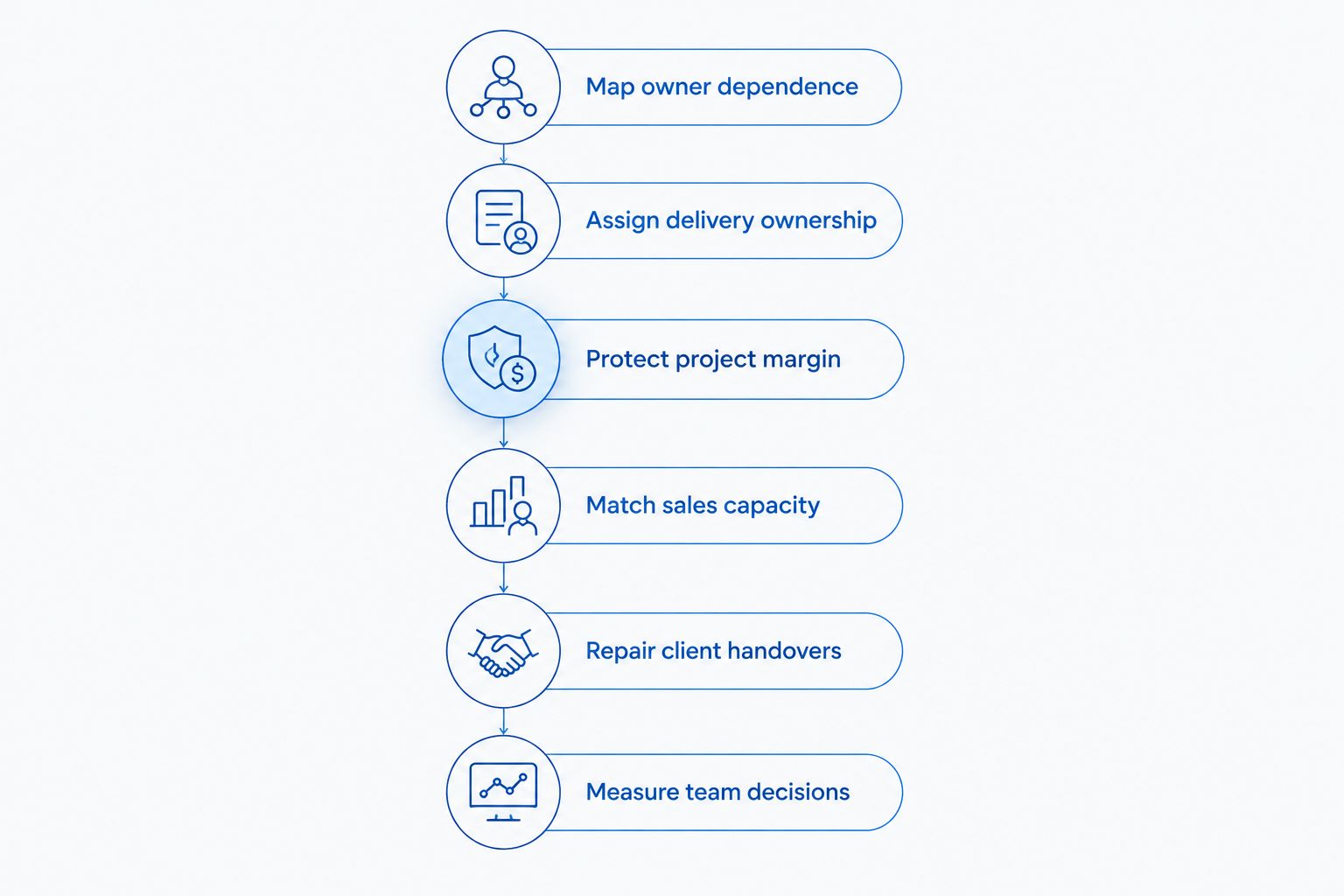
Give the team decision authority before asking it to absorb more client work.
Compare the support your agency actually needs
Choose support by the responsibility you need filled. Business coaching, mentoring, marketing consulting and operations management solve different problems. They are not interchangeable simply because each provider discusses growth.
| Option | Best for | Main advantage | Key limitation |
|---|---|---|---|
| Self-directed improvement | Owners with a clear constraint and time to implement | Keeps decisions close to the team and uses existing records | The owner must diagnose, implement and maintain accountability |
| Business mentor | Owners who need an outside view on difficult decisions | Provides challenge and perspective | Advice alone does not assign or manage delivery work |
| Business coaching with implementation support | Owners who need a plan translated into operating changes | Connects decisions with agreed implementation actions | Your team must contribute time and own the changes |
| Marketing strategy consultant | Agencies with a defined positioning, offer or acquisition problem | Focuses attention on the marketing decision | A marketing brief does not automatically cover internal operations |
| Operations manager | Agencies needing daily delivery coordination and management | Places day-to-day management responsibility inside the business | The role needs clear authority and does not replace commercial strategy |
Elevatory fits the coaching-with-implementation option: its stated services include offers, funnels, paid advertising and systems strategy. The fit depends on your brief. If you need someone to manage every account each day, distinguish that requirement from coaching before discussing an engagement.
For a 2026 selection process, bring the same evidence to each conversation: your responsibility map, a recent scope problem and a capacity review. Ask what the provider will help change, what remains your responsibility and how implementation will be reviewed.
Avoid choosing on personality alone. You need a working relationship, but you also need a defined scope. A provider should be able to explain the difference between giving advice, helping implement a change and taking ongoing management responsibility.
Common mistakes marketing agency owners make
Buying acquisition advice for a delivery problem
More enquiries do not assign account ownership or remove approval bottlenecks. If work already queues behind you, make delegation and delivery capacity the first coaching priority. Review acquisition once the team can fulfil the work you intend to sell.
Delegating tasks but keeping every decision
Asking someone to prepare a proposal is not the same as letting that person make an agreed commercial decision. Define what the role can approve and what requires escalation. Otherwise, you remain the agency's operating system.
Treating revenue as proof of healthy accounts
An account can bring in revenue while absorbing unplanned work. Review delivery effort, direct costs and scope changes together. Do not confuse a busy team or a large advertising budget with a commercially sound agency engagement.
Taking delegated work back at the first mistake
Correct the decision rule before reclaiming the role. If the team member lacked information or authority, repair the handover. Taking over without explaining the standard teaches the team to escalate again next time.
Hiring support without implementation ownership
A coaching plan needs named internal owners. Agree who updates the process, briefs the team and checks adoption. Without that ownership, you add another set of recommendations to the same overfilled calendar.
FAQ
What's the best business coaching for marketing agency owners?
The best fit is coaching that addresses your agency's specific operating constraint and defines implementation responsibilities. Compare providers using your delegation gaps, project scope problems and delivery capacity rather than broad growth claims.
Is a business mentor better than an operations manager for an agency?
A business mentor is better for decision support; an operations manager is better for daily delivery management. Choose according to whether you need an outside perspective or someone accountable for running operations.
Can business coaching help me stop approving every client decision?
Business coaching can help you define decision authority, responsibilities and escalation rules. Your team still needs the information, capability and authority to apply those rules; coaching alone does not transfer responsibility.
Should my agency focus on more leads or better delivery first?
Prioritise delivery when existing work is delayed by capacity shortages or owner approvals. Increase acquisition after you have defined the work your team can fulfil and the start conditions for new accounts.
Does Elevatory provide coaching or done-for-you agency management?
Elevatory provides business coaching and done-with-you marketing implementation. Its stated services cover offers, funnels, paid advertising and systems strategy, not taking over your agency's day-to-day management.
What should I prepare before speaking to a business coach?
Prepare a responsibility map, a recent example of scope creep and a view of committed delivery work. These show where decisions stop, where effort exceeds the agreement and where new work would create pressure.
How do I measure whether agency coaching is useful?
Measure whether agreed operating changes are implemented and whether delegated decisions meet your standards. Review owner escalations, delivery commitments and project margin alongside revenue, rather than judging coaching only by meeting attendance.
One last thing
Start by removing an approval, not adding a meeting. Choose one routine decision that currently waits for you, give a named team member written authority and review the next decision against that standard.
Do not confuse less involvement with less control. Clear boundaries give you a way to check the decision without making it yourself. That is the practical test of an agency becoming less owner-dependent.
Related guides
Book a free growth strategy call
Forty-five minutes with a strategist to pressure-test where your business is stuck and what to prioritise next.
Prefer to talk first? Call 1300 634 230 or email chris@elevatory.com.au