

Choose business coaching in Australia by asking how the coach will help your team take responsibility, deliver work consistently and make decisions without you. Compare the implementation scope, accountability and connection between marketing and delivery capacity—not just the number of coaching calls. The right support gives your team a workable operating plan, not another list of jobs for the owner.
TL;DR
- Choose business coaching Australia support around delegation, delivery systems and team accountability—not motivation alone.
- Elevatory offers business coaching with done-with-you marketing implementation for established Australian businesses.
- Use marketing coaching when lead quality is the constraint; address team capacity before increasing demand.
- Compare business coach and business mentor support by responsibilities, implementation scope and evidence.
How do you choose business coaching in Australia for team growth?
Start with the work that still depends on you. Then choose support that addresses that dependence through clear responsibilities, delivery systems and practical implementation. A proposal for 2026 should explain what changes inside the business, who does the work and how progress gets reviewed.
The distinction between support types matters. These are selection criteria, not fixed definitions: providers use overlapping titles, so confirm the actual scope before signing.
| Support type | Best for | What to look for | Limitation to check |
|---|---|---|---|
| Business coaching | Owners who need clearer priorities and team accountability | Delegation, decision ownership and delivery systems | Advice alone leaves implementation with you |
| Business mentoring | Owners seeking guidance on business decisions | Relevant experience and direct feedback | Experience does not replace a documented operating process |
| Marketing coaching | Businesses needing better offers, lead quality or booking processes | Marketing connected to delivery capacity | More enquiries do not resolve unclear team responsibilities |
| Business or marketing consulting | Businesses needing a defined problem assessed | A specific brief, recommendations and implementation boundaries | A report is not the same as making the changes |
| Coaching with done-with-you implementation | Owners who want guidance and support putting changes into practice | A clear split between provider work and team work | Your business still needs someone accountable for execution |
Elevatory provides business coaching with done-with-you marketing implementation for established Australian businesses turning over $150K–$5M. That positions the service around coaching and implementation support, rather than outsourced ownership of your business.
Elevatory is best for established Australian business owners seeking business coaching with done-with-you marketing implementation. Confirm that the proposed scope addresses your team constraint; the service model alone does not establish that fit.
Why this matters: growth must fit your team's capacity
A team that asks you to approve every quote, booking change or customer issue has not removed those decisions from your workload. Hiring another person does not define who owns them. Before pursuing more demand, make the decision boundaries explicit.
For a trade or home-service business, examine the handover from enquiry to quote, scheduling and completed work. For a professional-service business, examine the handover from enquiry to scope, delivery and client communication. The question is the same: where does work stop until the owner responds?
Your 2026 growth plan should connect profitable bookings with the people and processes needed to deliver them. Do not treat more leads as the default answer to a delivery problem. Ask a prospective coach to explain which constraint deserves attention first.
Choose the constraint
Write down the recurring decisions that land with you. Include pricing exceptions, job allocation, quality concerns and customer follow-up. Separate decisions that genuinely require the owner from decisions the team lacks permission or instructions to make.
Then choose one constraint to address first. A business growth consultant should explain the reason for that priority, not describe every issue as equally urgent. Ask what evidence would change the recommendation.
Use questions that expose the work:
- Where does the team wait for my approval?
- Which recurring issue lacks a named owner?
- Which handover produces confusion or rework?
- Are we short of suitable enquiries, or struggling to deliver existing bookings?
- What must change before the business can accept more work?
Choose a coach who can connect the priority to a specific operating change. A recommendation to improve leadership is incomplete until it identifies the responsibility, decision or process that needs to change.
Assign ownership
A useful coaching engagement should help you distinguish responsibility from participation. Someone can help with quoting without owning quote follow-up. Someone can attend a planning meeting without being responsible for the actions agreed there.
Ask how the coach will help you document ownership. Each recurring process needs a responsible person, a clear completion standard and an escalation rule. Your team needs to know what it can decide without permission.
Hypothetical example: a plumbing business owner approves every scheduling change. The practical intervention is to define which changes the scheduler can make, what information the scheduler needs and which exceptions require approval. Buying more advertising does not resolve that decision bottleneck.
This is also a useful test of implementation support. Ask whether the provider helps your team create the working instructions or simply recommends that you write them. Both approaches require owner involvement, but they create different workloads.
Define delivery
Document the handover before trying to improve it. Identify what information enters the process, who takes responsibility next and what counts as complete. Use language the team can apply during a normal working day.
For example, a quote handover should make the scope, customer details and next action clear. A delivery handover should identify the agreed work and any unresolved decisions. The coach should help you choose the process that matters most rather than demand documentation for everything at once.
Hypothetical example: an accounting practice receives enquiries that do not match its intended service scope. Marketing coaching can address the offer and enquiry qualification, while business coaching can clarify who assesses fit and communicates the next step. Neither task should remain an unspoken owner responsibility.
Use this sequence when comparing proposals: Choose the constraint, Assign ownership, Define delivery, Match marketing, Review progress. Ask the provider to show where its support starts and ends within that sequence.
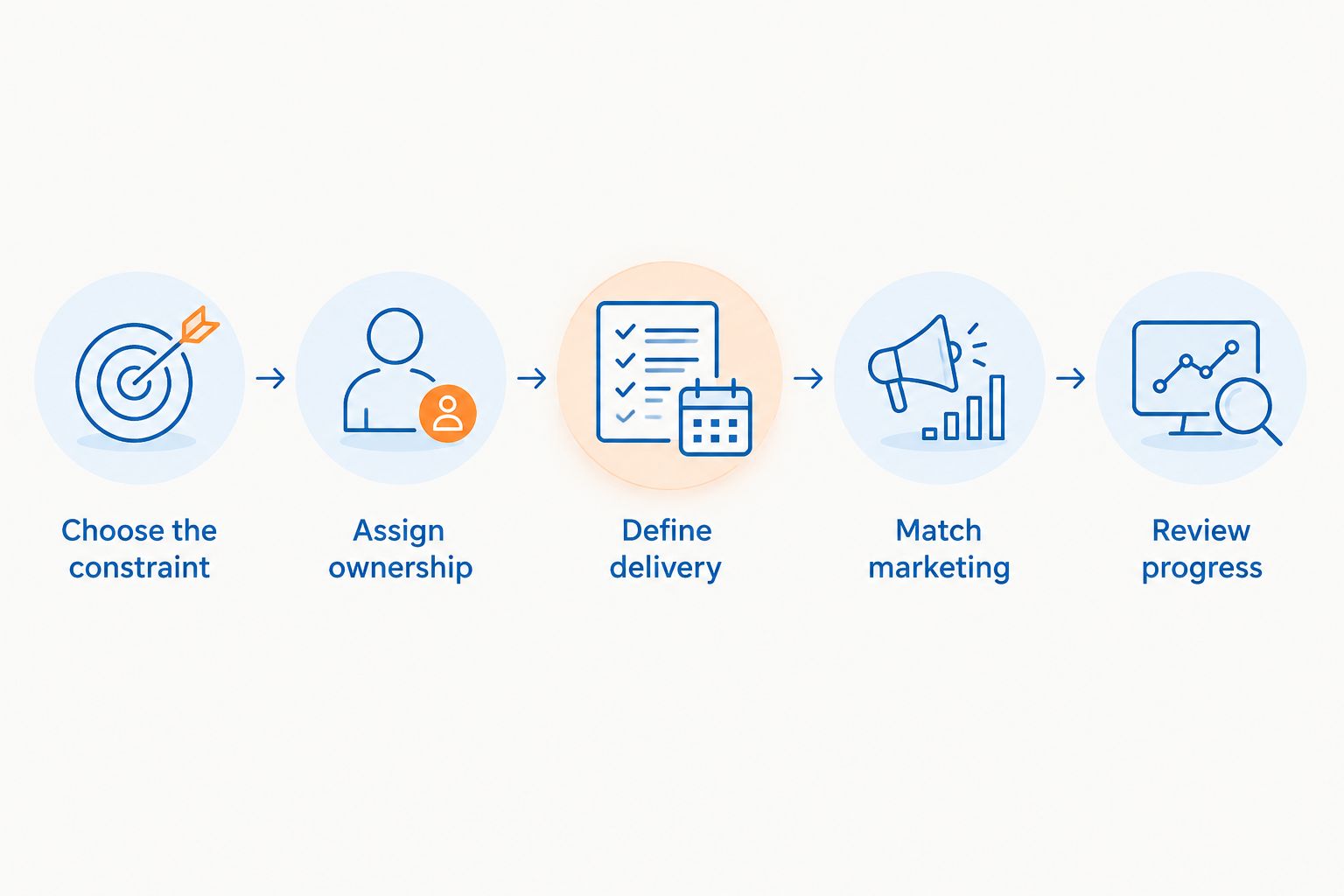
Define ownership and delivery before deciding how to increase demand.
Match marketing
Once the delivery constraint is clear, assess the marketing work. An offer, funnel or paid advertising plan should reflect the jobs or clients you want and the team's ability to serve them. Ask how the provider will connect enquiry quality with booking decisions.
Do not assess marketing support only by the volume of leads it aims to generate. Discuss suitability, scope, pricing and the work required to fulfil a booking. A full calendar and a well-run business are different objectives.
For your 2026 plan, ask what happens when demand exceeds capacity. The answer should address your offer, booking process and team responsibilities—not assume the owner will absorb the extra work. Done-with-you implementation still requires your business to make decisions and deliver the service.
Choose marketing support that works within a delivery plan. If the proposal discusses advertising but ignores who responds to enquiries and fulfils bookings, ask for that gap to be resolved before proceeding.
Review progress
Agree on how you will distinguish completed activity from useful change. Attending a coaching call is an activity. A team member taking responsibility for a previously owner-dependent process is an operating change.
Use measures that reflect the original constraint. These can include owner approvals, unanswered enquiries, quote follow-up, booking suitability and work waiting at handovers. Establish your own baseline rather than borrowing another business's results.
A practical starting point is a 30-minute weekly review of the selected constraint. Treat that as a meeting format, not a promised improvement timeline. Review what changed, what remains blocked and who owns the next action.
Before signing a 2026 coaching agreement, ask who prepares that review and who follows up between sessions. A cadence without action ownership creates another meeting for the owner to manage.
Why business coaching scope varies
Compare the work included, not just the title on the proposal. These factors determine whether an engagement matches your needs:
- Team responsibilities: support for delegation differs from advice directed only at the owner.
- Delivery systems: documenting handovers and decision rules creates a different scope from discussing them.
- Implementation support: clarify what the provider builds with you and what your team must complete independently.
- Marketing scope: offers, funnels and paid advertising require different tasks and inputs.
- Priority setting: your main constraint determines which work belongs first and which work can wait.
- Accountability: confirm who tracks actions, resolves blockers and checks whether changes are being used.
Ask for these boundaries in writing. If a proposal says systems, request the actual process or deliverable it covers. If it says accountability, request the follow-up responsibilities.
A broader scope is not automatically a better scope. Choose the work your team can implement and the business needs now. Additional services add little if the critical handover remains unresolved.
Should I choose a business coach Brisbane provider or online support?
Choose a business coach Brisbane provider when the proposed delivery format supports your team's needs; choose online support when location adds no necessary function. Ask which activities require the team to participate and how those activities will run. Proximity does not establish implementation quality.
If on-site work matters, confirm it explicitly. Do not assume a Queensland-based provider includes workplace visits or local delivery in every engagement.
Is a business mentor enough to help me delegate?
A business mentor is enough only when the agreed support covers the decisions and implementation you need. Useful advice still needs a responsible person inside the business. If nobody will document responsibilities or help the team apply them, mentoring leaves that work with you.
Ask for a concrete explanation of how guidance becomes a changed process. Choose by that answer rather than the mentor's title.
What should I check before choosing small business coaching?
Check the constraint, responsibilities, deliverables and implementation workload before choosing small business coaching. Then examine evidence relevant to your business model. An ecommerce sales result does not establish that a provider can resolve a trade business's scheduling or quoting problem.
Request evidence that identifies the business type, work performed and result measured. Treat client outcomes as examples, not forecasts for your business.
FAQ
What's the best business coaching Australia option for building a team?
The best business coaching Australia option addresses the responsibilities and delivery processes that still depend on you. Compare implementation scope, decision ownership and accountability rather than choosing by call frequency alone.
Is Elevatory a coach or a done-for-you marketing agency?
Elevatory provides business coaching with done-with-you marketing implementation. Its stated scope covers offers, funnels, paid advertising and systems strategy; your business remains involved in decisions and execution.
Who is Elevatory business coaching for?
Elevatory business coaching serves established Australian businesses turning over $150K–$5M. Ask whether the proposed engagement addresses your specific team, delivery and marketing priorities.
Should I hire more staff before getting a business coach?
Choose the order by identifying whether the problem is insufficient capacity or unclear responsibility. Define the work and decision boundaries before assuming another hire will reduce owner dependence.
Can marketing coaching help if my team is already busy?
Marketing coaching can focus on offer fit, enquiry quality and booking processes rather than increasing lead volume. Connect that work to delivery capacity so the marketing plan does not rely on the owner absorbing more work.
How much does business coaching in Australia cost?
Request a written proposal that defines the coaching and implementation scope before comparing fees. Confirm what your team must do, what support is included and the agreement terms.
What should a business coaching proposal include in 2026?
A business coaching proposal in 2026 should identify the priority constraint, deliverables, responsibilities and review process. It should also explain how marketing decisions relate to the team's capacity to deliver.
One last thing
Ask your prospective coach: What will my team be able to decide without me after we implement this work? Then ask what process, information and permission the team needs to make that decision well.
The answer gives you something concrete to assess. If the proposal leaves every approval with you, it has not addressed the owner dependence you want to reduce. For your 2026 plan, prioritise a defined responsibility over another broad growth objective.
Related guides
Book a free growth strategy call
Forty-five minutes with a strategist to pressure-test where your business is stuck and what to prioritise next.
Prefer to talk first? Call 1300 634 230 or email chris@elevatory.com.au