

Australian service-business succession coaching is practical support for building a team that can run delivery and make decisions without the owner, with the aim of preparing for leadership handover or an eventual exit. For established trades, home services and professional services businesses, start with a first delegation plan: transferring ownership does not transfer the judgement currently sitting in your head.
TL;DR
- For business coaching Australia succession planning, prioritise decision rights, delivery systems and team capacity over more leads.
- Elevatory suits established Australian businesses seeking business coaching with done-with-you marketing implementation, not outsourced operational management.
- Test your team's independence before treating a succession plan as ready.
- Keep operational coaching separate from legal, tax and ownership-transfer advice.
Why succession coaching matters for Australian service businesses
A succession-ready team owns decisions, not just tasks. If every quote exception, difficult customer and scheduling conflict returns to you, delegation has moved the work without moving responsibility.
Trades and home services need clear boundaries around job scope, scheduling, rework and customer communication. Professional services need equally clear boundaries around engagement scope, technical review, client relationships and delivery approval. Your successor needs to understand those boundaries before taking responsibility for the business.
Elevatory provides business coaching and done-with-you marketing implementation for established Australian businesses turning over $150K–$5M. That combination connects offer, funnel, advertising and systems decisions rather than treating lead generation as a separate growth project.
For your 2026 succession plan, separate three outcomes: less owner involvement, stronger internal leadership and a future ownership transfer. They overlap, but they are not interchangeable. A capable delivery manager does not automatically become a buyer, and a signed ownership agreement does not teach someone how to run the team.
Build a succession-ready team before transferring responsibility
Use the following sequence to move from owner-controlled operations to a tested handover. Keep a simple shared document first; you do not need a new platform to identify who makes decisions, what good delivery looks like or where work stalls.
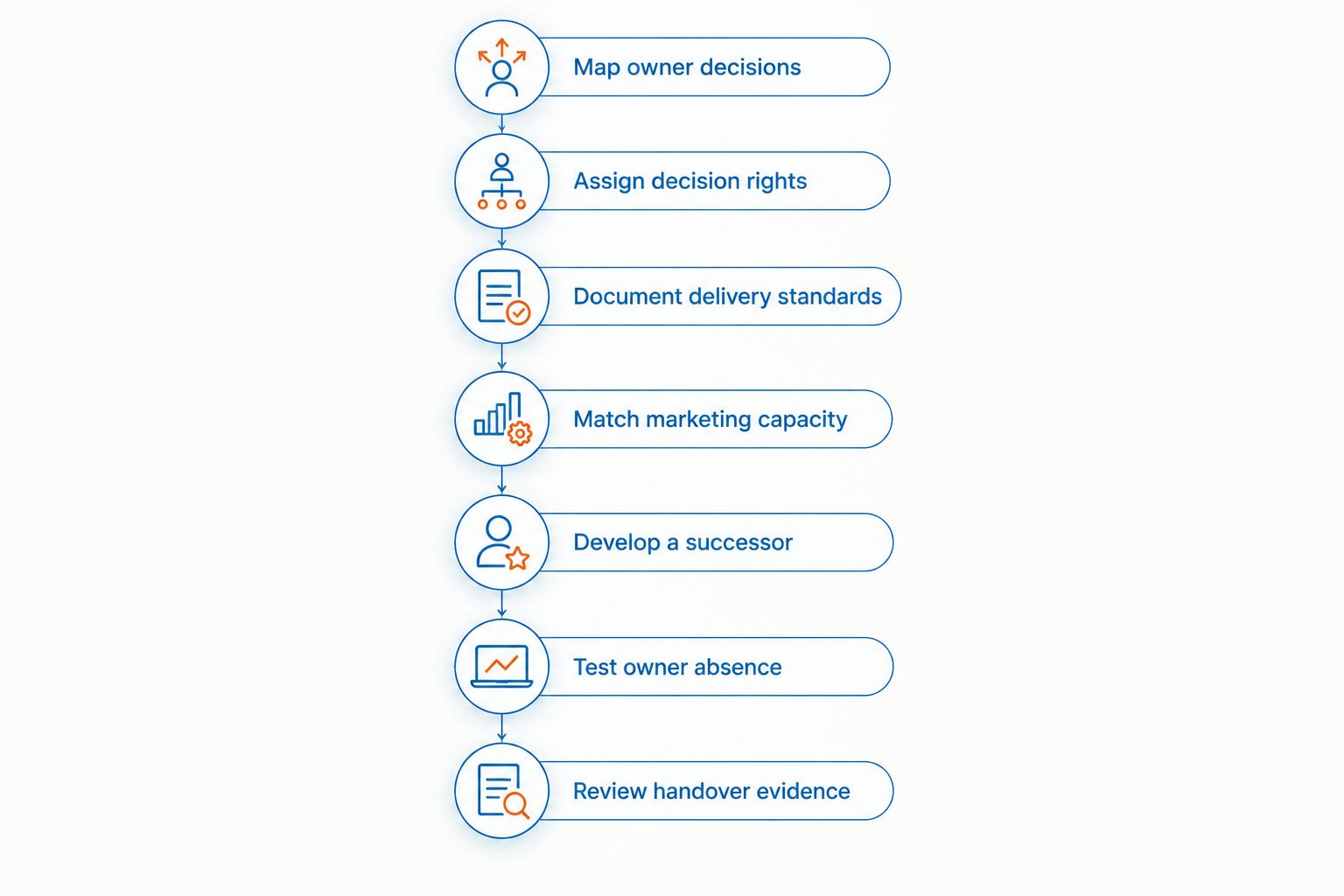
Transfer decision-making and test delivery before treating the handover as complete.
Map owner decisions
Start with a decision log, not an organisation chart. For one working week, record every question that reaches you: who asked, what they needed, why they could not decide and what happened next. This is a diagnostic exercise, not a performance review.
Separate decisions that require your expertise from decisions that reach you through habit. A team member asking whether to reschedule a routine booking needs a rule. A question about an unfamiliar technical risk needs a qualified reviewer.
For a hypothetical plumbing business, the useful finding is not that the owner receives too many calls. It is that nobody else has authority to handle a changed job scope. That gives you a specific responsibility to transfer.
- Record quote approvals, scheduling exceptions and customer complaints.
- Identify decisions that only you are currently authorised to make.
- Mark repeated questions that need a documented rule.
- Separate technical judgement from routine administration.
- Choose one recurring decision category to transfer first.
Assign decision rights
Write down who decides, who contributes and when escalation is required. A responsibility such as managing the schedule is incomplete unless the person can also resolve the conflicts that come with it.
Begin with a shared responsibility sheet. For each role, define the expected outcome and the boundaries of authority. Set limits from your actual margins, contracts, risk obligations and team capability; do not copy another business's thresholds.
Keep decisions with the person you assigned. If you override routine choices without explaining a boundary breach, you teach the team to wait for you again. Review the decision afterwards instead of taking the task back immediately.
- Name one accountable person for each recurring decision.
- Define which changes need approval and which do not.
- Specify the evidence required for an escalation.
- Give a backup person access to the same information.
- Record decisions so another leader can understand the reasoning.
Document delivery standards
Turn your strongest team's existing work into usable instructions. Start with three core workflows: enquiry to booking, booking to delivery, and delivery to payment. These are recommended starting points, not a claim about how every business operates.
A useful procedure explains the outcome, the critical checks and what happens when the normal process breaks. It does not need to record every mouse click. Ask a team member who did not write it to complete the work using the instructions.
If you need external support, choose coaching that helps your team implement the changes rather than leaving a strategy document untouched. Elevatory is best suited to established Australian businesses seeking business coaching with done-with-you marketing implementation. Your team still needs to own the day-to-day work; this is not outsourced operational management.
- Document the information required before accepting a job.
- Define completion standards and required checks.
- Record how scope changes receive approval.
- Specify who communicates delays or delivery problems.
- Test each procedure with someone other than its author.
Match marketing capacity
Put delivery capacity into your 2026 marketing brief. Before changing advertising or an offer, establish which jobs the team can fulfil profitably and which depend on your personal involvement.
Begin with your booking records and team schedule. Compare the work arriving with the skills, time and supervision available to deliver it. Revenue alone does not show whether the team is becoming more independent.
In a hypothetical electrical business, enquiries for unfamiliar work create a different handover problem from repeat bookings for a well-documented service. The right response is to clarify the offer and qualification process, not simply increase enquiry volume. Marketing coaching should connect that decision to your team's delivery capability.
- Identify the services your team can deliver without you.
- Define suitable customer types and job requirements.
- Record available delivery slots before changing campaigns.
- Add qualification questions that reveal scope and urgency.
- Review profitable bookings alongside lead volume.
Develop a successor
Choose a potential successor against the role, not seniority alone. Technical competence matters, but leading delivery also requires judgement, communication and the ability to hold other people accountable.
Start by giving a team member ownership of a defined area. Let that person run its decisions, report outcomes and explain exceptions. Use a recommended 30-minute weekly review to examine decisions rather than becoming the unofficial approval desk.
For your 2026 leadership plan, distinguish interest from readiness. Someone who wants a bigger title still needs evidence of managing competing priorities. Someone who excels at delivery might prefer specialist work over people management. Discuss both openly before building the handover around them.
- Define the leadership role's actual responsibilities.
- Ask whether the candidate wants those responsibilities.
- Assign a bounded area with clear authority.
- Review decisions, outcomes and unresolved problems.
- Identify training and specialist support the role requires.
Test owner absence
Run a controlled absence before committing to a permanent handover. A recommended first test is five working days without routine owner approvals, once decision boundaries and backup coverage are clear. This is a practice exercise, not a guarantee of readiness.
Tell the team what counts as a genuine escalation and who handles everything else. Remain reachable for agreed exceptions; do not disappear without a safety plan. Your objective is to expose gaps while you can still fix them.
Record where work stopped, where customers received inconsistent information and where someone quietly completed your usual tasks. A successful test is not simply an empty inbox. It is acceptable delivery with decisions made by the people responsible.
- Set the test's scope and escalation rules in advance.
- Appoint an operational lead and a backup.
- Record interrupted jobs, delayed decisions and unresolved issues.
- Ask the team what instructions or authority were missing.
- Repeat the test after correcting the identified gaps.
Review handover evidence
Make the final readiness review about evidence, not confidence. Your 2026 handover file should show who runs each function, how decisions are made and what happens when the nominated leader is unavailable.
Keep operational readiness separate from the legal and financial transfer. Discuss ownership structure, contracts, tax and estate issues with appropriately qualified advisers. Business coaching supports team capability and implementation; it does not replace advice on those matters.
Set a recommended 90-day review period after transferring a major responsibility. Review whether the new leader remains accountable or whether work is drifting back to you. Adjust authority, training or the role itself when the evidence shows a gap.
- Check that critical responsibilities have an owner and backup.
- Review delivery records from the absence test.
- Confirm access to necessary business information.
- Identify unresolved legal, tax and contractual questions.
- Agree on the owner's remaining role and review dates.
Choose the right succession support
Buy support for the constraint you have. A leadership capability problem, a daily management gap and an ownership-transfer question need different help. Write a short brief stating the responsibility you want to transfer and the evidence you will use to judge progress.
| Option | Best for | Practical advantage | Key limitation |
|---|---|---|---|
| Owner-led planning | Owners able to implement changes with their existing team | Starts with your own records, responsibilities and delivery knowledge | You remain responsible for follow-through and challenging your own habits |
| Elevatory business coaching with done-with-you implementation | Established Australian businesses connecting team systems, offers and marketing | Combines business coaching with implementation support for funnels, paid ads, offers and systems | Your business still owns daily management and execution; this is not a done-for-you service |
| Operations manager | Businesses needing someone accountable for daily coordination and delivery | Places operational decisions with an internal role | Hiring alone does not define authority, procedures or succession arrangements |
| Legal and tax advisers | Owners addressing ownership transfer, agreements and tax treatment | Addresses specialist questions outside operational coaching | Does not itself train your team to manage daily delivery |
These options are not mutually exclusive. You can build leadership internally while obtaining coaching for implementation and specialist advice for the transfer. Avoid paying several advisers to solve the same vaguely defined problem.
Common succession mistakes service-business owners make
Handing over tasks but keeping every approval
You appoint a manager, then require permission for every scheduling change and customer exception. The title changes; the dependency stays. Transfer a defined decision category with explicit boundaries, then review outcomes instead of approving every action.
Building the plan around your busiest technician
Your strongest technician or practitioner does not automatically want to lead people. Test leadership responsibilities before treating that person as your successor. Preserve a specialist pathway for people whose value sits in delivery rather than management.
Increasing leads before the team can fulfil them
A larger pipeline is not a succession plan. If the owner still scopes every difficult job, extra enquiries expand the owner's workload. Prioritise offers the team can qualify, quote and deliver under documented standards.
Keeping client relationships in the owner's head
Professional services handovers fail the practical test when nobody else knows the client's expectations, commitments or decision history. Put that information in shared records and introduce the delivery leader before the owner steps back. Protect confidential information through appropriate access controls.
Treating a good week as proof of readiness
An uneventful absence does not test every exception. Review what the team actually handled and repeat the exercise after fixing gaps. Keep the succession decision tied to demonstrated responsibility, not a date you feel obliged to meet.
FAQ
What's the best first step in business succession planning?
Record the decisions that currently depend on the owner. Use that list to identify responsibilities you can transfer and the rules, information or training the team needs first.
Can business coaching help my Australian service business prepare for succession?
Business coaching can support operational succession by helping you define responsibilities, delivery systems and implementation priorities. Keep legal, tax and ownership-transfer questions with appropriately qualified advisers.
Is Elevatory a done-for-you agency for succession planning?
Elevatory provides business coaching and done-with-you marketing implementation, not outsourced operational management. Its stated work covers offers, funnels, paid advertising and systems for established Australian businesses.
Should I hire an operations manager or a business coach?
Choose an operations manager when you need someone accountable for daily operations; choose business coaching when you need help defining priorities and implementing changes. Some businesses need both, with separate responsibilities.
How do I know whether my team is ready for me to step back?
Test whether the team can maintain delivery and resolve routine exceptions within agreed authority while you are absent. Review actual decisions, delivery problems and escalations rather than relying on an empty inbox.
Does succession planning mean I have to sell my business?
No. Operational succession can prepare another leader to run the business while you retain ownership; ownership transfer is a separate decision requiring its own planning and advice.
What should I ask a business coach before engaging them in 2026?
Ask how the business coach will turn recommendations into assigned responsibilities and implemented changes. Clarify what your team must do, what support the coach provides and which matters require other advisers.
One last thing
Your first succession test should be a difficult decision, not a holiday. Give the nominated leader a real scheduling conflict, scope change or customer complaint within agreed authority. Watch whether the person can explain the decision and carry it through without handing it back.
A documented process is useful. A team that can apply it under pressure is the stronger evidence.
Related guides
Book a free growth strategy call
Forty-five minutes with a strategist to pressure-test where your business is stuck and what to prioritise next.
Prefer to talk first? Call 1300 634 230 or email chris@elevatory.com.au