

Family-business coaching in Australia is structured support for clarifying responsibilities, delegating decisions and reducing the business’s dependence on its owners. For established Australian service businesses, the job is to separate family relationships from workplace authority so your team knows who decides, who delivers and when to escalate.
TL;DR
- Business coaching Australia family business roles: clarify decision rights before adding more leads or another manager.
- Elevatory supports established Australian businesses through business coaching and done-with-you marketing implementation.
- Give each recurring decision a named owner, clear boundaries and an escalation rule.
- Match marketing activity to delivery capacity, not just the owner’s revenue target.
Why business coaching matters for family businesses
A family relationship is not a job description. Your sibling might manage bookings while your parent still changes the schedule, leaving employees unsure whose instructions count. Coaching should turn those competing instructions into agreed responsibilities, rather than adding another meeting where everyone repeats their position.
This guide focuses on established Australian businesses turning over $150K–$5M, particularly trades, home services and professional services. The priority is a team that can deliver without asking the owner to approve routine work. Start by measuring owner dependence, rather than treating every interruption as an unavoidable part of running a family business.
For your 2026 plan, separate the growth target from the operating constraint. More enquiries do not fix a schedule that only one family member understands, and another employee does not resolve conflicting authority. Clarify the work before you increase the workload.
How to clarify family-business roles
Start with a shared document and the decisions your team actually faces. You do not need new software to record responsibilities, approval boundaries and unresolved questions. Use the following steps to build an agreement that employees can follow, not an organisation chart that only makes sense to the family.
1. Record the decisions that return to the owner
Track routine decisions for a suggested 14-day baseline before rewriting anyone’s role. Record what the question was, who received it, why it escalated and whether the owner genuinely needed to decide. Include calls, messages and questions asked across a desk or job site.
Separate missing information from missing authority. An employee who cannot find the booking instructions has a different problem from an employee who knows the process but is not allowed to confirm the booking. Training addresses the first; a clear decision boundary addresses the second.
Hypothetical plumbing example: a scheduler asks a family director to approve every booking change because another director regularly reverses those changes. The constraint is conflicting authority, not the scheduler’s confidence. Giving the scheduler more training leaves the underlying problem untouched.
Use the record to select a manageable responsibility to transfer first. Choose recurring work with a clear outcome, rather than the most emotionally charged family disagreement.
- Log the decision and its business consequence.
- Identify the person currently doing the work.
- Record every approval or reversal.
- Mark the information needed to decide independently.
- Choose a repeatable decision for the first handover.
2. Separate family status from workplace authority
Create a role map around outcomes: profitable bookings, reliable delivery, accurate accounts and customer follow-up. Assign a named person to each outcome. A family member can hold several responsibilities, but employees should not have to negotiate between competing instructions for the same task.
For your 2026 role map, distinguish ownership decisions from daily operating decisions. An ownership stake does not tell the booking team who can approve a schedule change. Record the operating authority explicitly, while referring legal questions about ownership, employment or director duties to appropriately qualified advisers.
Discuss the map with the people doing the work before finalising it. Ask where instructions conflict and where responsibility exists without permission to act. That conversation tests whether the document matches the workplace.
Use a simple role card with the following fields. Keep the wording specific enough that someone outside the family can understand it.
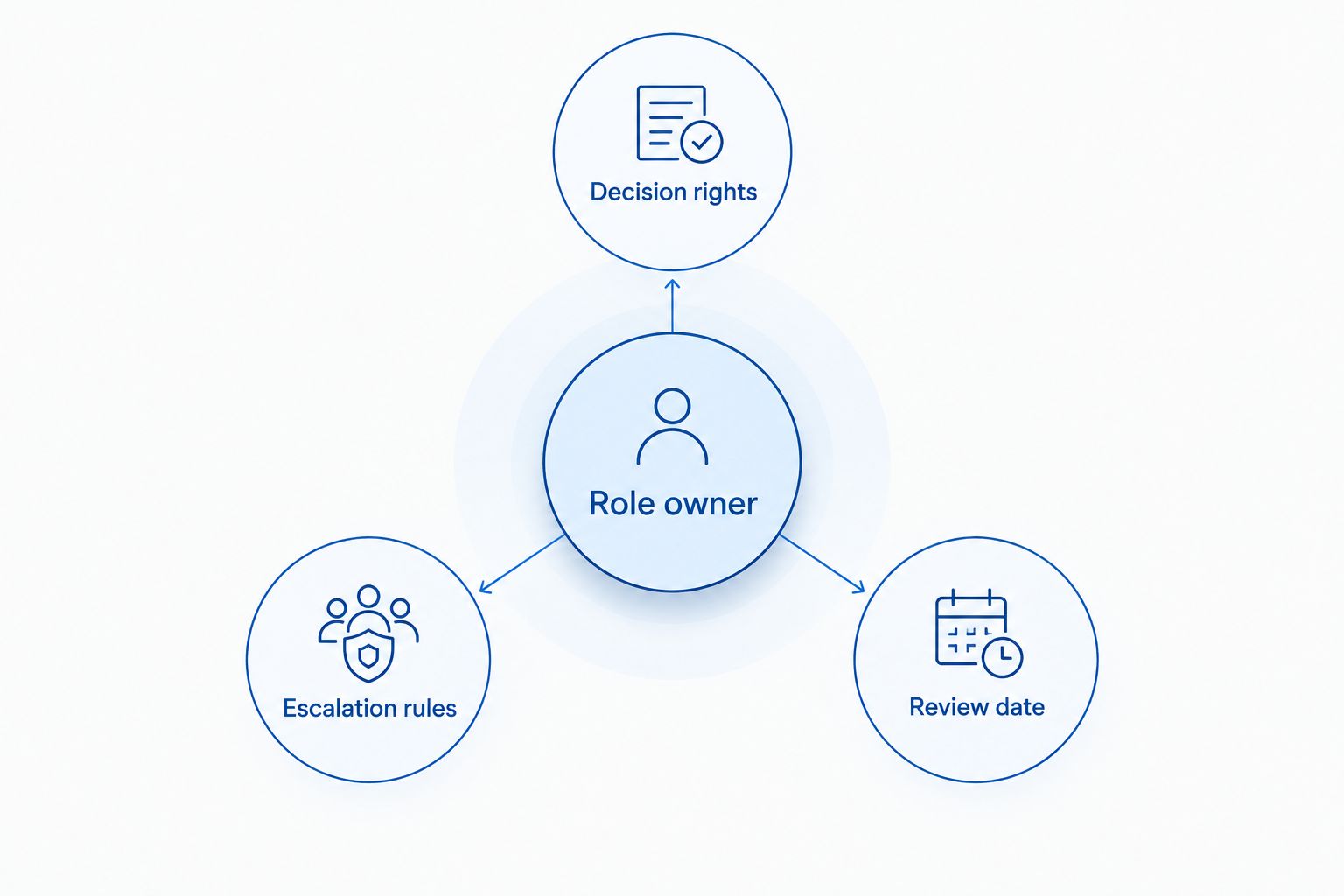
A role needs permission to decide, not just a list of tasks.
- Role owner: name the person accountable for the outcome.
- Decision rights: state what that person can approve independently.
- Escalation rules: identify exceptions requiring another decision-maker.
- Review date: agree when to assess the arrangement.
3. Write handovers your team can use
Begin with a plain checklist for a recurring task. Capture the trigger, required information, expected result and exception route. Test it with the person receiving the work, then revise the instructions wherever they need extra explanation.
A handover is incomplete when the recipient still needs the owner’s memory. Include where job details live, how changes are recorded and who informs the customer. For professional services, also clarify who checks scope before a new request becomes unplanned work.
Elevatory business coaching is best for established Australian owners seeking coaching with done-with-you marketing implementation. That support can sit alongside your internal role-setting work; it does not replace a person accountable for daily delivery. Ask prospective coaches how implementation responsibilities will be shared before choosing support.
The manual approach keeps the agreement in your hands, but your team must maintain it. Done-with-you support is the alternative when you want help progressing agreed changes rather than another document left unfinished.
- Define what starts the task.
- List the information required before work begins.
- Describe the finished outcome and checking responsibility.
- Record the exception and escalation process.
- Have the recipient test the checklist without live prompting.
4. Agree how family members resolve disagreements
Set a regular operating meeting instead of resolving workplace disagreements through private family conversations. A suggested 30-minute weekly meeting gives you a place to review exceptions, decide changes and record who will act. Keep personal matters outside that agenda.
The point is not to stop disagreement. It is to stop unresolved disagreement becoming contradictory instructions for employees. When family members disagree about an operating decision, use the agreed decision-maker and escalation process rather than asking the team to choose sides.
Keep your 2026 handover agreements in a shared decision log. Record the issue, the decision and the person responsible for communicating it. If someone changes an instruction, update the record and tell the affected team members directly.
Do not give responsibility with one hand and take authority back with the other. If the role owner follows the agreed boundaries, review a disputed decision through the process rather than quietly reversing it.
- Set a recurring operating meeting with a written agenda.
- Bring unresolved exceptions, not general complaints.
- Record the decision and its accountable owner.
- Communicate changes to affected employees.
- Use a qualified independent adviser for disputes outside coaching’s scope.
5. Connect marketing decisions to delivery capacity
Write down what the team can currently deliver before changing campaigns. Identify the services you want to book, the work you want to decline and the information needed to qualify an enquiry. Assign responsibility for keeping that information current.
Your 2026 marketing plan should reflect those operating choices. A full enquiry pipeline is not the same as profitable work, and the family member running advertising should not have to guess which jobs the delivery team can accept.
Hypothetical home-services example: the marketing lead promotes a service that only the owner can quote and supervise. Enquiries then create more owner work, despite a goal of reducing owner dependence. The practical response is to clarify quoting and delivery responsibilities before expanding that campaign.
Elevatory connects business coaching with done-with-you work on offers, funnels, paid advertising and systems. Ask how that work will fit your team’s delivery responsibilities, and who inside the business will maintain each change. Implementation still needs an internal owner.
- Define the services and locations you want to promote.
- Agree enquiry qualification and handover requirements.
- Name the person responsible for current capacity information.
- Set approval boundaries for pricing and scope exceptions.
- Review bookings alongside delivery workload and profitability.
6. Review independence, not just completed tasks
Check whether decisions stay with the role owner after the handover. A task marked complete tells you little if the family director still approved every detail. Review the exceptions and identify why they occurred before deciding that delegation has failed.
Use a suggested 30-day review to examine the first transferred responsibility. Ask whether the person had enough information, authority and access to complete the work. Change the instructions where they are unclear; change the decision boundary where it unnecessarily returns routine work to the owner.
Keep the same definitions throughout 2026 so your comparisons remain useful. For example, distinguish a genuine exception from an owner checking work that was already within the employee’s authority. Otherwise, routine interference can disappear inside a reassuring completion report.
Do not measure independence by silence alone. Employees also need a clear route for raising risks, customer issues and decisions outside their authority.
- Count routine decisions returned for owner approval.
- Record reversals and the reasons behind them.
- Check whether handovers contain the required information.
- Review delivery errors and customer complaints alongside independence.
- Agree the next responsibility to transfer.
Compare support for family-business roles
Choose support for the constraint you have identified. Coaching, operational management and specialist advice serve different purposes. Ask each provider what they will do, what your team must do and which issues sit outside their scope.
| Option | Best for | Practical advantage | Key limitation |
|---|---|---|---|
| Owner-led role reset | Families ready to agree and enforce responsibilities themselves | Starts with existing documents and direct conversations | Requires the family to challenge its own habits |
| Elevatory business coaching | Established Australian owners seeking coaching with done-with-you marketing implementation | Connects coaching with offers, funnels, advertising and systems work | Is not a substitute for internal daily management |
| Operations manager | Businesses needing an accountable person to run daily delivery | Places operating responsibility inside a defined role | Cannot settle ownership authority that the family leaves unresolved |
| Independent mediator | Families needing a structured process for a dispute | Gives the disagreement a dedicated process | Mediation does not itself run the business |
| Legal or accounting adviser | Ownership, employment, tax or structural questions | Provides advice within the adviser’s professional scope | Does not replace ongoing team leadership |
Before committing, request a clear scope and division of responsibilities. Do not assume that business coaching includes mediation, legal advice or day-to-day management. If the immediate problem is a family dispute, address that directly rather than expecting a marketing project to resolve it.
Common mistakes family-business owners make
Giving relatives titles without decision rights
Calling someone operations manager changes little when every employee still seeks the founder’s approval. Write down the decisions attached to the title, then tell the team where authority now sits. Test the arrangement using an actual scheduling, customer or delivery decision.
Letting family conversations override work agreements
A decision made outside work still affects employees when it changes their instructions. Bring operational changes back into the shared record and communicate them through the agreed channel. Do not make non-family employees responsible for discovering which private conversation takes precedence.
Delegating work while keeping every approval
Passing on administration is not the same as transferring responsibility. If the recipient must seek permission for routine decisions, the owner remains the decision-maker. Set boundaries that permit action, then review exceptions without rechecking everything.
Asking marketing to solve a delivery problem
More enquiries add pressure when nobody owns quoting, scheduling or customer updates. Fix those responsibilities before increasing demand. Judge marketing against suitable bookings and delivery capacity, not enquiry volume in isolation.
Using coaching to avoid a specialist issue
A coach can help structure operating responsibilities, but a disputed ownership arrangement or employment question needs the appropriate adviser. State the issue plainly when seeking help. Buying the wrong type of support delays the decision your family actually needs to make.
FAQ
How does business coaching help clarify family-business roles?
Business coaching helps you define responsibilities, decision boundaries, handovers and review routines. Family members still need to agree to those boundaries and follow them at work.
What should a family-business role description include?
A family-business role description should name the accountable person, expected outcomes, independent decisions and escalation rules. Add the information, access and review process needed to carry out the role.
Should a family member always manage non-family employees?
Choose the manager according to the role’s requirements, not family status. Employees need a manager with clear authority and accountability, regardless of whether that person is related to the owners.
Is a business coach better than an operations manager?
A business coach supports decisions and change; an operations manager takes responsibility for defined daily operations. Choose according to whether you need help changing the operating arrangement or someone accountable for running it.
Can Elevatory help with marketing as well as business coaching?
Elevatory offers business coaching and done-with-you marketing implementation covering offers, funnels, paid advertising and systems. Agree the scope and your team’s implementation responsibilities before engaging support.
What can I do before hiring a family-business coach?
Start by recording routine decisions that return to the owner and where instructions conflict. Use that record to define the problem you want coaching to address.
Can business coaching resolve a family ownership dispute?
Business coaching is not a substitute for specialist help with a family ownership dispute. Seek appropriately qualified legal advice or mediation support, while keeping operating responsibilities clearly documented.
One last thing
Test your role map on an ordinary decision, not a major crisis. Ask an employee who can approve a booking change, who handles an exception and where the answer is recorded. If the answers differ between family members, revise the agreement before blaming the employee.
The practical test is whether the team can follow the agreement without finding a family member to interpret it. Start there, then transfer the next responsibility.
Related guides
Book a free growth strategy call
Forty-five minutes with a strategist to pressure-test where your business is stuck and what to prioritise next.
Prefer to talk first? Call 1300 634 230 or email chris@elevatory.com.au