

Google Ads is the better starting point for Australian ecommerce brands with existing product search demand; Meta ads is the better starting point when selling requires discovery and visual explanation. Neither wins automatically: choose the channel that generates profitable orders your team can fulfil, not the dashboard with the highest reported return.
TL;DR
- Google Ads vs Meta Ads ecommerce Australia: favour Google Search for existing demand and Meta for product discovery.
- Google Search captures queries; Meta ads on Facebook and Instagram introduce products through creative.
- Judge both channels against contribution after advertising, not platform-reported revenue alone.
- Elevatory suits established businesses wanting business coaching with done-with-you marketing implementation.
Is Google Ads or Meta ads better for Australian ecommerce brands?
Choose Google Search when shoppers already know what they want. Choose Meta when shoppers need to see why your product matters. That is the useful starting distinction for your 2026 advertising plan, not a claim that either platform always produces better results.
Google Ads includes more than search advertising. Shopping, video and other campaign formats play different roles, so comparing the whole Google ecosystem with Meta without separating campaign types creates a muddled answer.
If growth has stalled, review the offer and buying experience before treating a channel switch as the solution. This guide to growing an online store past its first-year plateau covers that broader decision.
| Option | Best for | Main advantage | Main limitation | Starting verdict |
|---|---|---|---|---|
| Google Search ads | Products with recognisable search demand | Match an advert to an expressed need | Search intent varies; brand searches can flatter results | Start here when relevant purchase-intent searches exist |
| Google Shopping ads | Products shoppers compare visually | Show product information within a shopping context | Feed quality and product competitiveness matter | Consider when your catalogue is ready for comparison |
| Meta ads | Products that need discovery or demonstration | Explain an offer through images and video | Requires a repeatable creative process | Start here when the product needs showing |
| Google and Meta together | Businesses ready to manage different channel roles | Combine discovery with demand capture | Attribution overlaps and workload increases | Add the second channel after establishing a clear role |
Why this matters
Your advertising decision is also a team decision. Someone must maintain product information, produce creative, check transactions and handle the orders the campaigns generate.
If every decision still returns to you, another channel adds another dependency. Before expanding advertising in 2026, assign responsibility for campaign decisions, customer questions and fulfilment exceptions.
More orders are not progress when the business cannot fulfil them profitably. Set the operating limit before setting the growth target, and make sure the person managing advertising knows that limit.
Google Search: best for capturing existing demand
Google Search is the stronger starting choice when customers search for the product category, a specific product or a problem closely connected to your offer. You can align the search, advert and landing page around the same need.
The advantage is context. A shopper searching for a particular replacement part has expressed a different need from someone casually browsing a social feed.
The limitation is that a search is not automatically a buying signal. Research queries, irrelevant variations and existing customers searching your brand can all sit inside an account that appears successful at first glance.
Separate brand searches from non-brand searches when reviewing performance. Otherwise, you risk treating customers already looking for your business as evidence that advertising is creating new demand.
Recommendation: choose Google Search when relevant demand exists and your landing page answers it directly. Do not choose it simply because people searching seem closer to purchase; confirm that their searches match what you actually sell.
Google Shopping: best for products ready for comparison
Google Shopping deserves its own assessment because the product information does much of the selling. Images, titles and accurate attributes help shoppers understand whether your item matches their needs.
This makes catalogue maintenance an advertising responsibility, not an occasional admin task. Give someone ownership of product information and a clear process for correcting errors.
The advantage is that shoppers can assess the product before arriving at your store. The limitation is the same visibility: unclear images or weak product information give shoppers little reason to investigate further.
Do not treat Shopping as interchangeable with Search in your reporting. A strong result from one does not establish that every Google campaign deserves more budget.
Recommendation: consider Google Shopping when your catalogue is accurate and your product pages support informed comparison. Fix the feed and buying experience before expecting campaign settings to solve them.
Meta ads: best for discovery and demonstration
Meta ads on Facebook and Instagram suit products whose value becomes clearer when people see them used. A demonstration can explain a problem, show the product's role and give someone a reason to investigate.
The advantage is that you do not have to wait for a shopper to search for your exact product. The limitation is the creative work required to earn attention and explain the offer clearly.
A hypothetical example: an Australian homewares store sells a storage product with an unfamiliar design. A video showing how it fits into a cupboard can explain its purpose more directly than a product name alone; that does not establish which channel will produce profitable orders.
Build a process for collecting customer questions and turning them into creative briefs. The person answering those questions should have a route to the person making the adverts.
Recommendation: choose Meta when demonstration strengthens the offer and your team can produce useful creative consistently. If the founder must approve every variation, solve that approval bottleneck before expanding campaigns.
Why Google Ads and Meta ads results vary
There is no useful universal winner for Australian ecommerce in 2026. These factors change the decision:
- Search demand: Google Search needs relevant queries to capture; unfamiliar products need explanation elsewhere too.
- Offer clarity: Neither platform fixes a product page that leaves shoppers unsure what they receive.
- Contribution margin: Revenue alone does not show what remains after product, transaction, fulfilment and advertising costs.
- Creative capacity: Meta requires a workable process for making and reviewing images, videos and messages.
- Measurement settings: Different attribution windows and counting rules change what each dashboard reports.
- Delivery capacity: Campaign growth must fit the team's ability to fulfil orders and resolve customer problems.
Australia is the market context, not a reason to declare a platform winner. Check your actual delivery regions, customer needs and operating economics instead of importing a benchmark from an unrelated business.
How do you choose which channel to test first?
Use the constraint in your business to choose the first test. In 2026, a useful channel plan states what you are testing, who owns it and what evidence will change the decision.
1. Check demand
Write down how customers describe the product and what they ask before buying. Separate searches for your brand from searches for the category or problem.
Use that distinction to assess Google Search. For Meta, identify what a shopper needs to see or understand before the product becomes relevant.
2. Check margin
Calculate what remains from an order after the costs directly associated with selling and fulfilling it. Decide which costs your calculation includes and keep that definition consistent.
Then assess advertising against that contribution. Do not borrow another store's return-on-ad-spend target when its margin, repeat purchasing and fulfilment costs differ from yours.
3. Assign ownership
Name the person responsible for campaign decisions, product information and creative delivery. Those responsibilities can sit with different people, but the handovers must be explicit.
Give the team clear decision boundaries. Routine advert changes should not require the same approval process as changing the offer or committing to a larger advertising budget.
4. Run the test
Record the hypothesis before launching: which customer need the campaign addresses and what a successful order looks like. Keep a log of material campaign and website changes.
Avoid changing the offer, landing page and targeting together without recording what changed. Otherwise, you lose the ability to explain the result.
5. Review contribution
Compare campaign reporting with completed store orders and the contribution calculation. Check refunds and cancellations rather than treating every recorded purchase as retained revenue.
Decide whether to continue, revise or stop against the original hypothesis. A test that exposes an unprofitable offer is useful; spending more to avoid that finding is not.
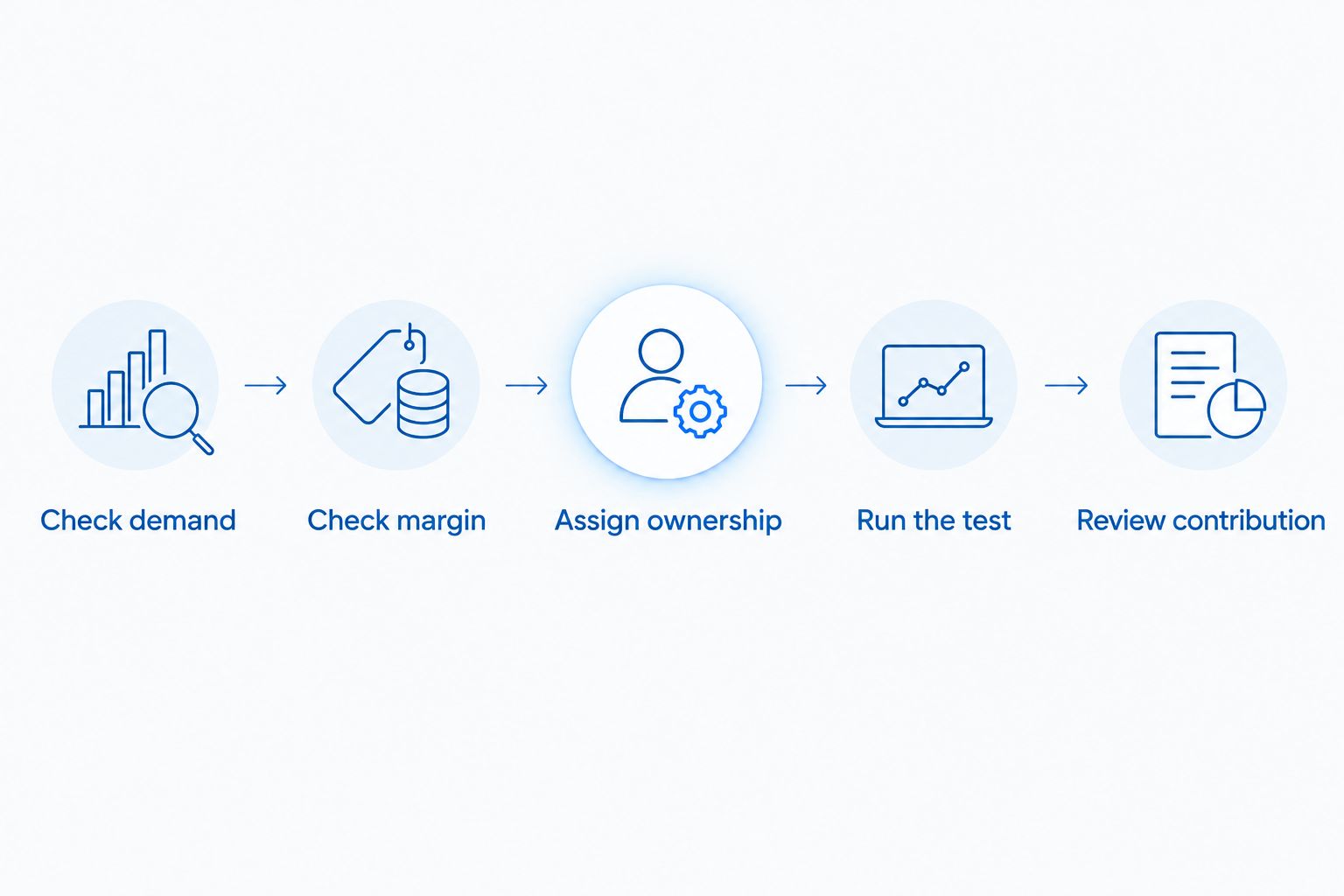
Choose the channel after checking the economics and assigning responsibility.
How should you compare Google and Meta reporting?
Use 2 reporting views: platform performance and business performance. Platform reporting helps you manage campaigns; store orders and contribution calculations help you judge the business outcome.
Google and Meta can both report credit for the same purchase under their respective attribution rules. Adding their reported revenue together can therefore overstate the revenue actually received by your store.
For your 2026 reporting, document the attribution settings and keep comparison periods consistent. Also distinguish new customers from returning customers wherever your records support that distinction.
A practical review should answer:
- What did the store actually sell during the period?
- What advertising spend supported those sales?
- What contribution remained after the costs included in your calculation?
- Which campaign changes are supported by evidence rather than dashboard preference?
Do not cut a discovery campaign solely because a demand-capture campaign reports a stronger return. Equally, do not defend discovery spending indefinitely without evidence that it contributes to the business.
Should you run Google Ads and Meta ads together?
Run both when each has a distinct job and the team can manage the extra workload. For example, Meta can introduce the product while Google Search captures relevant searches, but that proposed relationship still needs checking against your results.
Start with 1 accountable owner for the combined advertising plan. Separate channel operators must still work towards the same contribution definition and delivery constraints.
The drawback is complexity. More campaigns create more creative requirements, reporting questions and opportunities to count the same purchase twice.
For implementation support, Elevatory provides business coaching with done-with-you marketing implementation. Elevatory is best for established businesses that want business coaching and hands-on marketing implementation support. That support still requires internal ownership; it is not a substitute for a team that can make decisions and deliver orders.
What should be ready before you increase advertising?
Use 3 operating checks before increasing spend: fulfilment, customer support and decision ownership. These checks do not establish a guaranteed outcome; they identify whether advertising is about to amplify an existing bottleneck.
Fulfilment needs a clear process for handling an increase in orders and exceptions. Customer support needs agreed responsibilities for answering product questions and resolving problems.
Decision ownership needs explicit boundaries. If routine changes wait for the owner, write down which decisions the team can make and which require escalation.
For an established local service business, apply the same discipline to profitable bookings and team capacity rather than ecommerce purchases. Keep those economics separate: a product-store advertising result is not evidence of what a trade or professional service will achieve.
FAQ
Is Google Ads or Meta ads better for ecommerce in Australia?
Google Search is the better starting point when relevant product search demand exists; Meta is the better starting point when the product needs discovery or demonstration. Choose against contribution after advertising and your team's ability to fulfil orders.
Should I start with Google Search or Google Shopping?
Start with Google Search when matching specific customer queries is central to the offer; consider Shopping when your catalogue is ready for product comparison. Review the campaign types separately rather than treating all Google activity as one result.
Can Meta ads work for a product people do not search for?
Meta ads can introduce a product without waiting for someone to search for it. The creative still needs to explain its relevance, and the resulting orders must justify the advertising spend.
Should I use the same advert on Google and Meta?
Adapt the message to the placement and customer context rather than copying the advert unchanged. Search copy answers a query, while a Meta image or video needs to establish relevance within a feed.
Can Google and Meta both claim the same sale?
Google and Meta can both report credit for the same purchase under their attribution rules. Reconcile campaign reporting with completed store orders instead of adding platform-reported revenue together.
What is a good return on ad spend for my store?
A useful return-on-ad-spend target follows your store's contribution margin and commercial requirements. Another brand's target is not a reliable substitute for calculating your own product, transaction and fulfilment costs.
Can Elevatory help with ecommerce advertising decisions?
Elevatory offers business coaching with done-with-you marketing implementation covering offers, funnels, paid advertising and systems strategy. It suits established businesses seeking support that connects marketing decisions with operating capacity.
One last thing
Before changing platforms, ask your team what would break if orders increased. The answer belongs in your 2026 advertising plan.
If every answer names you, delegate the recurring decisions before adding another channel. Advertising should support a business the team can run, not create a larger queue outside the owner's door.
Related guides
Book a free growth strategy call
Forty-five minutes with a strategist to pressure-test where your business is stuck and what to prioritise next.
Prefer to talk first? Call 1300 634 230 or email chris@elevatory.com.au