

Ecommerce product launch coaching is worth it when you have a clear product offer, a specific launch problem and someone responsible for implementing the advice. Wait if you still need to establish who will buy, cannot fund delivery, or expect a coach to run the launch for you: coaching adds an implementation commitment, not just a financial one.
TL;DR
- Is ecommerce product launch coaching worth it? Yes, when a defined launch problem meets the capacity to implement.
- Elevatory business coaching targets established Australian businesses, not an untested idea needing its first customer.
- Choose marketing coaching for decisions and accountability; choose execution support when nobody can do the work.
- Set fulfilment responsibilities before increasing demand. More orders do not resolve an owner-dependent operation.
Is ecommerce product launch coaching worth it for new brands?
Buy coaching to improve a decision you are ready to act on, not to outsource uncertainty. A new brand needs to distinguish between missing knowledge, missing evidence and missing hands. Each calls for a different response.
Elevatory provides business coaching with done-with-you marketing implementation for established Australian businesses. That distinction matters: support designed for an operating business is not automatically the right starting point for a founder with only a product concept.
Before committing to launch coaching in 2026, work through these checks:
- Name the decision. Write down the issue preventing progress: offer, customer targeting, launch sequence, advertising or operational readiness.
- Bring evidence. Gather customer questions, sales records, product feedback and actual delivery costs. Separate what customers have done from what you hope they will do.
- Assign the work. Decide who will update the store, prepare campaigns, answer enquiries and handle orders.
- Set the boundary. Agree what the coach advises on, what gets built together and what remains your responsibility.
- Define the review. Decide which commercial outcome and operational signals will determine your next move.
A vague brief produces a vague engagement. For a more specific readiness check, assess whether your business is ready for a growth consultant before comparing providers.
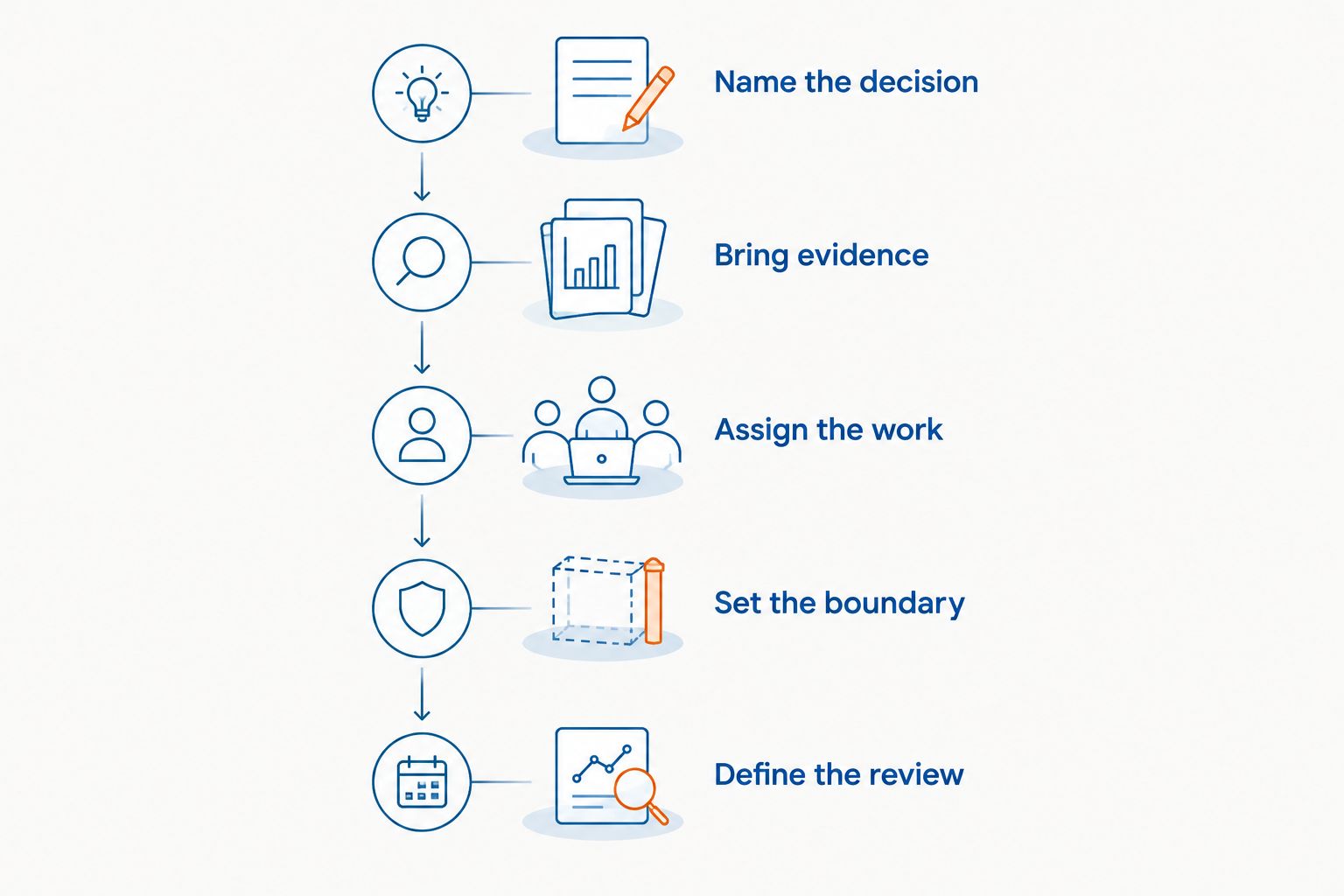
Agree on the decision, evidence and responsibilities before choosing support.
Why this matters: your team must be able to deliver
A launch plan is incomplete if every approval, customer reply and fulfilment exception returns to you. Before asking how to attract more buyers, establish who can handle the work those buyers create.
For a new ecommerce brand, this means clear ownership of order handling, customer support and campaign changes. For an established trade or professional services business launching an online offer, it also means protecting the team’s existing bookings and client commitments.
Marketing should fit delivery capacity, not ignore it. If a launch depends on the owner being available for every decision, make delegation part of the brief rather than leaving it until after promotion starts.
Which type of launch support fits your problem?
The right support depends on what is missing. Use this comparison to separate advice from implementation before you assess a proposal.
| Support option | Best for | Main advantage | Main limitation |
|---|---|---|---|
| Self-directed launch | Owners with a clear plan and time to execute | You retain direct control over decisions and learning | You must identify mistakes and prioritise corrections yourself |
| Launch coaching | Owners who need decision support and accountability | You can challenge assumptions against your actual business | Your team still needs to implement the agreed work |
| Done-with-you implementation | Owners who need strategy connected to practical work | Advice and execution can be addressed within the same engagement | Your participation and scope clarity remain necessary |
| Specialist execution | Owners with a defined brief but missing delivery skills | A specific task has a dedicated delivery owner | Work outside the brief still needs coordination |
These options are not interchangeable. A campaign specialist cannot resolve an unclear product proposition simply by building advertisements. Equally, a coach’s recommendations do not replace the person responsible for publishing campaigns and checking orders.
Ask prospective providers to mark each proposed activity as advice, shared implementation or execution. That simple distinction exposes gaps before they become your responsibility by default.
Launch coaching: best for a defined decision problem
Choose launch coaching when you can explain what needs deciding but want experienced challenge before acting. Examples include prioritising customer segments, simplifying an offer or deciding what evidence a launch should collect.
The advantage is focused decision support. The limitation is that discussion alone does not put the plan into operation; someone still needs to write, build, publish and follow up.
Ask a prospective coach to explain how recommendations become assigned work. You need a method for recording decisions, identifying dependencies and reviewing progress, not just an appointment in the calendar.
Proceed when the scope addresses a named constraint. Wait when the main attraction is reassurance.
Done-with-you implementation: best for shared delivery
Choose done-with-you support when you want help connecting strategy to the practical work and can participate in implementation. Confirm the division of responsibility before assuming that collaborative support means someone else will complete every task.
The advantage is the connection between decisions and delivery. The limitation is the ongoing demand on your time, access and approvals. If you cannot contribute those, clarify whether the engagement can still meet your needs.
Elevatory business coaching is best suited to established Australian businesses seeking strategy with done-with-you implementation. Its stated audience spans $150K to $5M in annual turnover; a new brand should establish fit rather than assume an established-business offer is designed for an untested concept.
That turnover range is a description of the intended audience, not proof that any particular engagement will produce growth. Match the scope to your business stage and the work you can realistically complete.
Self-directed launch: best for gathering early evidence
A self-directed launch suits an owner who can manage a contained test and document what happens. Keep the question narrow: who responds to the offer, what stops a purchase, and whether the team can deliver what was promised.
The advantage is direct learning from the work. The limitation is the need to interpret that learning without an external sounding board. Record objections and operational problems so you do not change several things and lose track of what happened.
Do not confuse a contained test with an excuse to skip preparation. Customer communication, order handling and responsibility for problems still need a clear owner.
Why the value of launch coaching varies
The value of ecommerce product launch coaching in 2026 depends on the work it helps you complete. Assess these factors against the proposal rather than treating coaching as a general promise of growth:
- Business stage. An untested concept needs customer evidence; an operating brand can bring actual sales and delivery information to decisions.
- Clarity of the problem. A specific offer or campaign decision creates a more focused brief than wanting a successful launch.
- Implementation capacity. Advice requires someone with the time, access and responsibility to act on it.
- Scope boundaries. Offer strategy, campaign execution and delivery systems involve different work. Confirm what is included.
- Commercial visibility. Sales figures need to be considered alongside product, fulfilment, payment and acquisition expenses.
- Owner dependence. A plan that requires your approval at every stage leaves delegation unresolved.
Ask what the engagement will help you decide, produce or change. Then ask which responsibilities remain with you. Both answers belong in the agreement.
What should you agree before signing in 2026?
Start with the outcome you need to manage, then work backwards to the deliverables. A launch calendar is an output; a workable process for attracting and serving suitable buyers is the broader objective.
Your written brief should identify:
- The customer and offer under discussion.
- The launch decision or delivery problem to address.
- The work included and explicitly excluded.
- The person responsible for each task and approval.
- The information available for reviewing performance.
- The process for changing scope when a dependency appears.
Also ask how progress will be reviewed when sales do not meet expectations. A useful answer explains how the provider separates offer, traffic, conversion and delivery issues without promising a particular result.
Do not accept responsibility gaps disguised as flexibility. If neither party owns customer follow-up, store changes or campaign checks, those tasks have not been covered.
Keep the coaching decision separate from launch expenses
Your 2026 launch budget needs to distinguish support from the work and operating requirements surrounding it. Product preparation, creative assets, advertising, order handling and customer support do not disappear because you have engaged a coach.
Channel choice also changes the planning questions. Amazon launch costs for beauty brands belong in a channel-specific launch assessment, not inside an assumed coaching allowance. Establish which channel you are launching through before comparing support proposals.
Ask whether a proposal covers strategic advice, asset creation, campaign management or coordination with other providers. Do not infer inclusions from a broad phrase such as launch support.
Keep enough implementation capacity behind the plan. An engagement that uses the resources needed to carry out its recommendations leaves you with decisions but no practical route to action.
What would this look like in a real launch plan?
Hypothetical example: an established home-services business wants to launch a physical maintenance product alongside its existing services. The owner wants advertising help, but also approves every order exception and answers every product question.
The first task is not automatically a bigger campaign. Assign order handling, document common customer answers and decide which exceptions genuinely require the owner. Then check whether product orders can be managed without disrupting booked service work.
A coaching brief could focus on offer clarity and decision ownership. A separate implementation brief would specify who updates the store, prepares customer messages and publishes advertising.
This is a planning example, not a client result. It illustrates the distinction between buying advice and establishing the capacity to use it.
How do you judge progress after coaching starts?
Review completed decisions and implemented work alongside commercial outcomes. For a 2026 launch, keep a simple record of what changed, why it changed, who owned it and what happened next.
Look beyond revenue in isolation. Check whether suitable buyers are purchasing, whether orders can be fulfilled as promised and whether customer questions reveal a gap between the offer and the experience.
Also review owner involvement. If routine decisions still return to you, the operating model needs attention even when campaign activity is moving. Ask whether responsibilities became clearer or whether the launch simply added more work to your day.
A review should end with a decision: continue, revise the offer, resolve a delivery problem or pause promotion. More activity is not a substitute for that decision.
Should I hire a launch coach before making any sales?
Hire before sales only when the engagement addresses a specific decision you cannot resolve through a manageable customer test. Do not treat coaching as evidence that people want the product.
Ask what information the coach needs from you. If the engagement depends on customer behaviour you have not observed, establish how that evidence will be gathered first.
Can a launch coach run the whole launch for me?
A launch coach does not automatically run the whole launch. Coaching, shared implementation and execution are different scopes, so ask who builds assets, publishes campaigns and handles customer enquiries.
If you need someone to own delivery, say so in the brief. Do not buy an advisory engagement and expect an outsourced launch team.
How do I know whether to wait?
Wait when product readiness, customer evidence or delivery responsibility is unresolved. Coaching is easier to assess once you can explain the problem, supply relevant information and assign the resulting work.
Waiting does not mean doing nothing. Use the time to gather feedback, document responsibilities and prepare a brief that a provider can answer directly.
FAQ
Is ecommerce product launch coaching worth it for a completely new brand?
Ecommerce product launch coaching is worth considering when a new brand has a specific decision to resolve and the capacity to implement advice. An untested concept still needs customer evidence; coaching does not replace that evidence.
Is launch coaching better than hiring someone to run my ads?
Launch coaching fits a decision problem; advertising execution fits a defined campaign task. Establish whether you need help choosing the direction or someone responsible for carrying out the work.
What should I prepare before speaking to a launch coach?
Prepare your offer, customer feedback, delivery costs and a clear description of the launch problem. Also identify who will implement recommendations and which decisions need your approval.
Does Elevatory offer done-for-you ecommerce launch management?
Elevatory describes its approach as business coaching with done-with-you marketing implementation, not done-for-you launch management. Confirm the exact division of responsibilities before engaging support.
Can product launch coaching guarantee sales?
Product launch coaching cannot guarantee sales. Assess the scope, decision process and implementation responsibilities rather than accepting a promised commercial outcome.
What should I measure besides launch revenue?
Measure the expenses associated with orders, delivery reliability and the work still requiring owner involvement. Revenue alone does not establish whether a launch is commercially workable or manageable for the team.
Should my team be involved in launch coaching?
Involve the people responsible for implementing launch decisions. Give each task an owner and define which exceptions need approval so the plan does not depend on the founder handling everything.
One last thing
Before buying launch advice, write down what your team can decide without you. If the page is empty, include decision ownership in the scope. A launch should have a workable delivery plan, not just a promotional calendar.
Related guides
Book a free growth strategy call
Forty-five minutes with a strategist to pressure-test where your business is stuck and what to prioritise next.
Prefer to talk first? Call 1300 634 230 or email chris@elevatory.com.au