

A small Australian business should budget for paid ads from the profitable bookings its team can deliver, then work backwards to an affordable customer acquisition cost. Your 2026 budget must also cover campaign management, creative, tracking and follow-up—not just the money paid to the advertising platform.
TL;DR
- Paid ads budget small business Australia: start with delivery capacity and contribution per booking, not a turnover percentage.
- Set separate limits for advertising spend and the total cost of winning customers.
- Elevatory business coaching suits established Australian service businesses seeking coaching with done-with-you marketing implementation.
- Increase advertising spend only when booked work, margins and team capacity support the decision.
Why this matters
An advertising budget is a commitment to handle more work, not just buy more enquiries. If every quote, scheduling change and customer question still reaches you, additional leads add another queue to manage.
Before setting your 2026 advertising allowance, identify the team capacity bottlenecks that limit delivery. A campaign cannot fix unclear responsibilities or make an unavailable crew available.
Start with the work you want. Then check who will sell it, who will deliver it and what remains after the costs of doing both.
How much should a small Australian business budget for paid ads?
Set your paid ads budget below both your affordable acquisition limit and your delivery-capacity limit. The right amount funds a defined booking target without relying on unproven repeat purchases or work your team cannot complete.
For your 2026 plan, build the budget in this order:
- Choose the work. Name the service, customer type and service area you want to promote.
- Check capacity. Identify the additional bookings your team can complete without displacing better work.
- Calculate contribution. Subtract the direct costs of delivering that work from the revenue it generates.
- Set acquisition limits. Decide how much contribution you can spend winning a customer while retaining the profit you require.
- Separate the costs. Allocate advertising spend separately from management, creative, tracking and sales follow-up.
These are planning steps, not a promise that advertising will produce bookings. Your actual enquiry quality, booking rate and delivery costs determine whether the budget works.
| Budget approach | Best for | Main advantage | Main limitation |
|---|---|---|---|
| Capacity-led | Businesses with constrained crews, appointments or specialist time | Keeps the booking target tied to available delivery | Capacity alone does not establish profitable acquisition costs |
| Contribution-led | Businesses that know their service delivery costs | Connects acquisition spending to retained profit | Incorrect cost assumptions produce an incorrect spending limit |
| Cash-capped test | Businesses testing a defined offer without reliable campaign history | Limits financial exposure while collecting evidence | A spending cap does not guarantee enough evidence for a decision |
Use these approaches together. Capacity sets the ceiling on additional work, contribution sets the financial limit, and available cash limits the test.
Calculate the advertising portion separately
Use this planning relationship:
Advertising allowance = target new customers × affordable advertising cost per customer.
Your affordable advertising cost per customer is what remains after allowing for other acquisition costs and the profit you intend to retain. Do not treat the full contribution from a booking as available advertising money.
For a new campaign, that allowance is a hypothesis. Replace assumptions with recorded results as enquiries become quotes, bookings, completed work and collected payments.
What belongs in the total budget?
The platform spend is only part of the decision. Write the full scope beside the advertising allowance so you can compare proposals without confusing different services.
- Advertising spend: the amount paid to the platform to distribute your ads.
- Campaign work: planning, setup, monitoring and changes to the campaign.
- Creative and destination: the ad materials and the page or enquiry path customers use.
- Measurement: the setup and checking needed to connect enquiries with booked work.
- Sales handling: the time and systems required to qualify enquiries, prepare quotes and follow up.
- Internal ownership: the person responsible for decisions, approvals and reporting inside your business.
Not every proposal includes every item. Ask what is included, what your team must provide and what requires separate approval.
Judge the total acquisition cost, not the advertising account in isolation. A campaign that generates enquiries still needs a workable sales process and enough margin to justify its full cost.
Why paid advertising budgets vary
Your spending limit changes when the economics or delivery requirements change. These factors belong in the budget discussion before you choose a channel.
- Contribution per booking. Work with substantial delivery costs leaves less room for customer acquisition than the headline invoice suggests.
- Available capacity. Empty appointments and fully committed crews require different booking targets.
- Enquiry-to-booking conversion. Unqualified enquiries and unaccepted quotes do not create the same value as completed, paid work.
- Service area and scope. Travel, job suitability and delivery requirements affect which customers you should pursue.
- Acquisition scope. A business needing landing-page work, measurement and follow-up support has a different total requirement from one with those pieces operating.
- Cash timing. The timing of advertising payments, customer receipts and delivery expenses determines how much exposure the business can carry.
Avoid borrowing another business's advertising allowance. Even a nearby competitor can have different labour costs, customer requirements and spare capacity.
Build a budget your team can execute
A useful budget ends with named responsibilities. Otherwise, you have a spending decision without a delivery plan.
Capacity check
Ask your delivery lead which services the team can accept and where the constraints sit. Check skills, materials, scheduling and the work already promised to customers.
Set 1 booking target for the service being promoted. Keep unsuitable work outside that target, even when it produces attractive enquiry numbers.
Margin check
Use completed work to review direct labour, materials, subcontractors and other costs attached to delivery. Separate revenue from the contribution left to fund acquisition, overheads and profit.
Where quoting errors or inconsistent scope make contribution unclear, fix that uncertainty before treating an advertising return as proof of profitability.
Handover check
Assign 1 accountable owner to the enquiry-to-booking process. That person does not need to perform every task, but must know who qualifies enquiries, prepares quotes and records outcomes.
Write down which decisions the team can make without you. A handover that sends every exception back to the owner has not removed owner dependence.
Review decision
Keep 1 review sheet that connects campaign spending with qualified enquiries, accepted bookings, completed work and delivery capacity. Give each measure an agreed definition.
Use that sheet to decide whether to continue, change the offer, repair follow-up or stop spending. Do not let separate advertising and operations reports tell unrelated stories.
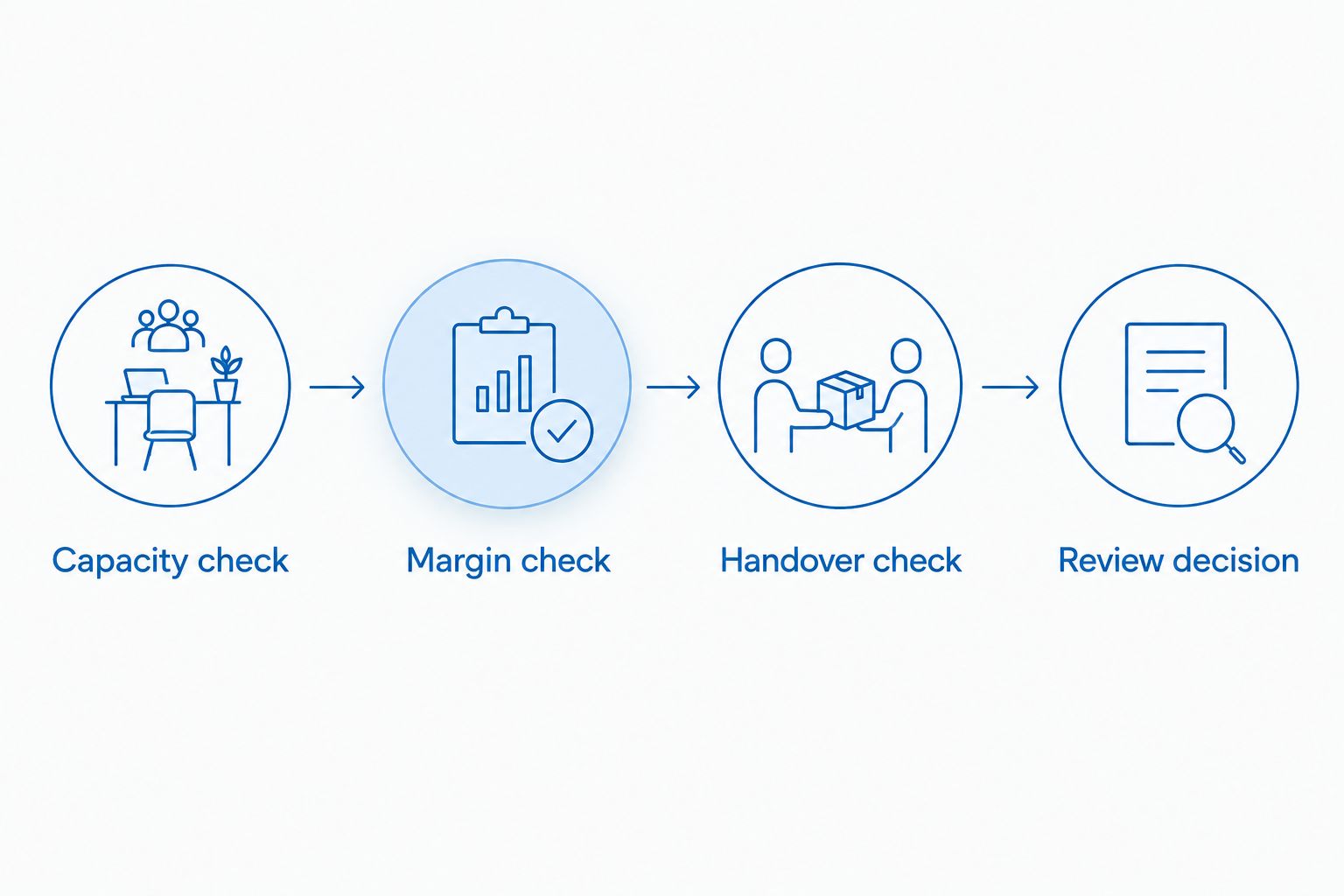
Set the delivery and financial limits before approving more advertising spend.
What does this look like for a local service business?
Hypothetical example—not a client result: a plumbing business wants more booked work, but the owner still approves every quote and allocates every job. The advertising decision starts with those responsibilities, not a larger lead target.
First, the business identifies the job types its available crew can complete. It then defines qualification questions, quoting authority and the circumstances that genuinely require the owner.
The campaign brief can now specify suitable work, service area and a booking target tied to crew capacity. The budget has a purpose beyond generating enquiries.
If unsuitable jobs dominate the enquiry list, inspect targeting, the offer and qualification. If suitable enquiries arrive but quotes stall, inspect the handover before buying more traffic.
The same logic applies to professional services. Additional consultations are not useful when the only partner authorised to scope and approve work already has a full delivery schedule.
Should I use a percentage of turnover for my ads budget?
Use contribution, capacity and cash exposure to set the budget; use turnover only as context. A turnover percentage does not tell you whether the next booking is profitable or deliverable.
For established businesses, revenue also hides differences between service lines. Assess the work you are advertising rather than assuming every booking has the same economics.
Should I increase spending when enquiries get cheaper?
Cheaper enquiries justify a closer look, not an automatic budget increase. Check whether those enquiries match your service area, become accepted work and leave the required contribution after delivery.
Before increasing your 2026 allowance, confirm that the team can handle the additional quoting and bookings. A lower enquiry cost does not remove an operational bottleneck.
When should I pause paid ads?
Pause spending when you cannot establish what it is buying or cannot reliably handle the work it attracts. That includes broken enquiry tracking, an unowned follow-up queue or a delivery schedule with no suitable capacity.
Define the restart condition before pausing. Assign the repair to a named person so the campaign does not restart with the same unresolved problem.
What support should you pay for?
Choose support around the work that needs doing. Ask who will set the acquisition limit, make campaign changes, improve the enquiry handover and check delivery capacity.
If your team already handles delivery and sales reliably, the brief can focus on advertising execution. If responsibilities, offers and follow-up remain unclear, campaign management alone leaves those decisions unresolved.
Elevatory business coaching is best for established Australian businesses seeking coaching with done-with-you marketing implementation. That model combines business decisions with implementation support rather than positioning the service as advertising software or a done-for-you replacement for your team.
The trade-off is participation. Your business still needs someone to provide financial information, approve decisions and carry the agreed responsibilities internally; outsourcing the advertising account does not outsource delivery accountability.
You can review Elevatory when your requirement includes offers, funnels, paid advertising and systems strategy. Choose the support model only after defining which decisions and implementation tasks your business needs help with.
FAQ
What's a sensible paid ads budget for a small Australian service business?
A sensible paid ads budget is the amount your contribution margin, delivery capacity and cash position can support. Set a target for suitable bookings, calculate an affordable acquisition limit and include costs beyond platform spend.
Should my paid ads budget include management and creative?
Your total marketing acquisition budget should include management and creative where those services are required. Keep them separate from platform spend so you can assess the full cost of winning customers.
Can I run paid ads before hiring more staff?
You can run paid ads before hiring when your current team has capacity for the work being promoted. If delivery is already constrained, resolve capacity or narrow the offer before pursuing additional bookings.
Is cost per lead enough to judge whether paid ads work?
Cost per lead is not enough to judge whether paid ads work. Connect spending with qualified enquiries, accepted bookings, completed work and the contribution retained after delivery.
Should I advertise every service my business offers?
Prioritise services your team can deliver profitably and reliably. A focused offer gives you a clearer booking target and makes it easier to identify unsuitable enquiries.
Can Elevatory help with more than advertising strategy?
Elevatory provides business coaching with done-with-you marketing implementation across offers, funnels, paid advertising and systems strategy. The service is relevant when the business needs help connecting marketing decisions with implementation, rather than software alone.
One last thing
Write down who can approve the next suitable booking without asking you. If that answer is unclear, include decision authority in the work required before increasing your advertising allowance.
For your next 2026 budget review, bring the delivery schedule alongside the advertising report. The next move depends on both: what you can acquire profitably and what your team can deliver without pulling you back into every decision.
Related guides
Book a free growth strategy call
Forty-five minutes with a strategist to pressure-test where your business is stuck and what to prioritise next.
Prefer to talk first? Call 1300 634 230 or email chris@elevatory.com.au