Published:
How much does a digital marketing agency cost for a small Australian business?

For a small Australian business in 2026, digital marketing agency costs depend on the scope, who implements the work and what ongoing support you need. The agency fee is only part of the commitment: advertising spend, software and your team's time need separate treatment. Compare the total scope and delivery responsibilities, not just the headline fee.
TL;DR
- Digital marketing agency cost small business Australia: compare scope, advertising spend, implementation and internal workload separately.
- Elevatory combines business coaching with done-with-you marketing implementation for established Australian businesses.
- Choose marketing support around profitable bookings and team capacity, not enquiry volume alone.
- Get written responsibilities, exclusions, reporting measures and exit terms before committing.
Why this matters
If every quote, booking and customer issue still reaches you, buying more enquiries adds work before it removes pressure. Your marketing decision needs to account for who answers leads, approves quotes and delivers the service.
Elevatory provides business coaching and done-with-you marketing implementation. That distinction matters when you compare it with an agency expected to execute campaigns independently: the responsibilities are different.
For your 2026 brief, start with the job you need done. Is the constraint too few suitable enquiries, poor follow-up, an unclear offer or a team that cannot take more work? Each calls for a different scope.
How much does a digital marketing agency cost for a small Australian business?
A useful cost comparison separates the provider's work from advertising expenditure and your own delivery obligations. Ask each provider to quote against the same brief, with the same inclusions and exclusions.
Build that brief in this order:
- Define the outcome. Specify the services, locations and customer types you want to attract. Name what counts as a qualified enquiry and a profitable booking.
- Set the capacity limit. Identify the work your team can accept without relying on you to rescue delivery. Include the person responsible for confirming that capacity.
- List the deliverables. Separate strategy, campaign setup, landing pages, tracking, creative, follow-up and ongoing management. Ask who supplies each item.
- Separate the commitments. Request distinct treatment of provider fees, advertising expenditure, software, setup work and internal responsibilities.
- Agree on review and exit terms. Define reporting, approval responsibilities, ownership of accounts and what happens when the engagement ends.
This gives you a basis for comparing proposals. Without it, a smaller scope can look cheaper while leaving essential implementation with your team.
What belongs in the cost breakdown?
Use the following as a quote checklist, not a list of items every provider includes. Require a clear answer for each line.
| Component | What to clarify | What remains your responsibility? |
|---|---|---|
| Strategy | Audience, offer, channel choice and priorities | Commercial decisions and delivery constraints |
| Setup | Campaigns, tracking and landing-page work | Access, approvals and source material |
| Ongoing management | Campaign reviews, changes and reporting | Timely decisions and feedback on lead quality |
| Advertising expenditure | How media spend is authorised and paid | Budget approval and spending limits |
| Software | Required systems, account ownership and billing | Staff access and day-to-day use |
| Sales follow-up | Enquiry routing, qualification and booking process | Named staff members and escalation rules |
Ask what triggers extra work. New services, additional locations, replacement creative and changes to the original brief should have a written approval process before implementation begins.
Which engagement model fits the work?
Project work, ongoing agency management and coaching with implementation support solve different problems. Choose the operating model before comparing proposals. A useful comparison asks who makes decisions, who executes and who remains accountable inside your business.
| Engagement model | Best for | Main benefit | Main limitation |
|---|---|---|---|
| Defined project | A business with a specific setup or repair task | Clear deliverables and a defined handover | Ongoing management needs separate agreement |
| Ongoing agency management | A business ready to delegate agreed marketing execution | Named responsibility for recurring campaign work | Sales follow-up and service delivery still need internal owners |
| Coaching with done-with-you implementation | An owner building marketing capability and clearer systems | Connects decisions with implementation alongside the business | Requires owner or team participation |
Defined project: best for a bounded task
A project suits work with a clear finish, such as establishing an agreed campaign setup or improving a defined lead-handling process. Specify acceptance criteria before work starts.
The limitation is continuity. Ask who maintains the work, checks tracking and trains staff after handover; do not assume those tasks sit inside the project.
Ongoing agency management: best for delegated execution
An ongoing engagement suits recurring work that needs a named external owner. Your agreement should identify what gets reviewed, what can be changed without approval and how performance is reported.
Delegating campaigns does not delegate your business judgement. Someone inside the business still needs to explain which bookings were suitable, which jobs consumed too much capacity and which enquiries never received follow-up.
Coaching with implementation: best for building capability
Coaching with done-with-you implementation suits an owner who needs help choosing priorities and putting changes into practice with the team. It is not the same as handing all marketing work to an external agency.
Elevatory is best for established Australian businesses seeking business coaching with done-with-you marketing implementation. The practical limitation is participation: you need someone available to make decisions, supply business information and carry agreed responsibilities.
Why digital marketing agency costs vary
Scope changes the work required. Use these factors to test whether a proposal addresses your business rather than offering a generic package.
- Implementation responsibilities. Strategy advice, collaborative implementation and externally managed execution involve different divisions of work. Ask where the provider stops and your team starts.
- Starting condition. Identify what already exists: accounts, tracking, landing pages, offers and follow-up processes. Put required repairs in the brief instead of leaving them as assumptions.
- Campaign scope. Specify the services, locations and channels covered. Avoid treating an undefined promise to manage marketing as an agreed deliverable.
- Creative and approval workload. Clarify who writes copy, supplies images, approves claims and requests changes. Unassigned work becomes an owner task.
- Measurement requirements. Distinguish platform enquiries from qualified leads, bookings and completed work. Agree on the records needed to connect those stages.
- Handover and support. State what documentation, staff instruction, account access and ongoing assistance you need. These are responsibilities to agree, not extras to assume.
For a 2026 proposal, ask each provider to mark every item as included, excluded or your responsibility. That simple distinction makes differences in scope visible before you sign.
Match marketing spend to the team's capacity
Before approving more demand, map the path from enquiry to completed work. Give each stage a named owner and define which decisions require your involvement.
Use this sequence:
- Delivery capacity: Confirm which services the team can fulfil and where scheduling becomes constrained.
- Lead qualification: Set the information needed to establish service fit, location and customer requirements.
- Booking ownership: Assign responsibility for replying, quoting, following up and confirming work.
- Campaign scope: Choose what to promote based on the capacity and responsibilities already agreed.
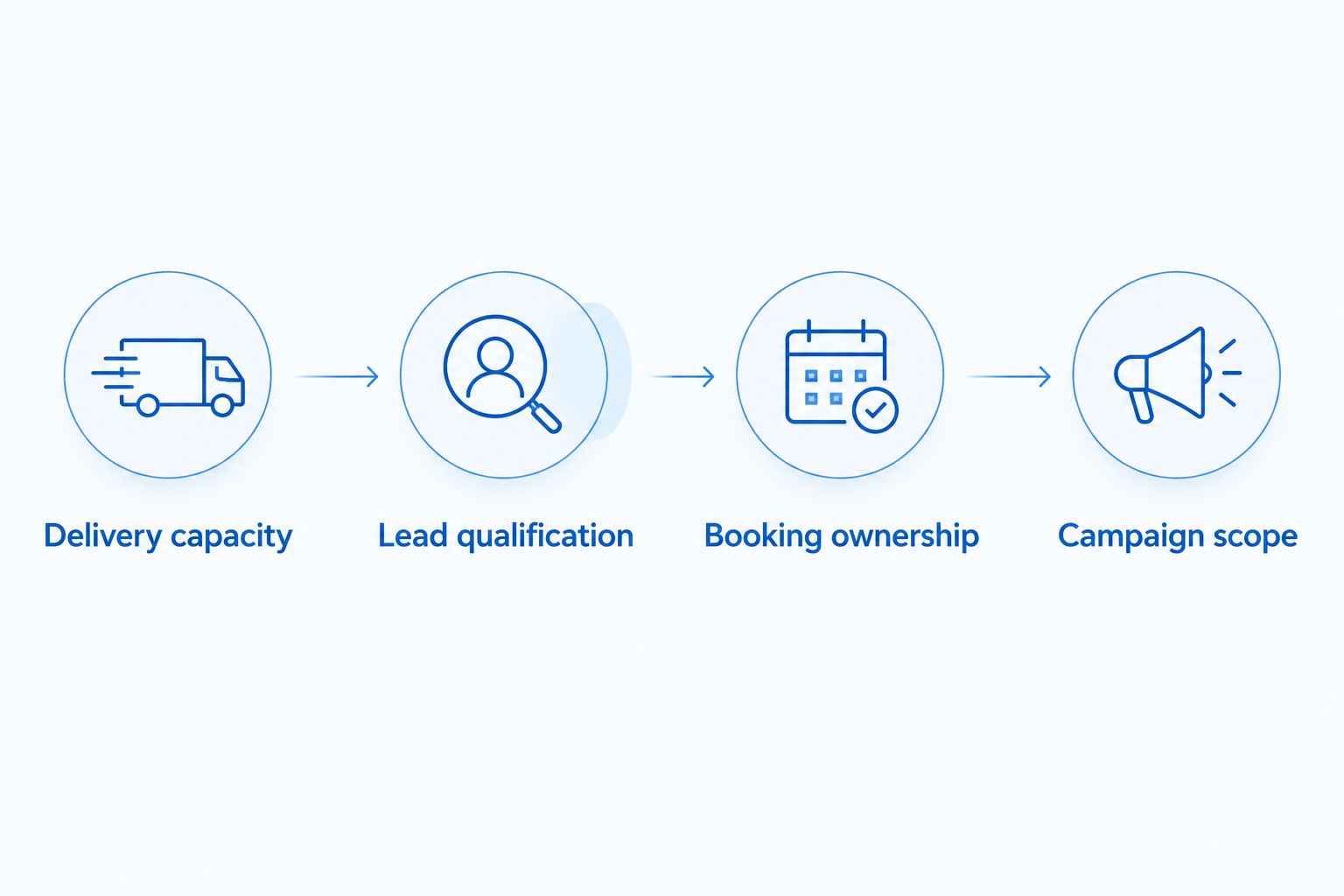
Decide who can deliver and who owns the enquiry before expanding campaign scope.
Consider a hypothetical plumbing business whose owner approves every quote and allocates every job. More enquiries create more decisions for that owner unless quoting boundaries and scheduling responsibilities change too.
The marketing brief should reflect that constraint. Promote work the crew can deliver, define which enquiries the office can qualify and reserve owner approval for exceptions. This is an illustrative example, not a client result.
If delivery is already stretched, review team capacity bottlenecks before expanding the brief. Fix the handover that blocks bookings before paying to feed it more enquiries.
How do you compare agency proposals fairly?
Compare proposals against the same business objective and responsibility list. A long deliverables list is not a substitute for an agreed commercial purpose.
Ask each provider to explain:
- What work will begin first, and why?
- Which deliverables will your team receive?
- Who approves changes to campaigns and expenditure?
- How will unsuitable enquiries be identified?
- Who records whether an enquiry became completed work?
- What access and documentation remain with you when the engagement ends?
Then ask your team a separate question: can you fulfil your side of this agreement? A proposal that relies on frequent owner approvals is a poor fit if reducing owner dependence is the immediate priority.
For your 2026 review process, use a shared record of enquiries, qualification decisions, bookings and completed jobs. Record why work was declined or lost. This gives the provider something useful to act on beyond a headline enquiry total.
Do not reward enquiry volume while ignoring the work those enquiries become. Assess the marketing against the service mix, delivery capacity and commercial outcome agreed in the brief.
Is hiring an agency better than marketing coaching?
Agency management fits a business ready to delegate defined execution; marketing coaching fits an owner who needs support with priorities, decisions and implementation capability. Neither removes the need for internal responsibility.
Elevatory's business coaching and done-with-you marketing implementation sits in the latter category. Compare that model on the participation it requires and the work it covers, rather than expecting a done-for-you arrangement.
Should you improve follow-up before buying more leads?
Improve follow-up first when enquiries are waiting for an owner decision or have no clear person responsible. Name who responds, what they can approve and when they must escalate.
Use existing enquiries to check whether the handover works. Advertising does not assign responsibility for unanswered calls, incomplete quotes or unconfirmed bookings.
What should you ask before signing in 2026?
Ask for the scope, exclusions, responsibilities, account ownership and exit process in writing. Then check that the person delivering the work shares the same understanding as the person who proposed it.
A useful final question is: what will my team need to do for this engagement to work? The answer should identify actual tasks and decision-makers, not simply ask you to stay involved.
FAQ
What's included in a digital marketing agency fee?
The written scope determines what an agency fee includes. Ask separately about strategy, setup, campaign management, creative, tracking, reporting and follow-up responsibilities rather than assuming they are bundled together.
Is advertising spend included in agency management?
Do not assume advertising spend is included in agency management. Require the proposal to distinguish provider work from media expenditure and explain who authorises and pays for each.
Should a small business choose a project or ongoing marketing support?
Choose a project for a defined task with a clear handover, and ongoing support for agreed recurring work. In either case, specify who maintains the work and handles sales follow-up.
What if my team cannot handle more bookings?
Resolve delivery capacity and booking responsibilities before expanding demand. Identify which services the team can fulfil and who can make routine decisions without involving the owner.
How do I tell whether marketing is producing useful leads?
Track whether enquiries meet your service criteria and become suitable bookings and completed work. Give the provider feedback on rejected enquiries and lost bookings, not just the total enquiry count.
Can I stop being involved if I hire an agency?
Hiring an agency does not remove internal decision-making and delivery responsibilities. Assign a team contact with clear authority so routine approvals do not keep returning to the owner.
What should I own when the marketing engagement ends?
Agree on account access, creative files, reporting records and handover documentation before signing. The contract should explain what remains accessible to your business and what requires a separate transfer or agreement.
One last thing
Before accepting a marketing proposal, ask your team to handle an enquiry without sending a routine decision back to you. Watch where responsibility becomes unclear.
That point belongs in the brief. Your next marketing commitment should support a business that can handle the work, not create another queue at the owner's desk.
Related guides
Book a free growth strategy call
Forty-five minutes with a strategist to pressure-test where your business is stuck and what to prioritise next.
Prefer to talk first? Call 1300 634 230 or email chris@elevatory.com.au