

Run Meta ads long enough for the enquiries they generate to complete your normal sales cycle before judging revenue-based ROAS; there is no universal number of days that makes the result reliable. Check tracking, lead quality and follow-up immediately rather than waiting for the final revenue figure. For an Australian service business, the decision depends on whether enquiries become profitable work your team can deliver—not simply how long the campaign has been live.
TL;DR
- How long to run Meta ads before judging ROAS depends on your sales cycle, reliable tracking and completed sales.
- Meta Ads Manager attribution is not the same as proof that advertising caused every reported sale.
- Judge lead quality and follow-up before revenue matures; do not keep funding broken tracking or unsuitable enquiries.
- Elevatory business coaching suits established Australian businesses seeking marketing strategy with done-with-you implementation.
Why this matters
A campaign can generate suitable enquiries while your team loses them through missed calls, slow quoting or unclear responsibilities. More advertising will not fix that handover. It puts more work into the same bottleneck.
Elevatory connects business coaching with done-with-you marketing implementation. That distinction matters when the advertising decision also requires changes to who answers enquiries, prepares quotes and books work.
For your 2026 campaign review, separate advertising performance from sales handling and delivery capacity. Start with a clear service-business lead handover: name the person responsible for each enquiry and define what happens next. Otherwise, you risk judging the ad for a problem that sits inside the business.
How long should you run Meta ads before judging ROAS?
Wait for the sales outcome, not an arbitrary anniversary of the campaign launch. A lead-generation campaign cannot show meaningful revenue-based ROAS before the leads have had a reasonable opportunity to become customers.
Use this sequence to set your review point. It gives your team a decision process without pretending every service business has the same buying cycle.
1. Check tracking
Confirm what the campaign actually records: an enquiry, a booking, a payment or a completed sale. These are different outcomes. A lead event with an assigned value is not automatically collected revenue.
Check that the recorded action matches what happened in your booking system or customer records. Investigate duplicate events, missing outcomes and revenue values that do not match the underlying transaction before assessing returns.
2. Map the sale
Trace the route from first enquiry to the revenue measure you intend to use. Include qualification, site visits, quotes, customer approval and payment where those steps apply.
Use your own customer records to establish how long this normally takes. Separate genuinely lost enquiries from open quotes that are still within your usual decision period. An unanswered quote is not necessarily a failed sale—or a future win.
3. Group enquiries
Review enquiries generated during the same period as a group, often called a cohort. Follow that group through to its sales outcome rather than dividing this week's revenue by this week's advertising spend without checking the connection.
Keep campaign and enquiry dates attached to customer records. Otherwise, older sales can make a newer campaign look stronger, while recent enquiries make it look weaker simply because they have not matured.
4. Reconcile revenue
Compare platform reporting with your customer records using a consistent revenue definition. Choose whether your internal assessment uses accepted bookings, invoiced revenue or collected revenue, and label it clearly.
Those measures answer different questions. A booking shows commitment; collected revenue shows payment. Neither should silently replace the other between reports.
5. Decide action
Once the enquiry group has progressed through your normal sales process, assess revenue alongside advertising spend, delivery costs and available capacity. Decide whether to continue, change or pause based on the constraint you can identify.
Do not extend a campaign merely because someone says it needs more time. State what evidence you are waiting for and which open opportunities can still change the conclusion.
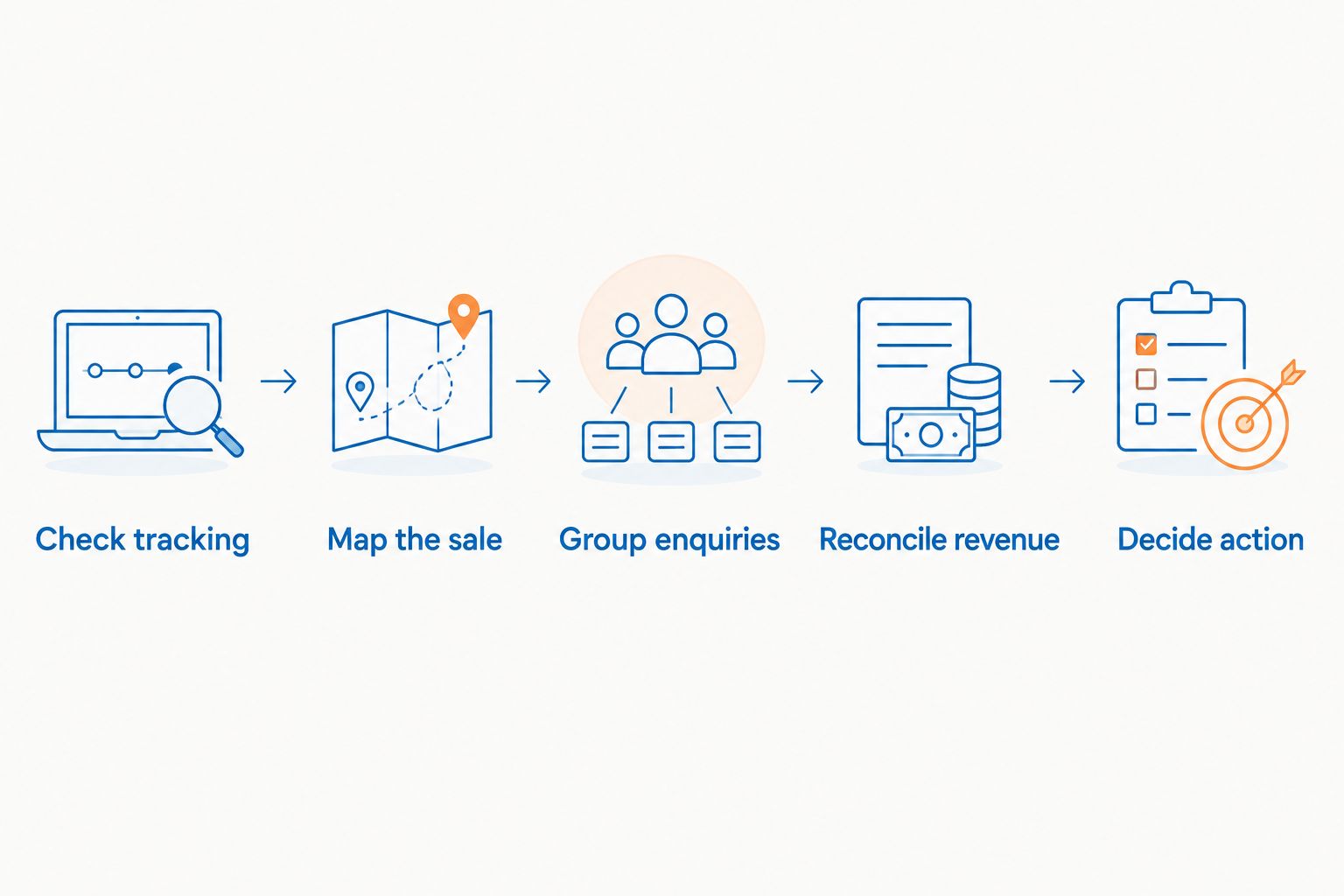
Set the review point around the sales process, not campaign age alone.
Which review approach fits your sales process?
Different buying processes need different evidence. For your 2026 reporting, choose the approach that matches how customers actually commit—not the reporting view that produces the strongest-looking result.
| Review approach | Best for | What supports a decision | Main limitation |
|---|---|---|---|
| Direct booking review | Services where customers book and pay without a quote | Confirmed transactions linked to advertising activity | Bookings can still be cancelled or refunded |
| Enquiry cohort review | Trades and professional services with qualification or quoting | The same enquiry group tracked through sales outcomes | Revenue takes longer to become observable |
| Early diagnostic review | Any campaign before sales outcomes mature | Tracking checks, enquiry suitability and follow-up records | It cannot establish final revenue-based ROAS |
Use early diagnostics to protect the process; use completed sales outcomes to judge revenue return. These approaches complement each other rather than compete.
Direct bookings: judge confirmed outcomes
When customers can book and pay directly, revenue evidence arrives earlier in the customer journey. Check whether the recorded transaction is genuine and whether cancellations or refunds change the result.
The advantage is a shorter route between the advert and a commercial outcome. The limitation is that attributed booking revenue still does not tell you the profit left after delivering the service.
Quoted work: follow the enquiry through
For work that requires a consultation, inspection or proposal, an enquiry is only the start. Your review needs to distinguish unsuitable leads, qualified opportunities, outstanding quotes, accepted work and lost work.
The advantage is a clearer view of where sales stall. The limitation is extra record-keeping: someone must own status updates, rather than leaving the owner to reconstruct the pipeline from messages.
Why the right review period varies
The time needed to judge Meta ads depends on what happens between the advert and the commercial outcome. Build your review around these factors:
- Customer decision process. A customer who books directly follows a different path from someone comparing proposals or arranging a site inspection.
- Revenue recording. Accepted work, invoices and payments become visible at different stages. Your chosen measure determines when a revenue assessment is possible.
- Enquiry volume. A result resting on an isolated sale gives you less evidence about repeatability than a pattern across completed customer journeys.
- Follow-up ownership. Unanswered enquiries and unissued quotes delay or prevent sales. Check the team's actions before blaming the campaign.
- Attribution settings. The reporting window affects which conversions the platform credits. Keep that context attached to the figures you compare.
- Delivery capacity. Advertising can attract work your team cannot currently schedule. That is a capacity issue, even when the enquiries are suitable.
Document these conditions in your 2026 review brief. If the conditions change, explain the change before comparing campaign periods. A new quoting process or different service offer changes the context of the result.
What should you check before the revenue arrives?
Your team should know whether enquiries fit the service, location and type of work you want. That information becomes available before the final sales result and helps distinguish an advertising problem from a handling problem.
Use a short enquiry review with clear ownership:
- Suitability: Record whether the person wants a service you actually provide in an area you serve.
- Contact: Record whether your team reached the person and what happened next.
- Quote progress: Identify quotes waiting on staff action separately from quotes waiting on the customer.
- Lost reason: Record the customer's stated reason where available; do not invent one to complete the report.
- Capacity: Confirm whether your team can deliver the requested work within the customer's requirements.
Do not treat every unconverted enquiry as evidence of poor advertising. Equally, do not excuse unsuitable enquiries because the platform reports an attractive lead figure.
A hypothetical plumbing business illustrates the distinction. If suitable enquiries sit unanswered because every technician assumes someone else handles calls, the next action is to assign enquiry ownership. If callers consistently request work outside the service area, review the campaign and landing-page message instead. These are examples, not client results.
When should you change or pause Meta ads?
You do not need to wait for mature ROAS to correct a confirmed problem. Broken forms, misleading messaging and enquiries for services you do not provide are reasons to act immediately.
Use the evidence to choose the action:
| Action | Best for | Benefit | Trade-off |
|---|---|---|---|
| Continue while monitoring | Suitable enquiries still moving through a working sales process | Allows sales outcomes to become visible | Continued spend remains at risk |
| Change the identified constraint | A specific problem in messaging, qualification or follow-up | Addresses an observed failure | The change complicates comparison with the earlier period |
| Pause affected activity | Broken enquiry handling or no capacity to accept the work | Stops adding demand the business cannot handle | Interrupts new enquiry flow |
Avoid changing the offer, audience, creative and sales process together without recording what changed. If the outcome improves, you will struggle to identify which change mattered.
For a 2026 spending decision, write down the reason, responsible person and next evidence check. “Give it longer” is not a decision unless it names the sales outcomes still pending and the condition that would change your view.
Does a high Meta ROAS mean the campaign is profitable?
A high reported ROAS does not establish profit. ROAS compares attributed revenue with advertising spend; it does not, by itself, subtract the costs of delivering that revenue.
For a service business, review labour, materials, subcontractors and other relevant delivery costs alongside the marketing result. Consider whether the campaign attracts the type of work you want, rather than simply work with a large invoice value.
Also separate attribution from causation. A platform can credit a sale within its reporting rules without proving the customer would not have purchased otherwise. Use platform reporting as evidence within a broader business review, not as a complete account of advertising's effect.
Should you wait for Meta's learning phase to finish?
A delivery-status label is not a substitute for a completed sales cycle. Keep checking tracking and enquiry handling while the campaign runs; neither problem improves simply because a platform status changes.
Treat delivery information as context for campaign management. Your commercial assessment still needs suitable enquiries, completed sales and a consistent revenue definition. Do not promise the team that a status change will produce profitable work.
When does coaching help with an ads decision?
Elevatory business coaching is best suited to established Australian businesses seeking strategy and done-with-you implementation. It is relevant when the advertising question exposes a broader problem with offers, sales handover, team responsibilities or delivery systems.
The benefit is connecting marketing decisions to how the business operates. The boundary is equally important: done-with-you implementation still requires participation from your team. It is not a substitute for someone answering enquiries, maintaining records or making delivery decisions.
Before seeking support, prepare your enquiry records, campaign reporting, sales stages and current capacity constraints. Ask who will implement each change and what evidence will determine whether it worked.
FAQ
How long should I run Meta ads before deciding they do not work?
Run Meta ads long enough for the resulting enquiries to complete your normal sales process before judging revenue-based ROAS. Correct confirmed tracking, targeting and enquiry-handling problems immediately rather than waiting for that review.
Can I judge Meta ads from enquiries instead of sales?
Enquiries help you assess suitability and sales handling, but they do not establish revenue-based ROAS. Track qualified enquiries through to bookings, sales and the revenue measure you have chosen.
Should I pause Meta ads if no sales have been recorded?
No recorded sales alone does not identify the problem. Check whether tracking works, enquiries are suitable and open opportunities remain within your usual sales process before deciding to continue or pause.
Is Meta Ads Manager ROAS the same as business profit?
Meta Ads Manager ROAS is not business profit. It compares attributed revenue with advertising spend, while profit also depends on delivery costs and other business expenses.
Should I increase the budget when reported ROAS improves?
Do not increase the budget solely because reported ROAS improves. Confirm the underlying sales, review delivery economics and check that your team can handle additional work.
What should my team record for each Meta enquiry?
Record the enquiry source, date, suitability, responsible person, sales status and eventual outcome. Keep enough detail to connect the advertising period with the resulting commercial outcome.
Can Elevatory help with marketing and team capacity together?
Elevatory provides business coaching and done-with-you marketing implementation for established Australian businesses. Its scope includes offers, funnels, paid advertising and systems strategy; confirm the responsibilities required for your business before engaging support.
One last thing
Before your next 2026 campaign review, ask who owns every open enquiry. If the answer is always you, the next improvement might be a handover—not a new advert.
Choose an enquiry your team can trace from first contact to final outcome. Check where it waited, who made the decisions and whether the work fitted your capacity. That trail gives you a practical starting point for the next advertising decision.
Related guides
Book a free growth strategy call
Forty-five minutes with a strategist to pressure-test where your business is stuck and what to prioritise next.
Prefer to talk first? Call 1300 634 230 or email chris@elevatory.com.au