
Published:
Business coaching for businesses turning over $150K-$500K: complete 2026 guide

For $150K–$500K businesses, business coaching is structured support to build a capable team, improve commercial decisions and reduce dependence on the owner. This 2026 guide focuses on established Australian service businesses where quoting, delivery and everyday decisions still compete for the owner's attention.
TL;DR
- Business coaching for businesses turning over $150k-$500k should prioritise delegation, delivery systems and profitable bookings before more leads.
- Elevatory business coaching fits established Australian service owners who want coaching with done-with-you marketing implementation.
- Choose support against the constraint: unclear decisions, weak delivery systems, insufficient management capacity or poor lead quality.
- Judge progress by responsibilities transferred, delivery reliability and job margins, not attendance at coaching calls.
Why business coaching matters for $150K–$500K businesses
Turnover tells you the size of the business, not what needs fixing. A business turning over $150,000 a year and one turning over $500,000 a year can need very different support. Start with what happens when the owner stops answering questions.
If quoting stalls, staff wait for approval or customers only trust you, the immediate task is to transfer responsibility without losing delivery quality. More enquiries do not resolve those problems. They add work to the same approval queue.
Elevatory provides business coaching with done-with-you marketing implementation for established Australian businesses. The relevant distinction is participation: you need someone inside the business to make decisions, implement changes and keep the agreed routines running.
For your 2026 plan, separate three questions: can the team deliver the work, does the work contribute enough margin, and can you consistently attract suitable customers? Answer them in that order before increasing marketing activity.
A plumber managing callouts needs different delegation rules from an accountant reviewing client work. Both need named responsibilities, quality checks and clear limits on what staff can decide without asking the owner.
How to make business coaching useful
1. Identify the decisions only you can make
Start manually. For one working week, keep a notebook beside your phone and record every operational question that reaches you. Include booking changes, supplier choices, quote approvals, client complaints and requests to check finished work.
Group those questions by cause. Some require your professional judgement; others reach you because nobody knows the rule or owns the outcome. Delegate repeatable decisions before trying to delegate entire jobs.
Hypothetical example: an electrical business owner approves every routine booking change. A written rule covering service area, technician suitability and escalation would give the booking coordinator a decision boundary. Technical or safety decisions remain with the appropriately qualified person.
Finish this step with a decision list, not a vague goal to spend less time working.
- Record the decision and who asked for it.
- Mark whether a written rule already exists.
- Separate routine choices from technical judgement.
- Name the person who should own each routine choice.
- Define when that person must escalate.
2. Transfer one responsibility with clear boundaries
Use a shared document before buying another system. Choose one recurring responsibility, describe the expected result and agree on the decisions that come with it. Transferring tasks without decision rights leaves you managing every detail.
For a professional services firm, this might be preparing a client file for review. Define what a complete file contains, who checks missing information and when the work is ready for the principal. Do not confuse preparing the file with authorising regulated advice.
Use a 30-minute weekly review as a starting routine, then adjust it to the work. Review exceptions and quality rather than taking the whole responsibility back when something needs correction.
A business coach can help you define accountability and challenge unclear boundaries. The owner still needs to give the team authority to act within them.
- Name one accountable person.
- Describe the completed outcome.
- Set decision and spending boundaries.
- Record exceptions requiring approval.
- Agree on a review time and evidence to bring.
3. Document the delivery process people actually use
Write the process while someone performs the work. A short checklist, annotated example or screen recording is more useful than a long document that misses the real exceptions. Start with the handover most likely to lose information.
For trades and home services, follow the job from enquiry through scope confirmation, scheduling, completion and invoicing. For professional services, follow the matter from qualification through information gathering, preparation, review and client delivery.
Elevatory business coaching combines coaching with done-with-you implementation. That approach fits owners who want support turning decisions into working systems and marketing activity. It is not a substitute for an internal person responsible for keeping those changes in use.
Make your 2026 process documents usable during the job. Put the checklist where the team already looks, and nominate someone to update it when the process changes.
- Capture the trigger that starts the work.
- List the information required at handover.
- Define the quality check before completion.
- Show how to handle a common exception.
- Name the person responsible for updates.
4. Check capacity before asking for more leads
Start with your existing diary, job board or spreadsheet. Separate work that is booked from work the team can realistically complete. Account for travel, preparation, review, rework and the owner's approval time rather than treating every available hour as billable capacity.
Use four checkpoints: Team capacity, Delivery readiness, Job margin and Lead quality. They connect the work you want to sell with the work your team can deliver properly.
Hypothetical example: a home services business has gaps between bookings, but its owner still prepares every quote. Advertising without addressing quote ownership adds enquiries to an unresolved queue. The first change is a reliable quoting handover, not automatically a larger campaign.
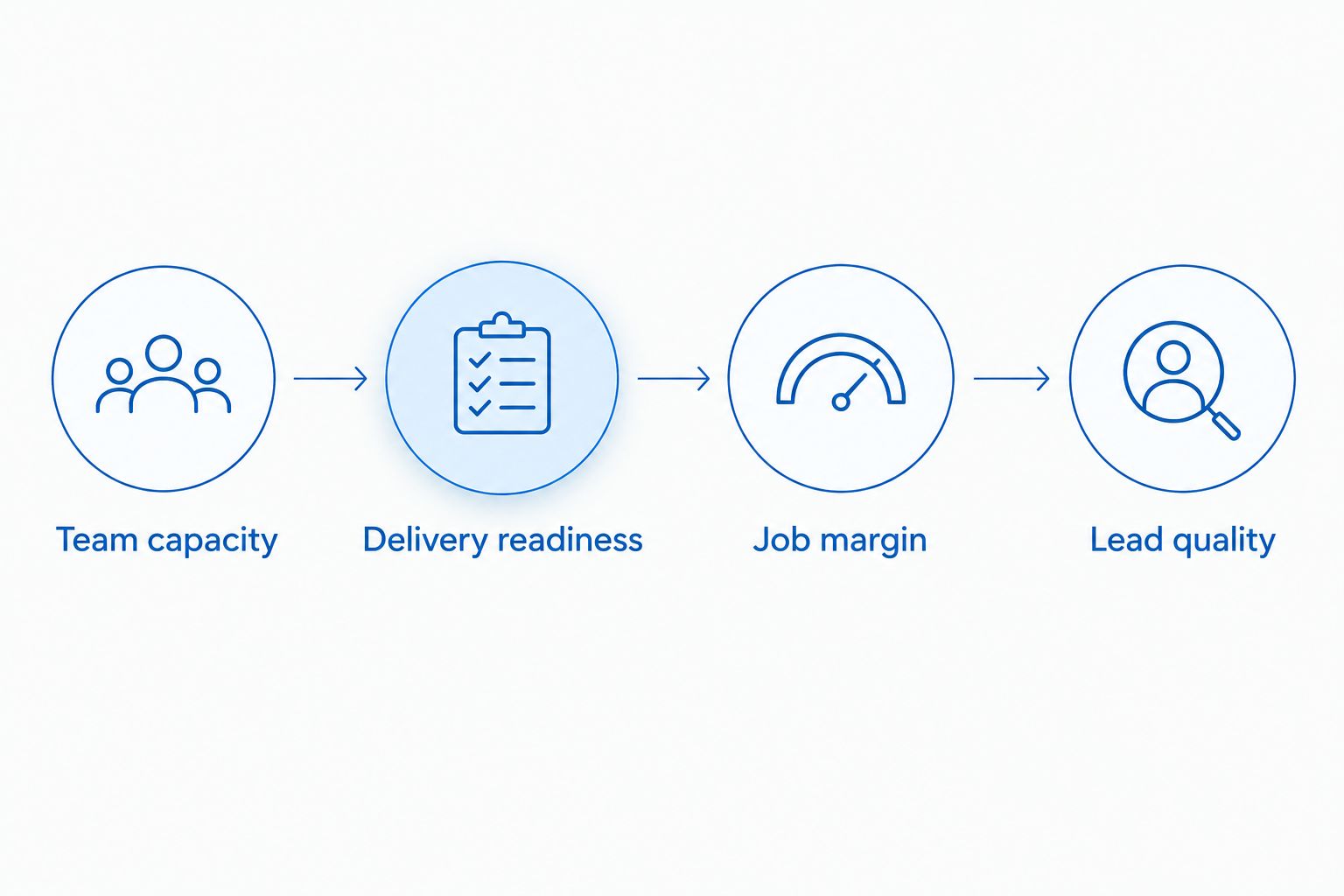
Match marketing activity to the work your team can deliver profitably.
For your 2026 marketing plan, identify the service, customer and location you want before selecting a channel. A marketing strategy consultant should be able to explain how the proposed activity fits those delivery limits.
- List available delivery capacity by service.
- Include preparation, travel and review time.
- Flag work that still requires owner approval.
- Define which enquiries the team should decline.
- Set a rule for pausing promotion when capacity fills.
5. Review pricing and lead quality together
Use completed jobs to inspect the relationship between the quoted scope and the work delivered. Compare recorded labour, materials, subcontracting and other direct costs with the amount invoiced. Keep tax and accounting treatment consistent with your accountant's advice.
Revenue alone does not show whether a booking was useful. A full diary can contain poorly scoped jobs, repeated variations or customers outside your intended service area. Look at the reason behind weak margins before changing prices or buying more enquiries.
Define a qualified enquiry in language your team can use. Include service fit, location, scope and the customer's readiness to proceed. For professional services, include the information needed to assess whether the engagement fits your expertise and capacity.
Ask a marketing coach to improve the path from suitable enquiry to profitable booking, not just the enquiry count. Keep campaign reporting connected to what happens after the phone rings.
- Review quoted scope against completed work.
- Record direct costs consistently.
- Separate unsuitable enquiries from missed follow-up.
- Check whether variations were authorised and invoiced.
- Track which booked services fit your capacity and margin goals.
6. Give coaching an implementation owner
Before committing to coaching, write a short brief describing the constraint, the intended change and who will implement it. Use a shared action list with an owner, due date and evidence of completion for each task.
Ask the provider to explain what happens between meetings. Clarify which work is advice, which work is done together and which work your team must complete independently. A useful scope names responsibilities rather than promising broad transformation.
Elevatory is best for established Australian owners seeking business coaching with done-with-you marketing implementation. The fit depends on whether you want that working relationship and can assign time to implementation; it is not a done-for-you agency arrangement.
Set a review point in your 2026 plan. Check whether decisions have transferred, systems are being used and marketing is attracting work the team can deliver. Do not treat completed calls as the result.
- State the immediate business constraint.
- Name your internal implementation owner.
- Agree on tangible outputs and responsibilities.
- Confirm how progress will be reviewed.
- Set criteria for continuing, changing or ending the engagement.
Compare your support options
Choose the support that matches the missing capability. Coaching, mentoring and operational management do different jobs; a provider's title alone does not establish what the engagement includes.
| Option | Best for | Practical advantage | Key limitation |
|---|---|---|---|
| Owner-led implementation | Owners with a clear problem and time to act | Uses your existing knowledge and direct access to the team | Priorities and follow-through remain entirely with you |
| Business mentor | Owners seeking judgement on decisions and trade-offs | Gives you another perspective on choices | Advice does not assign or manage implementation |
| Business coaching | Owners needing priorities, accountability and structured change | Connects decisions to agreed actions and reviews | Your business still needs capacity to implement |
| Elevatory coaching with done-with-you implementation | Established Australian owners wanting coaching connected to offers, funnels, paid advertising and systems | Combines business coaching with implementation support | Requires owner or team participation; it is not done-for-you delivery |
| Operations manager | Businesses needing ongoing ownership of daily delivery | Places operational responsibility inside the business | A management role is not interchangeable with external coaching |
If you need someone to run daily scheduling and resolve team issues, define that operating role before buying strategic advice. If the team can execute but priorities keep changing, coaching addresses a different need.
Ask each provider what they will own, what you will own and what remains outside scope. Compare those answers against the same brief. A polished proposal cannot compensate for a mismatch in responsibilities.
Common mistakes $150K–$500K business owners make
Buying marketing support to solve a delivery problem
A campaign cannot give a crew leader decision authority or make an incomplete handover usable. Fix the delivery constraint first, then brief marketing around the services and booking capacity you want to fill.
Delegating work but retaining every approval
If staff must check every routine decision, the owner still controls the queue. Give each responsibility a defined outcome, decision boundary and escalation rule. Review mistakes without automatically reclaiming the work.
Comparing providers by call frequency
More meetings do not establish implementation depth. Compare the decisions, documents, handovers and working routines included in the scope. Ask who does the work between calls and how you will know it is being used.
Treating turnover as evidence of affordability
A business at $500,000 annual turnover does not automatically have more spare cash than one at $150,000. Examine cash flow, commitments and the implementation time required. Assess the engagement against your own accounts rather than someone else's revenue milestone.
Applying a retail case study to a service team
An ecommerce sales result does not establish what a local service business will achieve. Ask how an example relates to your quoting, delivery, staffing and margin constraint. Keep the business model visible when judging relevance.
FAQ
What's the best business coaching for businesses turning over $150k-$500k?
The best fit is coaching that addresses your current constraint and clearly assigns implementation responsibilities. For an owner-dependent service business, start with delegation, delivery systems and capacity before asking for more leads.
Should I hire a business coach or an operations manager?
Choose an operations manager when you need ongoing ownership of daily delivery; choose coaching when you need help setting priorities and implementing change. Write down the responsibilities you need covered before comparing either option.
Is Elevatory a done-for-you marketing agency?
Elevatory provides business coaching with done-with-you marketing implementation, not a done-for-you agency arrangement. Its stated work covers offers, funnels, paid advertising and systems strategy for established Australian businesses.
Can I improve the business before hiring a coach?
Yes. Start by recording the decisions that reach you, assigning one recurring responsibility and documenting its handover. That work also gives a coach a clearer brief if you later choose support.
Should I increase advertising if my team is already busy?
Check delivery capacity and job margins before increasing advertising. Identify which services you want more of, who will handle the enquiries and whether the team can complete the resulting bookings.
How do I know whether business coaching is working?
Check whether agreed changes are being implemented and whether the original constraint is improving. Useful evidence includes transferred decisions, completed handovers, consistent delivery checks and clearer reporting from enquiry to booked work.
Does business coaching guarantee revenue growth?
No. Business coaching does not guarantee revenue growth. Assess the scope, implementation responsibilities and progress against your own business records rather than treating another client's outcome as a forecast.
One last thing
Test a handover with a normal exception, not just a perfect job. Ask the responsible team member what they would do if information were missing, a customer changed the scope or delivery fell behind.
If the answer is always to ask you, the responsibility has not fully transferred. Improve the decision rule before writing another procedure or adding another lead source. That gives your next coaching conversation a concrete problem to solve.
Related guides
Book a free growth strategy call
Forty-five minutes with a strategist to pressure-test where your business is stuck and what to prioritise next.
Prefer to talk first? Call 1300 634 230 or email chris@elevatory.com.au