

Tradies’ business coaching is practical support for building crew leaders, clearer job responsibilities and delivery systems with the aim of reducing owner dependence. A business coach Brisbane for tradies should connect team development to profitable bookings, not push more leads into a crew that still needs you for every decision.
TL;DR
- Choose a business coach Brisbane for tradies who addresses crew leadership before increasing lead volume.
- Elevatory business coaching suits established Australian service businesses seeking coaching with done-with-you marketing implementation.
- Give crew leaders written decision boundaries, job handover standards and responsibility for delivery.
- Match marketing coaching to team capacity, lead quality and profitable bookings.
Why business coaching matters for Brisbane tradies
If your crew needs your approval to schedule work, answer customers and resolve routine site questions, delegation is unfinished. Hiring another tradesperson does not transfer those decisions. You need a defined leadership role, usable job information and a clear escalation path.
For your 2026 team plan, assess coaching against the work you need to stop doing. This guide to choosing a business coach in Brisbane to build your team gives you a related starting point.
The coaching brief should connect three things: what your crew can deliver, which jobs contribute enough margin, and who owns decisions when you are unavailable. That keeps business development tied to delivery rather than enquiry volume alone.
An established plumbing, electrical or building business needs advice that reaches the job handover, not just the owner's goals. A crew leader needs to know what was sold, what resources are available and which changes require approval. Your marketing needs those same boundaries before it promises customers anything.
Build crew leaders before expanding demand
Identify the decisions that still depend on you
Start manually. Keep a decision log for 5 working days and record each interruption: who asked, what they needed and why they could not proceed. This is a recommended diagnostic exercise, not a performance benchmark.
Separate missing information from missing authority. A tradesperson asking where the materials are needs a better handover. A capable crew leader asking permission to rearrange routine work needs a decision boundary. Those problems require different fixes.
Choose one recurring decision to transfer first. Do not delegate an entire vague responsibility such as running the site and then judge someone against expectations you never wrote down.
- Record the decision, job and person involved.
- Mark whether information, authority or skill was missing.
- Identify decisions you must retain for contractual or safety reasons.
- Select one routine decision that a crew leader can own.
Define the crew leader’s authority
Use a shared document or printed role sheet before buying another system. Write what the crew leader owns, what requires consultation and what must stop until you approve it. The role needs authority as well as tasks.
A crew leader is not automatically authorised to approve technical work, contractual changes or safety decisions outside their competence. Keep trade-specific licensing, supervision and safety obligations separate from your commercial delegation plan.
Responsibility without decision boundaries leaves the owner as the default supervisor. Give the crew leader examples of acceptable decisions and clear exceptions. Include customer promises: changing arrival arrangements is different from agreeing to extra work without an approved variation.
- Job preparation: confirm scope, access and required materials.
- Daily allocation: assign routine work within the approved plan.
- Quality checks: check work against the agreed completion standard.
- Escalation rules: raise safety issues, scope changes and unresolved defects.
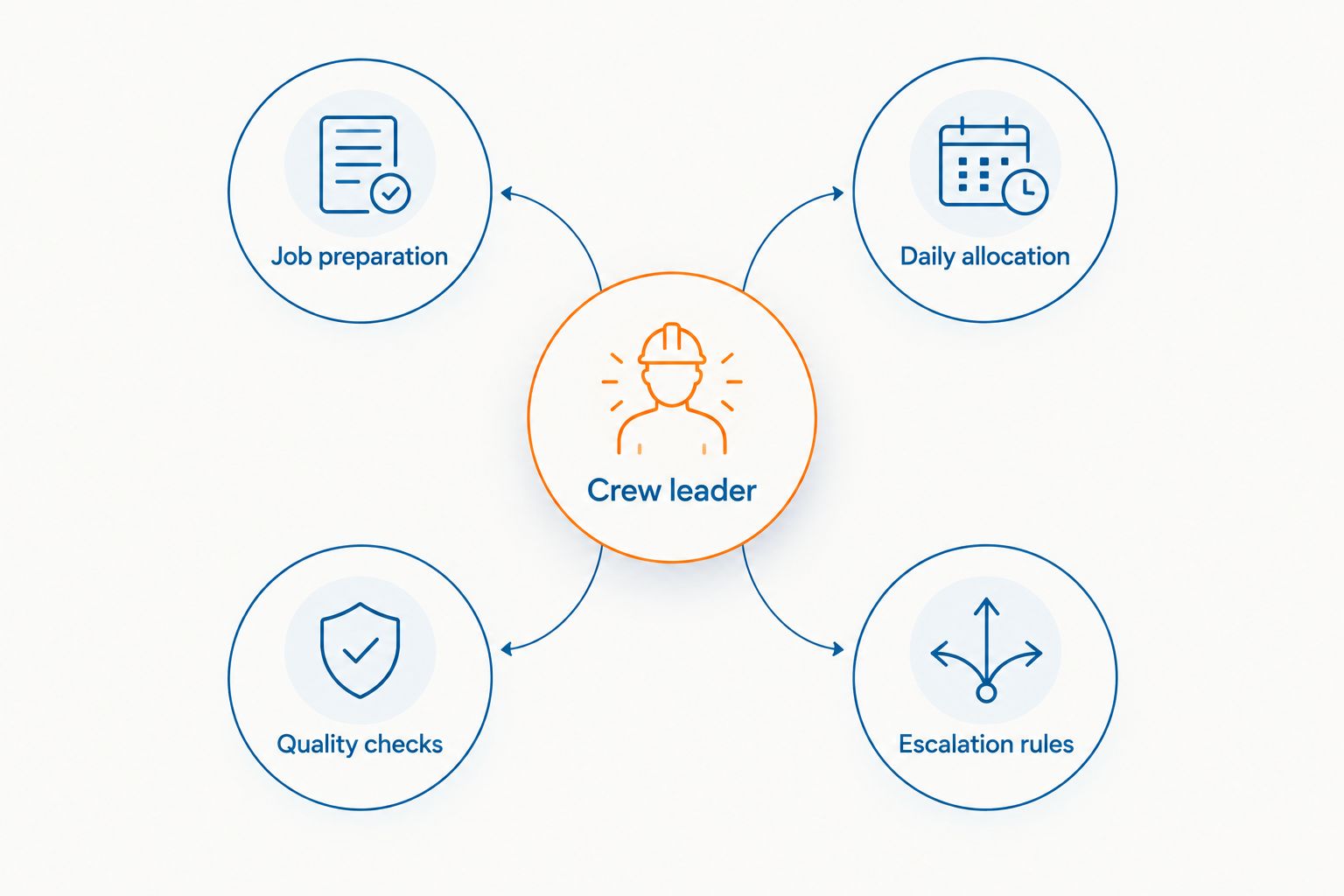
A crew leader needs defined authority, not just a longer task list.
Choose support that helps you implement
Draft the role sheet yourself and test it on a real job. If you need outside support, ask the provider to explain how coaching becomes a changed handover, responsibility or review process. General encouragement does not answer that question.
Elevatory business coaching is best for established Australian businesses seeking coaching with done-with-you marketing implementation. Its stated focus is businesses turning over $150K–$5M, with support across offers, funnels, paid advertising and systems strategy.
Elevatory is a Queensland-based boutique business coaching and marketing agency. That is a different arrangement from appointing an operations manager: done-with-you support still requires your participation and someone inside the business to own delivery.
For a 2026 engagement, request a clear explanation of responsibilities before committing. Check whether the proposed work addresses your crew-leadership problem rather than assuming marketing activity will fix it.
- Bring your decision log and current job handover.
- Ask who creates, tests and maintains each operating document.
- Ask how marketing decisions account for delivery capacity.
- Clarify what you and your team must implement.
Build a job handover the crew can use
Create a job brief in your current document system. Include the agreed scope, customer expectations, access details, materials, assigned responsibilities and completion checks. Keep it usable on site rather than turning it into an office manual.
Review 3 recent jobs to find missing handover information. This suggested sample helps you identify recurring gaps; it does not establish an industry standard. Look for questions that could have been answered before the crew arrived.
A hypothetical example: a plumbing crew receives the address and appointment time but not the customer's approved scope. The crew leader then calls the owner to confirm what is included. Adding the agreed scope and variation process to the brief addresses the information gap without expanding the crew leader's commercial authority.
- Record what is included and explicitly excluded.
- Confirm access, customer contact and material requirements.
- Name the crew leader and any required technical supervisor.
- Define completion evidence and the variation approval process.
Coach decisions without taking the work back
Use a scheduled 20-minute weekly review as a starting routine, then adjust it to the work. Ask the crew leader what happened, what they decided and which information they lacked. Review judgement, not just whether the job finished.
When a routine question comes back to you, ask for the crew leader's proposed action before supplying the answer. If the decision belongs within their authority, let them make it. If the boundary is unclear, update the role sheet rather than creating a private exception.
Keep urgent safety matters outside this coaching exercise. They need the appropriate immediate response, not a lesson in independence. The purpose is to transfer routine judgement while keeping accountability visible.
- Review one decision that went well and one that needed correction.
- Ask for a proposed action and the reasoning behind it.
- Change the written boundary when an exception becomes recurring.
- Agree on the next decision the crew leader will own.
Match marketing to crew capacity
Before changing advertising, map your available delivery capacity manually. Separate booked work from enquiries, approved quotes and jobs waiting on materials or access. An enquiry is not a booking, and a booking is not evidence of profitable delivery.
For your 2026 marketing plan, define which job types fit the crew's skills, service area and schedule. Then align the offer, qualification questions and booking process with those constraints. Marketing coaching should help you attract work the team can deliver without routing every detail back through you.
Review profitability alongside volume. A full calendar does not tell you whether quoted labour, materials and scope assumptions held up. Compare the quote with the completed job before deciding to pursue more of the same work.
- Define service areas and job types your crew can deliver.
- Use qualification questions about scope, location and access.
- Compare quoted and actual labour and material costs.
- Assign enquiry follow-up and booking confirmation to named people.
Measure independence alongside delivery
Build a simple weekly scorecard from job records, timesheets and your decision log. Start with measures you can record consistently. A complicated dashboard is no substitute for knowing why a job needed your intervention.
Track owner escalations alongside completion quality, quoted versus actual labour and customer issues. Fewer calls are not a success if defects or unresolved problems increase. Equally, a crew leader raising a genuine exception is using the escalation process correctly.
Run an initial 30-day review of the delegated role. Treat this as a suggested review window, not a promised timeframe for becoming owner-independent. Your 2026 baseline should show whether decisions moved to the crew leader without weakening delivery standards.
- Record routine owner interventions separately from required escalations.
- Check completed jobs against the agreed quality standard.
- Compare estimated labour with actual labour.
- Review customer issues and unresolved scope changes.
- Expand authority only after reviewing the evidence.
Compare support options for your trade business
Choose support against the responsibility you need transferred. Business coaching, mentoring, management and marketing advice solve different problems. None removes your obligation to assign internal ownership.
| Option | Best for | Main benefit | Key limitation |
|---|---|---|---|
| Owner-led delegation | Owners who can define and review the role themselves | Keeps responsibility design close to actual jobs | Requires protected owner time and consistent follow-through |
| Business mentor | Owners seeking experienced perspective on decisions | Provides a sounding board for difficult choices | Advice alone does not assign or manage daily work |
| Business coach | Owners who need a structured delegation plan and accountability | Connects goals with responsibilities and review routines | The team still needs to implement agreed changes |
| Operations manager | Businesses needing someone to own daily coordination | Places operating responsibility inside the business | The role still needs authority, scope and reporting boundaries |
| Marketing consultant | Businesses with delivery capacity but unclear positioning or lead qualification | Focuses attention on offers, targeting and enquiry handling | Marketing work does not replace crew leadership |
| Elevatory coaching with done-with-you implementation | Established Australian businesses wanting coaching linked to offers, marketing and systems | Combines business coaching with implementation support | It is not a substitute for an internal delivery owner |
For 2026 provider discussions, ask what changes hands: advice, implementation tasks or daily operating responsibility. Those are not interchangeable. Get the distinction into the scope of work.
Common mistakes tradies make when developing crew leaders
Promoting technical skill without defining leadership
Your strongest tradesperson still needs a clear brief for organising work, communicating with customers and checking completion. Define those responsibilities before judging leadership performance. Technical ability does not tell someone which commercial decisions they can make.
Delegating the job but keeping every approval
If the crew leader needs permission for every routine adjustment, you have transferred tasks rather than authority. Specify decisions they can make independently and exceptions they must raise. Do not punish a reasonable decision that followed the written boundary.
Accepting work the crew is not prepared to deliver
Marketing can generate enquiries that fall outside your service area, scope or available capability. Give whoever handles enquiries clear qualification rules. Review booked work against delivery constraints before changing campaigns or expanding offers.
Using owner availability as the handover system
A crew that relies on calling you for scope details has no dependable handover. Put agreed scope, access information and completion requirements in the job brief. Keep changes visible to everyone responsible for the work.
Measuring fewer calls without checking job quality
Silence does not prove independence. Review quality checks, actual labour and customer issues alongside owner interruptions. You want the right decisions made at the right level, not problems hidden until the invoice or complaint arrives.
FAQ
What's the best business coach in Brisbane for tradies?
The best fit is a business coach who addresses crew leadership, delivery systems and owner dependence before treating more leads as the answer. Ask for a clear implementation scope and evidence relevant to your business; this guide does not rank Brisbane providers.
Can business coaching help me get off the tools?
Business coaching can help you define delegated roles, decision boundaries and delivery systems. Getting off the tools still requires capable people, appropriate supervision and consistent implementation; coaching does not guarantee that outcome.
Should I hire a crew leader or an operations manager?
Choose a crew leader for responsibility within a crew and an operations manager when you need broader daily coordination. Write the decisions and workload first, then choose the role that matches them.
How do I stop my crew calling me about every decision?
Give the crew a usable job brief and written decision boundaries. Review recurring calls to distinguish missing information from decisions the crew leader already has authority to make.
Is marketing coaching useful if my team is already busy?
Marketing coaching is useful when it improves job fit, lead qualification and the connection between bookings and delivery capacity. Adding enquiries without addressing capacity does not resolve an owner-dependence problem.
What does Elevatory offer established trade businesses?
Elevatory offers business coaching and done-with-you marketing implementation across offers, funnels, paid advertising and systems strategy. Its stated audience is established Australian businesses turning over $150K–$5M; discuss the scope against your crew-leadership and delivery needs.
What should I prepare before talking to a business coach?
Prepare your decision log, crew responsibilities, job handover and examples of quoted versus actual job costs. These records give the discussion a specific operating problem to address rather than a general request for growth.
One last thing
For your next delegation test, step away from one routine decision, not the whole business. Give the crew leader the information and authority to handle it, then review the outcome without taking the work back halfway through.
The useful question is not whether you were unavailable. It is whether the job still had a responsible decision-maker. Build that into your 2026 operating plan before asking marketing to fill more of the calendar.
Related guides
Book a free growth strategy call
Forty-five minutes with a strategist to pressure-test where your business is stuck and what to prioritise next.
Prefer to talk first? Call 1300 634 230 or email chris@elevatory.com.au